



Beyond CVSS Scores: Smart Vulnerability Prioritization with Threat Intelligence


Join thousands of professionals and get the latest insight on Compliance & Cybersecurity.
Summary
- Traditional vulnerability management is broken; relying on CVSS scores is inefficient as only 2-3% of vulnerabilities are ever actively exploited.
- Shift to a Risk-Based Vulnerability Management (RBVM) model to prioritize vulnerabilities based on actual business risk and threat intelligence, not just severity scores.
- Implement a smart prioritization framework that combines asset criticality, exposure, and active threat data to focus remediation on what truly matters.
- Automate your risk-based approach with Cyber Sierra's Threat Intelligence platform to continuously monitor your attack surface and focus on the most critical threats.
You've just received the latest vulnerability scan report. Your heart sinks as you scroll through the endless list of "critical" findings. When you've got 3,000 "urgent" vulnerabilities flagged by your scanner, where do you even start? And more importantly, which ones actually matter to your business?
This scenario plays out in security teams worldwide every day. With over 25,000 new CVEs published in 2023 alone, the traditional approach to vulnerability management—heavily reliant on CVSS scores—is fundamentally broken. It's time for a smarter approach.
The CVSS Trap: Why High Scores Don't Always Mean High Risk
The Common Vulnerability Scoring System (CVSS) has long been the industry standard for rating vulnerability severity on a scale of 0-10. While it provides a useful baseline, relying solely on CVSS scores for vulnerability prioritization creates serious blind spots in your security program.
"Just because a finding is a CVSS 9.5 doesn't mean it's actually critical to your business," notes a seasoned security professional in a recent Reddit discussion. This sentiment echoes across the industry as teams struggle to make meaningful progress against their vulnerability backlogs.
The limitations of CVSS are both fundamental and practical:
- Lack of Business Context: CVSS scores are generic by design, failing to account for your specific environment. A critical vulnerability on an isolated test system poses less risk than a moderate one on your public-facing, mission-critical server.
- Static Nature: The base CVSS score doesn't change even when a vulnerability becomes actively exploited in the wild. While temporal and environmental metrics exist to address this, they've failed to gain widespread adoption in practice.
- Common Misinterpretations: Metrics are often misapplied, leading to inflated scores. For example, Attack Complexity (AC) is frequently misinterpreted as requiring high skill, when it actually refers to external conditions needed for an attack, like specific configurations.
The result? Alert fatigue, wasted resources, and a false sense of security. This poor approach to vulnerability prioritization leaves critical gaps open while your team chases high scores that may not represent genuine risk.

Introducing Risk-Based Vulnerability Management (RBVM)
Risk-Based Vulnerability Management (RBVM) offers a strategic alternative that prioritizes vulnerabilities based on the actual risk they pose to your organization, not just their technical severity.
The key differences between RBVM and traditional vulnerability management are stark:
| Traditional VM | Risk-Based VM |
|---|---|
| Focuses on technical severity | Focuses on business risk |
| Relies heavily on scanner output | Incorporates threat intelligence and business context |
| Results in unmanageable backlogs | Leads to efficient remediation and measurable risk reduction |
RBVM aligns security efforts with business objectives, making it easier to justify resource allocation and communicate risk to stakeholders. This approach is also increasingly important for compliance with frameworks like NIST, ISO 27001, and PCI-DSS, which require organizations to demonstrate a mature, risk-based security posture.
The Power of Threat Intelligence in Vulnerability Prioritization
At the heart of effective vulnerability prioritization lies threat intelligence—curated, contextual information about malicious actors, their tactics, techniques, and procedures (TTPs), and active exploits in the wild.
When integrated into your vulnerability management program, threat intelligence transforms vulnerability prioritization from a guessing game into a data-driven process by providing:
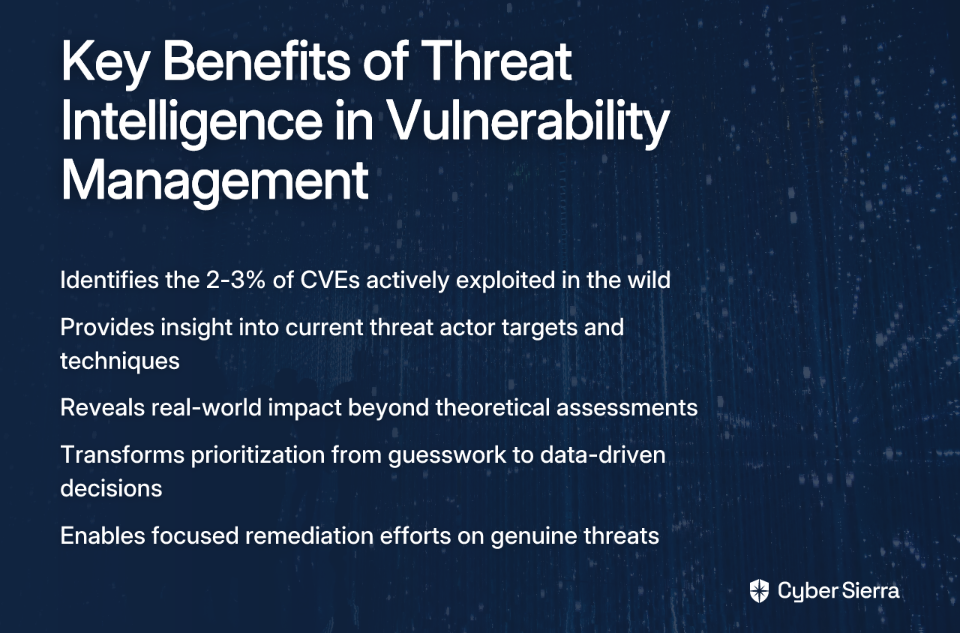
- Exploitation Data: Identifying which vulnerabilities have known exploits or are actively being targeted by threat actors. Research from Recorded Future shows that only about 2-3% of all published CVEs are actively exploited in the wild—meaning you can significantly narrow your focus.
- Threat Actor Focus: Understanding which industries or technologies are currently being targeted helps you anticipate threats specific to your organization.
- Real-World Impact: Moving beyond theoretical impact assessments to understand the actual consequences of successful exploits in similar environments.
This intelligence allows security teams to focus on the small percentage of vulnerabilities that pose a clear and present danger, drastically improving the efficiency of their vulnerability prioritization process.
A Practical Framework for Smart Vulnerability Prioritization
Many security professionals express frustration at the lack of "real-world models" for implementing effective vulnerability prioritization across teams and technologies. Here's a step-by-step framework that addresses this need:
1. Continuous Asset Discovery & Classification
You can't protect what you don't know exists. The foundation of smart vulnerability prioritization is a comprehensive, continuously updated inventory of all organizational assets, classified by:
- Business criticality: How important is this asset to core operations?
- Data sensitivity: What type of information does it process or store?
- Exposure: Is it internet-facing or isolated in a protected network?
2. Vulnerability Detection
Implement automated scanning tools to continuously discover vulnerabilities across your network and cloud infrastructure. Modern vulnerability management requires coverage across:
- Traditional on-premise systems
- Cloud environments (IaaS, PaaS, SaaS)
- Container ecosystems
- Web applications
3. Threat Intelligence Integration
Enrich your vulnerability data with threat intelligence to answer crucial questions:
- Is this CVE being actively exploited in the wild?
- Is it featured in known exploit kits or malware campaigns?
- Are threat actors targeting our industry with this vulnerability?
- Has this vulnerability been weaponized in recent attacks?
4. Contextual Risk Scoring
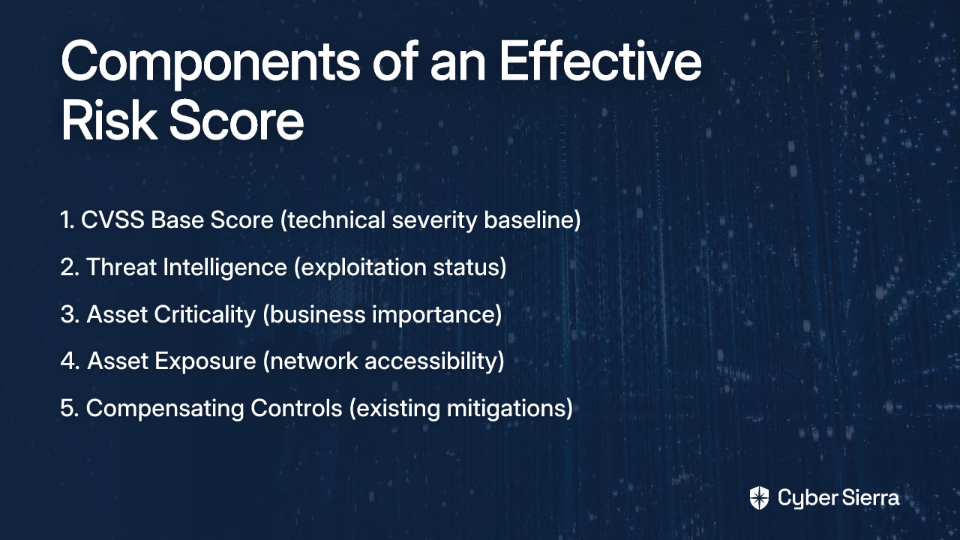
Develop a multi-factor risk score that goes beyond CVSS. This score should incorporate:
- CVSS Base Score (as a starting point)
- Threat Intelligence (active exploitation)
- Asset Criticality (is it a mission-critical system?)
- Asset Exposure (is it internet-facing?)
- Compensating Controls (do existing security measures mitigate the risk?)
Many organizations also find value in complementary models like DREAD (Damage potential, Reproducibility, Exploitability, Affected users, Discoverability) to provide a more nuanced view of risk.
5. Remediation Orchestration & Automation
Establish clear workflows and SLAs for vulnerability remediation based on risk scores. As one security professional noted, "The effort to 'coordinate' can be very heavy at first but through good data... which leads to automatically assign findings out."
Effective remediation orchestration includes:
- Defined ownership for each asset category
- Clear timelines based on risk level
- Automated ticket creation and assignment
- Regular progress tracking and reporting
6. Validation and Continuous Monitoring
Ensure patches are deployed correctly and continuously monitor for new threats. This creates a closed-loop process that evolves with your environment and the threat landscape.
Automating Intelligence for Continuous Compliance and Security
Implementing this framework manually is challenging. It requires significant coordination, data aggregation, and expertise—resources that many security teams simply don't have. This is where automation becomes essential.
Modern security platforms automate the entire vulnerability lifecycle by:
- Providing a unified view of assets, vulnerabilities, and threats
- Automating risk scoring based on integrated threat intelligence
- Streamlining remediation workflows
- Delivering dashboards for tracking key metrics like Mean Time to Remediation (MTTR)
Platforms like Cyber Sierra provide an integrated suite of tools to operationalize this approach. The Threat Intelligence module offers comprehensive attack surface visibility, performing network and cloud vulnerability scanning to identify risks before they are exploited.
This intelligence feeds directly into Cyber Sierra's Continuous Control Monitoring (CCM) engine, which provides near real-time visibility into your security posture against multiple compliance frameworks. The combination transforms vulnerability prioritization from a periodic, manual chore into a continuous, automated, and intelligent process.
Transforming Security Through Smart Prioritization
Moving beyond CVSS is not about ignoring severity; it's about adding intelligence and context. True security maturity comes from a risk-based approach to vulnerability prioritization that focuses on what matters most to your business.
The benefits of this approach are substantial:
- Strategic Risk Reduction: A global financial institution reduced critical vulnerabilities by 90% and improved resolution times by 40% after implementing RBVM.
- Operational Efficiency: Eliminate alert fatigue and empower security teams to work more effectively.
- Enhanced Compliance: Demonstrate a mature, risk-aware security program to auditors and regulators.
The vulnerability management landscape continues to evolve, with organizations facing more sophisticated threats and complex environments. By integrating threat intelligence into your vulnerability prioritization process, you position your security program to be proactive rather than reactive, focusing resources where they'll have the greatest impact.

Stop drowning in a sea of "critical" alerts. It's time to adopt a smarter, risk-based strategy for vulnerability prioritization. Discover how Cyber Sierra's AI-enabled platform can automate your threat intelligence and GRC processes, making your organization more secure and audit-ready. Book a demo today to see our platform in action.
Frequently Asked Questions
Why is relying only on CVSS scores for prioritization a bad idea?
Relying solely on CVSS scores is a bad idea because they lack business context and do not account for active threats, leading to inefficient remediation efforts. A CVSS score is a generic rating of a vulnerability's technical severity, but it doesn't consider if the vulnerability is on a critical, internet-facing server or an isolated test machine. Furthermore, a high CVSS score doesn't necessarily mean the vulnerability is being actively exploited by attackers, causing teams to waste time on theoretical risks instead of genuine threats.
What is Risk-Based Vulnerability Management (RBVM)?
Risk-Based Vulnerability Management (RBVM) is a strategic approach that prioritizes vulnerabilities based on the specific risk they pose to an organization, not just their technical severity. RBVM incorporates crucial context, such as threat intelligence (is the vulnerability being exploited?), asset criticality (how important is the affected system?), and asset exposure (is the system internet-facing?), to create a more accurate risk score. This allows security teams to focus their efforts on fixing the vulnerabilities that matter most to the business.
How does threat intelligence make vulnerability prioritization smarter?
Threat intelligence makes vulnerability prioritization smarter by identifying which vulnerabilities pose a clear and present danger to your organization. It provides data on which CVEs are actively being exploited in the wild, which threat actors are targeting your industry, and the real-world impact of successful attacks. Since only a small fraction (around 2-3%) of all vulnerabilities are ever exploited, threat intelligence allows you to cut through the noise and focus remediation efforts on the threats that are most likely to impact you.
What are the first steps to implement a risk-based approach to vulnerability management?
The first steps to implementing a risk-based approach are to create a comprehensive asset inventory and classify assets by business criticality. You cannot protect what you don't know you have. Once you have a clear picture of your assets and their importance, you can begin integrating threat intelligence and other contextual factors to move beyond CVSS and develop a true risk score for each vulnerability.
How does automation improve vulnerability prioritization?
Automation significantly improves vulnerability prioritization by continuously aggregating data, calculating risk scores, and streamlining remediation workflows. Modern security platforms can automate the process of integrating threat intelligence, assessing asset context, and assigning risk-based priorities to vulnerabilities. This eliminates manual effort, reduces human error, and provides a near real-time view of your security posture, enabling teams to respond to critical threats much faster.
