



Cybersecurity GRC, Compliance & Third‑Party Risk Benchmarks – 2026 Report



Join thousands of professionals and get the latest insight on Compliance & Cybersecurity.
Summary
- With 92% of organizations conducting multiple compliance audits annually, the cost and complexity of GRC are at an all-time high, demanding more efficient, automated solutions.
- The industry is shifting from periodic audits to continuous assurance, as human error now causes 82% of cloud misconfigurations and third-party vendors are linked to over 35% of data breaches.
- Key actions for 2026 include implementing continuous control monitoring (CCM) to detect control drift, enhancing third-party risk programs, and investing in ongoing employee security training.
- An integrated GRC platform like Cyber Sierra can automate these processes, helping teams manage compliance, monitor controls, and secure their supply chain from a single dashboard.
Executive Summary: The State of GRC in 2026
In 2026, Governance, Risk, and Compliance (GRC) has evolved from a back-office function to a strategic, board-level imperative. Modern security leaders face unprecedented challenges as regulatory pressure escalates, digital supply chains expand, and cyber threats evolve relentlessly.
The central challenge for organizations lies in balancing the increasing complexity and cost of compliance with the need for genuine risk reduction and business agility. This report provides data-driven benchmarks from hundreds of sources to help security and risk leaders measure their programs, justify investments, and build more resilient organizations.
Key themes explored in this report:

- The rising cadence and cost of audits and compliance requirements
- The critical shift from point-in-time assessments to continuous assurance
- The overwhelming scale of third-party risk and its impact on security posture
- The persistent challenge of human error and strategies to mitigate it
- The symbiotic relationship between robust GRC and cyber insurance
1. Audit & Compliance Benchmarks: The Rising Tide of Scrutiny
The frequency, cost, and complexity of compliance audits have reached unprecedented levels, forcing organizations to seek more efficient approaches.
1.1 Audit Cadence and Scope are Exploding
The sheer volume of compliance requirements has dramatically increased. According to A-LIGN's 2025 Compliance Benchmark Report, 92% of organizations conducted at least two compliance audits in 2025, with over half (58%) performing four or more. This audit burden is particularly heavy for large enterprises, where 35% ran six or more audits – more than double the rate seen at smaller firms (15%).
Moreover, SOC 2 is now table stakes rather than a differentiator. Most companies pursue multiple certifications simultaneously, including ISO 27001, PCI DSS, and HIPAA, to satisfy a widening range of stakeholders.
1.2 The Staggering Cost of Compliance
The financial investment in compliance is substantial. 71% of enterprise companies spend over $100,000 annually on audits, according to A-LIGN. Even more striking, 32% of businesses reported audit-related costs exceeding $1 million, with 31% needing 10+ internal employees dedicated solely to audit management tasks.
From a broader perspective, U.S. companies now spend between 1.3% and 3.3% of their total payroll on regulatory compliance efforts – a significant operational expense that continues to grow.
1.3 Framework Priorities are Shifting
When asked about their most important frameworks in 2025, organizations ranked ISO 27001, SOC 1, and SOC 2 as their top three. Notably, ISO 27001 adoption is surging, with 81% of organizations having or planning ISO 27001 certification in 2025, up from 67% in 2024 – a massive 14-point jump in just one year.
This suggests ISO 27001's international credibility is becoming a key differentiator in the market, even edging ahead of SOC 2 in importance for many enterprises.
1.4 What Defines a "Quality" Audit in 2026?
Perceptions of audit quality have evolved significantly. Stakeholders now value substance over reputation, with the number of controls tested and report length emerging as the top indicators of a high-quality audit, replacing "trust in the auditor," which was previously the leading factor.
This shift is reflected in the high premium organizations place on thoroughness – A-LIGN'S report notes that 70% of companies rate audit report quality as "extremely important". Superficial, "checkbox" audits are rapidly losing value as stakeholders demand rigorous, detailed evidence of control effectiveness.
Meanwhile, the overwhelming manual effort of evidence collection (screenshots, log exports) and cross-team coordination remains a top challenge. Many GRC teams still rely on spreadsheets and email chains, creating version-control headaches and late nights during audit season.
Section Conclusion: The data reveals a clear need to move beyond manual, heroic efforts. Leaders must seek automation and establish a single source of truth to manage the growing audit burden efficiently and meet rising quality expectations.
2. Control Effectiveness & Continuous Monitoring: Beyond the Annual Audit
Point-in-time compliance is no longer sufficient. Controls drift, misconfigurations are rampant, and the speed of modern IT requires continuous, automated assurance to prevent breaches.
2.1 The Silent Threat of Configuration Drift
Human error has emerged as the primary cause of security control failures. 26% of data breaches stem from human error, not software defects.
Cloud misconfigurations by humans have direct security consequences. 15% of data breaches trace back to cloud misconfigurations as the initial attack vector. This statistic shows the critical importance of continuous monitoring of configuration states.
2.2 The High Cost of Unmonitored Assets and Slow Detection
Most organizations have significant blind spots in their security monitoring. According to Orca's 2025 State of Cloud Security Report, about 32% of cloud assets lack security monitoring, each harboring over 115 unknown vulnerabilities.
Detection and response times remain troublingly slow. Check Point's 2025 Cloud Security Report found that only 6% of companies**** managed to contain security incidents within an hour of discovery, while the majority take over 24 hours to fully contain. When misconfigurations lead to breaches, the mean time to identify is ~186 days and another 65 days to contain – over 8 months of exposure.
2.3 The Shift to Continuous Assurance
The compliance landscape is evolving toward real-time visibility. Most organizations now report using some form of automation to test and monitor controls continuously. This trend is driven by both regulatory pressure and board-level demand – over half of CFOs and boards are asking internal audit for more continuous control monitoring and enterprise risk management.
Continuous Control Monitoring (CCM) tools are the direct answer to these challenges, transforming security from periodic checks to ongoing, automated validation. This shift is also fueled by the realization that manual, periodic control testing is insufficient to address the speed and complexity of today's threat landscape.
Section Conclusion: The evidence is clear – manual, periodic control testing is insufficient in today's environment. The path to resilience lies in adopting a CCM strategy to detect and remediate control drift in near real-time, long before an auditor or an attacker discovers it.

3. Third-Party Risk Management Benchmarks: Your Attack Surface is Your Supply Chain
The vendor ecosystem has exploded in size and complexity, making third-party risk a dominant threat vector that traditional questionnaire-based methods fail to adequately address.
3.1 The Scale of the Vendor Ecosystem
The numbers are staggering: the average organization now uses ~286 different vendors, representing a 21% year-over-year increase. This expanded digital supply chain creates an exponential risk surface, as for each third-party, there are an average of 13-14 fourth and fifth-party dependencies.
Managing this sprawling ecosystem has become the top compliance challenge for security leaders. According to the World Economic Forum's 2025 Global Cybersecurity Outlook, 48% of CISOs say ensuring third-parties comply with security requirements is their #1 challenge in meeting cyber regulations.
3.2 Third-Party Incidents by the Numbers
The consequences of this expanded attack surface are evident in breach statistics. SecurityScorecard's 2025 Global Third-Party Breach Report found that 35.5% of all data breaches in 2024 were third-party related. Even more concerning, 41.4% of ransomware attacks now start via a third-party access point.
The risk is ubiquitous – an incredible 98% of organizations have a relationship with at least one third-party that has been breached in the past. These incidents carry steep costs: third-party breaches cost $370,000 more on average (~$4.91M total) and can be ~40% more expensive to remediate than equivalent in-house incidents.
3.3 "Questionnaire Fatigue" and the Limits of Point-in-Time Assessments
Traditional third-party risk assessment methods are buckling under the volume. 44% of organizations assess over 100 third-parties each year, yet confidence in these assessments is alarmingly low. Only 4% of organizations have high confidence that a vendor's questionnaire accurately reflects their real security posture.
The industry is responding to this challenge – more than half (56%) of organizations have adopted purpose-built technology to manage third-party risk in 2025, signaling a shift away from manual spreadsheets toward more sophisticated approaches.
Section Conclusion: Your organization's security is inextricably linked to your vendors'. A modern TPRM program must evolve beyond static questionnaires to embrace continuous monitoring, risk-based segmentation, and automated intelligence to manage this critical risk area effectively.
4. Security Awareness & Human Risk Benchmarks: The Enduring Human Element
While technology provides the defenses, human behavior remains a decisive factor in the majority of breaches. Mature security awareness programs are demonstrably effective at reducing this risk.
4.1 Human Error: The Common Denominator in Breaches
The human element continues to be implicated in 60%-74% of all data breaches, according to various studies. While this figure has trended down slightly from previous years, it remains the dominant cause of security incidents.
A Stanford study suggests that approximately 88% of breaches can be traced back to an employee mistake. Risk is also concentrated – just 8% of employees are responsible for 80% of observed security incidents, highlighting the opportunity for targeted interventions.
4.2 Phishing Benchmarks: The Persistent Threat
Phishing remains the most pervasive cyber attack vector targeting humans. In 2023, 71% of organizations**** experienced at least one successful phishing attack, though this represents an improvement from 84% in 2022.
The vulnerability of untrained users is stark. According to KnowBe4's benchmarking report, 34.3% of untrained end users will fail a phishing test on average. However, training works: after a year of ongoing training and simulations, the global phish-prone percentage drops to just 4.1%. The finance sector, for example, improved its failure rate to 9% from 16% in just one year.
4.3 Gaps in Security Training
Despite the known importance of security awareness, significant gaps remain in training coverage. KnowBe4's survey revealed that 18% of employees have never received any cybersecurity training. Even more concerning, 51% of employees say they have not been trained on how to recognize phishing scams.
The quality of existing training is also questionable – 34% of employees feel worried about their readiness**** for modern threats, particularly regarding AI-powered cyberattacks.
Section Conclusion: Investing in a continuous, engaging, and adaptive security awareness program is one of the highest-ROI activities a security leader can undertake. The goal is to transform employees from the biggest risk into the strongest line of defense by building a resilient human firewall.
5. Threat & Vulnerability Management: Winning the Race Against Exploitation
The explosion in vulnerability disclosures has created a backlog crisis, while the window to patch before exploitation shrinks. A risk-based approach is the only viable strategy.
5.1 The Vulnerability Deluge
The volume of vulnerabilities is overwhelming security teams. 27% of all CVEs ever published**** were released in just the last two years. Remediation efforts can't keep pace – most teams can only fix around 1 in 10 vulnerabilities, leaving 90% unaddressed. In fact, 45% of known enterprise vulnerabilities are never remediated.
This remediation gap has direct security consequences – 60% of data breaches involve an available but unapplied patch.
5.2 Patching SLAs vs. Reality
The gap between patching goals and reality is substantial. The average time to remediate a vulnerability is ~74 days for applications and ~55 days for infrastructure. About 17% of critical/high-severity vulnerabilities remain open after a full year – a significant compliance and security risk.
5.3 The Shrinking Window to Act
The timeline for effective remediation continues to compress. Approximately 80% of exploits appear before or at the same time as the CVE disclosure, giving attackers a median head-start of 23 days before a patch is even available.
Exploitation is increasingly becoming a primary attack vector: 35% of intrusions in 2024 started with a vulnerability exploit, double the rate of phishing. This trend underscores the critical importance of rapid remediation capabilities.
Section Conclusion: The old model of "scan and patch everything" is broken. Leaders must adopt a Risk-Based Vulnerability Management (RBVM) approach, integrating threat intelligence to prioritize flaws that pose a clear and present danger to critical assets.
6. Cyber Insurance & GRC: A Symbiotic Relationship
Cyber insurance has become a key driver for good security hygiene. Underwriters now mandate specific controls, and a strong GRC posture can lead to significant premium savings and better coverage.
6.1 The Evolving Market
After years of dramatic growth, the cyber insurance market is moderating but remains substantial at ~$15.6B in premiums in 2025. Following several years of steep rate increases, the market has stabilized or even improved for organizations with strong security postures, with some seeing premium decreases of 5%-10%.
6.2 The Underwriter's Mandate: Table-Stakes Controls
Insurance carriers have established non-negotiable security baselines. Multi-factor authentication (MFA) is essentially mandatory – most carriers will not even quote a policy without comprehensive MFA implementation.
Similarly, advanced endpoint detection and response (EDR/XDR) has replaced traditional antivirus as the new standard for endpoint protection. Secure, offline, and tested backups are prerequisites for ransomware coverage, with weak backup strategies being one of the top reasons for claim denial.
6.3 The ROI of Good Controls: Premium Incentives
Organizations that implement a suite of top controls have seen 20-50% lower cyber insurance premiums compared to less prepared peers. The "big three" controls that drive the largest premium discounts are MFA, EDR, and employee security awareness training.
This creates a direct financial incentive for security investment, providing CISOs with a powerful argument for their budget requests. The ability to demonstrate immediate ROI through premium savings helps justify security improvements to CFOs and boards.
6.4 Claims Landscape and Trends
The cyber insurance claims landscape shows mixed trends. Overall claims frequency dropped to 1.55% in the first half of 2024 (from 1.61%), the lowest level since 2022. However, the average loss per claim increased by ~14% to $122,000.
Ransomware continues to drive costs – ransomware claim severity jumped 68% to an average of $353,000. Meanwhile, business email compromise (BEC) accounts for nearly one-third of all claims filed, though these tend to have lower severity with an average loss of ~$26,000.
Section Conclusion: Cyber insurance is no longer just a financial backstop; it's an active partner in risk management. A demonstrable, mature GRC program is the key to securing favorable terms and proving due diligence, turning a cost center into a strategic enabler.
7. The GRC Landscape in 2026: Macro Trends, Headwinds & Tailwinds
GRC leaders in 2026 must navigate a complex environment of escalating regulations and resource constraints while leveraging powerful tailwinds like automation and executive support.
7.1 Key Trends Shaping the Future
Escalating Regulatory Enforcement: SEC cyber disclosure rules, the EU's Digital Operational Resilience Act (DORA), and a surge in state-level bills are raising the compliance stakes. A Thomson Reuters C-Suite survey found that 21% of CEOs now list "regulatory compliance" as their top strategic priority, up from just 2% the previous year.
Continuous Assurance is the New Standard: Regulators and customers demand real-time proof of control effectiveness, moving beyond annual audits. PCI DSS v4.0 and financial regulators are explicitly pushing for continuous monitoring.
AI Governance Emerges: A huge new domain for GRC, with 76% of organizations expecting to undergo an AI compliance review by 2027. AI ethics and security are becoming compliance requirements.
Convergence of Risk Disciplines: Cyber, privacy, and operational risk are merging under a unified GRC umbrella, with stronger board oversight. By 2025, 78% of Fortune 100 companies had a dedicated CISO role, nearly double the number in 2018.
7.2 Major Headwinds (The Challenges)
Tool & Data Sprawl: Large organizations operate 75-80 security tools on average, creating silos and complexity.
Compliance Fatigue: 69% of professionals find regulations too numerous and complex to keep up with.
Talent Shortage: A global cybersecurity workforce gap of 3.4-4 million unfilled positions hampers program maturity.
Budget & ROI Pressure: Increased expectations are met with flat budgets, requiring leaders to "do more with less."
7.3 Powerful Tailwinds (The Opportunities)
Automation & AI Scaling GRC: Most organizations are now leveraging technology to automate manual compliance tasks, with some seeing audit cycles shorten by 30-40%.
Integrated GRC Platforms: Consolidation and integration address tool sprawl, with 56% of organizations having adopted a dedicated GRC/IRM platform.
Executive & Board Support: 87% of CISOs now feel they have strong board support, a significant jump from 66% in 2024. This "tone at the top" unlocks resources and fosters a risk-aware culture.
Section Conclusion: While the challenges are significant, the tailwinds of technological advancement and strategic alignment provide a clear path forward. The most successful leaders will be those who harness these opportunities to build proactive, efficient, and integrated risk management programs.
8. Actionable Benchmarks & KPIs: What "Good" Looks Like in GRC
Use these metrics to measure your program's performance, report to the board, and drive continuous improvement.
🎯 Audit & Compliance Metrics
- Audit Cycle Time: Target a 30-40% reduction with automation
- Evidence Collection Effort: Aim to cut manual evidence hours by 50%+ through continuous control monitoring
- Audit Findings Rate: Strive for zero major findings in external audits
- Compliance Coverage: Implement controls for more than 95% of applicable requirements
🎯 Control Effectiveness & Risk Monitoring
- MTTI/MTTR for Control Failures: Reach less than 24 hours to identify control drift and less than 1 week to remediate critical controls
- Vulnerability Management SLAs: Achieve over 90% compliance with patch SLAs for critical vulnerabilities
- Unresolved Critical Vulnerabilities: Drive the number of critical vulnerabilities open over 30 days to near zero
🎯 Third-Party Risk & Supply Chain
- Vendor Assessment Coverage: Ensure 100% of critical/high-risk vendors have up-to-date risk assessments
- TPRM Cycle Time: Reduce vendor security review time from 4 weeks to 1-2 weeks without sacrificing rigor
- Continuous Monitoring: Aim for more than 90% of critical vendors to have a security rating of 'B' or higher
🎯 Human Risk & Awareness
- Phishing Simulation Click Rate: Target less than 5% for a mature program
- Training Completion: Strive for over 99% of employees completing required training on time
- Repeat Offenders: Reduce the percentage of employees who clicked multiple phishing simulations from 8% to 3%
🎯 Cyber Incident & Insurance Metrics
- Cyber Insurance Readiness: Meet 100% of underwriter-recommended controls
- Incident Response Preparedness: Ensure 100% of critical action items from tabletop exercises are addressed
Section Conclusion: Frame these KPIs as a balanced scorecard. Presenting your program's performance against these industry benchmarks provides context and credibility for your strategic decisions and budget requests.
9. Strategic Recommendations for 2026: A Data-Driven Roadmap
Based on the benchmarks and trends identified in this report, here are nine actionable recommendations for security and GRC leaders:
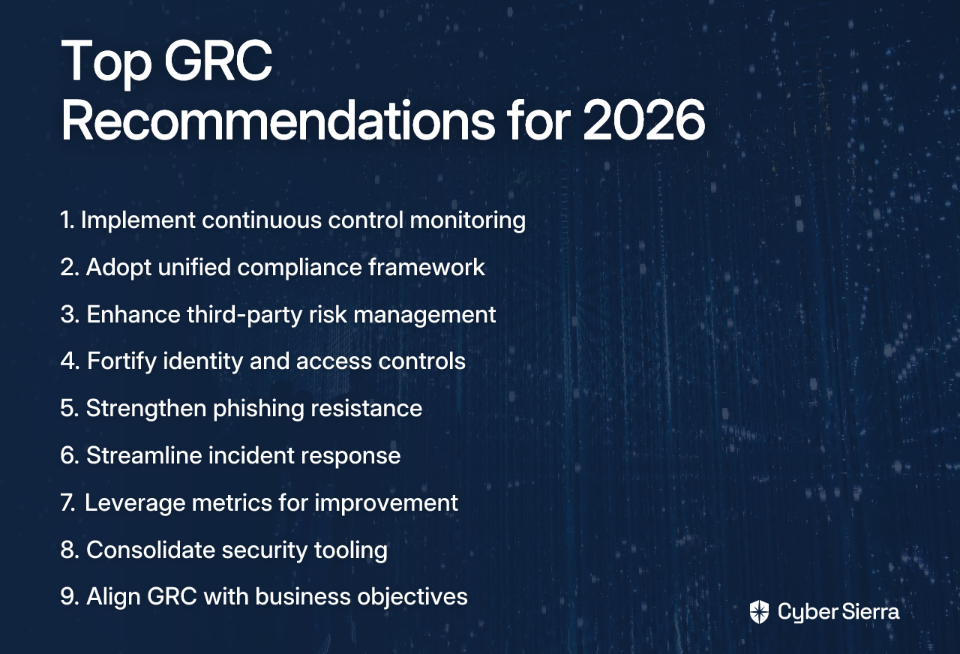
1. Implement Continuous Control Monitoring & Evidence Automation
Address audit fatigue and catch control drift early by automating evidence collection for at least your top 20 security controls. This can cut audit prep time by 50-70% while ensuring that configuration drift is detected in near real-time.
2. Adopt a Unified, Multi-Framework Compliance Approach
Create a common control framework that maps to all major requirements you face, enabling a "test once, comply many" approach. This is essential given that 58% of organizations now conduct 4+ audits annually.
3. Elevate Third-Party Risk Management with Continuous Monitoring
Go beyond questionnaires to address the 35.5% of breaches originating from third parties. Segment vendors by risk, implement continuous monitoring for high-risk suppliers, and enforce strong contractual controls requiring vendors to maintain baseline security measures.
4. Fortify Identity & Access Controls (MFA & PAM Everywhere)
Implement MFA on all user accounts and deploy Privileged Access Management (PAM) for admin credentials. Set a goal that by the end of 2026, 100% of employees and contractors use MFA, and 100% of admin access goes through PAM with session recording.
5. Enhance Phishing Resistance Through Training and Simulations
Run monthly phishing simulations and provide immediate coaching for employees who click. Deploy a "Report Phish" button in email clients and measure the reporting rate, aiming for over 20% of simulations reported. The goal should be to drive your phish simulation click rate below 5%.
6. Streamline Incident Response and Business Continuity Plans
Conduct at least one full-fledged tabletop exercise with executive participation annually. According to IBM, organizations that test IR plans save on average $2.66M in breach costs. Ensure your cyber insurance coverage aligns with your risk profile and that you meet all carrier requirements.
7. Leverage Metrics & Benchmarking to Drive Improvement
Create a dashboard of 8-10 key KPIs covering audits, vulnerabilities, phishing, vendor risk, and incidents. Report progress quarterly to the board and tie metrics to accountability – each metric should have an owner responsible for improvements.
8. Integrate and Consolidate Security & Compliance Tooling
Combat tool sprawl (75+ security tools at large firms) by consolidating overlapping solutions and ensuring proper integration between remaining systems. Conduct a tooling rationalization exercise to identify at least 2-3 tools that could be phased out or merged by end of 2026.
9. Align GRC Initiatives with Business Objectives
Frame your security and compliance efforts in business terms – enabling trust, protecting revenue, and supporting innovation. Establish a cyber risk section in enterprise risk registers and introduce key risk indicators (KRIs) with business relevance.
Conclusion: From Reactive Compliance to Proactive Resilience
The era of reactive, checklist-driven compliance is over. The data overwhelmingly shows that resilience in 2026 requires a proactive, integrated, and automated approach to GRC.
The journey involves embracing continuous monitoring, unifying risk disciplines, empowering employees, and leveraging technology not just to pass audits, but to build genuine, measurable security.
By adopting the strategies and benchmarks outlined in this report, leaders can transform their GRC programs from a necessary burden into a strategic asset that builds trust, enables growth, and secures the organization for the challenges ahead.
Frequently Asked Questions
What is GRC and why is it important in 2026?
GRC stands for Governance, Risk, and Compliance. In 2026, it is a critical business function that helps organizations strategically manage risks, comply with regulations, and align their security efforts with business objectives in an increasingly complex threat and regulatory landscape. GRC provides a structured approach to dealing with challenges like escalating cyber threats, expanding digital supply chains, and stringent new regulations. A mature GRC program enables an organization to build trust with customers, justify security investments, and achieve proactive resilience rather than just reactive compliance.
How can organizations reduce the cost and effort of compliance audits?
Organizations can significantly reduce audit costs and effort by implementing automation, particularly through Continuous Control Monitoring (CCM), and by adopting a unified control framework. The traditional manual process of collecting evidence is a primary driver of expense. By automating evidence collection and continuously monitoring controls, teams can cut audit preparation time by 50-70%. Furthermore, creating a common control framework that maps to multiple regulations (e.g., SOC 2, ISO 27001) allows for a "test once, comply many" approach, eliminating redundant work.
What is Continuous Control Monitoring (CCM) and why is it replacing traditional audits?
Continuous Control Monitoring (CCM) is an automated process that continuously tests and validates the effectiveness of security controls in near real-time. It is replacing traditional point-in-time audits because it provides ongoing assurance and detects issues like cloud misconfigurations or control failures as they happen, not just once a year. With threats evolving daily and human error causing most cloud issues, annual audits are no longer sufficient. CCM provides the constant visibility needed to proactively find and fix control drift before an attacker or auditor discovers it.
How does a strong GRC program affect cyber insurance?
A strong GRC program directly impacts cyber insurance by making an organization eligible for better coverage at lower premiums. Insurers now mandate specific security controls, and being able to demonstrate a mature GRC posture can lead to premium savings of 20-50%. A well-documented GRC program provides tangible proof of key controls like multi-factor authentication (MFA), endpoint detection and response (EDR), and robust security awareness training. This turns GRC from a cost center into a strategic enabler with a clear return on investment (ROI).
What are the biggest security risks facing organizations in 2026?
The biggest security risks in 2026 stem from three key areas: the expanded digital supply chain (third-party risk), the high frequency of human error, and the failure to patch known vulnerabilities. Over 35% of breaches are now third-party related, as the average organization relies on hundreds of vendors. Concurrently, human error remains a factor in 60-74% of all breaches, with phishing as a primary vector. Finally, 60% of breaches involve an available but unapplied patch. Addressing these areas is critical for modern defense.
What are the most important GRC metrics to track?
The most important GRC metrics provide a balanced view of your program's health, covering audit efficiency, control effectiveness, third-party risk, and human risk. Key metrics include Audit Cycle Time, Mean Time to Remediate Control Failures, Vendor Risk Assessment Coverage, and Phishing Simulation Click Rate. Tracking these KPIs helps you measure performance and communicate value to the board. For example, a mature program should aim for an audit cycle time reduction of 30-40% and a phishing click rate below 5%.
—
This report is produced by Cyber Sierra, an AI-enabled cybersecurity platform specializing in Governance, Risk & Compliance (GRC), Continuous Control Monitoring (CCM), and Third-Party Risk Management (TPRM). For more information about how our integrated platform can help you implement these recommendations, visit cybersierra.co.
