



9 Best Operational Risk Management Software for Financial Institutions

Join thousands of professionals and get the latest insight on Compliance & Cybersecurity.
Summary
- The operational risk management software market is projected to reach $11.5 billion by 2033, highlighting the critical need for financial institutions to adopt effective tooling.
- Key features to look for in ORM software include continuous control monitoring (CCM), integrated GRC, and robust third-party risk management (TPRM) to navigate complex regulations.
- To avoid compliance gaps, financial institutions should prioritize platforms that automate evidence collection, centralize risk data, and provide real-time visibility into their security posture.
- An integrated platform like Cyber Sierra helps automate these critical GRC processes, turning compliance from a burden into a competitive advantage.
In today's complex regulatory landscape, financial institutions face mounting pressure from increasing regulatory complexity (Basel III, Dodd-Frank) and sophisticated cyber threats. With the stakes so high, choosing the right operational risk management software is crucial.
As one risk manager confessed, "Their solution was extremely poor in features, buggy, and cost a huge amount of money to fix and maintain." This sentiment echoes across the industry, where poor software choices lead to compliance gaps and wasted resources.
The global operational risk management software market is expanding rapidly, projected to hit $11.5 billion by 2033 at a 10.6% CAGR, underscoring the critical need for effective tooling. But with so many options available, how do you make the right choice?
This guide will methodically evaluate nine leading operational risk management platforms, helping you avoid common pitfalls and select a solution that provides robust compliance features for financial institutions, automates tedious tasks, and offers a clear view of your risk posture.
What Experienced Risk Managers Look For in ORM Software
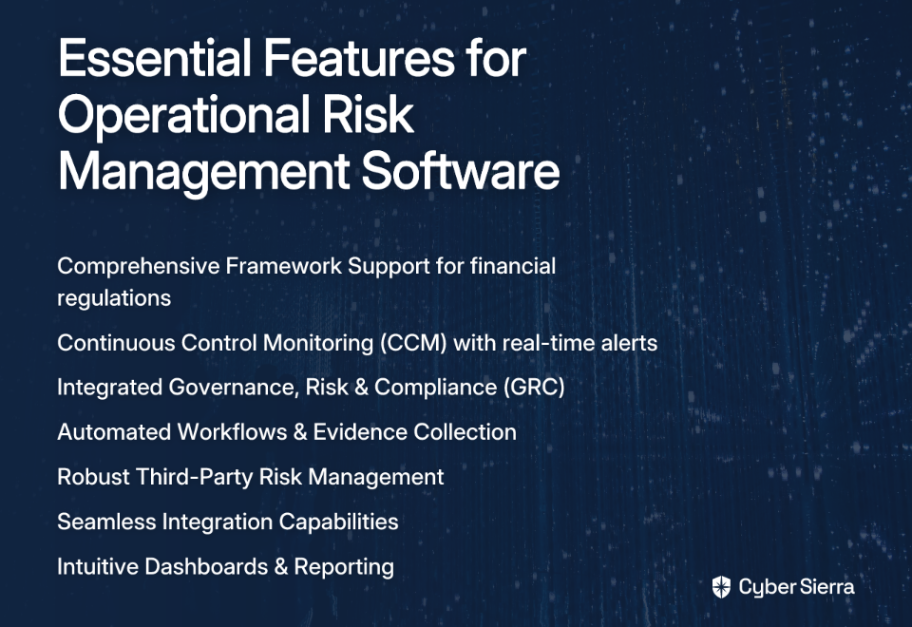
Before diving into specific platforms, let's establish the essential features any operational risk management software should have for financial institutions:
Comprehensive Framework Support
The platform must support multiple frameworks out-of-the-box (SOC 2, ISO 27001, PCI DSS, GDPR) while being flexible enough to adapt to financial-specific regulations like Basel III and Dodd-Frank.
Continuous Control Monitoring (CCM)
Move beyond point-in-time audits. Look for tools that offer real-time visibility into security controls, automate testing, and provide immediate alerts on deviations. As one compliance manager noted, "It needs to catch issues and just work without us having to keep an eye on it the whole time."
Integrated Governance, Risk & Compliance (GRC)
The software should centralize risk data, policies, controls, and audit evidence into a single source of truth, eliminating silos and streamlining audit preparation.
Automated Workflows & Evidence Collection
Prioritize platforms that automate data collection, risk assessments, and reporting. This directly reduces audit fatigue and frees up your team for more strategic tasks.
Robust Third-Party Risk Management (TPRM)
Financial institutions rely heavily on third parties. A strong TPRM module is essential for automating vendor assessments, performing due diligence, and continuously monitoring supply chain risk.
Seamless Integration Capabilities
The solution should feature "plug-and-play frameworks" that can integrate with your existing tech stack (ERP, CRM, SIEM) to avoid "integration complexities and IT dependency."
Intuitive Dashboards & Reporting
Demand real-time, role-based dashboards that provide a live view of Key Risk Indicators (KRIs) and generate customizable, audit-ready reports.
The 9 Best Operational Risk Management Platforms for Financial Institutions
1. Cyber Sierra
Overview: An AI-enabled cybersecurity platform designed to simplify and automate security compliance and risk management. It's built for regulated industries like financial services, focusing on moving organizations from periodic checks to continuous, proactive risk management.
Key Features for Finance:
- Governance, Risk & Compliance (GRC): Automates data collection, risk assessments, and reporting across multiple frameworks (SOC2, ISO 27001, HIPAA, PCI DSS), making financial institutions audit-ready faster.
- Continuous Control Monitoring (CCM): Provides ongoing, near real-time visibility into security controls, automates testing, and detects exceptions—critical for maintaining compliance with dynamic regulations.
- Third-Party Risk Management (TPRM): Streamlines vendor risk assessment with automated questionnaires and continuous monitoring, addressing supply chain vulnerabilities.
- Threat Intelligence: Offers vulnerability scanning and a security scorecard to proactively manage the organization's attack surface.
Best For: Financial institutions needing an integrated, all-in-one platform to manage multiple compliance frameworks with continuous automation and clear risk visibility.
Pricing: Contact for a tailored quote.
2. MetricStream
Overview: A well-established, enterprise-grade GRC platform known for its "Connected GRC" solutions that provide comprehensive risk visibility.
Key Features for Finance: Centralized risk repository, AI-powered predictive risk insights, extensive loss event management features, and support for ESG compliance.
Best For: Large enterprises in highly regulated sectors like banking and insurance that require a powerful, unified GRC solution.
Pricing: Available upon request.
3. Archer
Overview: A robust, highly customizable Integrated Risk Management (IRM) solution designed to unify risk data across large organizations.
Key Features for Finance: Extensive risk quantification capabilities, customizable workflows for complex risk processes, and intuitive dashboards for real-time analysis.
Best For: Large, mature organizations with complex risk environments that need a highly configurable platform and have the resources to manage it. (Note: some users find it complex and costly).
Pricing: Available upon request.
4. LogicGate (Risk Cloud®)
Overview: A user-friendly and flexible GRC platform that uses a no-code interface to allow businesses to build and automate their own risk and compliance workflows.
Key Features for Finance: Drag-and-drop workflow customization, automated risk assessments, role-based dashboards, and a centralized space to track operational risks.
Best For: Firms that require highly tailored risk management processes and want the flexibility to adapt workflows without relying on IT or developers.
Pricing: Available upon request.
5. Ncontracts
Overview: A risk management platform designed specifically for financial institutions like banks and credit unions.
Key Features for Finance: Offers connected risk visibility across the organization, customizable risk assessments tailored to financial regulations, strong vendor risk management, and integrated compliance training modules.
Best For: Banks, credit unions, and other regulated financial entities looking for an industry-specific solution with expert support.
Pricing: Available upon request.
6. Hyperproof
Overview: An integrated risk and compliance management platform that focuses on making compliance efforts efficient and user-friendly.
Key Features for Finance: Automated evidence collection, a centralized risk register, real-time monitoring dashboards, and flexible risk classification to align with internal methodologies.
Best For: Compliance teams looking for a streamlined, easy-to-use tool to manage controls and prepare for audits.
Pricing: Available upon request.
7. Workiva
Overview: A platform that excels at connecting risk management with financial reporting, audit, and compliance workflows.
Key Features for Finance: Strong integration for SOX compliance and financial reporting, automated control testing, and real-time monitoring of risk levels tied to financial data.
Best For: Publicly traded financial institutions that need to ensure tight alignment between their GRC activities and SEC reporting requirements.
Pricing: Available upon request.
8. ServiceNow GRC
Overview: Leverages the widely-used ServiceNow IT Service Management (ITSM) platform to provide integrated GRC functionalities.
Key Features for Finance: Integrates risk and compliance management directly into daily IT and business workflows, offers no-code playbooks for process automation, and provides real-time compliance monitoring.
Best For: Organizations already heavily invested in the ServiceNow ecosystem that want to consolidate GRC onto a single, familiar platform.
Pricing: Available upon request.
9. IBM OpenPages
Overview: An AI-powered, enterprise-scale GRC platform designed for comprehensive risk management across the organization.
Key Features for Finance: Integrates multiple operational risk domains (IT risk, third-party risk, audit), uses AI for predictive insights, and supports large-scale compliance automation.
Best For: Large enterprises seeking an AI-driven GRC solution for managing a wide array of interconnected risks at scale.
Pricing: Starts around $750/instance.
A Quick Look at Pricing Models
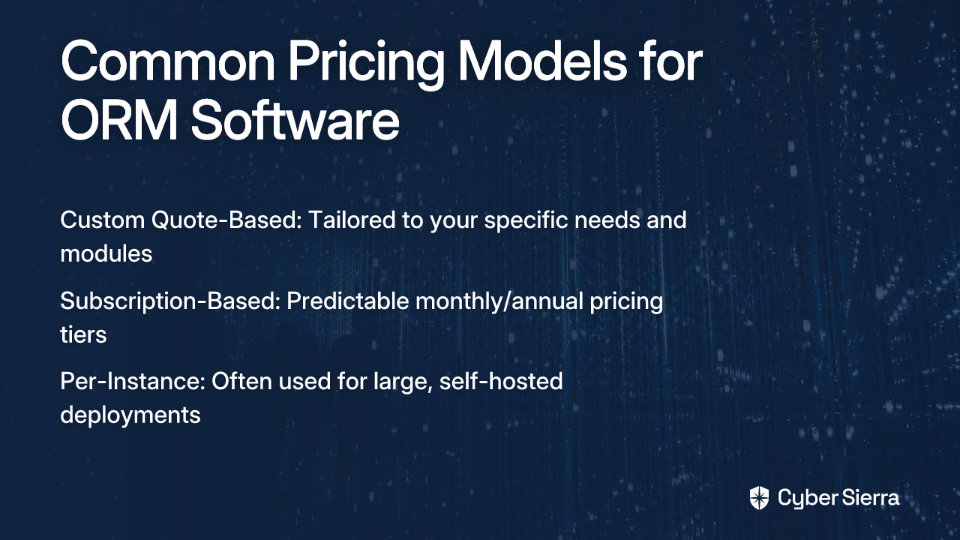
Custom Quote-Based (Most Common): Platforms like Cyber Sierra, MetricStream, and Archer provide tailored pricing. This model is based on factors like the number of users, specific modules required (GRC, TPRM, CCM), company size, and integration needs. It ensures you only pay for what you use but requires a consultation.
Subscription-Based: Some platforms offer tiered monthly or annual subscriptions. For example, Pirani starts around $304/month, and Strike Graph is around $750/month. This offers more predictable pricing but may be less flexible for enterprise needs.
Per-Instance: Solutions like IBM OpenPages may charge per software instance, a model often suited for large, self-hosted deployments.
Transform Compliance into a Competitive Advantage
In today's demanding regulatory landscape, the shift from manual spreadsheets and periodic checks to automated, continuous operational risk management is no longer optional—it's essential for survival and growth in the financial sector.
Choosing the right operational risk management software is a strategic decision that enhances resilience, reduces audit fatigue, and builds trust with regulators and customers. The key is to find a platform that not only meets today's compliance needs but also scales to address future risks.
An integrated platform like Cyber Sierra empowers financial institutions by automating evidence collection, providing a real-time view of your control posture across multiple frameworks, and simplifying vendor risk management. Move beyond compliance as a burden and transform it into a competitive advantage.
Frequently Asked Questions
What is operational risk management (ORM) software?
Operational risk management (ORM) software is a specialized tool that helps organizations, particularly in regulated industries like finance, to identify, assess, monitor, and report on risks arising from internal processes, people, and systems. It centralizes risk data, automates compliance tasks, and provides real-time visibility into an organization's risk posture, moving beyond manual tracking in spreadsheets.
What key features should financial institutions look for in ORM software?
Financial institutions should prioritize ORM software with comprehensive framework support (e.g., SOC 2, ISO 27001, Basel III), continuous control monitoring (CCM) for real-time alerts, and integrated Governance, Risk & Compliance (GRC) capabilities. Other essential features include automated workflows for evidence collection, robust third-party risk management (TPRM), and seamless integration with existing tech stacks.
How does ORM software help with compliance for regulations like SOC 2 and ISO 27001?
ORM software streamlines compliance by providing pre-built frameworks and controls mapped directly to regulations like SOC 2 and ISO 27001. It automates the collection of audit evidence, monitors controls continuously to detect gaps, and centralizes all compliance documentation. This significantly reduces manual effort, shortens audit cycles, and ensures you are always audit-ready.
Why is continuous control monitoring (CCM) a critical feature?
Continuous control monitoring (CCM) is critical because it shifts organizations from periodic, point-in-time audits to a proactive, real-time approach to compliance. For financial institutions, CCM automatically tests security controls against policies and regulations, providing immediate alerts on deviations. This allows for rapid remediation of issues before they become significant compliance failures or security breaches.
Why replace spreadsheets with dedicated ORM software?
Replacing spreadsheets with dedicated ORM software is essential for accuracy, efficiency, and scalability. Spreadsheets are prone to human error, lack automation, and cannot provide a real-time, consolidated view of risk. Dedicated software automates data collection, centralizes your risk register, provides intuitive dashboards for reporting, and ensures a single source of truth for all risk and compliance activities.
Ready to see how an AI-enabled platform can streamline your operational risk and compliance programs? Book a demo of Cyber Sierra to get started on your journey to more efficient operational risk management.
