



7 Practical Steps to Achieve CUI Compliance for Government Contractors



Join thousands of professionals and get the latest insight on Compliance & Cybersecurity.
Summary
- Failing to protect Controlled Unclassified Information (CUI) can lead to severe penalties under the False Claims Act and disqualification from government contracts.
- Achieving compliance requires implementing the 110 security controls from NIST SP 800-171 and documenting them in a System Security Plan (SSP) to prepare for CMMC Level 2 certification.
- A crucial first step is to identify all CUI and isolate it within a secure "enclave" to simplify compliance and reduce the scope of your efforts.
- Shifting from manual audits to automated Continuous Control Monitoring (CCM) is the most effective way to maintain readiness and reduce audit fatigue.
Are you feeling overwhelmed by CUI markings on every email? Struggling to understand technical compliance requirements without an IT background? Concerned about implementing costly, complex solutions for your small team? You're not alone.
"I can read through it and understand it, but I am not an IT person by trade and do not know the options available to meet the standard," shared one government contractor on Reddit. Another lamented, "These days literally every email DLA sends in regards to quotes are marked as CUI," highlighting the confusion many face.
This article provides a clear roadmap to CUI compliance, focusing on practical, scalable solutions that won't break the bank or require an army of IT specialists.
What is CUI and Why Does It Matter?
Controlled Unclassified Information (CUI) is information created or possessed by the government (or an entity on its behalf) that requires safeguarding but is not classified. The CUI program was established by Executive Order 13556 and implemented through 32 CFR Part 2002, with the National Archives and Records Administration (NARA) serving as the Executive Agent.
The stakes are high: Misrepresenting your CUI protection can lead to severe liability under the False Claims Act, potentially resulting in triple damages and multi-million dollar settlements. Beyond penalties, non-compliance can disqualify you from government contracts altogether.
Let's dive into the seven practical steps that will help you achieve and maintain CUI compliance.
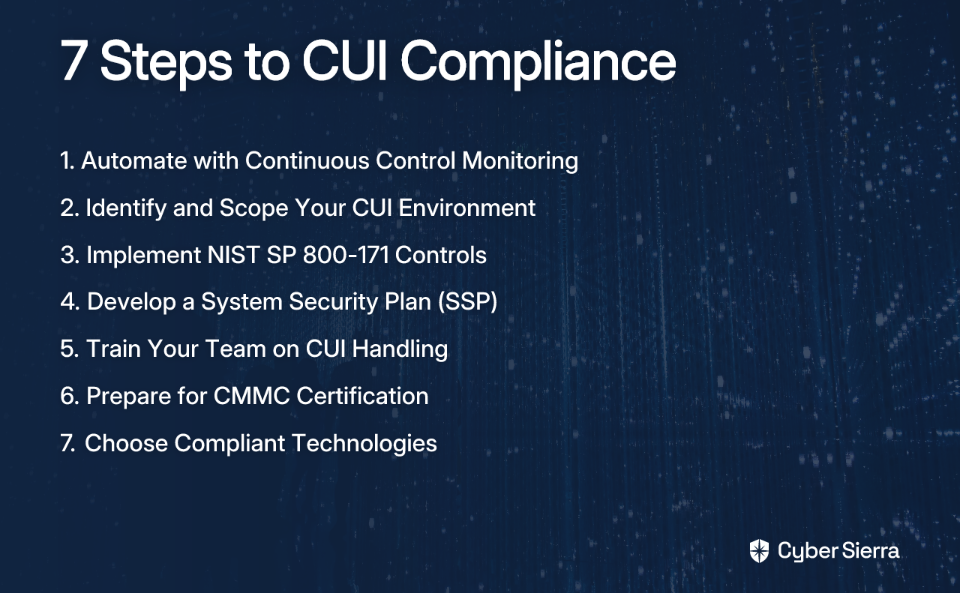
Step 1: Automate Your Foundation with Continuous Control Monitoring
The traditional approach to compliance—manual, periodic checks—is resource-intensive, error-prone, and ultimately inadequate for today's threat landscape. It creates audit fatigue and leaves gaps in your security posture between assessments.
The solution is automation through Continuous Control Monitoring (CCM). This approach shifts your security governance from reactive to proactive by continuously testing and monitoring controls to identify risks in near real-time.
Cyber Sierra's Continuous Control Monitoring (CCM) platform transforms this process by:
- Building a central controls repository that serves as a single source of truth
- Providing real-time visibility into your security posture
- Automating control testing and validation across multiple frameworks (NIST SP 800-171, CMMC, etc.)
- Generating actionable intelligence to prioritize remediation efforts
This automation addresses the pain point expressed by many contractors who find manual compliance processes "clunky" and unscalable as their organizations grow.
Step 2: Identify and Scope Your CUI Environment
You can't protect what you can't find. One of the biggest challenges in CUI compliance is simply knowing what information qualifies as CUI and where it resides within your organization.
Here's how to tackle this challenge:
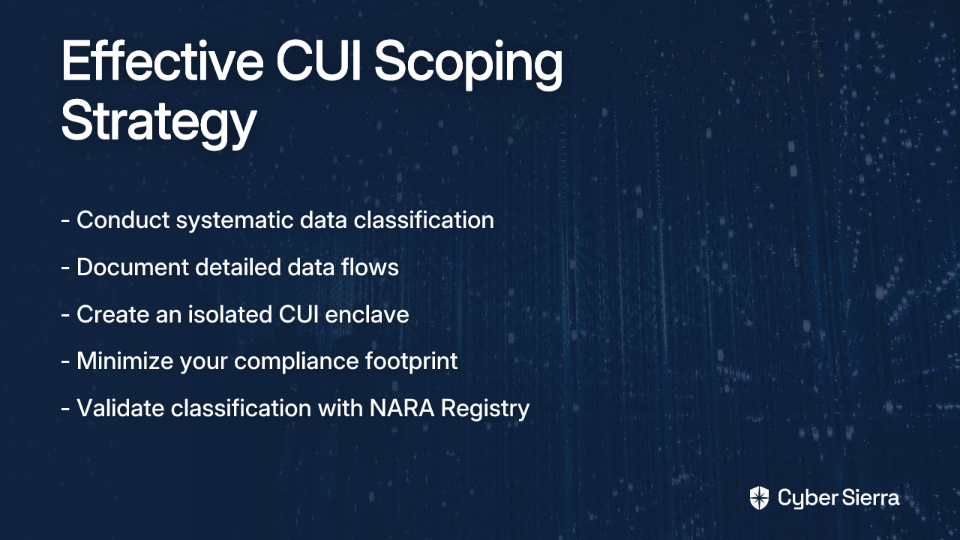
- Conduct Data Classification: Systematically identify all data that qualifies as CUI. Use the official National Archives CUI Registry as your definitive source for categories.
- Document Data Flows: Map out how CUI enters, moves through, and leaves your organization. This includes email communications, file transfers, cloud storage, and physical documents.
- Reduce Your Scope: To simplify compliance, consider creating a secure enclave—an isolated environment for handling all CUI. This minimizes the number of systems that need to meet the stringent requirements of NIST SP 800-171.
Many contractors struggle with the perception that "literally every email" contains CUI. In reality, proper classification often reveals that your CUI footprint is smaller than feared, making compliance more manageable.
Step 3: Implement NIST SP 800-171 Security Controls
Protecting CUI on non-federal systems requires implementing the security controls outlined in NIST Special Publication 800-171.
Follow these practical steps:
- Understand the Framework: NIST SP 800-171 organizes 110 security controls into 14 control families, including Access Control, Incident Response, and System and Information Integrity.
- Perform a Gap Analysis: Assess your current security posture against all 110 controls to identify where you fall short. Document your findings meticulously.
- Create a Plan of Action & Milestones (POA&M): For any controls that are not yet met, develop a POA&M that details your plan for implementation, including timelines and resources. This document is a mandatory component of compliance and demonstrates your commitment to addressing gaps.
Remember that implementing these controls doesn't necessarily mean purchasing expensive new systems. Many requirements can be met through policy development, configuration changes to existing tools, and staff training.
Step 4: Develop and Maintain a System Security Plan (SSP)
An SSP is a formal document that describes how your organization implements the security requirements from NIST SP 800-171. It's the primary document auditors will review and is essential for demonstrating compliance.
Your SSP must include:
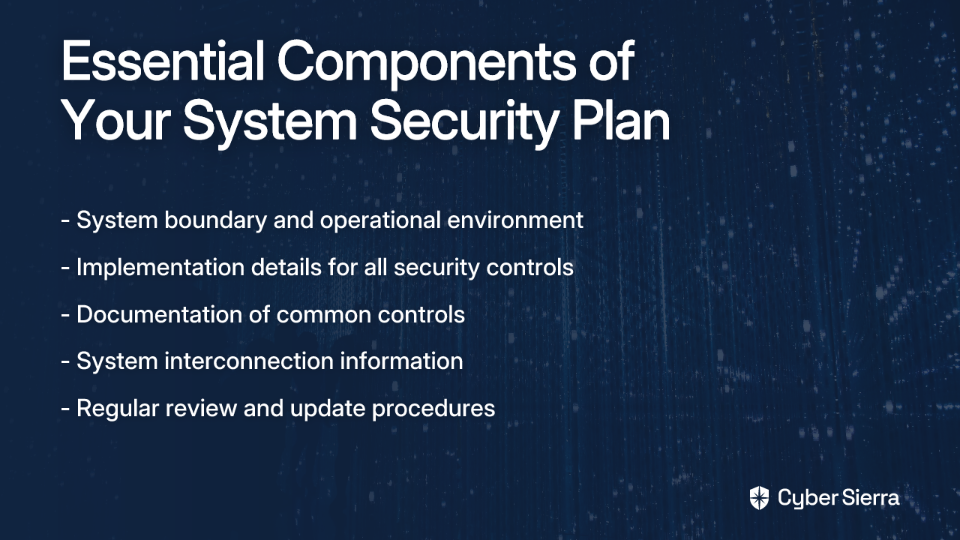
- A description of your system boundary and operational environment
- Details on how each security control is implemented
- Documentation of any planned or implemented common controls
- Information about connections to other systems
The SSP is not a "set it and forget it" document. It must be reviewed and updated regularly, especially when there are significant changes to your systems or security controls.

Step 5: Train Your Team on CUI Handling and Marking
Your employees are the first line of defense in protecting CUI. A security-conscious workforce is critical for compliance.
Establish a formal training program that covers:
- Proper CUI Marking: Follow the guidelines from the NARA CUI Marking Handbook to correctly label documents, emails, and other media. Train employees to understand the difference between CUI Basic and CUI Specified.
- Secure Handling: Provide clear procedures for email encryption, secure storage of printed documents, and proper disposal of CUI materials.
- Incident Response: Ensure everyone knows how to identify and report a potential CUI breach or unauthorized disclosure.
Cyber Sierra's Employee Security Training platform can automate this process with interactive modules and simulated phishing campaigns to test and reinforce learning, helping you build and prove a strong security culture.
Step 6: Prepare for Cybersecurity Maturity Model Certification (CMMC)
CMMC is the DoD's framework for verifying that contractors have implemented the required cybersecurity standards to protect CUI. It's no longer optional—it's becoming a prerequisite for winning and maintaining DoD contracts.
For most contractors handling CUI, the target is CMMC Level 2. This level aligns directly with the 110 controls in NIST SP 800-171 and will require a successful third-party assessment.
Don't wait to begin preparation. The steps you're taking now—implementing NIST 800-171, creating an SSP, and using CCM—are the direct path to CMMC readiness. By building compliance into your daily operations, you'll be prepared when assessment time comes.
Step 7: Choose Compliant Technologies and Services
Using the wrong tools can undermine your entire compliance effort. This is particularly important for small teams concerned about implementing overly complex or expensive solutions.
Key considerations include:
- Cloud Services: If you store or process CUI in the cloud, you must use a service that is FedRAMP Authorized. For DoD contractors, this often means using a government-specific cloud environment like AWS GovCloud or Microsoft 365 GCC High.
- Email Encryption: As noted by compliance experts, "Emails that contain CUI must be encrypted." Ensure your email solution provides end-to-end encryption for transmitting CUI.
- Third-Party Risk: Evaluate the security posture of all vendors in your supply chain who may touch CUI. Cyber Sierra's Third-Party Risk Management (TPRM) can automate vendor assessments and provide continuous monitoring of their compliance.
Small teams should resist the urge to implement overly complex solutions like VDI environments when simpler options might suffice. As one Reddit user advised another contractor with just four employees: "Why would you add VDI and Proofpoint to the equation when you only have 4 employees?"
From Manual Checks to Continuous Compliance
Achieving CUI compliance can feel daunting, but it's a manageable process when broken down into these practical steps. The key is to move away from stressful, point-in-time audits toward a state of continuous readiness.
Embracing automation isn't just about efficiency; it's about transforming your security posture. By leveraging a platform for Continuous Control Monitoring, you replace manual guesswork with real-time visibility, ensuring you're not just compliant on audit day, but every day.
Frequently Asked Questions
What is the first step to becoming CUI compliant?
The first step is to accurately identify and scope all Controlled Unclassified Information (CUI) within your organization. You cannot protect what you don't know you have. This involves conducting data classification using the NARA CUI Registry, mapping data flows, and creating a secure enclave to minimize your compliance footprint.
What is the difference between NIST SP 800-171 and CMMC?
NIST SP 800-171 is the set of security controls you must implement, while CMMC is the framework used to verify that you have implemented them correctly. Think of NIST SP 800-171 as the "what" (the 110 security requirements) and CMMC as the "how" (the assessment and certification process). Achieving CMMC Level 2 certification requires a third-party assessment to prove you meet the NIST SP 800-171 controls.
Do I need a System Security Plan (SSP) even if I've implemented all controls?
Yes, a System Security Plan (SSP) is a mandatory component of CUI compliance. The SSP is a critical document that details how your organization implements each of the 110 security controls from NIST SP 800-171. It serves as the primary evidence for auditors and demonstrates your ongoing commitment to protecting CUI.
Can small businesses handle CUI compliance without a large IT team?
Yes, small businesses can achieve CUI compliance without a large IT team by leveraging automation and scalable solutions. Tools for Continuous Control Monitoring (CCM) can automate testing and validation, while creating a secure CUI "enclave" can significantly reduce the scope of your compliance efforts. Using compliant cloud services like Microsoft 365 GCC High can also simplify the technical implementation.
How do I know if an email or document contains CUI?
You can identify CUI by checking the official National Archives (NARA) CUI Registry, which lists all authorized CUI categories. CUI is often marked with specific labels (e.g., "CUI" in the header/footer), but you are responsible for identifying and marking it even if it's received unmarked. When in doubt, consult your government contract and the CUI Registry to determine if the information requires protection.
What happens if my organization is not CUI compliant?
Non-compliance with CUI requirements can have severe consequences. These can include losing your government contracts, being disqualified from future bidding, and facing legal liability under the False Claims Act, which can result in triple damages and significant financial penalties. Proactively managing compliance is essential to avoid these risks.
Ready to move beyond spreadsheets and build a scalable, automated CUI compliance program? Schedule a demo of Cyber Sierra to see how our AI-enabled platform provides the continuous visibility and control you need to protect sensitive data and win government contracts.
