



7 Best Continuous Controls Monitoring Solutions for Financial Services

Join thousands of professionals and get the latest insight on Compliance & Cybersecurity.
Summary
- Financial institutions face severe penalties for non-compliance, with GLBA violations reaching $100,000 and 35.5% of breaches involving third-party vendors.
- Regulators now expect ongoing oversight, making Continuous Controls Monitoring (CCM) essential for proactively managing security risks and moving beyond periodic audits.
- When selecting a CCM tool, prioritize solutions with deep cloud integrations, customization for financial regulations, and robust automation to ensure effectiveness.
- A unified CCM platform can integrate GRC and vendor risk management, helping financial institutions achieve a constant state of audit readiness.
Are you trying to implement Continuous Controls Monitoring (CCM) in your financial institution but finding most solutions too generic for your complex regulatory needs? Or perhaps you've tried tools like Wiz, only to find the compliance module lacking the customization required for your organization's "big AWS footprint" and intricate compliance requirements?
You're not alone. In the high-stakes world of financial services, generic compliance tools simply don't cut it.
The High-Stakes World of Financial Compliance
Financial institutions operate in one of the world's most complex regulatory environments. From the Sarbanes-Oxley Act (SOX) to the Gramm-Leach-Bliley Act (GLBA), PCI DSS, and emerging frameworks like DORA (Digital Operational Resilience Act), the compliance burden is immense and ever-growing.
The stakes couldn't be higher. GLBA violations alone can result in penalties of up to $100,000 per violation for institutions and $10,000 for individual officers, not to mention potential criminal charges and devastating reputational damage.
What's more, regulators are no longer satisfied with point-in-time audits. Today, they expect financial institutions to demonstrate ongoing compliance through continuous monitoring of controls and risks.
Why Continuous Monitoring is Non-Negotiable in Finance
Continuous Controls Monitoring (CCM) represents a paradigm shift from reactive to proactive compliance. It's a technology-driven approach for ongoing, automated oversight of security and financial controls to mitigate risks in near real-time.
Here's why CCM has become essential for financial services:
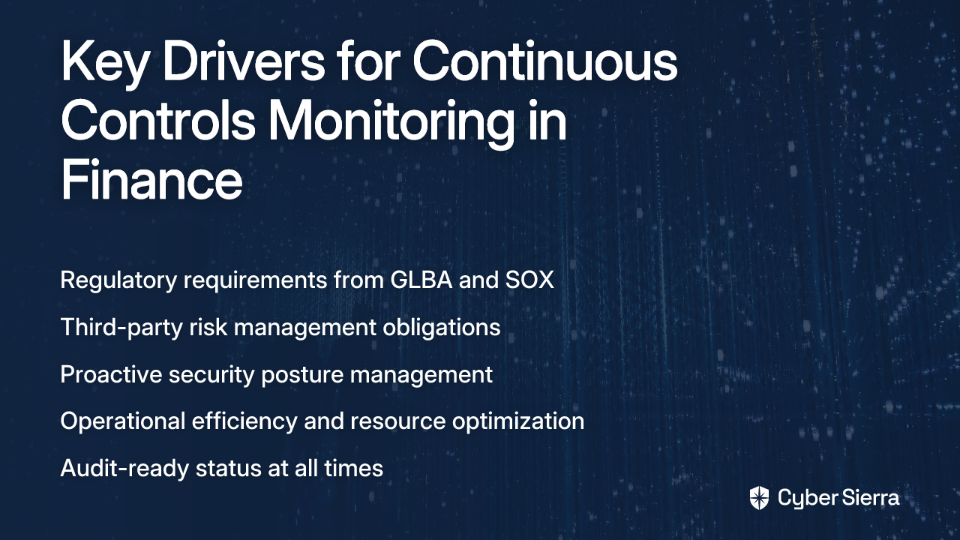
Regulatory Imperatives
The GLBA Safeguards Rule explicitly mandates a security program that includes continuous monitoring or penetration testing, data encryption, strict access controls, and multi-factor authentication.
SOX Compliance requires stringent internal controls over financial reporting. CCM automates the testing of these controls, providing a continuous audit trail and ensuring integrity.
Third-Party Risk Management is critical as GLBA holds institutions accountable for the security practices of their vendors. With research showing 35.5% of breaches involve a third party, continuous monitoring of your vendor ecosystem is no longer optional.
Operational Benefits
Beyond regulatory compliance, CCM delivers significant operational advantages:
- Proactive Risk Management: Catch misconfigurations, vulnerabilities, and compliance gaps before they become breaches or audit findings.
- Enhanced Efficiency: Automate manual evidence collection and testing, freeing up GRC teams to focus on strategic risk management.
- Improved Transparency: Gain near real-time dashboards and reporting, fostering better communication between IT, compliance, and leadership.
- Audit Readiness: Maintain a continuous state of preparedness for internal and external audits, eliminating the "audit scramble" that plagues many financial institutions.
Now, let's explore the seven best continuous controls monitoring solutions specifically tailored for financial services.
The 7 Best Continuous Controls Monitoring Solutions for Financial Services
1. Cyber Sierra
Best For: Financial institutions seeking a unified, AI-enabled platform that integrates GRC, TPRM, and CCM to achieve continuous compliance and audit readiness.
Key Features:
- Unified GRC & CCM: Manages multiple compliance frameworks (SOX, GLBA, NIST, ISO 27001, PCI DSS) from a single dashboard, eliminating siloed tools.
- Automated Control Testing: Automates evidence collection from cloud services (like AWS), vendors, and internal systems, drastically reducing manual audit preparation.
- Actionable Risk Intelligence: Provides a near real-time view of your security posture, delivering data-driven insights to prioritize remediation efforts.
- Integrated Third-Party Risk Management (TPRM): Continuously monitors vendor security, ensuring compliance with GLBA requirements for third-party oversight.
Why It Works for Finance: Cyber Sierra is more than a CCM tool; it's a comprehensive compliance operating system. It directly addresses the pain of GRC teams in financial services who are managing "big compliance requirements" with a "big infrastructure." By integrating GRC, CCM, and TPRM, it provides the single source of truth needed to satisfy auditors and regulators, transforming security from periodic checks into a continuous, automated process.
2. MetricStream
Best For: Cloud-native financial firms needing autonomous control verification for their cloud environments.
Key Features:
- Specializes in cloud compliance monitoring, perfect for institutions with significant AWS or cloud footprints
- Offers autonomous control verification to reduce manual checks
- Provides risk, audit, and compliance management modules
Why It Works for Finance: As financial services increasingly move to the cloud, a solution focused on cloud compliance is critical. MetricStream helps ensure that cloud infrastructure meets stringent regulatory standards while providing the continuous monitoring capabilities required by frameworks like GLBA.
3. Pathlock
Best For: Institutions focused on monitoring controls within critical business applications and financial transactions.
Key Features:
- Monitors application-level controls (e.g., in SAP, Oracle)
- Focuses on preventing fraud and ensuring compliance within financial processes
- Provides detailed visibility into user access and segregation of duties
Why It Works for Finance: Pathlock goes deep into the applications that power financial reporting and transactions, making it a strong choice for ensuring SOX compliance and internal control integrity. Its focus on transaction monitoring and segregation of duties aligns perfectly with financial services' need to prevent fraud and maintain accurate financial reporting.
4. IBM OpenPages
Best For: Large enterprises looking for an AI-driven GRC platform with predictive risk insights.
Key Features:
- Leverages AI for predictive insights and advanced risk management
- Offers real-time compliance risk monitoring
- Includes automated workflows specifically for SOC compliance
Why It Works for Finance: For large, complex financial organizations, the AI capabilities of IBM OpenPages can help identify emerging risks and automate sophisticated compliance workflows at scale. Its enterprise-grade architecture can handle the complexity and volume of compliance data generated by major financial institutions.
5. Panaseer
Best For: Security teams that need to correlate data from various security tools to get a unified view of control effectiveness and risk.
Key Features:
- Aggregates data from existing security tools (vulnerability scanners, endpoint protection, etc.)
- Provides real-time visibility into security posture
- Helps prioritize vulnerabilities based on business context and risk
Why It Works for Finance: Financial institutions have a vast array of security tools. Panaseer acts as a data aggregation and analytics layer, turning disparate security signals into a clear, measurable picture of control strength. This is particularly valuable for institutions dealing with multiple security vendors and tools.
6. Hyperproof
Best For: Compliance teams looking to reduce manual evidence collection and testing across a wide variety of control types.
Key Features:
- Automates evidence collection by connecting directly to cloud and on-premise systems
- Focuses on continuous monitoring across IT, security, and operational controls
- Streamlines audit preparation with a central repository of evidence
Why It Works for Finance: Hyperproof excels at the tactical, time-consuming work of audit prep. Its strength lies in automating the collection of proof, which is a major pain point for teams facing frequent SOX, PCI, and internal audits. Financial institutions often struggle with the volume of evidence requests during audits, and Hyperproof's automation capabilities directly address this challenge.
7. Centraleyes
Best For: Financial conglomerates or holding companies that need to manage compliance across multiple entities.
Key Features:
- Multi-entity compliance dashboards for a consolidated, real-time view
- Smart framework mapping to test a control once and apply it to multiple regulations
- Automated evidence collection at the infrastructure layer
Why It Works for Finance: For large financial groups with multiple subsidiaries, Centraleyes simplifies the complexity of managing and reporting on compliance across the entire organization from a single platform. This is particularly valuable for financial holding companies that must maintain a consistent compliance posture across diverse business units.
How to Choose the Right CCM Solution for Your Financial Institution
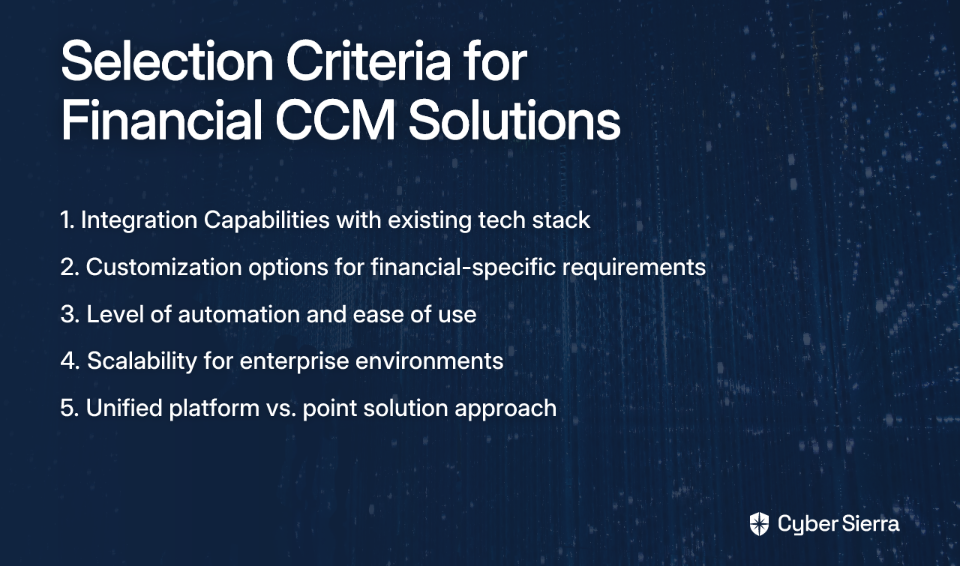
With so many options available, how do you select the right continuous controls monitoring solution for your specific needs? Consider these key factors:
Integration Capabilities
Does the solution integrate with your existing tech stack (e.g., AWS, Snowflake, vulnerability scanners)? As one user noted, having a "big AWS footprint" requires tools that can deeply integrate with cloud services. A tool with extensive plugins and APIs will prevent it from becoming another data silo.
Customization vs. Genericity
As one Reddit user complained, "Wiz compliance is very generic." Look for a platform that allows you to tailor controls and risk assessments to your specific business processes and regulatory landscape. Financial services have unique compliance requirements that off-the-shelf solutions often fail to address adequately.
Ease of Use & Automation
The goal is "hands-off compliance." The platform should automate evidence collection, testing, and reporting to reduce manual effort and allow your team to focus on strategic risk management. As another user noted, they "had [their] eye on a continuous compliance/monitoring tool that works in the background without much fuss."
Scalability
Can the tool handle your scale? Consider your infrastructure size, number of employees, and the complexity of your compliance requirements. For organizations with "big infrastructure, big compliance requirements, big AWS footprint, Snowflake, etc.," scalability is non-negotiable.
Unified Platform vs. Point Solution
Evaluate whether you need a standalone CCM tool or a comprehensive GRC platform like Cyber Sierra that combines CCM with policy management, risk assessment, and vendor management for a holistic view of your compliance posture.
Secure Your Future with Integrated, Continuous Compliance
The financial sector's regulatory landscape is only getting more complex. Relying on spreadsheets and periodic audits is no longer a viable strategy for managing risk.
The future of compliance is continuous, automated, and integrated. A unified platform that brings together Governance, Risk, and Compliance (GRC) with Continuous Controls Monitoring (CCM) provides the real-time visibility and control needed to stay ahead of threats and regulators.
Cyber Sierra's AI-enabled platform is built for this future. It moves your organization from compliance fatigue to a state of perpetual audit readiness. By centralizing your controls, automating evidence collection, and providing actionable intelligence, it empowers you to build a resilient and trustworthy financial institution.
Don't wait for your next audit to find the gaps in your compliance program. Schedule a free demo of Cyber Sierra to see how our unified platform can streamline your compliance processes and provide peace of mind in the high-stakes world of financial services compliance.
Frequently Asked Questions
What is Continuous Controls Monitoring (CCM) for financial services?
Continuous Controls Monitoring (CCM) is a technology-driven approach that automates the ongoing oversight of a financial institution's security and financial controls. Instead of relying on periodic, point-in-time audits, CCM provides near real-time visibility into the effectiveness of controls. This helps financial institutions proactively identify and mitigate risks, ensure compliance with regulations like SOX and GLBA, and maintain a constant state of audit readiness.
Why are generic compliance tools often a poor fit for financial institutions?
Generic compliance tools often fail to meet the specific, complex, and stringent regulatory requirements unique to the financial services industry. Financial institutions face a unique set of regulations (e.g., GLBA, SOX, DORA) and have intricate infrastructure, such as large cloud environments. Generic tools may lack the necessary customization for specific controls, fail to integrate deeply with financial tech stacks, and may not provide the granular evidence required by financial auditors and regulators.
Which financial regulations mandate continuous monitoring?
Key regulations like the Gramm-Leach-Bliley Act (GLBA) and the Sarbanes-Oxley Act (SOX) strongly imply or directly mandate the need for continuous monitoring. The GLBA Safeguards Rule requires a security program with continuous monitoring or regular testing. SOX demands stringent internal controls over financial reporting, and CCM provides the continuous validation needed to ensure their effectiveness. Emerging frameworks like DORA also emphasize ongoing operational resilience monitoring.
What are the main benefits of a unified GRC and CCM platform?
A unified GRC and CCM platform provides a single source of truth for all compliance activities, breaking down data silos and improving efficiency. By integrating Governance, Risk, and Compliance (GRC) with Continuous Controls Monitoring (CCM), financial institutions can manage policies, assess risks, monitor controls, and handle third-party risk from one central dashboard. This leads to reduced manual effort through automated evidence collection, better decision-making with a holistic view of risk, and a state of perpetual audit readiness.
How does CCM improve third-party risk management (TPRM)?
CCM automates the monitoring of security controls and compliance posture of third-party vendors, which is a critical requirement under GLBA. Financial institutions are held accountable for the security practices of their vendors. A CCM solution with integrated TPRM capabilities can continuously assess vendor risks, monitor their security performance, and collect evidence of their compliance, ensuring the entire supply chain adheres to regulatory standards without burdensome manual check-ins.
How do I select the best CCM solution for my organization?
To select the best CCM solution, evaluate its integration capabilities, customization options, level of automation, and scalability against your institution's specific needs. Ensure the tool integrates with your existing tech stack (e.g., AWS, security tools). Look for a platform that can be tailored to financial-specific controls, not a generic one. Prioritize solutions that offer high levels of automation to reduce manual work and can scale with your organization's growth and complexity. Finally, decide if a standalone tool or a unified GRC platform best suits your strategic goals.
