



10 Compliance Monitoring and Testing Best Practices for Cybersecurity Teams

Join thousands of professionals and get the latest insight on Compliance & Cybersecurity.
Summary
- Traditional point-in-time audits are inefficient and reactive. The solution is to shift to continuous monitoring to stay audit-ready 24/7.
- Automating evidence collection and control testing can reduce manual compliance work by up to 80%, freeing your team to focus on proactive security.
- A complete compliance strategy involves validating control effectiveness (not just existence), integrating with frameworks like NIST and ISO 27001, and building a top-down security culture.
- Cyber Sierra's Continuous Control Monitoring platform helps automate these processes, providing real-time visibility to transform compliance from a burden into a strategic advantage.
You've reviewed the latest security metrics and your team is drowning in compliance tasks. Countless hours are spent manually gathering evidence, executives don't fully grasp the importance of your frameworks, and the technical debt from unaddressed security issues keeps growing. With your next audit approaching, the familiar feeling of dread sets in as you anticipate the last-minute scramble.
Sound familiar? You're not alone.
Traditional point-in-time audits create a reactive cycle that's inefficient, error-prone, and fails to provide real-time visibility into your security posture. The result? Compliance becomes a burden rather than a strategic advantage.
The solution lies in shifting from periodic compliance checks to continuous monitoring and testing—transforming compliance from a dreaded annual event into an automated, ongoing process that keeps you audit-ready 24/7.
This article outlines 10 actionable best practices to help cybersecurity teams implement effective compliance monitoring and testing, reduce manual effort, and maintain a strong security posture between audits.
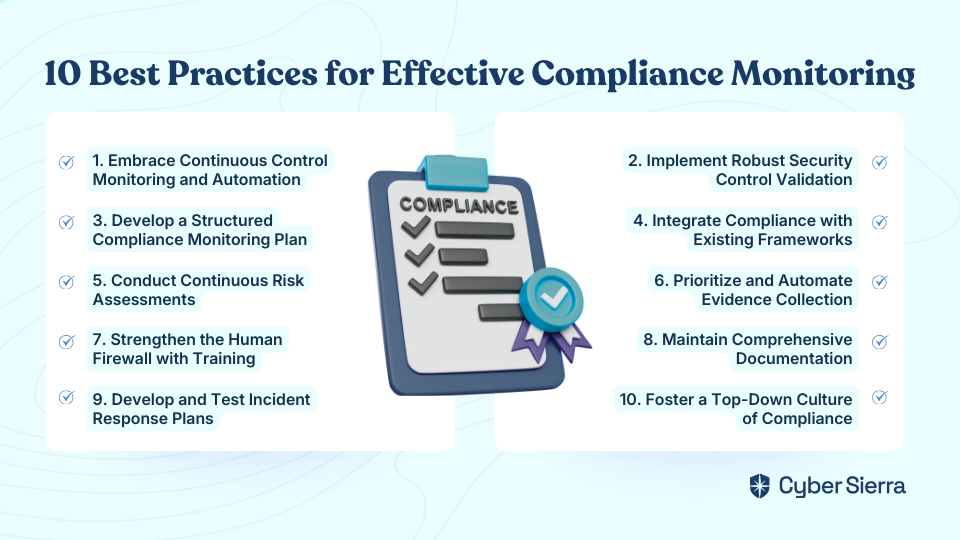
1. Embrace Continuous Control Monitoring (CCM) and Automation
The days of manual, point-in-time compliance checks are over. Continuous Control Monitoring (CCM) represents a fundamental shift in how organizations approach compliance—using technology to automate the ongoing tracking of security and compliance controls.
Cyber Sierra's CCM platform exemplifies this approach by providing real-time visibility into your security posture through automated control testing and validation. The platform builds a central controls repository with near real-time updates across multiple frameworks like NIST, ISO 27001, and PCI DSS.
According to industry research, automation can eliminate up to 80% of manual compliance work, dramatically reducing the time spent gathering evidence and allowing your team to focus on addressing actual security issues rather than documentation.
Key benefits of implementing CCM include:
- Increased Efficiency: Drastically reduces manual evidence gathering for audits
- Cost Reduction: Identifies and helps remediate control deficiencies early, before they become costly problems
- Improved Decision-Making: Provides a comprehensive, real-time overview of risk posture
- Proactive Security: Lowers the risk of breaches by identifying vulnerabilities and misconfigurations as they happen
2. Implement Robust Security Control Validation (SCV)
It's not enough to have controls in place—you need to continuously validate their effectiveness against real-world threats. Security Control Validation (SCV) is "the process of ensuring security controls are properly implemented and configured to mitigate risks" (Cymulate).
There's a crucial difference between control monitoring (checking if a control exists) and control validation (testing if it actually works as intended). Traditional approaches rely on periodic penetration testing, but modern SCV involves:
- Continuous, automated testing of controls against the latest attack vectors
- Breach and Attack Simulation (BAS) tools that safely simulate real-world threats
- Regular validation of both preventive and detective controls
- Documenting validation results as evidence for auditors
The benefits of robust SCV include enhanced security posture, improved audit outcomes, and the ability to demonstrate the effectiveness of your security investments to leadership.
3. Develop a Structured Compliance Monitoring Plan
A strategic monitoring plan is essential for effective compliance. Rather than reacting to audit findings, define your scope, objectives, and processes upfront to guide your ongoing compliance efforts.
Steps to create an effective compliance monitoring plan:
- Understand Requirements: Identify all applicable laws, regulations, and industry standards (e.g., GDPR, CCPA, PCI DSS)
- Perform a Gap Analysis: Compare your current controls against required controls to identify gaps
- Define Control Objectives: Align controls with specific business goals and your organization's risk appetite
- Set Monitoring Frequencies: Define how often controls are monitored (hourly, daily, weekly) based on risk and criticality
- Assign Ownership: Clearly define roles and responsibilities for each control
When determining monitoring frequencies, consider the control's criticality, volatility of the environment, and regulatory requirements. For example, access controls in highly dynamic cloud environments may require daily monitoring, while policy reviews might only need quarterly validation.
4. Integrate Compliance with Existing Security Frameworks
Don't treat compliance as a separate silo. Align your monitoring efforts with established frameworks like NIST, ISO 27001, or SOC 2 for a unified and structured approach.
Manually mapping controls to multiple frameworks is inefficient and error-prone. Instead, adopt a unified approach that:
- Maps common controls across different frameworks to prevent duplication of effort
- Creates a single source of truth for all compliance requirements
- Leverages automation to streamline evidence collection across frameworks
- Ensures consistent implementation of controls across the organization
Cyber Sierra's GRC platform helps manage controls across multiple compliance frameworks from a single dashboard, simplifying the process of staying compliant with various regulations. It automates data collection, risk assessments, and reporting, streamlining audits and reducing compliance fatigue.
5. Conduct Continuous, Proactive Risk Assessments
Risk assessments should not be an annual event. They must be an ongoing process to inform decision-making and prioritize remediation efforts.
Regular risk assessments help identify internal audit issues early, reducing long-term costs and preventing data breaches. Key elements of continuous risk assessment include:
- Automated vulnerability scanning and configuration assessments
- Regular security testing and evaluation
- Threat intelligence integration to identify emerging risks
- Prioritization of findings based on business impact
Cyber Sierra's Threat Intelligence capabilities provide a comprehensive security scorecard, perform vulnerability scanning, and help prioritize remediation based on risk. This enables teams to focus on the most critical issues first, rather than trying to address everything simultaneously.
6. Prioritize and Automate Evidence Collection
Manual evidence collection is the biggest bottleneck in any audit. Automating this process is critical for efficiency and accuracy.
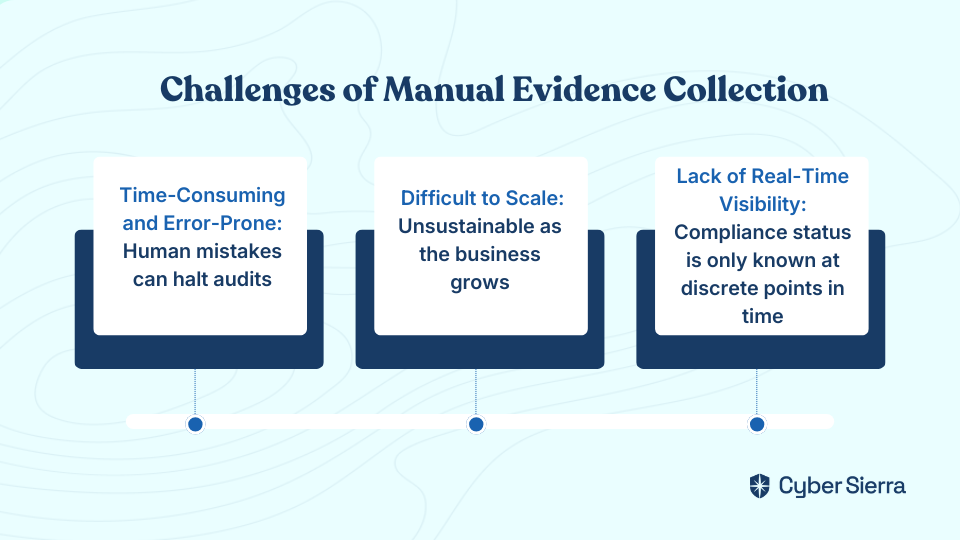
Automated evidence collection leverages technology to streamline the gathering, organization, and management of compliance-related documentation. The challenges of manual processes include:
When implementing evidence collection automation, look for solutions with these key capabilities:
- Deep integration with your tech stack (cloud services, HRIS, etc.)
- Ability to pull detailed, granular data
- Context-rich visibility into control effectiveness
- Auditor-friendly export options
- Evidence versioning and change tracking
By automating evidence collection, organizations can reduce the compliance burden on technical teams, improve the quality and consistency of evidence, and maintain a continuous state of audit readiness.
7. Strengthen the Human Firewall with Continuous Security Training
Technology alone is not enough. Employees are the first line of defense and must be continuously trained on security best practices and compliance requirements.
Effective security training programs should be:
- Ongoing: Not just a one-time onboarding activity
- Relevant: Covering topics specific to your industry and regulatory requirements
- Engaging: Using interactive formats to increase retention
- Measurable: Tracking completion rates and effectiveness through assessments
- Adaptive: Evolving based on emerging threats and changing regulations
Cyber Sierra's Employee Security Training module offers interactive training, quizzes, and simulated phishing campaigns to build a security-conscious culture. This integrated approach ensures that compliance isn't just about technology—it's about building human awareness and vigilance throughout the organization.
8. Maintain Comprehensive Documentation and Clear Communication
Maintain meticulous records of all compliance activities and establish clear communication channels with regulators and internal stakeholders.
Documentation challenges are consistently cited as a pain point by compliance teams. To address this:
- Implement a centralized repository for all compliance documentation
- Document all risk assessments, control tests, remediation actions, and changes
- Establish consistent documentation formats and naming conventions
- Create clear audit trails showing who did what and when
- Set up automated notifications for control failures or compliance issues
For internal communication, use dashboards and reports to provide leadership with clear visibility into compliance status and control effectiveness. Regular briefings help ensure executives understand the importance of compliance frameworks and can make informed decisions about resource allocation.
9. Develop and Regularly Test Incident Response Plans
Having a well-documented and frequently tested incident response (IR) plan is a critical compliance requirement and a security necessity.
An effective IR plan ensures a rapid and coordinated response to security breaches, minimizing damage and meeting regulatory notification deadlines. Most compliance frameworks like SOC 2 and ISO 27001 explicitly mandate having and testing an IR plan.
Best practices for incident response planning include:
- Defining clear roles and responsibilities for response team members
- Documenting step-by-step procedures for various incident types
- Conducting regular tabletop exercises and simulations
- Integrating vulnerability scanners and monitoring tools with compliance platforms
- Tracking incident resolution and automating evidence gathering for audit purposes
- Reviewing and updating the plan regularly based on lessons learned
Remember that auditors will want to see evidence that your IR plan is not just a document gathering dust—it needs to be a living, tested process that your team can execute effectively when needed.
10. Foster a Top-Down Culture of Compliance
Compliance cannot be solely the responsibility of the IT or security team. It must be a shared responsibility, championed by leadership and embedded in the company culture.
Reddit discussions frequently highlight "insufficient management involvement" and "poor understanding of compliance frameworks at executive levels" as significant challenges. To foster a compliance culture:
- Secure visible executive sponsorship for compliance initiatives
- Integrate compliance into business planning and decision-making processes
- Recognize and reward compliance-conscious behavior
- Include compliance responsibilities in job descriptions and performance evaluations
- Provide regular updates to leadership on compliance status and emerging requirements
- Ensure compliance considerations are part of the change management process
When compliance is part of the culture, security becomes a core part of business operations, not an afterthought. This cultural shift transforms compliance from a burden to a competitive advantage that builds customer trust and protects your brand.
From Compliance Burden to Strategic Advantage
Effective compliance monitoring and testing is not about passing an annual audit—it's about building a resilient, secure, and trustworthy organization through continuous, automated processes.
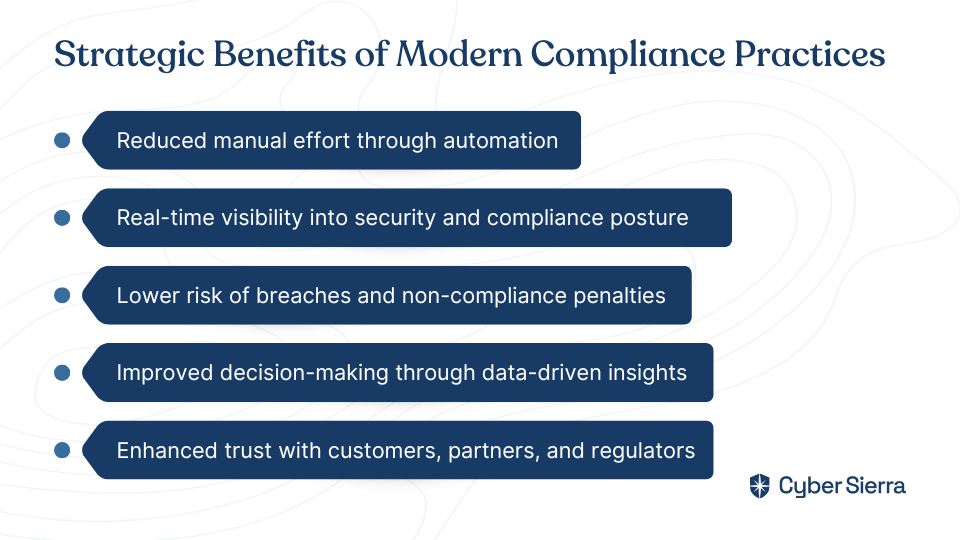
By implementing these best practices, you can transform compliance from a reactive, resource-draining activity to a proactive, strategic advantage. The benefits include:
Cyber Sierra's unified AI-enabled platform helps organizations implement these best practices seamlessly. With integrated modules for Continuous Control Monitoring, GRC, Threat Intelligence, and more, Cyber Sierra automates the entire compliance lifecycle, making your team audit-ready 24/7.
Ready to transform your approach to compliance monitoring and testing? Request a demo today to see how Cyber Sierra can help your team reduce manual effort, gain real-time visibility, and turn compliance into a strategic advantage.
Frequently Asked Questions
What is continuous compliance monitoring?
Continuous compliance monitoring is the process of using technology to automatically and continuously track, test, and validate security and compliance controls in real-time. Unlike traditional point-in-time audits that provide a snapshot, continuous monitoring offers ongoing visibility into your security posture. This proactive approach helps organizations identify and remediate control deficiencies as they occur, ensuring they remain audit-ready 24/7.
Why is automating evidence collection important for compliance?
Automating evidence collection is crucial because it eliminates the most time-consuming, error-prone, and inefficient part of the audit process. Manual evidence collection is difficult to scale and lacks real-time visibility. Automation streamlines the gathering, organization, and management of compliance data, reducing manual effort by up to 80%, improving accuracy, and ensuring a constant state of audit readiness.
How often should security controls be monitored?
The frequency of monitoring for a security control depends on its criticality, the volatility of the environment it operates in, and specific regulatory requirements. Critical controls in dynamic cloud environments may require daily or even hourly monitoring, whereas less dynamic controls like annual policy reviews might only need quarterly validation. A structured compliance plan should define these frequencies based on a thorough risk assessment.
What is the difference between security control monitoring and validation?
Security control monitoring checks if a control is in place, while security control validation tests if that control is actually effective against real-world threats. For example, monitoring might confirm a firewall is active, but validation would test if that firewall can successfully block specific types of malicious traffic. Both are essential for a strong security posture.
How can I manage compliance across multiple frameworks like SOC 2 and ISO 27001?
The most effective way is to adopt a unified GRC (Governance, Risk, and Compliance) platform that maps common controls across different standards. This creates a single source of truth by identifying overlapping requirements, which streamlines evidence collection, ensures consistent implementation, and dramatically reduces the administrative burden of staying compliant with multiple regulations.
What is the first step to implementing a continuous compliance program?
The first step is to develop a structured compliance monitoring plan by identifying all applicable regulations and performing a gap analysis of your current controls. Before you can automate, you need a clear strategy that outlines your legal and industry requirements, identifies existing gaps, defines control objectives, and assigns ownership. This foundational plan guides your entire continuous monitoring and automation strategy.
