



7 Audit Remediation Tools That Automate Compliance Tracking

Join thousands of professionals and get the latest insight on Compliance & Cybersecurity.
Summary
- Manual audit tracking in spreadsheets causes inefficiencies, errors, and a lack of real-time visibility into your compliance posture.
- Automated audit remediation tools solve these issues by continuously monitoring controls, streamlining evidence collection, and ensuring clear accountability.
- When selecting a tool, prioritize key features like continuous monitoring, broad system integrations, and clear workflow management to ensure you stay audit-ready.
- To unify your compliance efforts, an integrated Governance, Risk & Compliance (GRC) platform like Cyber Sierra can automate workflows across multiple frameworks and provide a single source of truth.
Are you tired of being in "spreadsheet hell" for audit tracking? Is your team constantly struggling with a process where "nobody ever knows the real status" of remediation efforts? You're not alone. Managing audit findings and their remediation has traditionally been a tedious, manual process fraught with inefficiencies and gaps.
The challenges of manual audit remediation are numerous:
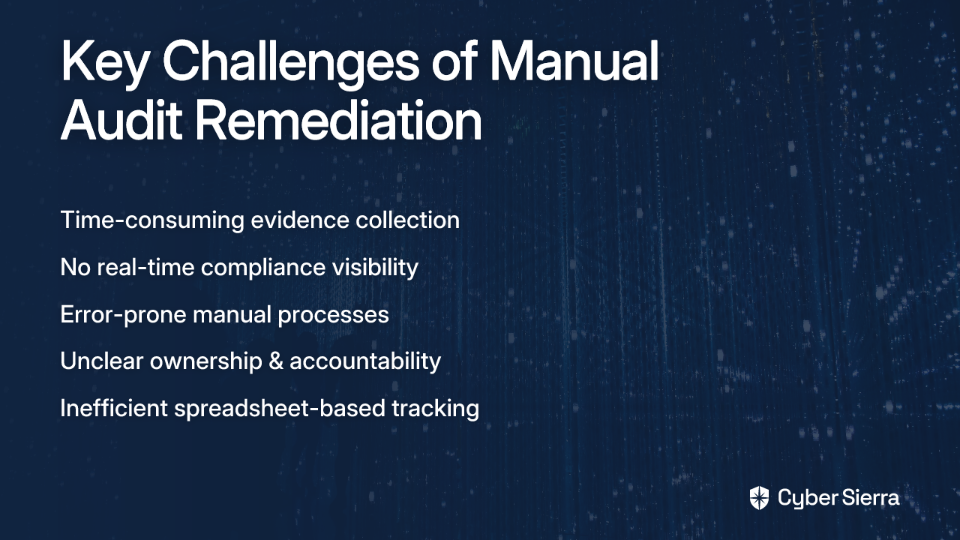
- Evidence collection is time-consuming and resource-intensive, especially for lean teams
- Point-in-time checks fail to provide real-time visibility into compliance status
- Manual processes are prone to human error, leading to ineffective controls
- Lack of clear ownership creates an "accountability issue" that hampers follow-through
Fortunately, modern audit remediation tools can automate these processes, streamlining evidence collection, control testing, and continuous monitoring to make your organization truly audit-ready. This article reviews seven leading tools, evaluating them on automation capabilities, dashboard functionality, and integration options to help you find the right fit for your compliance needs.
1. Cyber Sierra: Comprehensive Compliance Automation
Cyber Sierra offers an AI-enabled, integrated cybersecurity platform designed to automate governance, risk, compliance, and audit remediation from end to end. Unlike point solutions, it unifies multiple functions into a single source of truth, moving organizations away from periodic checks toward proactive, near real-time risk management.
Key Features:
- Continuous Control Monitoring (CCM): Builds a centralized controls repository with near real-time updates, automates control testing and validation for frameworks like NIST, ISO 27001, and PCI DSS, and detects exceptions and anomalies in real-time.
- Governance, Risk & Compliance (GRC): Automates data collection, risk assessments, and reporting for SOC 2, ISO 27001, HIPAA, and other frameworks. Maintains detailed audit trails to keep your organization audit-ready.
- Third-Party Risk Management (TPRM): Automates vendor risk assessments and provides continuous visibility into vendor compliance, streamlining the entire vendor lifecycle.
Cyber Sierra stands out by combining these capabilities in one platform, eliminating the need to juggle multiple tools and providing a holistic, real-time view of your entire compliance and risk posture.
2. AuditBoard: User-Friendly Workflow Management
AuditBoard is a cloud-based platform focused on streamlining operational audit, risk, and compliance management. It's well-regarded for its user-friendly interface that helps manage workflows and assign ownership.
Key Features:
- Unified platform for managing SOX, operational audits, and compliance frameworks
- Creates formal issues where "remediation owners and issue subscribers assigned can view their issues at any time"
- Provides advanced analytics and risk assessment capabilities
- Offers robust workflow automation for audit processes
AuditBoard excels in creating clear accountability through its assignment and tracking features, addressing a key pain point in audit remediation.
3. Vanta: Continuous Compliance Monitoring
Vanta is a compliance automation platform popular with technology companies aiming for certifications like SOC 2 and ISO 27001. It focuses heavily on continuous monitoring and integration with cloud services.
Key Features:
- Continuously tracks compliance status by connecting to cloud platforms, identity providers, and other systems
- Automates evidence collection across dozens of security standards
- Sends automated alerts on compliance gaps for quick remediation
- Provides a current view of your security posture with automated testing
Vanta is particularly strong for organizations with cloud-first infrastructure who want to automate the majority of their evidence collection process.
4. Drata: Evidence Automation at Scale
Drata is a security and compliance automation platform that helps companies achieve and maintain compliance through continuous, real-time monitoring and evidence collection.
Key Features:
- Provides a unified platform for managing multiple compliance frameworks (SOC 2, ISO 27001, HIPAA, etc.)
- Integrates with hundreds of vendors and systems to automate evidence gathering
- Offers a single source of truth for compliance status through a comprehensive dashboard
- Streamlines the audit process with pre-built controls and evidence mappings
Drata's strength lies in its extensive integration ecosystem, allowing organizations to automate evidence collection from virtually any source while maintaining a clear audit trail.
5. ServiceNow GRC: Enterprise-Grade Integration
ServiceNow GRC leverages the powerful ServiceNow platform to automate GRC and audit workflows. It's ideal for organizations already invested in the ServiceNow ecosystem for ITSM and other operational tasks.
Key Features:
- Strong workflow automation for managing audit processes, from planning to remediation
- Powerful integration capabilities with other business applications and IT systems
- Real-time dashboards and reporting for visibility into risk and compliance posture
- Built-in policy management and control testing capabilities
ServiceNow GRC excels in environments where cross-functional collaboration is essential for effective audit remediation, connecting IT, security, and compliance teams on a single platform.
6. Workiva
Workiva provides a cloud platform that excels at connecting data from disparate sources for reporting and compliance. While known for financial reporting, its GRC capabilities are strong for audit management.
Key Features:
- Real-time collaboration features for teams working on audit evidence and reports
- Connects data from ERPs, GRC systems, and spreadsheets into a single environment
- Automated report generation and auditable trails
- Powerful document management for controlling versions of policies and evidence
Workiva is particularly valuable for organizations that need to manage complex reporting requirements alongside their audit remediation processes.
7. RSA Archer
RSA Archer is an enterprise-grade, mature GRC solution for managing risk, compliance, and audit activities. It's a comprehensive suite suitable for large organizations with complex requirements.
Key Features:
- Highly configurable platform for various GRC use cases
- Comprehensive reporting and dashboarding capabilities
- Strong focus on integrated risk management
- Advanced workflow capabilities for complex approval processes
Despite being perceived by some users as "outdated," RSA Archer remains a powerful tool for organizations with sophisticated audit remediation requirements, particularly in highly regulated industries.
How to Choose the Right Audit Remediation Tool
With so many options available, selecting the right tool for your organization requires careful consideration of several key factors:
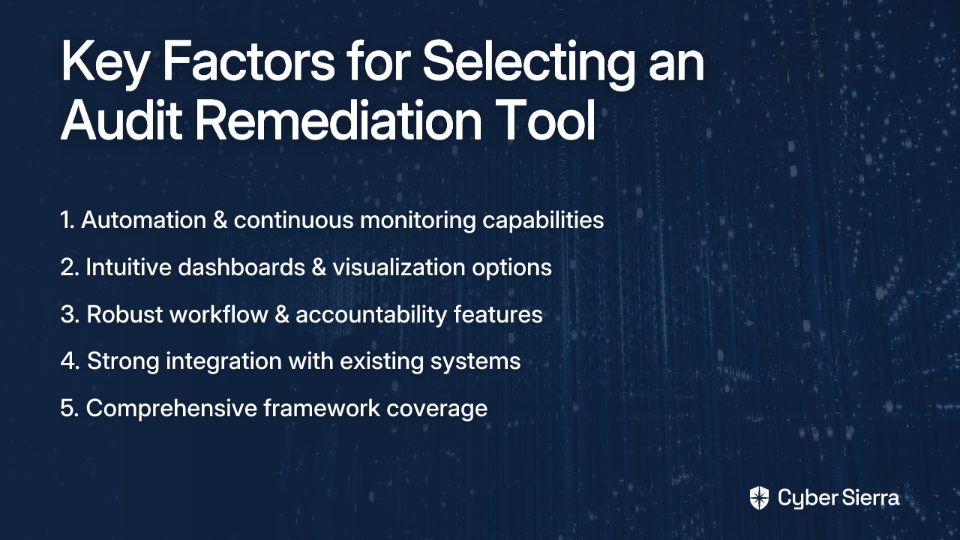
1. Automation & Continuous Monitoring
Look for tools that automate evidence collection directly from your cloud providers, code repositories, and HR systems. This is critical for frameworks like SOC 2 and ISO 27001. Prioritize platforms that offer continuous control monitoring over point-in-time checks to maintain a real-time view of your compliance status.
2. Dashboards & Visualization
The tool should provide a centralized dashboard giving a real-time overview of compliance status, open findings, and remediation progress. The ability to "connect a visualization tool to provide awesome monitoring" is a huge plus. Check for native reporting or integrations with tools like Power BI to enhance visibility.
3. Workflow & Accountability
A key requirement is the ability to "log the finding, assign it, set due dates," and require evidence that it's fixed before closing it." The system must clearly assign responsibility to "remediation owners" to solve the core problem of accountability that plagues many audit processes.
4. Integration Capabilities
Evaluate how well the tool connects with your existing infrastructure and security tools. Strong integrations reduce manual evidence collection and provide more accurate, real-time data. Consider both pre-built connectors and API capabilities.
5. Framework Coverage
Ensure the tool supports all compliance frameworks relevant to your organization, whether that's SOC 2, ISO 27001, HIPAA, PCI DSS, GDPR, or industry-specific requirements. The best solutions offer a library of pre-mapped controls to streamline implementation.
Automate Your Way to Continuous Compliance
The days of managing compliance in spreadsheets are over. As one Reddit user put it, after years in "spreadsheet hell," moving to an automated solution was transformative. To stay secure and audit-ready in today's dynamic threat landscape, organizations need automation, real-time visibility, and clear accountability.
While many tools solve parts of the audit remediation challenge, Cyber Sierra offers a uniquely integrated approach through its unified, AI-enabled platform. By bringing together Governance, Risk, Compliance, and Continuous Control Monitoring, Cyber Sierra transforms security from a reactive, periodic task into a proactive, continuous program.
The result is not just easier audits, but a stronger security posture overall. With automated evidence collection, real-time control monitoring, and clear accountability tracking, your organization can spend less time preparing for audits and more time focusing on strategic initiatives.
Ready to escape spreadsheet hell and build a resilient compliance program that makes you audit-ready 24/7? Explore the Cyber Sierra platform today and discover how our automated solutions can streamline your audit remediation process while strengthening your security posture.
By implementing the right audit remediation tool, you'll not only satisfy auditor requirements more efficiently but also gain valuable insights into your security controls that can drive continuous improvement across your organization.
Frequently Asked Questions
What is an audit remediation tool?
An audit remediation tool is a software solution designed to automate and streamline the process of managing and resolving audit findings. It replaces manual methods like spreadsheets with a centralized platform for tracking issues, assigning ownership, collecting evidence, and monitoring remediation progress in real time.
Why is automating audit remediation important?
Automating audit remediation is important because it saves time, reduces human error, and provides real-time visibility into your compliance posture. Manual processes are often inefficient, prone to mistakes, and lack clear accountability. Automation enforces workflows, ensures timely follow-up, and helps organizations stay continuously audit-ready rather than scrambling before an audit.
How do audit remediation tools help with compliance frameworks like SOC 2 and ISO 27001?
Audit remediation tools help with frameworks like SOC 2 and ISO 27001 by automating the collection of evidence required for specific controls. They integrate with cloud services, HR systems, and security tools to continuously monitor configurations and activities, mapping the collected data directly to framework requirements and alerting teams to any gaps.
What are the most important features to look for in an audit remediation tool?
The most important features to look for are strong automation and continuous monitoring capabilities, intuitive dashboards for real-time visibility, robust workflow management to assign accountability, and seamless integration with your existing systems. The tool should also offer comprehensive coverage for all the compliance frameworks relevant to your business.
How does continuous control monitoring (CCM) improve audit readiness?
Continuous control monitoring (CCM) improves audit readiness by shifting from periodic, point-in-time checks to ongoing, automated validation of security controls. This provides a near real-time view of your compliance status, allowing you to detect and remediate exceptions or anomalies as they occur, rather than discovering them during an audit.
What is the difference between a point solution and an integrated GRC platform?
A point solution typically addresses a single function, such as evidence collection for one specific framework. An integrated Governance, Risk, and Compliance (GRC) platform, like Cyber Sierra, unifies multiple functions—such as continuous monitoring, vendor risk management, and GRC—into a single source of truth. This provides a holistic view of your risk and compliance posture, eliminating data silos and the need to manage multiple tools.
