



10 Best Cyber Scorecard Tools for Enterprise Risk Assessment (2026)

Join thousands of professionals and get the latest insight on Compliance & Cybersecurity.
Summary
- Static, spreadsheet-based risk assessments are inefficient and create security gaps; effective ERM programs can reduce risk-event frequency by 63%.
- Continuous monitoring is the new standard for effective risk management, providing real-time visibility into your security posture and your vendors' risks.
- Enterprises should adopt a unified platform that automates GRC, vendor risk management (TPRM), and continuous control monitoring to eliminate manual work. Cyber Sierra offers an AI-enabled solution to streamline these processes and ensure you are always audit-ready.
Are you drowning in spreadsheets and chasing vendors for questionnaires? If your risk assessments feel like "a mess" with "each assessment different and almost arbitrary," you're not alone. Today's enterprises face an overwhelming challenge: managing cybersecurity risk in an increasingly complex digital ecosystem where point-in-time assessments no longer suffice.
The era of static, manual risk assessments is ending. Organizations need continuous visibility into their security posture across internal systems and third-party vendors. That's where cyber scorecard tools come in—platforms that provide dynamic, data-driven insights into an organization's security posture through continuous monitoring and automated assessments.
In this article, we'll evaluate the 10 best cyber scorecard tools for 2026, focusing on continuous monitoring capabilities, GRC framework integration, automation features, and vendor risk management. Whether you're tired of "editing reports that's a nightmare and error prone" or seeking solutions that go beyond "scan tools that are just not what we're looking for as a 'Risk Assessment'," this guide will help you identify the right platform for your enterprise's needs.
Why Static Risk Assessments No Longer Cut It
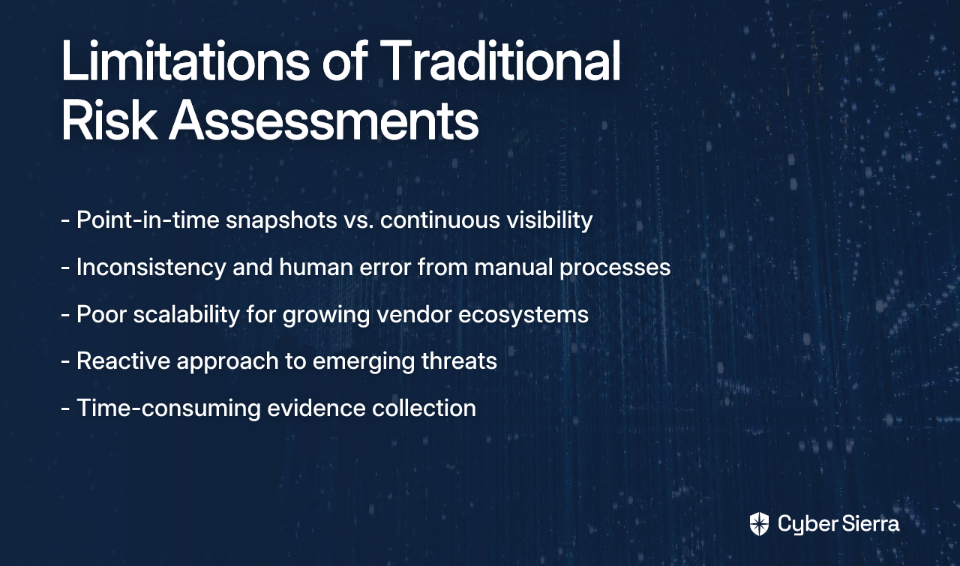
Traditional, spreadsheet-based risk assessments have significant limitations in today's threat landscape.
According to research cited by MetricStream, organizations with effective Enterprise Risk Management (ERM) programs experience a 63% reduction in risk-event frequency and a 35% decrease in operational losses. This highlights why moving to modern, automated solutions is crucial.
Continuous monitoring—defined by Splunk as "the ongoing, real-time process of collecting, analyzing, and acting on data across all IT environments to detect and address threats"—has become the new standard for effective enterprise risk management. Unlike periodic assessments, continuous monitoring provides real-time visibility into your security posture, enabling proactive threat detection and faster response.
Now, let's examine the top cyber scorecard tools that can transform your risk assessment processes.
The Top 10 Cyber Scorecard & Risk Assessment Tools
1. Cyber Sierra
Overview: Cyber Sierra offers a comprehensive, AI-enabled cybersecurity platform that unifies multiple critical functions into one solution. It moves beyond a simple scorecard to provide a full suite of tools for GRC, TPRM, and Continuous Control Monitoring (CCM), addressing the fragmented approach many organizations struggle with.
Key Features:
- Continuous Control Monitoring (CCM): Builds a central controls repository with near real-time updates, automates control testing, and provides clear visibility into security posture across frameworks like NIST, ISO 27001, and PCI DSS.
- Third-Party Risk Management (TPRM): Automates vendor assessments and provides 24/7 visibility into vendor compliance, streamlining due diligence and solving the complexity of managing countless vendor questionnaires.
- Governance, Risk & Compliance (GRC): Automates data collection, risk assessments, and reporting for frameworks like SOC2, ISO 27001, and HIPAA, reducing audit fatigue and making enterprises audit-ready faster.
- Threat Intelligence: Offers a comprehensive security scorecard plus network and cloud vulnerability scanning for a proactive, outside-in view of the attack surface.
Best For: Enterprises in regulated industries (BFSI, HealthTech) and technology companies looking for a unified, AI-driven platform to automate GRC, manage vendor risk, and achieve continuous compliance.
2. SecurityScorecard
Overview: SecurityScorecard is a leading platform specializing in security ratings and comprehensive third-party risk management (TPRM), helping organizations understand the security posture of their vendors.
Key Features:
- Non-intrusive continuous monitoring of your organization and vendors
- Automated security ratings based on observable security factors
- Customizable questionnaires with pre-built templates for common frameworks
- Collaborative remediation workflows with vendors
Best For: Organizations with extensive vendor ecosystems needing to align their TPRM and Security Operations Center (SOC) teams for accelerated threat response and improved vendor security.
3. UpGuard
Overview: UpGuard focuses on managing cyber risk across the entire vendor lifecycle with continuous monitoring and data-driven assessments, helping organizations identify and remediate security gaps.
Key Features:
- Comprehensive security risk ratings based on external signals
- Automated vendor questionnaires and risk assessment workflows
- Security documentation management and vendor communication
- Data leak detection across the web
Best For: Organizations needing to manage and secure extensive and complex vendor ecosystems with limited security resources.
4. BitSight
Overview: BitSight provides objective, data-driven security ratings and analytics to evaluate the cybersecurity performance of an organization and its vendors through continuous monitoring.
Key Features:
- Detailed security ratings with specific risk factors identified
- Continuous monitoring capabilities with alerts on new findings
- Peer comparison benchmarking against industry standards
- Automated vendor risk management workflows
Best For: Enterprises focused on improving their security posture through active, data-backed monitoring of third-party risks. According to BitSight's own data, their automated solutions lead to a 90% vendor acceptance rate and a 75% decrease in time spent on assessments.
5. RiskLens
Overview: RiskLens specializes in cyber risk quantification, using the Factor Analysis of Information Risk (FAIR) model to translate cyber risk into financial terms that executives and boards can understand.
Key Features:
- Financial quantification of cyber risk scenarios
- Risk-based prioritization of security investments
- Integration with existing GRC platforms
- Board-level reporting on cyber risk in financial terms
Best For: Enterprises seeking to prioritize vulnerabilities and justify security investments based on potential financial impact, particularly those in financial services or with regulatory requirements for quantitative risk reporting.
6. Resolver
Overview: Resolver offers an integrated governance, risk, and compliance (GRC) platform that provides data-driven insights for risk management across multiple domains, not just cybersecurity.
Key Features:
- Risk assessment automation with customizable workflows
- Control testing and validation tools
- Compliance management across multiple frameworks
- Incident management and investigation capabilities
Best For: Organizations needing to streamline compliance processes and integrate risk management across various business functions, particularly those seeking an enterprise-wide approach to GRC beyond just cybersecurity.
7. CyberGRX
Overview: CyberGRX is a third-party cyber risk management platform that uses a shared data exchange model to reduce assessment burdens on both enterprises and their vendors, creating efficiency in the ecosystem.
Key Features:
- Centralized vendor risk management dashboard
- Standardized assessments that can be shared across multiple requestors
- Validated assessment data with analyst insights
- Continuous monitoring of vendor security posture changes
Best For: Organizations with complex vendor landscapes looking to streamline the assessment process through a collaborative data model, especially those tired of redundant questionnaires.
8. Prevalent
Overview: Prevalent provides a comprehensive suite of tools for managing vendor assessments and monitoring third-party risks throughout the relationship lifecycle from onboarding to offboarding.
Key Features:
- Unified vendor intake and risk tiering
- Automated assessment questionnaires with evidence collection
- Continuous vendor monitoring with integrated threat intelligence
- Remediation management workflows
Best For: Companies needing a robust solution to manage the entire third-party risk lifecycle, particularly those in regulated industries with mature vendor management programs.
9. OneTrust
Overview: OneTrust is a widely used privacy, security, and governance platform that includes strong vendor risk management capabilities integrated with broader compliance functions.
Key Features:
- Pre-built assessment templates for various frameworks
- Automated workflow for vendor onboarding and assessment
- Integration with other OneTrust modules for privacy and governance
- Regulatory intelligence built into the platform
Best For: Organizations with high regulatory compliance needs, particularly around data privacy frameworks like GDPR and CCPA, seeking an integrated approach to compliance and vendor risk.
10. Censys
Overview: Censys focuses on attack surface management, providing continuous visibility and risk assessment for an organization's external assets and those of its vendors through internet scanning.
Key Features:
- Comprehensive discovery of internet-exposed assets
- Continuous monitoring for new vulnerabilities and misconfigurations
- Third-party security validation
- Integration with security operations workflows
Best For: Enterprises looking to bolster their vulnerability management and gain an "outside-in" perspective of their attack surface, particularly those concerned about shadow IT and unknown assets.
How to Choose the Right Cyber Scorecard Tool for Your Enterprise
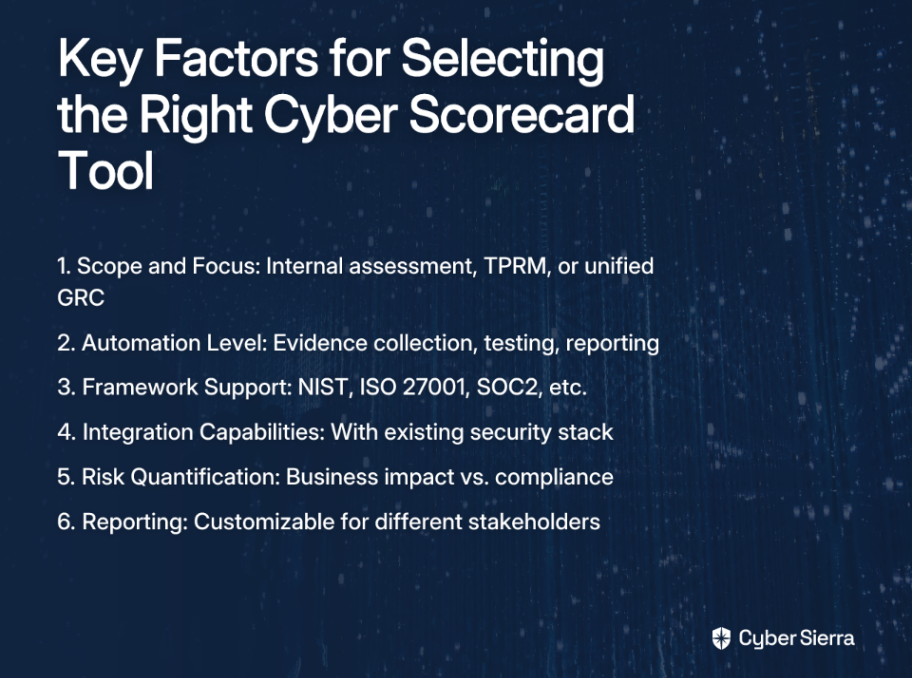
When evaluating cyber scorecard tools, consider these key factors to ensure you select a solution that meets your specific needs:
Automate Your Enterprise Risk Management Today
The era of static, periodic risk assessments is over. Modern enterprises need proactive, continuous, and automated risk management to stay resilient in the face of evolving threats. Relying on separate point solutions for GRC, TPRM, and security monitoring creates data silos and operational inefficiencies that can leave your organization vulnerable.
Cyber scorecard tools have evolved from simple rating systems to comprehensive platforms that provide continuous monitoring, automated assessments, and actionable insights across your entire risk landscape. By choosing the right solution, you can transform your security program from reactive to proactive, from compliance-focused to risk-based, and from manual to automated.
Stop wrestling with spreadsheets and chasing vendors for evidence. See how Cyber Sierra's AI-enabled platform can automate your security compliance and provide a continuous, unified view of your entire risk landscape. Book a demo today to learn how our Continuous Control Monitoring can make you audit-ready, all the time.
Frequently Asked Questions
What is a cyber scorecard tool?
A cyber scorecard tool is a platform that provides a data-driven, dynamic rating of an organization's cybersecurity posture through continuous monitoring and automated assessments. Unlike static, point-in-time assessments, these tools offer real-time visibility into security performance for both internal systems and third-party vendors, helping organizations proactively manage and remediate risks.
Why are traditional risk assessments no longer effective?
Traditional risk assessments, often managed with spreadsheets, are no longer effective because they provide only a static, point-in-time snapshot of an organization's security posture, which is insufficient for today's dynamic threat landscape. These manual processes are prone to human error, are difficult to scale for large vendor ecosystems, and are reactive rather than proactive.
How do cyber scorecard tools improve vendor risk management (TPRM)?
Cyber scorecard tools significantly improve Third-Party Risk Management (TPRM) by automating the vendor assessment process and providing continuous, 24/7 visibility into vendor security postures. Instead of relying on manual questionnaires that quickly become outdated, these platforms monitor vendors' external attack surfaces in real-time, streamline due diligence, and enable a more proactive approach to supply chain security.
What is the difference between a GRC platform and a third-party risk management (TPRM) tool?
A Third-Party Risk Management (TPRM) tool specifically focuses on managing the risks associated with external vendors, while a Governance, Risk, and Compliance (GRC) platform provides a broader framework for managing an organization's internal risk and compliance posture. Leading solutions like Cyber Sierra integrate both GRC and TPRM capabilities into a single, unified platform to provide a holistic view of the entire risk landscape.
Can cyber scorecard tools help with compliance for frameworks like ISO 27001 or SOC2?
Yes, modern cyber scorecard and GRC platforms are designed to help with compliance for frameworks like ISO 27001, SOC2, HIPAA, and NIST. They achieve this through features like Continuous Control Monitoring (CCM), which automates the collection of evidence and continuously tests security controls against framework requirements, ensuring your organization remains audit-ready and significantly reducing manual compliance effort.
