



Session Hijacking via Stolen Cookies: Real-World Attack Scenarios & Detection


Join thousands of professionals and get the latest insight on Compliance & Cybersecurity.
Summary
- Session hijacking via stolen cookies is a growing threat that allows attackers to bypass MFA by stealing the session token after a user has successfully authenticated.
- Attackers use sophisticated methods like Adversary-in-the-Middle (AITM) phishing and malware to steal these tokens, leading to significant business email compromise and data breaches.
- Key defensive actions include implementing phishing-resistant MFA, hardening session management policies, and continuously monitoring for signals like "impossible travel" or unusual account activity.
- Automated platforms like Cyber Sierra's Threat Intelligence provide the continuous monitoring needed to detect anomalies and stop session hijacking attempts before significant damage occurs.
"How did they bypass MFA? Even if the password was leaked, how did they manage to get past MFA?"
This question haunts security professionals when investigating account breaches where multi-factor authentication was supposedly in place. The answer often lies in an increasingly popular attack vector: session hijacking via stolen cookies.
Unlike brute force attacks that attempt to break through authentication, cookie theft elegantly sidesteps it altogether. By stealing session tokens after a legitimate user has already authenticated, attackers can impersonate users without needing their passwords or facing MFA challenges.
As one security professional noted on Reddit, "The token theft [is] becoming really popular, real pain." With the rise of these sophisticated attacks, understanding how they work and how to detect them has become essential for modern cybersecurity teams.
The Anatomy of a Cookie Heist: How Session Hijacking Works
What Are Session Cookies?
When you log into a web application, the server validates your credentials and creates a session. To maintain this session across multiple page requests without requiring you to re-authenticate, the server generates a unique session token (or "cookie") and sends it to your browser. This cookie serves as your digital ID badge, presented with each subsequent request to prove you're already authenticated.
The Core Attack
Session hijacking via stolen cookies involves an attacker capturing this digital ID badge and using it in their own browser. Since the cookie represents a session that has already passed all authentication challenges (including MFA), the attacker inherits the user's authenticated session—effectively walking right past security checkpoints without triggering alarms.
Common Cookie Stealing Techniques

1. Malware and Infostealers
Modern browsers store cookies in databases on the user's device. As one security expert explained, "cookies are stored in a SQL database that can be easily accessed by malware or an untrained user with access to the unlocked PC." Malware specifically designed to target these databases can silently extract session tokens and transmit them to attackers.
Popular infostealers like Raccoon, RedLine, and Vidar specifically target browser data, including cookies for high-value services like corporate email, cloud storage, and financial accounts.
2. Adversary-in-the-Middle (AITM) Phishing
This sophisticated approach is the primary method for bypassing MFA in targeted attacks. Here's how it works:
- The attacker creates a proxy server that sits between the victim and the legitimate login page
- The victim receives a phishing email with a link to this proxy
- When clicked, the victim sees what appears to be the legitimate login page (e.g., Microsoft 365)
- The victim enters their credentials, which the proxy forwards to the real site
- The real site requests MFA, which is relayed through the proxy to the victim
- The victim completes the MFA challenge
- Upon successful authentication, the legitimate site issues a session cookie
- The proxy captures this cookie before redirecting the user elsewhere
Tools like Evilginx2 and Modlishka have simplified this attack, making it accessible even to less technical attackers. The victim often has no idea their session has been compromised, as they experience what appears to be a normal authentication flow.
3. Cross-Site Scripting (XSS)
When websites contain XSS vulnerabilities, attackers can inject malicious scripts that execute within victims' browsers. These scripts can access and exfiltrate session cookies, sending them to attacker-controlled servers. This attack is particularly dangerous because it can affect multiple users of a vulnerable application simultaneously.
4. Packet Sniffing (Session Sidejacking)
While less common due to widespread HTTPS adoption, this technique involves monitoring network traffic on unsecured networks (like public Wi-Fi) to capture session cookies transmitted in plaintext. Though modern websites use encrypted connections, legacy applications or misconfigured servers may still expose session data.
From Theory to Reality: Documented Session Hijacking Attacks
The Firesheep Era (2010)
Incident: The release of Firesheep, a simple Firefox extension that automated session hijacking.
Timeline: Released in October 2010 at the ToorCon security conference.
Method: Firesheep monitored unencrypted network traffic on shared Wi-Fi networks and captured session cookies for popular websites like Facebook, Twitter, and Amazon that weren't fully implementing HTTPS. With a simple double-click interface, non-technical users could instantly hijack sessions of anyone on the same network.
Impact: While no precise numbers exist, countless accounts were compromised through public Wi-Fi networks worldwide. The tool was downloaded over 1 million times in its first month.
Takeaway: This attack raised widespread awareness about the importance of encrypted connections. It accelerated the adoption of HTTPS across the web, with major platforms implementing always-on encryption to protect session data in transit.
Yahoo Mail Forged Cookie Breach (2013-2014)
Incident: One of the largest breaches in history, affecting Yahoo Mail users.
Timeline: The initial breach occurred in 2013, but the full extent wasn't discovered until 2016.
Method: Attackers compromised Yahoo's source code to understand how cookies were generated. They then created forged cookies that allowed access to targeted email accounts without passwords.
Impact: Over 3 billion accounts were potentially affected. The breach led to a $350 million reduction in Yahoo's sale price to Verizon and $117.5 million in settlement costs.
Takeaway: This case highlighted how understanding the mechanics of cookie generation can lead to devastating attacks. It underscored the need for secure session management and rigorous code security practices.
Microsoft 365 AITM Phishing Campaigns (Ongoing)
Incident: Sophisticated phishing campaigns targeting corporate Microsoft 365 accounts.
Timeline: Ongoing, with significant increases noted since 2021.
Method: As described by IT professionals on Reddit, attackers send convincing phishing emails directing victims to AITM proxy sites. After victims authenticate with their username, password, and MFA, the attacker captures the session token.
Impact: Successful attacks lead to business email compromise, data exfiltration, and further internal phishing. According to the FBI, these attacks have resulted in millions of dollars in financial losses.
Takeaway: Even organizations with MFA remain vulnerable to session hijacking. As one security professional noted, "Can't really stop the session token heist as far as I know," highlighting the need for additional security layers beyond traditional MFA.
Building Your Defenses: Detection Signals and Automated Monitoring
Simply advising users to "log out of accounts" or "use 2FA" is insufficient against sophisticated session hijacking. As one security expert lamented, such advice is "overly simplistic and doesn't address real vulnerabilities." A robust defense requires both detection capabilities and preventive measures.
Key Detection Signals
Effective monitoring for session hijacking requires attention to these critical signals:
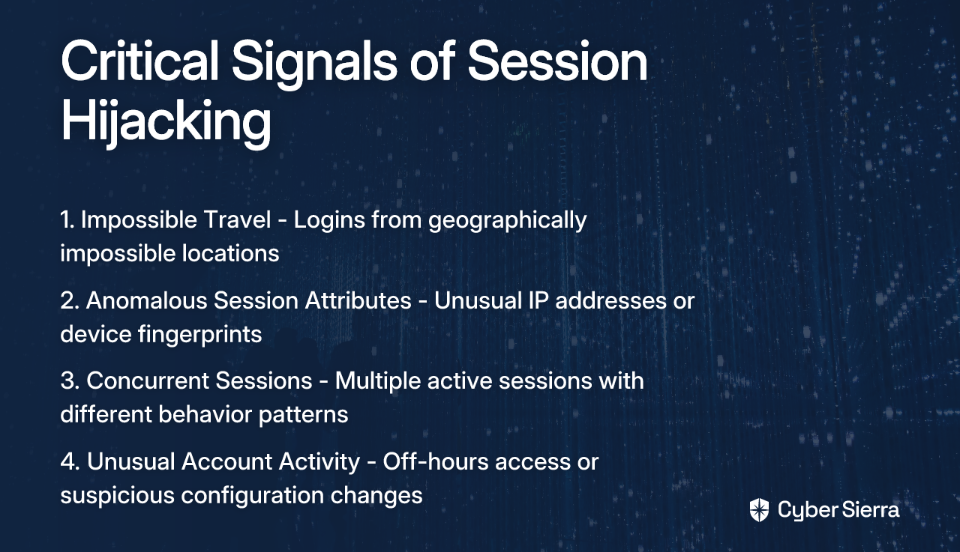
1. Impossible Travel
When a session token is used from two geographically distant locations within an impossibly short timeframe, it strongly indicates session hijacking. For example, if a session authenticated in New York is suddenly used from Singapore minutes later, this physical impossibility warrants immediate investigation.
2. Anomalous Session Attributes
Session tokens typically maintain consistent attributes. Sudden changes in IP address ranges, user-agent strings (browser/device identification), or device fingerprints often indicate a stolen session being used by an attacker.
3. Concurrent Sessions
Multiple active sessions for a single user from different IP addresses or devices, especially when they deviate from established patterns, can signal session hijacking. This is particularly suspicious when the sessions perform different activities simultaneously.
4. Unusual Account Activity
Actions performed outside normal working hours or atypical behavior like changing email forwarding rules, modifying security settings, or downloading unusual amounts of data are strong indicators of compromise.
A Multi-Layered Defense Strategy
1. Implement Continuous, Automated Monitoring
Cyber Sierra's Threat Intelligence platform provides the foundation for detecting session hijacking attempts. By continuously monitoring your environment, it identifies suspicious patterns and anomalies that indicate possible session theft. The platform's vulnerability scanning capabilities detect weaknesses like XSS vulnerabilities that enable cookie theft before they can be exploited.
Manual log review is simply too slow and resource-intensive to catch these attacks in progress. Cyber Sierra's near real-time monitoring enables quick detection and response, often before attackers can cause significant damage.
2. Harden Session Management
For development and security teams:
- Use Secure Cookie Attributes: Implement
HttpOnly(prevents JavaScript access to cookies),Secure(ensures cookies are only sent over HTTPS), andSameSite(restricts cookie sharing across sites) flags. - Regenerate Session IDs After Login: Create new session tokens immediately after authentication to prevent session fixation attacks.
- Enforce Short Session Timeouts: Limit how long session tokens remain valid to reduce the window of opportunity for attackers.
3. Strengthen Access Controls
- Implement Phishing-Resistant MFA: Move beyond SMS and push notifications to FIDO2-based security keys or passkeys that cryptographically bind authentication to specific devices and websites.
- Deploy Conditional Access Policies: These act as a critical defense layer by requiring additional verification when sessions exhibit suspicious characteristics. Even if a token is stolen, conditional access can block its use from unrecognized devices or locations.
4. Educate Your Team
Since phishing remains the primary entry point for session hijacking attacks, employee security awareness is crucial. Cyber Sierra's Employee Security Training platform builds resilience through interactive modules and simulated phishing campaigns that reflect real-world attack techniques.
Moving Forward: Proactive Defense Against Modern Threats
Session hijacking via stolen cookies represents a sophisticated evolution in attack methodology that bypasses traditional security controls. As attackers continue to refine their techniques, organizations must adopt equally sophisticated detection and prevention strategies.
The key to effective defense lies in continuous monitoring and automated detection. By implementing robust session management practices, deploying phishing-resistant authentication methods, and leveraging advanced monitoring solutions like Cyber Sierra's Threat Intelligence platform, organizations can significantly reduce their vulnerability to these attacks.
Frequently Asked Questions
What is session hijacking via stolen cookies?
Session hijacking is an attack where a cybercriminal steals a user's session cookie to gain unauthorized access. By using the stolen cookie, the attacker impersonates the legitimate user, bypassing the need for a password or traditional MFA challenges.
How do attackers bypass MFA with stolen cookies?
Attackers bypass MFA by stealing the session cookie after a user has already completed authentication. Since the cookie represents a fully trusted session, the application sees the attacker as the legitimate user and never prompts for another MFA check.
Why isn't traditional MFA enough to stop these attacks?
Traditional MFA (like SMS or push notifications) protects the login process, not the session itself. Once a session cookie is issued, attackers can steal that cookie through methods like malware or phishing and use it to sidestep MFA entirely.
What are the most common ways session cookies are stolen?
The most common methods include malware that extracts cookies from browser databases, Adversary-in-the-Middle (AITM) phishing that intercepts them during login, and Cross-Site Scripting (XSS) attacks that steal them from vulnerable websites.
How can you detect a session hijacking attack?
Key detection signals include "impossible travel" alerts, anomalous session data like new IP addresses or devices, multiple concurrent user sessions, and unusual account activity like off-hours access or sudden changes to security settings.
What is the best defense against session hijacking?
A multi-layered defense is best. This combines continuous automated monitoring for anomalies, implementing phishing-resistant MFA (like FIDO2 keys), enforcing strong session management policies, and robust employee security training.
Don't wait until after a breach to address these threats. Contact Cyber Sierra today to see how our integrated security platform can help protect your organization from session hijacking and other advanced cyber threats.
