



7 Regulatory Compliance Management Platforms for Financial Institutions

Join thousands of professionals and get the latest insight on Compliance & Cybersecurity.
Summary
- Growing regulatory complexity makes manual compliance management for financial institutions unsustainable, leading to significant risks of penalties and operational inefficiencies.
- To stay ahead, financial firms should adopt automated compliance platforms that offer real-time monitoring, automated evidence collection, and centralized control management across multiple frameworks.
- Shifting to a continuous compliance model can reduce audit preparation time by up to 70%; platforms like Cyber Sierra use Continuous Control Monitoring to help teams move from reactive audit prep to proactive risk management.
You've set up systems, implemented controls, and hired the right personnel. Yet, when audit season arrives, your team is drowning in spreadsheets, scrambling to collect evidence, and taking countless screenshots to satisfy auditors. It feels like you're "just constantly prepping for audits instead of doing the actual work that brings in money."
Sound familiar?
For financial institutions, regulatory compliance isn't just a challenge—it's an ever-expanding reality. With the growing complexity of requirements from consumer protection laws and regulations like Anti-Money Laundering (AML), Fair Lending, and Basel III, compliance teams are stretched thin. Non-compliance can lead to severe consequences, including litigation, financial penalties, and reputational damage, according to PwC.
The solution? Automated regulatory compliance management platforms that move teams away from manual, error-prone tasks toward continuous, efficient, and scalable compliance monitoring.
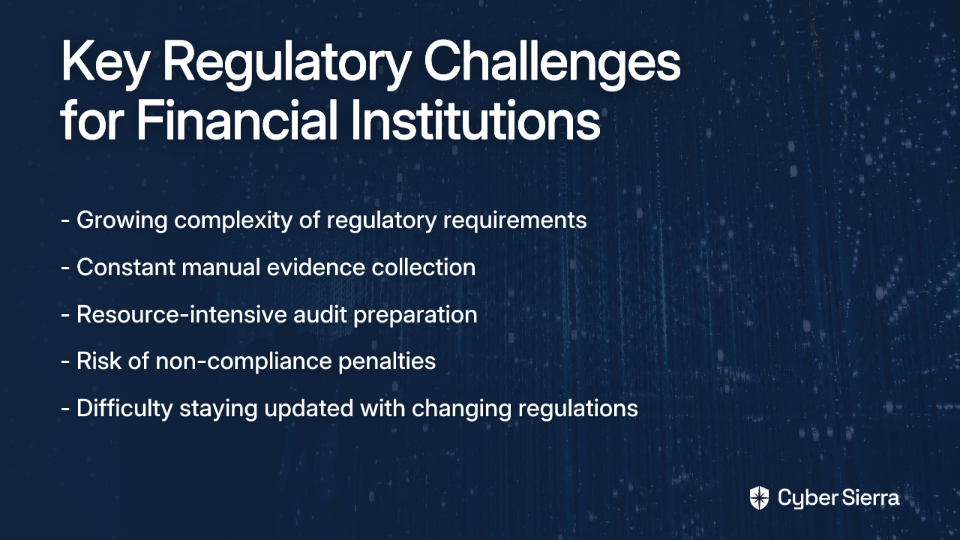
Why Compliance Management Software is Essential in a Complex Regulatory Landscape
In today's financial sector, adopting the right compliance software is no longer a luxury but a core operational necessity:
- Stay Ahead of Regulatory Changes: These platforms automate the tracking of updates to complex regulations like GDPR, SOX, and Basel III, ensuring businesses maintain compliance without constant manual research.
- Improve Operational Efficiency: As one sysadmin put it, manual compliance is "not possible to do manually for everything at the largest scales and can only be done successfully through automation." These tools minimize human error and save significant time in document tracking, audit preparation, and reporting.
- Reduce Legal and Financial Risks: By ensuring ongoing adherence to regulations, these platforms help financial institutions avoid costly fines and legal battles that can impact both bottom line and reputation.
- Enable Scalability: As an organization grows, compliance management software standardizes processes and centrally manages data, supporting expansion without a proportional increase in compliance overhead.
Key Features to Look for in a Financial Compliance Platform
When evaluating regulatory compliance management platforms for your financial institution, consider these essential features:
- Real-Time Regulatory Monitoring: The platform should track updates from thousands of regulatory bodies and alert compliance teams to relevant changes that affect your operations.
- Automated Evidence Collection & Reporting: Look for solutions that automatically gather evidence and generate audit-ready reports, dramatically reducing the manual labor of taking "full screen screenshots of cmdlets and outputs."
- Centralized Control Management: A strong platform consolidates controls, risks, policies, and issues to provide a single source of truth for your GRC posture.
- Support for Multiple Frameworks: The platform must handle key financial regulations like SOX, Basel III, and data privacy laws like GDPR, as well as industry standards like NIST, ISO 27001, and PCI DSS.
- AI-Powered Automation: Features like AI-driven obligation mapping, which links new regulations to existing controls, can dramatically speed up impact assessments and reduce manual review time.
- Comprehensive Audit Trails: The system must record all compliance activities to provide a clear, defensible trail for auditors, especially important for financial institutions facing strict regulatory scrutiny.

The Top 7 Regulatory Compliance Management Platforms for 2024
1. Cyber Sierra
Best for: Financial institutions seeking to embed automation and continuous monitoring deep into their GRC program, transforming compliance from a periodic chore into a real-time, strategic function.
Overview: Cyber Sierra provides an AI-enabled platform designed to simplify and automate security compliance. It moves organizations away from manual checks towards proactive, near real-time risk management, directly addressing the pain of being "stuck in the land of spreadsheets and scripts."
Key Features for Financial Institutions:
- Continuous Control Monitoring (CCM): This is the core strength. It offers ongoing visibility into security controls across frameworks like SOX, GDPR, Basel III, NIST, ISO 27001, and PCI DSS.
- Builds a central controls repository with near real-time updates
- Automates control testing and validation, detecting exceptions and anomalies in real-time
- Delivers actionable risk intelligence for data-driven remediation
- Governance, Risk & Compliance (GRC): Automates data collection, risk assessments, and reporting, streamlining the entire audit lifecycle.
- Third-Party Risk Management (TPRM): Simplifies vendor risk assessment with 24/7 visibility into vendor security compliance, which is critical for the interconnected financial ecosystem.
Unique Selling Point: Cyber Sierra's AI-driven approach has been proven to reduce audit preparation time by up to 70%, freeing compliance teams from tedious evidence collection to focus on strategic risk management initiatives.
2. Fenergo
Best for: Banks and financial institutions focused on client lifecycle management (CLM) and robust KYC/AML processes.
Overview: Fenergo specializes in automating the end-to-end client journey, from initial onboarding to ongoing due diligence and regulatory compliance.
Key Features:
- Deep specialization in Know Your Customer (KYC) and Anti-Money Laundering (AML) processes
- Integrates regulatory reporting to streamline client onboarding and lifecycle management
- Helps financial firms manage complex client data and regulatory obligations efficiently
Learn more at Fenergo
3. ComplyAdvantage
Best for: Organizations needing a data-centric approach to fighting financial crime and managing AML risk.
Overview: ComplyAdvantage is a data-driven platform that leverages AI and machine learning to provide real-time financial crime risk data.
Key Features:
- Focuses heavily on AML compliance, sanctions screening, and transaction monitoring
- Offers real-time monitoring and customizable alerts for risk detection
- Provides a dynamic global database of risk profiles on individuals and companies
Learn more at ComplyAdvantage
4. Actico
Best for: Financial services companies looking for a platform that combines compliance automation with real-time fraud detection.
Overview: Actico provides a suite of tools for credit risk management, compliance, and fraud prevention, powered by decision automation technology.
Key Features:
- Strong capabilities in risk management and compliance automation
- Includes features for real-time fraud detection, AML, and KYC compliance
- Allows institutions to build and deploy automated decision-making workflows
Learn more at Actico
5. AuditBoard
Best for: Enterprises seeking a connected GRC platform to manage SOX, risk, and compliance across the organization.
Overview: AuditBoard offers a comprehensive suite of tools for audit, risk, and compliance management, aiming to elevate teams into strategic business advisors.
Key Features:
- AI-Powered Recommendations: Integrated into workflows for obligation mapping and issue management
- Dynamic Regulatory Library: Sources updates from over 10,000 issuing bodies to provide proactive alerts
- Centralized Management: Consolidates controls, risks, and policies to strengthen the overall risk posture
Learn more at AuditBoard Regulatory Compliance
6. Vanta
Best for: Technology-driven financial companies needing customizable frameworks for standards like SOC 2, ISO 27001, and HIPAA, with growing needs for SOX compliance.
Overview: Vanta automates security and compliance, helping companies get audit-ready in weeks. While known primarily for SOC 2, its capabilities have expanded to other regulatory frameworks.
Key Features:
- Focus on customizable compliance frameworks and automated gap analysis
- Provides real-time monitoring and integrates with a wide range of cloud services and business tools
- Includes features for vendor risk management, critical for financial institutions
Learn more at Vanta
7. MetricStream
Best for: Large financial organizations looking for robust GRC capabilities with a focus on cloud security and continuous auditing.
Overview: MetricStream provides a comprehensive GRC platform that helps organizations manage risk, ensure compliance, and govern their operations effectively.
Key Features:
- Offers continuous auditing and vulnerability management
- Automates evidence collection for compliance, particularly for cloud environments
- Provides a connected GRC framework that links compliance activities to business objectives
Learn more at MetricStream CCM
Conclusion: Automating Compliance to Drive Business Forward
The modern financial landscape is defined by regulatory complexity. Manual compliance is no longer sustainable, efficient, or scalable. The platforms listed above offer a path forward through automation, centralization, and real-time monitoring.
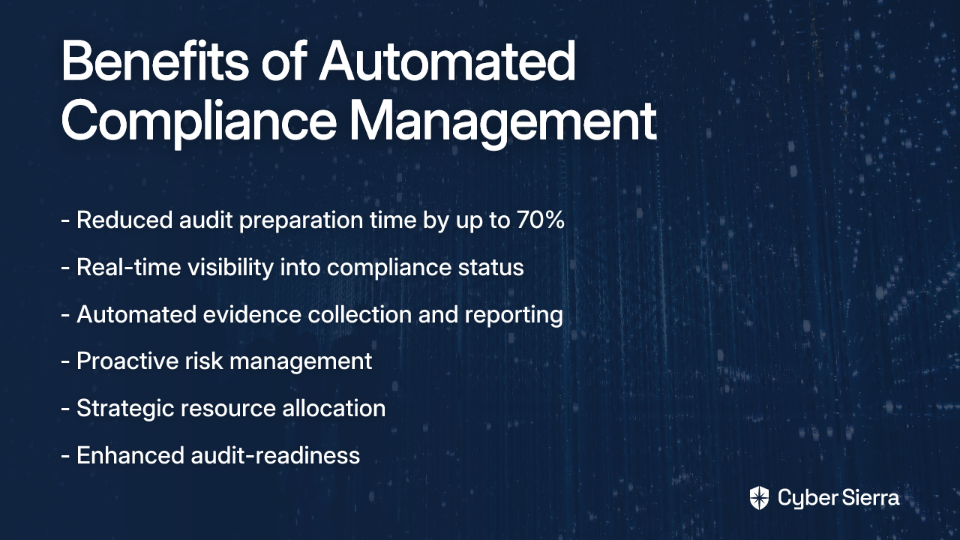
Choosing the right platform depends on your institution's specific needs—be it AML, client lifecycle management, or comprehensive GRC. However, the foundational principle is the same: shifting from a reactive, audit-driven posture to a proactive, continuous compliance model.
For organizations ready to reduce audit preparation time by up to 70% and gain real-time visibility into their security posture, exploring a solution built on Continuous Control Monitoring is the next logical step. Platforms like Cyber Sierra are designed to help financial institutions not just meet compliance obligations, but turn them into a competitive advantage.
As one compliance professional put it: "This is just not possible to do manually for everything at the largest scales and can only be done successfully through automation." In today's complex regulatory environment, that insight has never been more relevant.
Frequently Asked Questions
What is a regulatory compliance management platform?
A regulatory compliance management platform is a software solution that helps organizations automate, monitor, and manage their adherence to laws and regulations. It centralizes compliance activities, reducing manual effort and the risk of non-compliance.
Why is compliance automation crucial for financial institutions?
Compliance automation is crucial for financial institutions to manage complex regulations like AML, SOX, and GDPR efficiently. It reduces manual errors, saves time on audits, lowers the risk of penalties, and allows teams to focus on strategic risk management.
How does compliance software help with audits?
Compliance software helps with audits by automating evidence collection, generating audit-ready reports, and providing a centralized audit trail. This can reduce audit preparation time significantly, ensuring a smoother and more efficient process.
What is Continuous Control Monitoring (CCM)?
Continuous Control Monitoring (CCM) is an automated process that continuously tests and validates security controls against regulatory requirements. It provides real-time visibility into your compliance posture, detecting issues as they happen, not just during audits.
How do I choose the right compliance platform for my financial institution?
To choose the right platform, assess your specific needs (e.g., AML, GRC, TPRM). Look for key features like real-time regulatory monitoring, automated evidence collection, support for relevant frameworks (SOX, GDPR), and scalability to support future growth.
What are the key differences between platforms like Cyber Sierra and Fenergo?
The key difference lies in their focus. Cyber Sierra offers a comprehensive GRC and Continuous Control Monitoring platform for broad security compliance, while Fenergo specializes specifically in client lifecycle management (CLM) and robust KYC/AML processes.
