



10 Tools That Streamline ISO 27001 to SOC 2 Mapping and Compliance

Join thousands of professionals and get the latest insight on Compliance & Cybersecurity.
Summary
- Managing ISO 27001 and SOC 2 separately is highly inefficient, as 60-70% of controls overlap, leading to duplicated documentation and wasted effort.
- The solution is to use a compliance automation tool to create a unified control framework, allowing you to map controls once and reuse evidence across both standards.
- Adopt a platform with continuous control monitoring, like Cyber Sierra's GRC module, to move from periodic audit prep to a state of being always audit-ready.
Are you stuck documenting everything twice in separate sheets for ISO 27001 and SOC 2? You're not alone. Most companies end up re-documenting the same 60-70% of controls twice, creating unnecessary duplication and wasting valuable resources. When you're facing 300 requests for submissions—with a third being exclusive to each framework and another third overlapping—the inefficiency becomes painfully obvious.
The truth is, while ISO 27001 and SOC 2 have significant overlap, treating them as totally separate projects almost always leads to wasted effort. The good news? Modern compliance automation tools can transform this headache into a streamlined, efficient process.
In this article, we'll review 10 of the best tools that help organizations map controls between ISO 27001 and SOC 2, evaluating each based on automation capabilities, mapping accuracy, evidence management, and cost-effectiveness. We'll show you how the right technology can help you build a unified control framework where you "map once" and reuse evidence across both standards.
The High Cost of Manual Compliance: Why You Need a Mapping Tool
Before diving into the tools, it's important to understand the significant overlap between ISO 27001 and SOC 2. Both frameworks share common control areas including:
- Incident Response: Both require formal strategies for handling security incidents
- Access Control: Both mandate policies for authorized access to systems and data
- Vendor Management: Both require processes to assess and monitor third-party risk
- Change Management: Both need systematic approaches to authorize and track changes
Despite these overlaps, 85% of companies report increased compliance complexity, making manual audits prone to errors and costly violations. When compliance teams manage these frameworks separately, they create duplicate work in documentation, evidence collection, and control implementation.
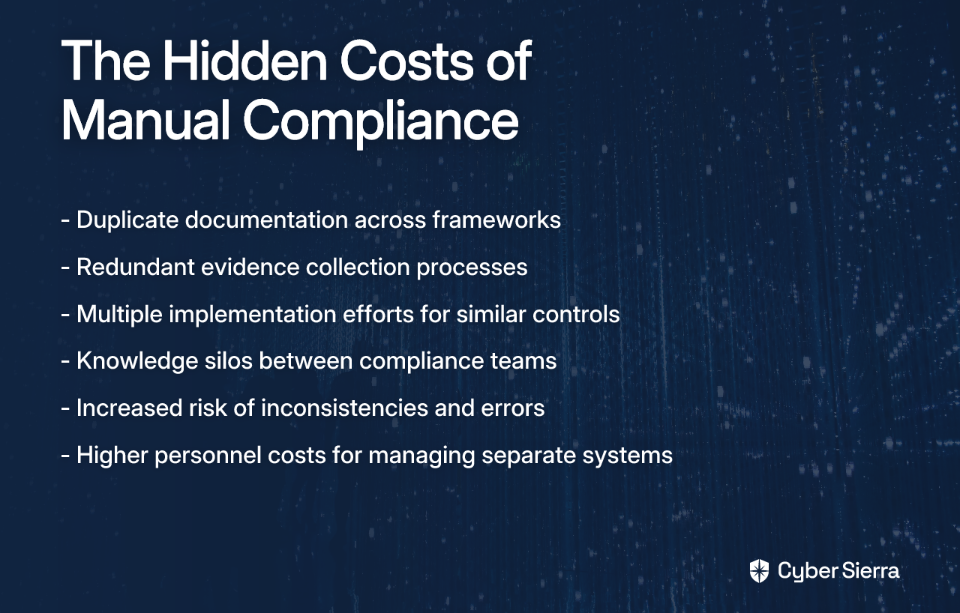
The traditional approach also creates a dangerous "point-in-time blindness." Manual checks only provide a snapshot of compliance, leaving organizations vulnerable between audits. This contrasts sharply with the continuous visibility offered by modern tools.
Compliance automation tools can reduce compliance costs by up to 50% by eliminating manual tasks. They create a central repository where evidence can be collected once, tagged, and reused across multiple frameworks. The right platform can also reduce audit prep time by up to 70% by shifting from frantic, periodic audit prep to a state of being always audit-ready with continuous control monitoring.
Top 10 Tools to Streamline ISO 27001 & SOC 2 Compliance
1. Cyber Sierra
Overview: Cyber Sierra provides an AI-enabled cybersecurity platform that transforms security compliance from periodic, manual checks to proactive, near real-time risk management.
Key Features for ISO 27001 vs SOC 2 Mapping:
- Governance, Risk & Compliance (GRC) Module manages multiple frameworks from a single dashboard, creating a unified control library that eliminates redundant documentation
- Continuous Control Monitoring (CCM) provides ongoing, near real-time visibility into security controls, automatically collecting evidence and detecting anomalies—a stark contrast to tools that only support point-in-time assessments
- Third-Party Risk Management (TPRM) automates vendor security assessments, a key control area for both frameworks
Best For: CISOs and Compliance Managers in regulated industries who need a holistic platform that goes beyond simple audit prep to provide continuous, proactive risk management.
Unique Selling Point: Cyber Sierra's emphasis on continuous monitoring transforms compliance from a reactive, periodic task into a proactive, ongoing business function, ensuring a consistently strong security posture rather than just passing point-in-time audits.
2. Drata
Overview: An AI-native GRC platform focused on automating compliance and risk management, particularly for cloud-native companies.
Key Features for Mapping:
- Automated evidence collection and continuous control monitoring across your tech stack
- Pre-mapped controls for various frameworks, including SOC 2 and ISO 27001, to accelerate readiness
- Centralizes governance, risk, and compliance activities into a single platform
Best For: Startups and mid-market tech companies seeking to accelerate security reviews and achieve compliance quickly.
3. Sprinto
Overview: A compliance automation platform designed to make enterprises audit-ready and maintain continuous compliance.
Key Features for Mapping:
- Features a dedicated control-mapping engine to align controls between frameworks like SOC 2 and ISO 27001
- Automates evidence collection and provides guided implementation from compliance experts
- Focuses on creating a unified security program that satisfies multiple standards
Best For: Tech-driven companies looking for a guided approach to implementing and mapping controls for multiple compliance frameworks.
4. Secureframe
Overview: A compliance automation platform that helps organizations streamline audit processes and achieve certifications faster.
Key Features for Mapping:
- Automates evidence collection from over 100 cloud services
- Provides continuous monitoring and a library of pre-built security policies
- Supports over 40 frameworks, simplifying multi-framework compliance
Best For: Startups and tech companies needing to achieve compliance certifications like SOC 2 and ISO 27001 on an accelerated timeline.
5. Vanta
Overview: A popular security and compliance automation platform that helps businesses centralize their security workflows and prepare for audits.
Key Features for Mapping:
- Extensive integrations (over 375 services) for automated evidence collection
- Continuous control testing to ensure ongoing compliance
- Provides a Trust Center to communicate security posture to customers
Best For: Startups and growth-stage companies that prioritize user-friendliness and broad integration capabilities.
6. AuditBoard
Overview: A cloud-based platform designed for audit, risk, and compliance management, helping teams move away from manual spreadsheets.
Key Features for Mapping:
- Centralizes GRC activities with pre-built templates for frameworks like SOC 2 and ISO 27001
- Offers AI-powered gap assessments to identify missing controls
- Strong workflow automation for collaboration between audit and compliance teams
Best For: Enterprise teams transitioning from manual GRC processes to a more collaborative and automated platform.
7. Hyperproof
Overview: A compliance operations platform that helps centralize control data and automate workflows across multiple frameworks.
Key Features for Mapping:
- Automated evidence gathering and testing capabilities
- Cross-framework mapping to reduce redundant work
- Integrated risk management tools to connect risks to controls
Best For: Organizations that need extensive integration capabilities and a user-friendly interface for managing compliance operations.
8. CyberStrong
Overview: A platform that automates risk and compliance management, with a unique focus on quantifying cyber risk in financial terms.
Key Features for Mapping:
- AI-powered compliance mapping across various standards
- Real-time compliance monitoring and patented control scoring
- Helps communicate risk posture to executive leadership using financial metrics
Best For: Organizations that need to align their compliance efforts with business-level risk management and financial reporting.
9. LogicGate (Risk Cloud)
Overview: A highly configurable, no-code GRC platform that enables organizations to build custom workflows for their specific risk and compliance needs.
Key Features for Mapping:
- Modular design allows for tailored solutions for controls management, policy management, and third-party risk
- No-code workflow builder is ideal for complex, enterprise-level processes
- Enables mapping of a single control to multiple frameworks
Best For: Large enterprises with complex and unique GRC processes that require a highly customizable platform.
10. Scrut Automation
Overview: An integrated GRC platform that helps cloud-native companies manage multiple infosec frameworks through a single interface.
Key Features for Mapping:
- Single-window management for tasks related to SOC 2, ISO 27001, and other frameworks
- Real-time control monitoring and automated evidence collection
- Extensive library of integrations with cloud services and developer tools
Best For: Mid-market SaaS companies looking for a comprehensive platform with strong automation and personalized support.
How to Choose the Right Tool for Your Organization
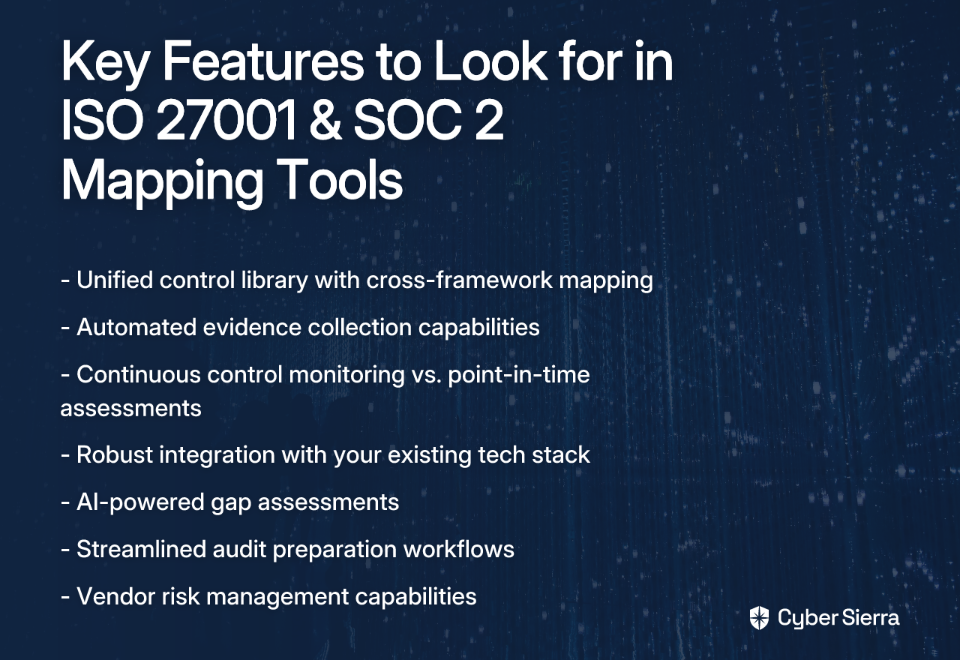
When evaluating tools for ISO 27001 vs SOC 2 mapping and compliance, consider these key criteria:
Integration with Your Tech Stack: Ensure the tool connects seamlessly with your cloud providers (AWS, Azure, GCP), ticketing systems (Jira), and identity providers (Okta). The more native integrations a platform offers, the less manual work your team will need to perform.
Framework Coverage: Does the tool support all the frameworks you need now and in the future (e.g., PCI DSS, HIPAA, GDPR)? A platform that can grow with your compliance needs will provide better long-term value.
Depth of Automation: Look beyond basic checklists. Does the platform offer true Continuous Control Monitoring (CCM) for real-time visibility? The difference between point-in-time assessments and continuous monitoring can dramatically impact your security posture.
Scalability & Usability: Is the tool intuitive for your team? Can it scale as your company and compliance needs grow? The best platform is one that your team will actually use consistently.
Conclusion
Manually juggling ISO 27001 and SOC 2 compliance is a recipe for duplicated effort and increased risk. As we've seen from compliance professionals on platforms like Reddit, treating these frameworks as separate projects creates unnecessary work when 60-70% of controls overlap.
The right automation tool is no longer a luxury but a necessity for modern, security-conscious organizations. These tools transform compliance by creating a unified control environment, automating evidence collection, and enabling a proactive, continuous approach to security.
For organizations ready to move beyond periodic audits to a state of continuous compliance and proactive risk management, exploring a unified platform is the next logical step. Cyber Sierra's AI-enabled GRC platform provides a comprehensive solution for streamlining multi-framework compliance, offering the continuous monitoring capabilities essential for maintaining a strong security posture in today's dynamic threat landscape.
Frequently Asked Questions
What is the main difference between ISO 27001 and SOC 2?
ISO 27001 is a broad standard for an Information Security Management System (ISMS), while SOC 2 is a report on specific controls related to security, availability, confidentiality, processing integrity, and privacy. ISO 27001 certifies your program.
Why is it inefficient to manage ISO 27001 and SOC 2 separately?
Managing them separately is inefficient because of the 60-70% control overlap. This leads to duplicating documentation, evidence collection, and implementation efforts, wasting valuable time and increasing the risk of inconsistencies between audits.
How do compliance tools map controls between ISO 27001 and SOC 2?
Compliance tools map controls by creating a unified library where a single control, like access management, is linked to requirements in both ISO 27001 and SOC 2. This allows you to test evidence once and apply it across multiple frameworks.
What is Continuous Control Monitoring (CCM)?
Continuous Control Monitoring (CCM) is an automated process that constantly checks if your security controls are working as intended. Unlike manual point-in-time checks, CCM provides real-time visibility, ensuring you stay compliant and secure at all times.
How much overlap is there between ISO 27001 and SOC 2 controls?
There is approximately 60-70% overlap between ISO 27001 and SOC 2 controls. Common areas include incident response, access control, vendor management, and change management, which makes a unified compliance approach highly effective and efficient.
Can I use one GRC tool for both ISO 27001 and SOC 2?
Yes, you can absolutely achieve both with a single GRC tool. Modern platforms are designed to manage multiple frameworks from one dashboard, using cross-framework mapping and a unified evidence repository to streamline audits for both standards simultaneously.
By investing in the right compliance automation tool, you can eliminate redundant work, reduce costs, and shift your focus from documentation to actually improving your security posture—a win for your team, your auditors, and your business.
Remember that when it comes to ISO 27001 vs SOC 2 mapping, the goal isn't just to pass audits, but to build a genuinely secure organization. The best compliance tools help you achieve both objectives simultaneously, turning compliance from a burden into a business advantage.
