



Best SOC 2 Automation Tools for SaaS Startups (Drata vs Vanta vs Cyber Sierra)

Join thousands of professionals and get the latest insight on Compliance & Cybersecurity.
Summary
- The real decision isn't just Vanta vs. Drata, but whether you need a tool for a single audit or a platform for a long-term compliance program.
- Vanta and Drata are ideal for startups needing a fast, first-time SOC 2 certification, but can be limiting as compliance needs grow.
- Scaling companies face challenges managing multiple frameworks (ISO 27001, HIPAA) and complex vendor risks, which requires more than single-audit tools.
- Cyber Sierra offers an integrated platform for GRC, Continuous Control Monitoring (CCM), and Third-Party Risk Management (TPRM) designed for enterprises building a continuous, multi-framework compliance program.
You've shortlisted Vanta and Drata. You've read six comparison articles that all say the same thing. And you're still not sure which one to pick — or whether either of them will actually serve you two years from now when your enterprise prospect asks for ISO 27001, or your healthcare customer needs HIPAA attestation.
Here's what most of those comparisons miss: the real decision isn't Vanta vs. Drata. It's whether you're buying a tool to pass your first SOC 2 audit, or building infrastructure for a long-term compliance program.
This article compares three platforms — Vanta, Drata, and Cyber Sierra — across the dimensions that matter most to scaling companies: automated evidence collection, integration breadth, Continuous Control Monitoring (CCM), Third-Party Risk Management (TPRM), multi-framework support, and pricing transparency. Then we'll help you figure out which one actually fits your stage.
Why Manual SOC 2 Compliance Is a Trap
Before comparing tools, it's worth understanding why automation matters in the first place. SOC 2 is a Trust Services Criteria-based framework requiring organizations to demonstrate that security controls around availability, confidentiality, processing integrity, privacy, and security are operating effectively — not just documented, but proven through evidence.
Manual compliance means someone owns a spreadsheet. That spreadsheet tracks which controls need evidence, who's responsible, and when the last check was run. It breaks constantly — through staff turnover, system changes, and the sheer volume of controls in a typical SOC 2 Type II audit.
The downstream effects hit teams hard:
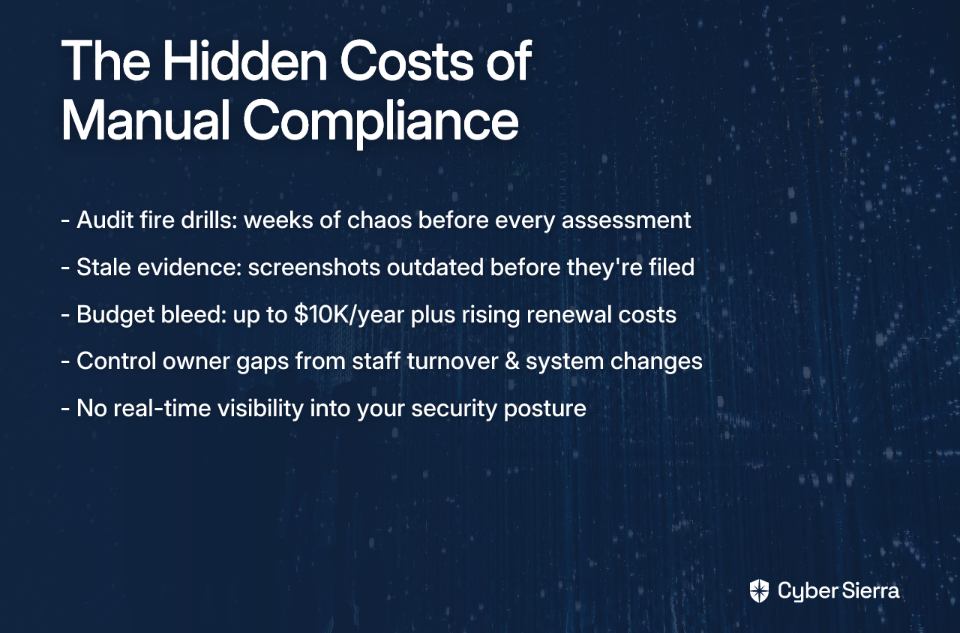
- Audit readiness anxiety. Audits become periodic fire drills. The weeks before an assessment are chaos — scrambling to collect evidence, chasing control owners, remediating gaps discovered at the last minute.
- Stale evidence. By the time a screenshot is captured manually, the state it documents may have already changed.
- Cost bleed. According to practitioners discussing compliance costs, compliance platforms can cost up to $10,000 annually — not including the audit itself, with price increases common after year one. But the same community notes that having a compliance automation platform in place typically produces around a 30% reduction in total audit cost, making the investment net positive when scoped correctly.
Automation solves the spreadsheet trap. It continuously collects evidence, flags control failures in near real-time, and keeps the audit trail current — so auditors find a clean record, not a scramble.
The Three Contenders
Here's how each platform positions itself before we get into the detailed scoring:
- Vanta. The market leader in SOC 2 compliance software for SaaS startups, known for fast time-to-audit and an extensive integration library covering 300+ tools. Strong choice for companies that need a certified report quickly.
- Drata. A deep automation-focused platform with a polished Governance, Risk, and Compliance (GRC) interface. Competitive with Vanta on most dimensions; users often describe the choice as "Hilton vs. Marriott" — similar enough that cost becomes the deciding factor.
- Cyber Sierra. An AI-enabled cybersecurity platform built around integrated GRC, CCM, and TPRM. Designed less as a sprint-to-audit tool and more as a continuous compliance operating system for enterprises managing multiple frameworks and vendor ecosystems.
Feature Matrix: Vanta vs. Drata vs. Cyber Sierra
The table below summarizes how each platform performs across six dimensions relevant to SOC 2 compliance software buyers:
| Feature | Vanta | Drata | Cyber Sierra |
|---|---|---|---|
| Automated Evidence Collection | Strong, continuous | Strong, continuous | Yes, embedded in CCM and GRC modules |
| Integration Breadth | Very extensive (300+) | Extensive | Focused on deep GRC and risk integration |
| Continuous Control Monitoring | Yes, core feature | Yes, core feature | Yes, central platform pillar with real-time alerting |
| Third-Party Risk Management | Limited | Basic module | Comprehensive, dedicated TPRM suite |
| Multi-Framework Support | Yes (SOC 2, ISO 27001, HIPAA, etc.) | Yes (SOC 2, ISO 27001, HIPAA, etc.) | Yes, designed to map overlapping controls across frameworks |
| Pricing Transparency | Custom quote required | Custom quote required | Flexible plans — see pricing details |
Scoring Each Platform: Honest Commentary
The matrix tells the structural story. Here's the reasoning behind each score.
Automated Evidence Collection and Integrations
Both Vanta and Drata excel here — and this is where most comparison articles spend 80% of their word count. Vanta's 300+ integrations make it particularly well-suited for startups running cloud-native stacks with common SaaS tools. Drata matches that depth on most enterprise integrations and has been praised for its accuracy compared to alternatives.
Cyber Sierra's integration layer is intentionally different. Rather than maximizing connector count, evidence collection is embedded directly into its continuous monitoring platform, feeding into a central controls repository that updates in near real-time. The result is evidence that's current by design, not by calendar.
Continuous Control Monitoring
Continuous Control Monitoring is the practice of automated, ongoing testing to verify that security controls are functioning as intended — not just at audit time, but every day. It eliminates manual work and enables faster detection of control failures before they become audit findings.
Vanta and Drata both deliver solid CCM capabilities, particularly for SOC 2 Trust Service Criteria. This is their primary value proposition, and they do it well.
Cyber Sierra's CCM module is positioned as the spine of the entire platform — not a feature bolt-on. It builds a centralized controls repository with near real-time updates, delivers actionable risk intelligence for remediation prioritization, and manages controls across multiple frameworks simultaneously. For a Chief Information Security Officer (CISO) who needs a single pane of glass across SOC 2, ISO 27001, and PCI DSS concurrently, this architecture matters.
Third-Party Risk Management
TPRM is where the gap between platforms becomes most visible — and most consequential at scale.
Vanta and Drata include TPRM features, but they are generally scoped to sending questionnaires and tracking vendor responses. That's useful for early-stage compliance. It's insufficient for a Series B company with 150 active vendors, where a breach through a third-party integration carries the same reputational weight as an internal incident.
As user research confirms, the desire to "standardise and automate the ability to assess, review and organise supply chain relationships" is a real and underserved pain in this category.
Cyber Sierra's TPRM module addresses this directly. It prioritizes vendor inventory by risk level, automates assessments, and provides near real-time, continuous visibility into vendor security posture — moving beyond point-in-time questionnaires to genuine ongoing monitoring.
Multi-Framework Support and Scalability
Here's where the strategic difference sharpens. Managing SOC 2 on its own is a project. Managing SOC 2 alongside ISO/IEC 27001:2022, HIPAA, and GDPR simultaneously is a program — and those two require entirely different tool architectures.
Vanta and Drata support multiple frameworks, but users have noted friction when scoping tests across environments with different control requirements: "it's pretty clunky trying to handle that." When controls from three frameworks need to be mapped, deduplicated, and evidenced without doubling work, the seams show.
Cyber Sierra's GRC module is built specifically to manage and map overlapping controls across SOC 2, ISO 27001, HIPAA, GDPR, PCI DSS, and NIST frameworks from a unified dashboard — reducing the compliance fatigue that comes from treating each framework as an independent workstream.
From First Audit to Ongoing Program: The Real Differentiator
Most SOC 2 comparison articles treat this as a race to the lowest price or the longest integration list. That framing serves startups getting their first certification. It doesn't serve companies building a security program.
Vanta and Drata are excellent first-certification platforms. They're designed to help SaaS companies achieve their first SOC 2 Type I or Type II report efficiently, unblock deals, and demonstrate baseline trustworthiness to customers. If that's your goal in the next six months, either platform will serve you well — and the "Hilton vs. Marriott" framing is honestly accurate. Evaluate on price, your existing tech stack, and which integrations matter most to you.
Cyber Sierra is built for enterprises treating compliance as an ongoing program. Once you're managing two or three frameworks, running 50+ vendors, and fielding board-level questions about security posture in business terms, the architecture of the platform you chose for your first audit starts to limit you.
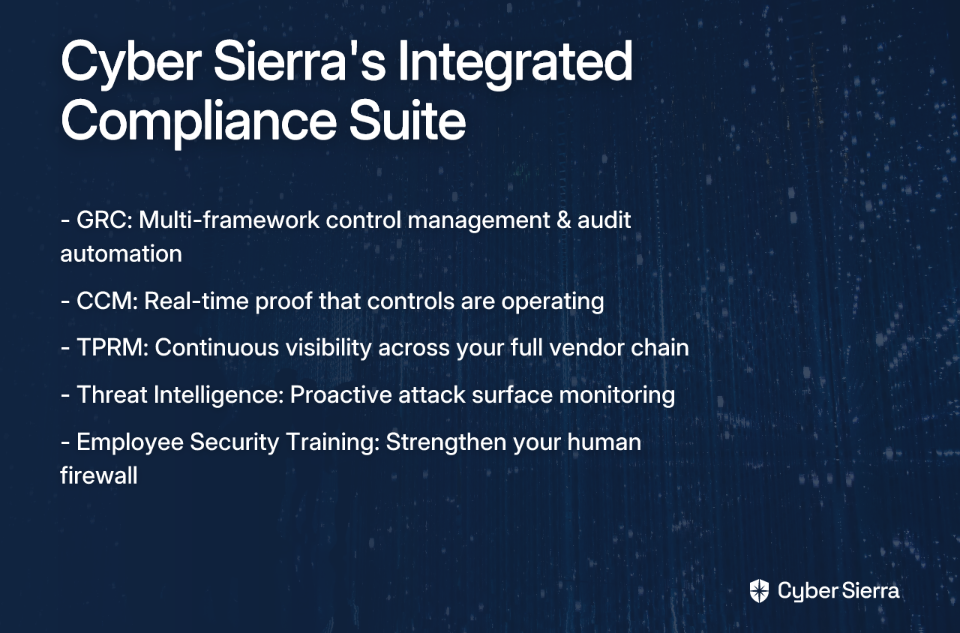
Cyber Sierra's value comes from its integrated suite working in concert:
- GRC. Manages the strategic picture across multiple frameworks, automates evidence collection, and reduces audit prep from a quarterly scramble to a continuous state.
- CCM. Provides the real-time data layer that proves controls are operating — not just documented.
- TPRM. Extends that visibility to the entire supply chain, not just internal systems.
- Threat Intelligence and Employee Security Training round out a platform that addresses both technical controls and human-layer risks — something neither Vanta nor Drata covers with comparable depth.
Cyber Sierra was recognized as a Sample Vendor in the Gartner® Hype Cycle™ for Cyber-Risk Management, 2024, and received the AI Innovation Awards 2024 from Singapore's Ministry of Communications and Information — recognitions anchored to the platform's broader risk management architecture, not just its compliance checklist features.
Which Tool Fits Your Stage?
Use this guide to match your current situation to the right platform.
Are you a seed-stage or Series A startup whose primary goal is getting your first SOC 2 report to close enterprise deals?
Your priorities are speed, broad integrations for your existing cloud stack, and a guided, project-based workflow that gets you audit-ready without a dedicated compliance team.
→ Consider Vanta or Drata. Both platforms are purpose-built for this scenario.
Are you a growth-stage company (Series B+) that already has SOC 2 and is now facing ISO 27001, GDPR, or HIPAA requirements from new markets or customers?
Your pain points are framework overlap, managing overlapping controls without duplicating effort, and a growing vendor list that's becoming a supply chain risk blind spot.
→ Consider Cyber Sierra. The multi-framework GRC architecture and dedicated TPRM module are designed specifically for this transition.
Are you a CISO or Compliance Lead at an enterprise where security is a board-level conversation, and you need to move from periodic audits to a continuous compliance posture?
You need a unified view of control effectiveness across all frameworks, continuous vendor monitoring, and the ability to report on risk in business terms — not just audit status.
→ Consider Cyber Sierra. The integrated GRC, CCM, and TPRM modules provide the single source of truth needed for that level of program maturity.
Are you primarily constrained by budget and need to maximize cost efficiency at an early stage?
Compliance automation platforms consistently deliver ROI through reduced audit costs and eliminated manual hours. For budget-first decisions, negotiate hard on annual pricing with both Vanta and Drata — both are known to be flexible on initial contracts. Keep in mind that first-year pricing often differs significantly from renewal pricing, so model the three-year cost, not just year one.
From Audit Project to Compliance Program
Choosing a compliance platform isn't just about features; it's about matching the tool's architecture to your company's growth trajectory. The wrong choice today can lead to a costly migration tomorrow.
Here are the key takeaways:
- For a fast, first-time audit, Vanta and Drata are excellent project-based tools designed to get you SOC 2 certified quickly.
- For a long-term security program, you need an integrated platform that can manage multiple frameworks (like ISO 27001 and HIPAA) and provide continuous visibility into vendor risk without multiplying your workload.
Before you decide, take 15 minutes to map your compliance needs for the next 18 months. If your future includes new frameworks and a growing vendor ecosystem, you’re building a program, not just passing an audit.
When you're ready to see how an integrated GRC, CCM, and TPRM platform scales with you, see Cyber Sierra's platform.
Frequently Asked Questions
What is the main difference between Vanta, Drata, and Cyber Sierra?
Vanta and Drata are best for startups needing their first SOC 2 audit quickly. Cyber Sierra is an integrated platform for scaling companies that are managing multiple compliance frameworks (like ISO 27001 and HIPAA) and complex vendor risks as a long-term, continuous program.
Why should a company automate SOC 2 compliance?
Automating SOC 2 compliance saves significant time, reduces total audit costs by around 30%, and provides real-time visibility into your security posture. It replaces error-prone manual spreadsheets, prevents last-minute audit fire drills, and ensures your evidence is always accurate.
When should a company choose Cyber Sierra over Vanta or Drata?
Choose Cyber Sierra when compliance becomes an ongoing program. This is typically when you need to manage multiple frameworks (e.g., SOC 2 + ISO 27001), have a growing list of third-party vendors, and require a unified, board-level view of your security and risk posture.
What is Continuous Control Monitoring (CCM) and why is it important?
Continuous Control Monitoring (CCM) is the automated, ongoing testing of your security controls. It is important because it proves your security measures are functioning correctly every day, not just at audit time, allowing you to find and fix gaps before they become critical findings.
How do these platforms handle third-party risk?
Vanta and Drata offer basic vendor questionnaire features. Cyber Sierra provides a comprehensive Third-Party Risk Management (TPRM) suite that includes continuous monitoring of vendor security posture, moving beyond point-in-time assessments to provide real-time visibility into supply chain risk.
Can I use Vanta or Drata for multiple compliance frameworks?
Yes, both Vanta and Drata support multiple frameworks. However, they are best suited for single-framework projects. A platform like Cyber Sierra is purpose-built with a unified GRC architecture to manage overlapping controls across multiple frameworks without duplicating work.
