



9 Best SOC 2 Compliance Software That Gets You Audit-Ready in 8 Weeks

Join thousands of professionals and get the latest insight on Compliance & Cybersecurity.
Summary
- Many companies pass their first SOC 2 audit only to face a frantic scramble every year due to "compliance drift" where security controls degrade over time.
- To achieve continuous compliance, evaluate platforms on their ability to prevent this drift through deep Continuous Control Monitoring (CCM) and year-round evidence collection.
- The best tools also support multiple frameworks like ISO 27001 and PCI DSS, eliminating redundant work by mapping overlapping controls.
- Cyber Sierra's GRC platform combines with a dedicated CCM module to solve this, helping enterprises stay audit-ready 365 days a year.
Passing your first SOC 2 audit feels like a win. Then 12 months later, your team is back in the same frantic sprint — hunting for evidence, chasing control owners, and discovering gaps you thought were closed. The certificate on the wall didn't prevent the drift.
This is the reality most SOC 2 compliance software doesn't address. While marketing promises rapid certification — with some platforms making bold claims about achieving SOC 2 compliance in days — the harder problem is staying compliant without rebuilding your program from scratch every year.
Making it worse, true continuous compliance is rarely achieved — especially at smaller organizations. Many teams end up breaking yearly audit work into smaller routines like quarterly access reviews or policy check-ins. While this is more organized, it's still a version of the same annual fire drill, not a true continuous compliance program.
There's also the cost reality. Platforms can run up to $10,000 annually before the audit fee, and many providers pump up prices after the first year. Without a clear way to differentiate tools beyond surface-level feature lists, it's easy to buy the wrong thing.
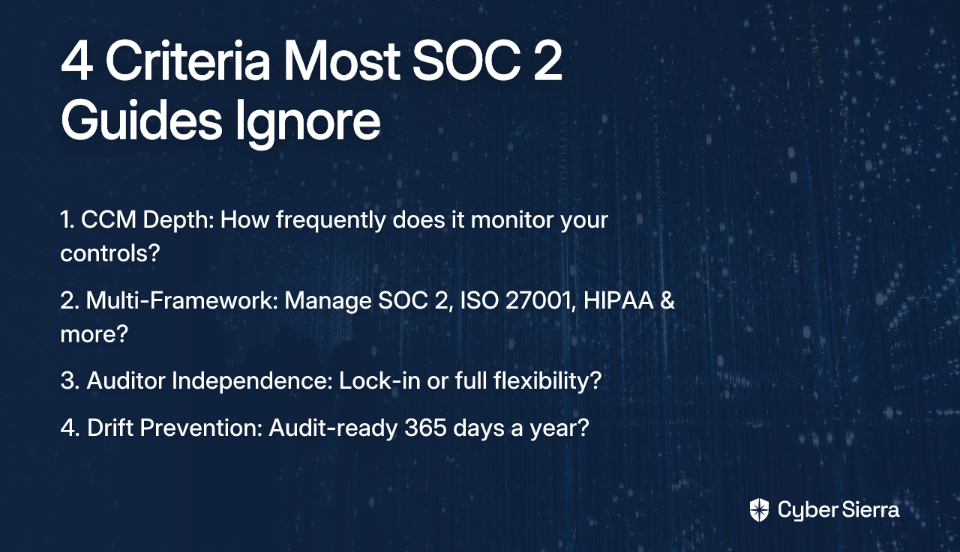
This article evaluates 9 SOC 2 compliance platforms on four criteria most comparison guides ignore:
- Continuous Control Monitoring (CCM) depth. How frequently and deeply does the platform monitor your controls — and does it catch failures before they become audit findings?
- Multi-framework coverage. Can it manage SOC 2 alongside ISO 27001, HIPAA, PCI DSS, and GDPR without making you duplicate work?
- Auditor relationships. Does it lock you in, or give you the independence to work with the firm that's right for you?
- Post-certification drift prevention. Does the platform keep you audit-ready 365 days a year, or does it go quiet until your next audit window?
What to Look for in SOC 2 Compliance Software (Beyond the Checklist)
Before diving into the tools, it's worth understanding why these four criteria matter more than feature count or integration library size.
Continuous Control Monitoring (CCM) Depth
Continuous Controls Monitoring (CCM) is the use of technology to automate and continuously track compliance, risk management, and security controls. The key word is continuously — not quarterly, not pre-audit, but always.
Traditional point-in-time checks are like annual fire inspections: useful, but you won't know your sprinklers are broken until the inspector shows up. CCM is the smoke detector. Shallow implementations check once a day or only during defined audit windows. Deeper implementations monitor in near real-time, automatically flag exceptions, and feed findings directly into your evidence repository.
When evaluating platforms, look for: automated control testing, high-frequency checks, real-time anomaly detection, and integration with a GRC solution so everything feeds into a unified view.
Multi-Framework Coverage
To be precise, the most important thing you should think about — as practitioners on compliance forums often say — is how much the platform can automate for you. That matters even more when you're managing multiple frameworks simultaneously.
SOC 2 controls overlap significantly with ISO/IEC 27001:2022, HIPAA, and PCI DSS v4.0. A platform without robust multi-framework support forces your team to document the same control twice, maintain separate evidence repositories, and run parallel audit tracks. According to Secureframe's compliance research, automated control mapping allows organizations to centralize documentation and eliminate this redundancy entirely.
Auditor Relationships and Independence
A common question in compliance communities: "I was considering getting an auditor through the platform. Is that a bad idea?" The honest answer is: it depends on what you value.
Platforms with embedded auditor networks offer convenience and bundled pricing, which can reduce initial costs. One practitioner noted platforms with compliance automation in place can produce 30% lower audit costs due to reduced auditor time needed. The trade-off is potential loss of negotiating power and limited choice. Auditor-agnostic platforms give you full flexibility — useful if you already have an audit firm relationship or need a specialist for your industry.
Post-Certification Drift Prevention
Compliance drift is the gradual degradation of security controls after an audit window closes. Configurations change, access permissions expand, policies go stale. A platform that only activates during audit prep isn't solving the problem — it's rescheduling it.
Genuine drift prevention requires automated evidence collection running year-round, not just when you flip a switch 90 days before the audit. The platforms that do this well make your next audit a routine check-in rather than a crisis.
The Top 9 SOC 2 Compliance Platforms for Continuous Readiness
Each platform below is evaluated against the four criteria above. No tool is perfect for every buyer — the decision matrix at the end of this article will help you self-qualify.
1. Cyber Sierra
Cyber Sierra is an AI-enabled cybersecurity platform built for enterprises that need compliance to be a continuous state, not a periodic project. It uniquely combines a GRC module with a dedicated CCM module — a pairing that addresses both framework management and real-time control visibility within a single platform.
Ideal for: Compliance-heavy enterprises, scale-ups managing multiple frameworks simultaneously, and security teams looking to eliminate the annual audit scramble permanently.
- CCM depth. Cyber Sierra's CCM module builds a central controls repository with near real-time updates, automates control testing, and detects exceptions and anomalies as they occur — not during the pre-audit sprint. This means your evidence is being collected and validated continuously, not assembled manually when the audit window opens.
- Multi-framework coverage. The GRC module natively manages controls across SOC 2, ISO 27001, HIPAA, PCI DSS, GDPR, and NIST frameworks. Automated control mapping reduces redundant documentation, letting teams manage overlapping requirements from a single source of truth.
- Auditor relationships. Auditor-agnostic. Cyber Sierra provides clean, organized evidence exports so you can work with any audit firm — no lock-in, no bundled pricing constraints.
- Post-certification drift prevention. This is where the GRC and CCM combination earns its keep. Automated data collection runs year-round. Continuous monitoring flags gaps before they become audit findings. The result is a compliance posture that's maintained on day 366, not just day 90.
Cyber Sierra is recognized as a Sample Vendor in the Gartner® Hype Cycle™ and is a winner of the AI Innovation Awards 2024, presented by Singapore's Ministry of Communications and Information. The platform is also ISO 27001 certified and accredited by the Cyber Security Agency of Singapore.
2. Drata
Drata is a widely adopted compliance automation platform known for its extensive integration library and developer-friendly design. It earned a strong reputation for accuracy — practitioners have specifically cited "more accurate data" compared to alternatives, attributed to the depth of its integrations.
Ideal for: Organizations of all sizes embedded in the SaaS ecosystem, particularly those relying heavily on cloud tooling for evidence collection.
- CCM depth. Strong, with 24/7 security control monitoring and automated evidence collection across a wide integration library.
- Multi-framework coverage. Supports multiple frameworks with a scalable architecture built for growing compliance programs.
- Auditor relationships. Features an auditor hub that connects users with partner audit firms, which can simplify coordination but narrows firm selection.
- Post-certification drift prevention. Continuous monitoring helps catch control failures outside of audit windows, though the breadth of coverage depends on integration configuration.
3. Vanta
Vanta is one of the most recognized names in compliance automation and is particularly well-suited for companies pursuing their first certification. Its guided onboarding and automated monitoring make the initial SOC 2 journey accessible.
Ideal for: Startups and small-to-mid-sized businesses prioritizing speed to their first SOC 2 Type I or Type II attestation.
- CCM depth. Provides automated security monitoring across an organization's tech stack, with integrations covering common SaaS and cloud environments.
- Multi-framework coverage. Strong and growing, with support for SOC 2, ISO 27001, HIPAA, and privacy frameworks including GDPR and CCPA.
- Auditor relationships. Partners with a vetted network of auditors, streamlining the audit experience — particularly useful for first-time buyers navigating the auditor selection process.
- Post-certification drift prevention. Continuous monitoring is in place, though enterprises with complex multi-framework environments may find it less configurable than purpose-built GRC platforms.
4. Secureframe
Secureframe positions itself on speed, usability, and guided compliance. It combines automated monitoring with expert support and proactive reminders to keep teams on track between audits.
Ideal for: Organizations that benefit from structured workflows and proactive task management to sustain compliance efforts year-round.
- CCM depth. Enables continuous compliance monitoring with integrations across major cloud environments. Real-time visibility is available, though monitoring depth depends on the integration stack in use.
- Multi-framework coverage. Strong support for SOC 2, ISO 27001, PCI DSS v4.0, and HIPAA, with control mapping tools to reduce duplication across frameworks.
- Post-certification drift prevention. Proactive reminders and workflow tracking help teams close gaps and maintain audit logs — particularly useful for compliance managers who need to coordinate across departments.
5. Thoropass
Thoropass takes a distinctive approach: it combines compliance software with in-house audit capability, positioning itself as a one-stop solution for organizations seeking both the platform and the attestation under one roof.
Ideal for: Organizations that prefer a bundled approach and want to reduce friction between the compliance workflow and the audit itself.
- Auditor relationships. Its core differentiator. Thoropass can act as both the platform and the audit firm, which simplifies logistics and can reduce audit coordination overhead — but removes auditor independence from the equation.
- Multi-framework coverage. Extends beyond SOC 2 into GDPR, HIPAA, and ISO 27001.
- Post-certification drift prevention. Continuous monitoring is available, though the bundled model is most compelling during the initial audit cycle rather than as a long-term drift prevention engine.
6. OneTrust
OneTrust is a broad trust intelligence platform that extends well beyond security compliance into privacy, ethics, ESG, and third-party risk. Its depth in privacy regulation makes it a natural fit for enterprises managing both security and data protection requirements.
Ideal for: Large enterprises that need a unified platform spanning security, privacy (GDPR, CCPA/CPRA), and GRC — particularly those in regulated industries with complex data handling obligations.
- Multi-framework coverage. One of its strongest capabilities. Deep coverage across security and privacy frameworks makes it well-suited to multi-regulation environments.
- CCM depth. Advanced risk assessment tools and control monitoring are available, with significant configurability suited to mature GRC programs.
- Post-certification drift prevention. Comprehensive, though the platform's breadth means there is a steeper implementation curve before drift prevention is fully operational.
7. LogicGate
LogicGate is a flexible, no-code GRC platform that allows organizations to build custom risk and compliance workflows. It's designed for teams with complex or unique process requirements that off-the-shelf compliance tools can't accommodate.
Ideal for: Mature enterprises with sophisticated GRC processes that require deep customization across risk management, audit, and compliance workflows.
- CCM depth. Focused on workflow automation and integrations that pull control evidence into custom-built compliance processes. Monitoring depth is largely a function of the workflows you configure.
- Multi-framework coverage. Broad, supported through its highly flexible architecture — covering security, privacy, and operational risk frameworks at scale.
8. ZenGRC
ZenGRC, now part of the LogicGate family, provides an intuitive interface for compliance, risk, and audit management. It's positioned as an accessible entry point into structured GRC practices for mid-market organizations.
Ideal for: Mid-market companies seeking an approachable GRC platform without the complexity overhead of enterprise-grade systems.
- CCM depth. Provides compliance insights through reporting dashboards, with real-time status tracking across control categories.
- Post-certification drift prevention. Customizable workflows and tracking capabilities help teams manage ongoing compliance posture between audits.
9. DuploCloud
DuploCloud takes a fundamentally different approach: it's a DevSecOps platform that embeds compliance guardrails directly into cloud infrastructure provisioning. Compliance becomes a byproduct of how you build, rather than a layer applied afterward.
Ideal for: Startups and engineering-led teams wanting to bake SOC 2, HIPAA, and PCI DSS controls into their cloud environment from day one on AWS, Azure, or GCP.
- CCM depth. Infrastructure-level control monitoring within cloud environments, focused on misconfigurations and deviation from compliance baselines.
- Multi-framework coverage. Covers SOC 2, HIPAA, PCI DSS v4.0, and GDPR within cloud-native contexts — but less suited to broader GRC program management outside the infrastructure layer.
Decision Matrix: Which SOC 2 Software Is Right for You?
Use this table to match your organization's profile to the platform best suited to your needs.
| Software | Best for Startups | Best for Scale-Ups | Best for Enterprises | Best for Multi-Framework |
|---|---|---|---|---|
| Cyber Sierra | ✓ | ✓ | ✓ | |
| Drata | ✓ | ✓ | ✓ | |
| Vanta | ✓ | ✓ | ||
| Secureframe | ✓ | ✓ | ✓ | |
| Thoropass | ✓ | ✓ | ||
| OneTrust | ✓ | ✓ | ||
| LogicGate | ✓ | ✓ | ||
| ZenGRC | ✓ | |||
| DuploCloud | ✓ |
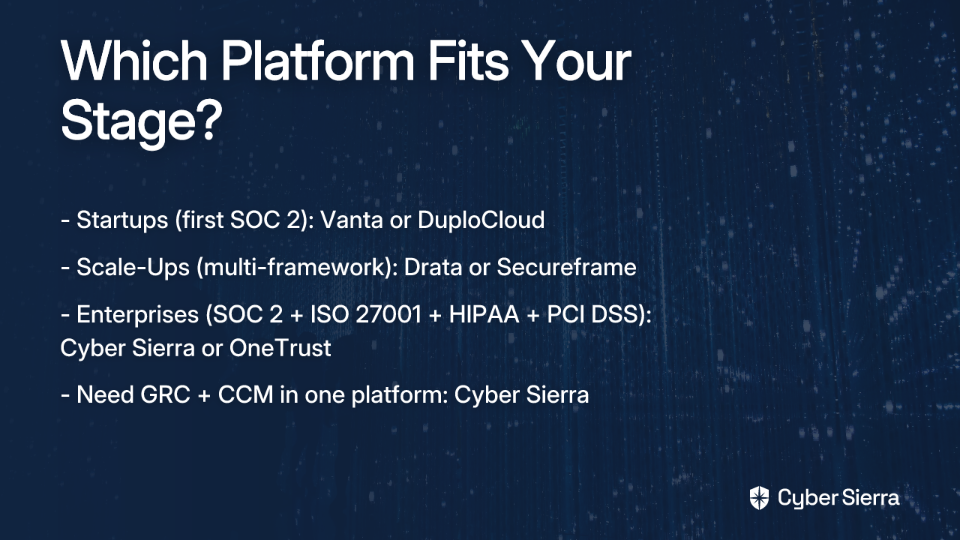
If you're a startup pursuing your first SOC 2 Type I, Vanta or DuploCloud offer straightforward paths to certification. If you're scaling and managing multiple frameworks, Drata and Secureframe provide strong automation depth. For enterprises managing SOC 2 alongside ISO 27001, HIPAA, PCI DSS, and beyond — and needing compliance to be a continuous operational state, not a recurring project — Cyber Sierra and OneTrust are the stronger fits, with Cyber Sierra specifically designed around the GRC-plus-CCM architecture that drives ongoing audit readiness.
From Audit-Ready to Always-Ready
Getting your SOC 2 certificate is a milestone, not the finish line. The real work is preventing the "compliance drift" that turns every subsequent audit into a frantic, last-minute sprint.
To break that cycle, focus on two core capabilities:
- Continuous Control Monitoring (CCM): A platform that automatically tests controls and collects evidence year-round—not just during the audit window—is non-negotiable.
- Multi-Framework Support: As you grow, managing SOC 2 alongside ISO 27001 or PCI DSS without a unified system means doing the work twice.
Your next step? Evaluate whether your current process is proactive or reactive. If you’re only checking controls when an audit is on the horizon, you’re rescheduling the fire drill, not preventing it.
When you’re ready to make compliance a continuous, background process instead of a recurring crisis, see our platform in action.
Frequently Asked Questions
What is SOC 2 compliance software?
SOC 2 compliance software is a tool that automates the process of preparing for and maintaining SOC 2 attestation. It helps by continuously collecting evidence, monitoring security controls, managing policies, and streamlining audit workflows, reducing the manual effort required from your team.
Why is continuous compliance more important than just getting certified?
Continuous compliance ensures your security controls remain effective year-round, not just during an audit. This prevents "compliance drift" where gaps re-emerge post-certification, maintaining customer trust and a strong security posture without the annual scramble to find and fix issues.
How does Continuous Control Monitoring (CCM) work?
Continuous Control Monitoring (CCM) automatically and perpetually tests your security controls. It integrates with your tech stack (e.g., cloud providers, developer tools) to verify configurations and collect evidence in near real-time, alerting you to failures before they become audit findings.
Can SOC 2 software help with other frameworks like ISO 27001 or HIPAA?
Yes, many advanced platforms provide multi-framework support. They map overlapping controls between frameworks like SOC 2, ISO 27001, HIPAA, and PCI DSS. This allows you to manage compliance from a single source of truth, eliminating redundant work and evidence collection for different audits.
What should I look for when choosing a SOC 2 platform?
Look beyond basic checklists. Prioritize platforms with deep Continuous Control Monitoring (CCM) for real-time visibility, strong multi-framework support to avoid duplicate work, auditor independence for flexibility, and features designed to prevent post-certification drift, keeping you always audit-ready.
How much does SOC 2 compliance software cost?
Costs vary based on company size and features, typically ranging from a few thousand to over $10,000 annually. This price does not include the separate audit fee paid to a CPA firm. Be aware that some providers may increase prices significantly after the initial contract year.
