



5 Best Healthcare Compliance Software for HIPAA, HITRUST, and State Regulations

Join thousands of professionals and get the latest insight on Compliance & Cybersecurity.
Summary
- Managing healthcare compliance with disconnected spreadsheets and tools creates significant liabilities and audit risks, especially when tracking Business Associate Agreements (BAAs).
- Effective compliance software centralizes key functions like policy management, risk assessments, and employee training into one platform, enabling continuous compliance.
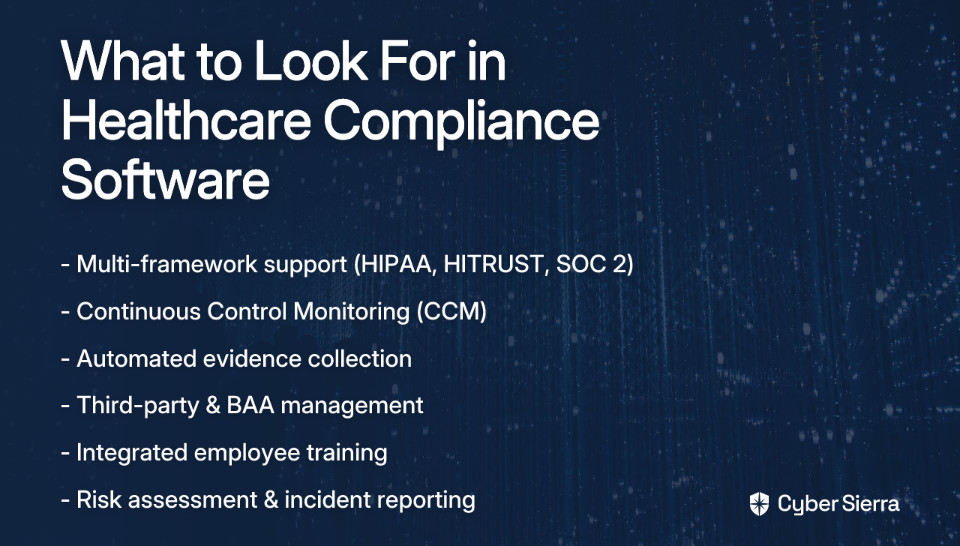
- When evaluating tools, prioritize features like multi-framework support (HIPAA, HITRUST), continuous control monitoring, and automated evidence collection.
- Platforms like Cyber Sierra unify GRC, vendor risk management, and continuous monitoring to simplify the complexity of managing HIPAA alongside other regulations.
If you've ever tried to balance Health Insurance Portability and Accountability Act (HIPAA) training, Business Associate Agreement (BAA) tracking, and risk assessments across a tangle of spreadsheets and disconnected tools, you already know the problem.
That fragmentation isn't just frustrating — it's a liability. A significant number of breaches originate from business associates, and the consequences of a failed BAA or a missed risk assessment can be severe. For smaller practices without dedicated compliance teams, the pressure is even heavier, with HIPAA training, incident tracking, and policy management often falling on whoever has bandwidth that week.
Modern healthcare compliance software aims to solve exactly this. Instead of stitching together a training platform, a spreadsheet for BAAs, and a separate tool for risk assessments, a centralized Governance, Risk, and Compliance (GRC) platform brings everything into one place — enabling continuous compliance rather than last-minute audit scrambles. This article reviews five of the best options available today, covering their strengths, key features, and who they're best suited for.
What to Look For in Healthcare Compliance Software
Before diving into specific platforms, it helps to know which capabilities actually matter for the complex, layered regulatory environment healthcare organizations operate in.
The right tool should do more than check a box. Here's what separates genuinely useful platforms from ones that add another login to your day:
The 5 Best Healthcare Compliance Software in 2025
The platforms below were selected based on their ability to address the challenges above — fragmentation, manual effort, multi-framework complexity, and the specific demands of HIPAA and HITRUST compliance.
1. MedTrainer
MedTrainer is a purpose-built compliance platform for healthcare organizations, designed to unify compliance management, credentialing, and learning into a single system. It holds the top healthcare compliance software ranking on G2 and is widely used across hospitals, clinics, and multi-site practices.
Key features:
- Centralized compliance management. Integrates document and policy management, incident reporting, safety plans, and new hire onboarding into one hub — directly addressing the pain of managing these functions across separate tools.
- AI-powered policy tools. The AI policy tools help keep policies up to date as regulations change, reducing the manual effort of tracking federal and state regulatory updates.
- Automated onboarding and training. Onboarding Paths standardize new hire training and ensure ongoing education requirements are tracked and completed on schedule.
- Audit-ready efficiency. Users report saving 40 hours weekly on compliance-related tasks, and 99.8% of MedTrainer customers passed their most recent audits.
Best for: Healthcare organizations looking for a deeply integrated compliance and learning solution — particularly those managing credentialing alongside HIPAA and policy requirements.
2. Cyber Sierra
Cyber Sierra is an AI-enabled cybersecurity platform that automates compliance management across multiple frameworks, including HIPAA, HITRUST, SOC 2, and ISO 27001. Its core strength is unification — where most organizations are juggling separate tools for GRC, vendor risk, and employee training, Cyber Sierra consolidates all of these into a single platform. It has been recognized as a Sample Vendor in the Gartner® Hype Cycle™ 2024, and is accredited by the Cyber Security Agency of Singapore.
Key features:
- Continuous Control Monitoring. The CCM module automates control testing and evidence collection, providing near real-time visibility into your security posture. Instead of reactive firefighting before audits, teams get a live view of what's working and what needs attention.
- Unified GRC automation. The GRC platform manages multiple compliance frameworks from a single dashboard, automating data collection, risk assessments, and audit reporting. This directly reduces the compliance fatigue that comes from managing HIPAA alongside other overlapping frameworks.
- Third-Party Risk Management. The TPRM module streamlines vendor risk assessments and BAA tracking with continuous monitoring — moving beyond the point-in-time questionnaire that's often outdated the moment it's submitted.
- Integrated security suite. Also includes Employee Security Training with simulated phishing campaigns, threat intelligence, and cyber insurance readiness — consolidating what would otherwise be four or five separate vendor relationships.
Best for: Technology-forward healthcare organizations and HealthTech companies that need a unified, automated platform covering GRC, vendor risk, and continuous compliance monitoring across HIPAA and beyond.
3. Drata
Drata is a security and compliance automation platform known for its breadth of integrations and its ability to keep companies continuously audit-ready. It supports a wide range of frameworks and is particularly strong for cloud-native environments.
Key features:
- Automated evidence collection. Drata connects to hundreds of SaaS, cloud infrastructure, and business applications to pull compliance evidence automatically — keeping your audit trail current without manual intervention.
- HIPAA-specific controls. The platform offers pre-mapped HIPAA controls and customizable policy templates designed to help organizations protect Protected Health Information (PHI) and demonstrate compliance.
- Continuous monitoring. Real-time dashboards show compliance status across all connected systems, with automated alerts when a control drifts out of compliance.
- Built-in training management. HIPAA training assignments and completion tracking can be managed directly within the platform, keeping workforce compliance requirements in one place.
Best for: Cloud-native companies and startups seeking deep, automated evidence collection across frameworks like SOC 2 and HIPAA, with minimal manual configuration.
4. Thoropass
Thoropass (formerly Laika) takes a hybrid approach to compliance automation — combining software with in-house audit and compliance expertise. This makes it especially well-suited for organizations navigating the complexity of HITRUST certification.
Key features:
- End-to-end HITRUST automation. Thoropass offers a comprehensive path to HITRUST certification, covering readiness assessment, documentation, and the final audit process — all within a single platform.
- Expert guidance included. Access to HITRUST-accredited assessors and compliance professionals helps organizations scope their programs correctly and avoid common pitfalls during the certification journey.
- Continuous post-certification monitoring. Automated checks and alerts help organizations maintain HITRUST compliance after certification, rather than treating it as a one-time achievement.
- Single-vendor simplicity. For certain frameworks, Thoropass acts as both the compliance software and the auditing partner, reducing the back-and-forth that typically comes with managing a platform vendor and an auditor separately.
Best for: Organizations specifically pursuing HITRUST certification who want a solution that combines powerful automation with hands-on expert support throughout the assessment process.
5. YouCompli
YouCompli takes a different angle than most compliance platforms — instead of focusing primarily on controls and audit readiness, it focuses on helping healthcare organizations keep up with the constant stream of new and changing regulations. For compliance officers at hospitals and health systems, this is often the most time-consuming and overlooked challenge.
Key features:
- Regulatory change analysis. YouCompli monitors healthcare regulations and translates them into plain-language summaries of what your organization is actually required to do — removing the burden of interpreting dense regulatory text.
- Actionable compliance workflows. Requirements are turned into assignable tasks with deadlines, ensuring that regulatory changes result in documented action rather than getting lost in an inbox.
- Centralized document management. All compliance documentation and attestations are stored in a single repository, creating a verifiable audit trail that demonstrates your organization stayed current with regulatory obligations.
- Healthcare-first design. The entire platform and service methodology are built around the operational realities of hospital and health system compliance officers, not adapted from a generic GRC tool.
Best for: Hospitals and health systems whose primary pain point is tracking and acting on the constant flow of new state and federal healthcare regulations — particularly those managing compliance across multiple facilities or jurisdictions.
Your Path to Continuous Healthcare Compliance
Managing healthcare compliance with disconnected tools isn't just inefficient—it's a critical liability. The path forward isn't about working harder; it's about consolidating your tools into a smarter, unified system. Here are the key takeaways:
- Centralize to stay compliant. The biggest audit risk comes from siloed data. A single platform for BAA tracking, risk assessments, and employee training provides one source of truth.
- Automate for continuous visibility. Replace last-minute audit scrambles with continuous control monitoring that gives you a real-time view of your security posture across frameworks like HIPAA and HITRUST.
As a next step, take 15 minutes today to map every tool your team uses for compliance. Visualizing the fragmentation is the first step to fixing it.
When you're ready to consolidate that map into a single, automated dashboard, see how Cyber Sierra unifies GRC, vendor risk, and employee training. Explore Cyber Sierra's platform and move from chasing compliance to mastering it.
Frequently Asked Questions
What is healthcare compliance software?
Healthcare compliance software is a centralized platform that helps organizations manage regulatory requirements like HIPAA and HITRUST. It automates tasks like risk assessments, policy management, employee training, and audit preparation, replacing fragmented spreadsheets with a single system.
Why is a centralized compliance platform important for healthcare?
A centralized platform is crucial for preventing critical tasks from falling through the cracks. It unifies training, vendor management (BAAs), and risk assessments, reducing liability from disconnected tools and providing a single source of truth for audits.
What are the most important features in healthcare compliance software?
Key features include multi-framework support (HIPAA, HITRUST), continuous control monitoring, automated evidence collection, and integrated employee training. Also, look for strong third-party risk management for tracking BAAs and modules for incident reporting.
How does this software specifically help with HIPAA compliance?
This software helps by automating the tracking of all HIPAA requirements, from employee training to Business Associate Agreements (BAAs). It provides pre-mapped HIPAA controls, manages policies, streamlines risk assessments, and generates audit-ready reports.
What is the difference between HIPAA and HITRUST?
HIPAA is a US federal law that sets standards for protecting patient health information. HITRUST is a comprehensive, certifiable security framework that incorporates HIPAA requirements along with other standards (like SOC 2) into a single, prescriptive framework.
How can small healthcare practices benefit from compliance software?
Small practices benefit significantly as the software automates tasks that would otherwise require a dedicated compliance team. It simplifies training, BAA tracking, and risk assessments, making robust compliance achievable without a large budget or staff.
