



Best GDPR Compliance Software for SaaS Companies in 2026
Join thousands of professionals and get the latest insight on Compliance & Cybersecurity.
Summary
- GDPR compliance for SaaS companies is a continuous discipline requiring automated monitoring of data, controls, and third-party vendors—not just a one-time audit preparation.
- When selecting GDPR software, prioritize tools that automate evidence collection, manage multiple frameworks like SOC 2 and ISO 27001 together, and provide robust third-party risk management (TPRM).
- AI-enabled platforms like Cyber Sierra unify GRC, automating control monitoring and vendor risk management to help SaaS companies stay audit-ready without slowing development.
Managing GDPR compliance as a SaaS company is a fundamentally different challenge than it is for a traditional business. You're not just protecting a single database—you're processing EU customer data at scale, routing it through a web of sub-processors, all while your engineering team ships features every other sprint.
The uncomfortable truth? Most SaaS teams underestimate GDPR until something forces the issue: a prospect's security questionnaire, a major enterprise deal, or a regulatory inquiry.
By then, the scramble begins. You're pulling logs manually, mapping vendors retroactively, and patching together documentation that should have been continuous from the start. It’s a reactive, chaotic process that slows down growth.
This guide cuts through the noise to highlight the best GDPR compliance software options for SaaS companies in 2026. We evaluated tools specifically on automated evidence collection, sub-processor and third-party risk management, and the ability to handle the common dual requirement of GDPR alongside SOC 2 or ISO 27001.
The Best GDPR Compliance Software for SaaS in 2026
The tools below were selected for SaaS teams that need to move beyond manual compliance and build a sustainable, automated program. The focus is on platforms that integrate into your existing tech stack and support — rather than slow down — product development cycles.
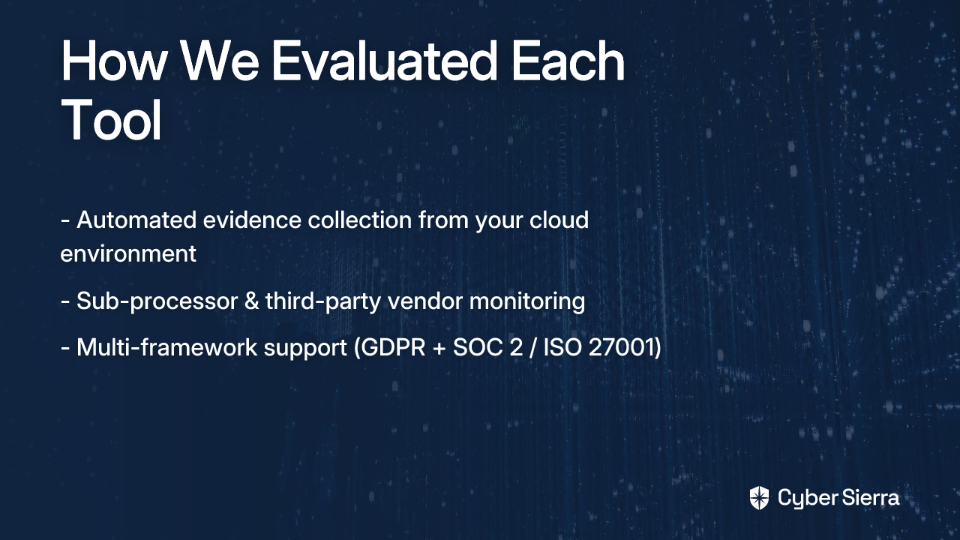
Here's what each tool is evaluated against:
- Automated evidence collection. Does it continuously pull compliance data from your cloud environment, removing the pre-audit scramble?
- Sub-processor management. Does it provide visibility and continuous monitoring of third-party vendors?
- Multi-framework support. Can it handle GDPR alongside SOC 2, ISO 27001, or other frameworks without duplicating effort?
1. Cyber Sierra
Best for: SaaS Chief Information Security Officers (CISOs) and compliance managers juggling GDPR, SOC 2, and ISO 27001 simultaneously.
Supported frameworks: GDPR, SOC 2, ISO 27001, HIPAA, PCI DSS, NIST CSF.
Deployment: Cloud-based SaaS.
Cyber Sierra is an AI-enabled cybersecurity platform built for tech companies wrestling with compliance fatigue across multiple frameworks. For SaaS companies, its core value is unification — instead of treating GDPR and SOC 2 as two separate, time-consuming compliance tracks, it provides a single source of truth for control monitoring and evidence collection. This is one reason it was recognized as a Sample Vendor in the Gartner® Cyber-Risk Management report.
Where it particularly stands out for SaaS is the combination of its Governance, Risk, and Compliance (GRC) and Continuous Control Monitoring (CCM) modules. Engineering teams can keep shipping, while compliance evidence is collected automatically in the background — rather than surfaced during a chaotic pre-audit sprint. That directly addresses the pain many compliance practitioners describe: being able to pull logs and reports without scrambling when a review comes around.
Key features:
- Continuous Control Monitoring. Provides near real-time visibility into control effectiveness across your cloud environment. Automates control testing and validation so you're not manually collecting screenshots before every audit cycle.
- Third-Party Risk Management. Addresses the sub-processor problem directly — automates vendor assessments, streamlines due diligence, and provides continuous monitoring of your third-party supply chain, not just point-in-time questionnaires.
- Unified GRC module. Maps overlapping controls between GDPR and other frameworks, automates data collection and risk assessments, and generates comprehensive audit trails. Custom controls are supported alongside standard frameworks.
Cyber Sierra offers flexible plans tailored to enterprise needs — visit the pricing page for details.
2. Sprinto
Best for: SaaS teams focused on achieving continuous audit readiness through deep cloud integrations.
Supported frameworks: GDPR, SOC 2, ISO 27001, HIPAA, and more.
Deployment: Cloud-based SaaS.
Sprinto is a strong contender for the best GDPR compliance software for SaaS companies whose primary goal is automating the path to audit readiness. The platform integrates directly with cloud infrastructure and SaaS tools to continuously collect evidence in the background — meaning your engineering and security teams are largely insulated from the compliance process until it's time to review findings, not gather them.
Its multi-framework support is particularly relevant for companies managing GDPR and SOC 2 in parallel, as it maps overlapping controls and flags gaps in near real-time. Teams with lean compliance functions will appreciate how much manual work it displaces.
Key features:
- Automated evidence collection. Continuously captures compliance data from integrated systems, significantly reducing the manual workload before an audit.
- Continuous monitoring. Provides a real-time dashboard of compliance controls, flagging misconfigurations or gaps as they occur rather than at audit time.
- Multi-framework mapping. Helps align controls across GDPR, SOC 2, and other frameworks to avoid duplicating effort across programs. Learn more on Sprinto.
3. Drata
Best for: Growth-stage SaaS startups with dedicated compliance resources prioritizing deep automation.
Supported frameworks: SOC 2, ISO 27001, GDPR, HIPAA, PCI DSS.
Deployment: Cloud-based SaaS.
Drata is a well-established compliance automation platform known for its broad integration library and robust evidence collection engine. It helps companies build and demonstrate a strong security posture to auditors and enterprise customers alike. For SaaS companies on an aggressive audit timeline, Drata's automation depth can be a significant advantage.
That said, some smaller teams have noted a steep learning curve — as a SaaS founder shared, "For someone like me in a small SaaS company, Drata felt overwhelming." That's a real consideration if you don't have a dedicated compliance manager on staff.
Key features:
- Automated evidence collection. Pulls evidence from over a hundred sources across cloud providers, HR platforms, and developer tools.
- Centralized Audit Hub. A single workspace for managing compliance and sharing evidence securely with auditors — no emailing spreadsheets.
- Continuous monitoring. Scans your tech stack continuously to ensure controls remain effective between audit cycles. Learn more at Drata.
4. OneTrust
Best for: Larger SaaS enterprises with dedicated privacy teams and complex, multi-jurisdictional data requirements.
Supported frameworks: GDPR, CCPA/CPRA, and a broad range of global privacy regulations.
Deployment: Cloud-based SaaS.
OneTrust is the market leader in privacy management, offering exhaustive tooling that goes deep into the legal mechanics of GDPR. For companies that need granular control over Records of Processing Activities (RoPA), Data Protection Impact Assessments (DPIAs), and consent management at scale, it is arguably the most comprehensive option available.
The tradeoff is complexity. OneTrust is purpose-built for privacy-first programs with dedicated legal and compliance functions. Smaller SaaS teams without those resources may find the platform's breadth more overwhelming than useful.
Key features:
- Comprehensive RoPA management. Structured workflows for documenting and maintaining Records of Processing Activities as required under Article 30 of the GDPR.
- DPIA and Data Subject Access Request (DSAR) workflows. Automates the processes for conducting impact assessments and responding to data subject rights requests.
- Regulatory tracking. Provides intelligence and updates on evolving privacy regulations beyond GDPR, including CCPA/CPRA and emerging global frameworks. Learn more at OneTrust.
5. Transcend
Best for: Engineering-led SaaS teams focused on automating DSAR fulfillment at the infrastructure level.
Supported frameworks: Specialized in the data rights components of GDPR, CCPA/CPRA, and other privacy laws.
Deployment: Cloud-based SaaS.
Transcend takes a different and narrower approach: it focuses specifically on one of the most technically demanding aspects of GDPR — automating the fulfillment of DSARs. Rather than a full Governance, Risk, and Compliance (GRC) platform, it acts as a data orchestration layer that programmatically accesses personal data across disparate systems, enabling structured responses to right-to-access, right-to-erasure, and portability requests.
For SaaS companies with complex data architectures spread across multiple databases and third-party tools, this kind of automation can eliminate an enormous engineering burden.
Key features:
- Automated DSAR orchestration. Connects to databases, SaaS tools, and data warehouses to programmatically retrieve or delete user data on request.
- Auditable fulfillment trail. Maintains a secure, auditable log of every DSAR response for compliance documentation purposes.
- Identity verification workflows. Ensures data requests are legitimate before fulfillment, reducing the risk of fraudulent data access. Learn more at Transcend.
How To Choose the Right GDPR Compliance Software for Your SaaS
Not every tool on this list will be the right fit. Choosing the best GDPR compliance software for your company comes down to matching the platform's strengths to where your compliance program actually is — and where it needs to go. Use the criteria below to guide your evaluation.
- Automation depth. Will the tool significantly displace manual work? Prioritize platforms that automate evidence collection from your cloud providers, code repositories, and HR systems. If you're still taking screenshots to prove control effectiveness, the platform isn't doing enough.
- Multi-framework capability. For most SaaS companies, GDPR doesn't exist in isolation — it overlaps with SOC 2, ISO 27001, or both. As research on framework integration shows, these frameworks are complementary, and managing them in an integrated way avoids duplicated effort. Look for platforms that map overlapping controls so you're not running two parallel programs.
- Sub-processor and vendor management. Third-party risk is one of the most underestimated GDPR exposure areas for SaaS. You need continuous monitoring of your sub-processors — not an annual questionnaire that's outdated by the time it's returned. A dedicated Third-Party Risk Management (TPRM) module is a critical differentiator.
- Integration ecosystem. Native integrations with AWS, Google Cloud, Azure, GitHub, Jira, and the rest of your core stack are what make automation actually work. Without them, you're still collecting evidence manually — just inside a different tool.
- Scalability and usability. Will the platform grow with your team and your framework requirements? A tool that requires a dedicated compliance engineer to operate is not viable for a 30-person SaaS company. Evaluate onboarding complexity honestly.
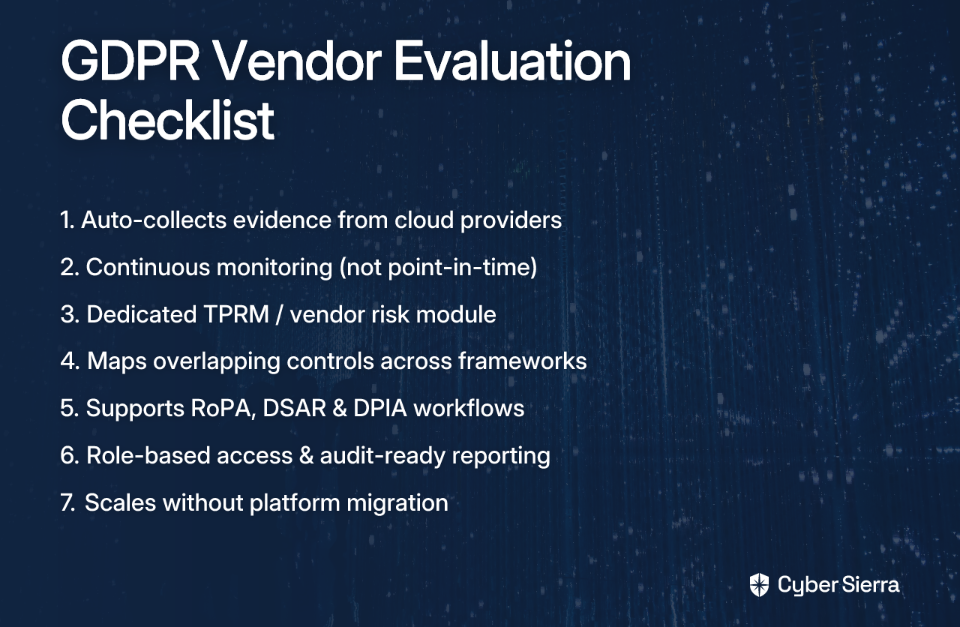
Your GDPR Compliance Vendor Evaluation Checklist
To make vendor comparison easier, here's a quick-reference checklist to use when evaluating any GDPR compliance software:
Turn GDPR Compliance Into a Competitive Advantage
Choosing the right GDPR software is about turning a painful obligation into a streamlined business process. For a fast-moving SaaS company, that means moving from chaotic, pre-audit scrambles to a state of continuous, automated readiness. The goal isn't just to pass an audit—it's to build a compliance program that enables growth, rather than slowing it down.
Here are the key takeaways to guide your decision:
- Automate evidence collection. Your top priority should be a platform that continuously pulls compliance data from your cloud environment. This is what ends the manual fire drills.
- Unify your frameworks. Don't manage GDPR and SOC 2 in separate silos. A tool that maps overlapping controls saves hundreds of hours of duplicated work.
- Monitor your vendors. Your sub-processors are your responsibility. You need a dedicated TPRM module that provides continuous visibility, not just a point-in-time questionnaire.
Your next step today? Map your sub-processors. List every third-party tool that touches EU customer data. This simple exercise will reveal the true scope of your compliance risk.
When you’re ready to automate that visibility and unify your entire compliance program, see Cyber Sierra. Our AI-powered platform gives you a single source of truth so you stay audit-ready without slowing down.
Frequently Asked Questions
What is GDPR compliance software and why do SaaS companies need it?
GDPR compliance software helps automate the management of data protection requirements. SaaS companies need it to replace manual, error-prone processes with continuous monitoring, automated evidence collection, and streamlined management of sub-processors, ensuring they stay audit-ready while growing.
What should I look for when choosing GDPR compliance software?
Look for three key features in GDPR compliance software. Prioritize tools with deep automation for evidence collection, support for multiple frameworks like SOC 2 and ISO 27001 to avoid duplicate work, and a robust module for continuous third-party and sub-processor risk management (TPRM).
How does automated evidence collection for GDPR work?
Automated evidence collection works by connecting directly to your company's tech stack. The software integrates with cloud providers (like AWS), developer tools, and HR systems to continuously gather proof that your security and privacy controls are operating effectively, eliminating pre-audit fire drills.
Why is multi-framework support for GDPR and SOC 2 important for a SaaS business?
Multi-framework support is crucial for efficiency. Many SaaS customers require assurances for both privacy (GDPR) and security (SOC 2), which have overlapping controls. An integrated platform prevents running two parallel compliance projects, saving immense time, effort, and resources.
When should a SaaS startup invest in GDPR compliance software?
A SaaS startup should consider GDPR software as soon as it begins processing EU customer data or targeting enterprise clients. Implementing a solution early builds a strong compliance foundation, prevents costly reactive work, and accelerates sales cycles by having audit-ready documentation on hand.
What is the difference between a GRC platform and a specialized tool like Transcend?
A GRC platform provides a broad, unified solution for managing risks and compliance across multiple frameworks like GDPR, SOC 2, and ISO 27001. A specialized tool solves a specific niche problem, such as Transcend's focus on automating Data Subject Access Request (DSAR) fulfillment.
