



5 Governance Risk Compliance Platform Integrations With ERP and ITSM Systems

Join thousands of professionals and get the latest insight on Compliance & Cybersecurity.
Summary
- Manually managing compliance across disconnected GRC, ERP, and ITSM systems is a major resource drain that leaves teams perpetually scrambling before audits.
- Integrating these platforms automates evidence collection directly from source systems, creating a continuous compliance posture and eliminating last-minute audit fire drills.
- When selecting a GRC tool, prioritize platforms with strong API-first architecture and pre-built connectors to ensure seamless automation with your existing tech stack.
- Cyber Sierra's unified GRC platform automates evidence collection and continuous control monitoring, helping your team stay audit-ready across multiple frameworks.
Managing compliance certifications, risk assessments, and vendor questionnaires has quietly become one of the most resource-draining responsibilities in enterprise IT. When your Governance, Risk, and Compliance (GRC) platform operates in isolation from the systems that run your business, every audit cycle turns into a scramble — chasing control owners, manually exporting data, and stitching together evidence from a dozen disconnected tools.
The core problem is fragmentation. Enterprise Resource Planning (ERP) systems hold your financial and operational data. IT Service Management (ITSM) systems track incidents, changes, and asset configurations. And your GRC platform sits somewhere in between, asking for data that those systems already have — but can't automatically share. The result is stale evidence, duplicated effort, and an organization that's never truly audit-ready.
Integration fixes this. When your GRC platform connects with your ERP and ITSM systems, compliance shifts from a periodic fire drill into a continuous, automated process. This article covers why that shift matters and which five governance risk compliance platforms do it best.
Why GRC Integration With ERP and ITSM Is No Longer Optional
Connecting your GRC platform to core business systems isn't a nice-to-have — it's what separates teams that are perpetually audit-ready from those that spend weeks scrambling before every review.
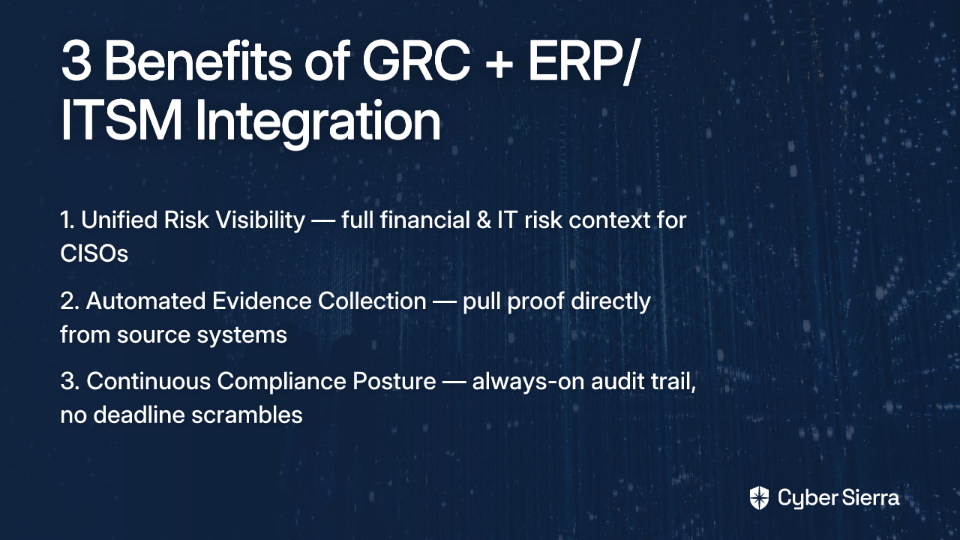
There are three concrete advantages that integration delivers.
Unified risk visibility. When GRC platforms pull data from ERP and ITSM systems, they gain full context. Financial data from ERP systems helps quantify the business impact of a control failure. Incident and change data from ITSM systems ties IT events directly to risk. Together, they give Chief Information Security Officers (CISOs) the unified security view they need to answer board-level questions with confidence — not guesswork.
Automated evidence collection. This is where integration pays the most immediate dividend. Instead of manually exporting logs, taking screenshots, or chasing control owners for attestations, an integrated GRC platform pulls evidence directly from the source. Consider a practical example: when a new privileged account is created in an ERP system, an integrated GRC platform automatically flags the event, creates a review task, and logs the action as audit evidence — no human touch required. This is the core promise of Continuous Control Monitoring.
Continuous compliance posture. The organizations that find audits least stressful are the ones that treat compliance as a continuous state rather than a deadline. Integration makes that possible by creating an always-on evidence trail. As Cerrix's integration guide outlines, connecting GRC to your existing systems requires assessing your current landscape, planning a detailed roadmap, and executing in phases — but the payoff is a compliance program that runs itself between audits, not just before them.
5 Top GRC Platforms for ERP and ITSM Integration
Not all GRC tools are built with deep system integration in mind. The platforms below stand out specifically for their ability to connect with enterprise ERP and ITSM environments — and deliver the automation that makes compliance less painful.
1. ServiceNow GRC
Best for: Organizations already invested in the ServiceNow ecosystem seeking a unified ITSM and GRC solution. Deployment: Cloud-based SaaS.
ServiceNow started as an ITSM leader, which means its GRC module isn't bolted on as an afterthought — it's built into the same data model as incident management, change management, and asset tracking. That native integration eliminates a class of problems that plague organizations trying to connect separate tools: data mapping, API maintenance, and version conflicts.
When an IT incident is logged in ServiceNow ITSM, it can automatically trigger a risk event in ServiceNow GRC. Control failures surface in real time. Audit evidence is linked directly to the operational record that generated it. For organizations already running ServiceNow, this creates a compelling single-platform argument.
Key features:
- Unified risk management. Integrates various risks on a single platform with a shared data model, eliminating silos between ITSM and GRC functions.
- Continuous control monitoring. Automates policy management and compliance tracking across multiple frameworks without manual intervention.
- Automated workflows. Links incidents to risks, streamlining response and keeping audit trails current.
- Third-party risk management. Establishes a systematic, automated approach to vendor risk assessment within the same platform.
2. MetricStream
Best for: Large, highly regulated enterprises in finance and healthcare needing a comprehensive, connected GRC suite. Deployment: Cloud-based SaaS.
MetricStream has built its reputation around what it calls "ConnectedGRC" — the idea that risk, compliance, audit, and even Environmental, Social, and Governance (ESG) reporting should operate from a single platform rather than a patchwork of point solutions. Its AI-powered analytics bring continuous control monitoring capabilities that go beyond scheduled assessments, flagging emerging risks before they become audit findings.
What sets MetricStream apart for integration is its low-code customization layer. Organizations with complex, non-standard ERP configurations can extend the platform to fit their environment without full development cycles. For enterprises managing regulatory change across multiple jurisdictions simultaneously, that flexibility has real operational value.
Key features:
- Centralized platform. Integrates risk, compliance, audit, and ESG functions into a single system of record.
- AI-powered analytics. Uses machine learning for continuous control monitoring and early detection of emerging risks.
- Regulatory change management. Automates regulation tracking and mapping them to existing controls.
- Low-code capabilities. Enables customization and integration extensions without heavy development resources.
3. Cyber Sierra
Best for: CISOs and Compliance Managers in technology, healthtech, BFSI, and manufacturing who need an AI-enabled, unified platform to automate multi-framework compliance without the complexity of legacy tools. Deployment: Cloud-based SaaS. Supported frameworks: SOC 2, ISO 27001, HIPAA, PCI DSS, GDPR, NIST CSF.
Cyber Sierra takes a different approach from traditional GRC platforms. Rather than adding compliance as a module on top of an ITSM or ERP system, it unifies GRC, Continuous Control Monitoring (CCM), and Third-Party Risk Management (TPRM) into a single AI-enabled platform purpose-built for security and compliance teams.
Its API-first architecture is designed to integrate with cloud environments, identity providers, and business systems — automatically pulling evidence rather than waiting for someone to gather it. For teams managing multiple frameworks simultaneously, the platform maps controls across SOC 2, ISO 27001, HIPAA, and PCI DSS from a central repository, eliminating the duplicate work that comes from treating each framework as a separate project.
Cyber Sierra is recognized as a Sample Vendor in the Gartner® Hype Cycle™ for Cyber-Risk Management, 2024, and holds accreditation from the Cyber Security Agency of Singapore (CSA) — signals that matter to procurement teams in regulated industries.
Key features:
- Continuous control monitoring. Automatically gathers evidence from integrated systems to provide near real-time visibility into control effectiveness, replacing manual audit prep with an always-on evidence trail.
- Unified compliance management. Manages multiple frameworks from a central control repository, mapping overlapping controls to eliminate redundant effort.
- Automated evidence collection. Connects directly to source systems to pull proof of compliance, addressing the core pain of manual data gathering before audits.
- Integrated TPRM. Unifies vendor risk management with internal GRC, so third-party risks surface in the same view as internal control gaps — not in a separate spreadsheet.
4. Archer
Best for: Mature enterprises with complex, multi-disciplinary risk environments requiring a highly configurable GRC solution. Deployment: On-premise or cloud.
Archer has been a fixture in enterprise GRC for over two decades. Its longevity reflects one core strength: configurability. Organizations with intricate risk taxonomies, custom workflows, or legacy systems that don't conform to modern API standards often find that Archer can be shaped to fit their environment in ways that out-of-the-box SaaS products cannot.
That flexibility comes with a trade-off. Archer implementations typically require dedicated resources and longer deployment timelines compared to cloud-native alternatives. For enterprises with the internal capacity to manage that complexity, it remains a powerful option — particularly for organizations integrating GRC with on-premise ERP environments.
Key features:
- Customizable dashboards. Provides flexible reporting tools that can be tailored to give different stakeholders precisely the risk views they need.
- Flexible assessment modules. Supports tailored risk assessments across business units, with deep integration capability for complex enterprise environments.
- Integrated risk management. Brings multiple risk disciplines — operational, IT, financial, regulatory — into a single cohesive environment.
- Strong analysis capabilities. Known for robust risk analysis tools across the organization.
5. SAP GRC
Best for: Organizations heavily reliant on SAP for ERP and core business operations. Deployment: Primarily on-premise, with cloud options available.
SAP GRC's primary advantage is straightforward: if your business runs on SAP S/4HANA or other SAP applications, no other GRC platform integrates as natively. Rather than building and maintaining a separate integration layer, SAP GRC monitors controls, access risks, and process compliance directly within the SAP environment — in real time.
For organizations in industries like manufacturing, financial services, or retail where SAP manages core financial and supply chain processes, this native integration translates directly into audit readiness for financial controls and Segregation of Duties (SoD) compliance. The tradeoff is scope: SAP GRC is purpose-built for the SAP ecosystem, making it less suited for organizations running multi-vendor technology stacks.
Key features:
- Real-time monitoring. Tracks policy violations and access risks directly within SAP systems as they occur, not after the fact.
- Automated access control. Manages SoD risks and user provisioning with built-in controls tied to SAP roles and permissions.
- Process control. Monitors embedded controls managed across the SAP landscape.
- Audit management. Provides tools to plan, execute, and document internal audits within the SAP environment.
Overcoming Common GRC Integration Challenges
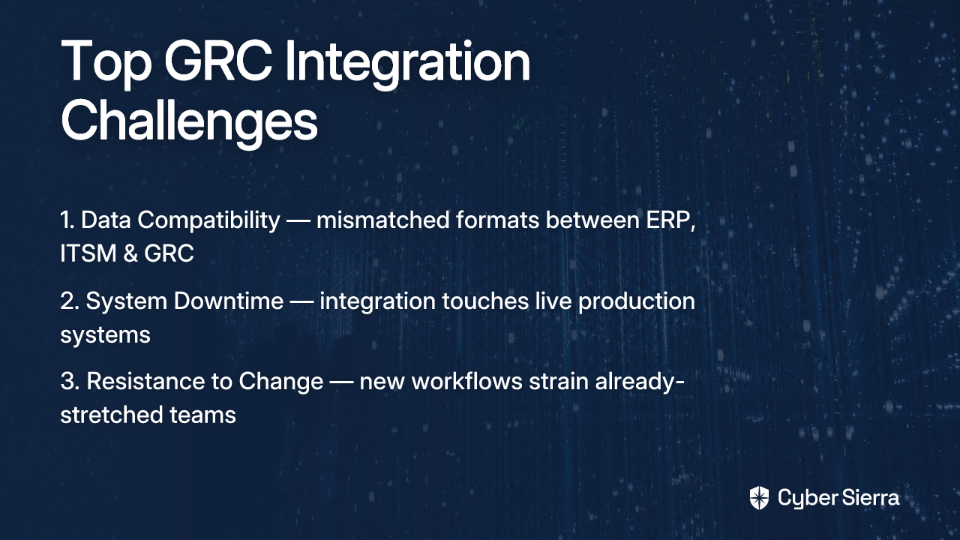
Connecting a GRC platform to your ERP and ITSM systems is not a plug-and-play process. Three challenges come up consistently, and knowing how to address them upfront saves significant time and friction.
Data compatibility issues. Different systems use different data formats, field structures, and standards. Without a clear data mapping strategy, even well-designed integrations produce incomplete or inconsistent results. The practical fix: prioritize GRC platforms with robust APIs and pre-built connectors for your specific ERP and ITSM tools. Invest time in the mapping phase before you build.
System downtime during implementation. Integration work touches production systems, which introduces risk. A phased approach — assess your current landscape first, plan a detailed roadmap second, execute in stages third — minimizes disruption. Avoid "big bang" go-lives where everything connects simultaneously.
Resistance to change. New workflows create friction, and security teams are already stretched thin. The teams most likely to adopt integrated GRC tools are the ones who understand the personal benefit: less manual data entry, fewer pre-audit fire drills, and more time for actual security work rather than compliance paperwork. Secure stakeholder buy-in early and communicate those individual-level benefits clearly.
These challenges are addressable. The Cerrix integration guide offers a practical framework for navigating each stage of the integration process.
From Audit Fire Drill to Always-On Compliance
Chasing down evidence before an audit isn't just stressful—it's a sign that your compliance tools are disconnected from your core business systems. The fix is integration. Connecting your GRC platform with your ERP and ITSM systems transforms compliance from a last-minute scramble into a continuous, automated process.
The most practical takeaways are simple:
- Automate evidence collection: Pull compliance data directly from source systems instead of chasing it down manually.
- Prioritize API-first tools: Select a GRC platform built for seamless integration with your existing tech stack.
Ready to see how a unified platform can automate these processes and keep you audit-ready? Explore Cyber Sierra's platform.
Frequently Asked Questions
What is GRC, ERP, and ITSM integration?
GRC, ERP, and ITSM integration connects your governance, risk, and compliance platform with your core business systems. This allows for automated data sharing, which eliminates manual evidence collection and creates a unified view of risk across the organization.
Why should I integrate my GRC platform with ERP and ITSM systems?
Integrating these systems transforms compliance from a periodic fire drill into a continuous, automated process. It delivers unified risk visibility, automates time-consuming evidence collection, and ensures your organization maintains an always-on audit trail.
How does GRC integration automate compliance?
GRC integration automates compliance by pulling evidence directly from source systems. For instance, when a privileged account is created in your ERP, an integrated GRC tool can automatically flag the event, create a review task, and log the action as audit evidence without manual effort.
What are the main challenges of GRC integration?
The most common challenges include data compatibility issues between different systems, potential downtime during implementation, and internal resistance to new workflows. Planning a phased rollout and prioritizing tools with strong APIs helps overcome these hurdles.
Which GRC tool is best for a multi-framework environment?
For managing multiple frameworks like SOC 2, ISO 27001, and HIPAA simultaneously, choose a platform designed for unified compliance. Tools like Cyber Sierra map controls across frameworks from a central repository, which eliminates the redundant work of treating each one as a separate project.
How do I choose the right GRC platform for integration?
Select a GRC platform based on its ability to connect with your existing tech stack (e.g., cloud services, identity providers). Prioritize tools with API-first architecture, pre-built connectors, and features like continuous control monitoring to ensure seamless integration and automation.
