



Continuous Compliance Tools vs. Traditional GRC Platforms: Which Fits Your Security Program?

Join thousands of professionals and get the latest insight on Compliance & Cybersecurity.
Summary
- Traditional GRC platforms create dangerous security blind spots by relying on periodic, point-in-time snapshots that are outdated almost immediately.
- Continuous compliance closes these gaps by using automation and real-time monitoring to ensure you meet security standards every day, not just during an audit.
- If your team is stuck in a cycle of manual evidence collection and "audit scrambles," it's a sign that your approach is inefficient and risky.
- Cyber Sierra's GRC platform automates this process, providing the continuous visibility needed to stay secure and audit-ready at all times.
You know the feeling. It's six months out from your next major audit, and someone on the team quietly mentions that you should probably start "the scramble." Evidence requests pile up in inboxes, engineers get pulled off product work to take screenshots, and spreadsheets multiply like rabbits. Then, just when you think you've got it under control, someone surfaces a VM improperly exposed to the internet or a workstation missing required security tools — and the tech debt keeps climbing.
The hard truth? For many organizations, this isn't a people problem. It's an architecture problem — specifically, a problem with how they've built their compliance program. And it usually comes down to a core choice: stick with a traditional GRC platform, or adopt a modern continuous compliance tool.
This article breaks down the key differences, gives you a practical decision framework, and highlights specific scenarios where each approach is likely to serve you best.
The Old Guard: Understanding Traditional GRC Platforms
Traditional Governance, Risk, and Compliance (GRC) platforms were built for a different era of security. They were designed to centralize policy management, track risks, and document compliance against frameworks — and in their time, they did that job reasonably well.
But the architectural assumptions baked into most traditional GRC tools haven't aged well. Here's why:
Point-in-Time Monitoring
Traditional GRC platforms rely on periodic assessments, providing snapshots of compliance that can quickly become outdated. You get a clear picture of your security posture on the day of the assessment. What happens in the 364 days between annual audits? That's anyone's guess. In dynamic cloud environments, that's a dangerous blind spot.
Manual Evidence Collection
This is where "compliance fatigue" is born. Gathering screenshots, pulling logs, chasing down control owners — it's a labor-intensive process that can result in outdated or inaccurate information. When your audit prep "scramble" starts eight months before the assessment date, that's a signal your evidence collection process is broken.
Siloed Integration
Traditional platforms are typically siloed, making integration challenging and slow, especially with modern CI/CD pipelines, cloud services, and SaaS toolchains. The result? Data that's always slightly stale and manual reconciliation that eats up analyst hours.
Limited AI & Predictive Capability
Functionality in legacy platforms is largely bounded to historical data analysis and reporting. They can tell you what happened, but they can't anticipate what's about to go wrong. In a threat landscape that moves faster than your quarterly review cycle, that's a significant handicap.
The New Wave: The Rise of Continuous Compliance
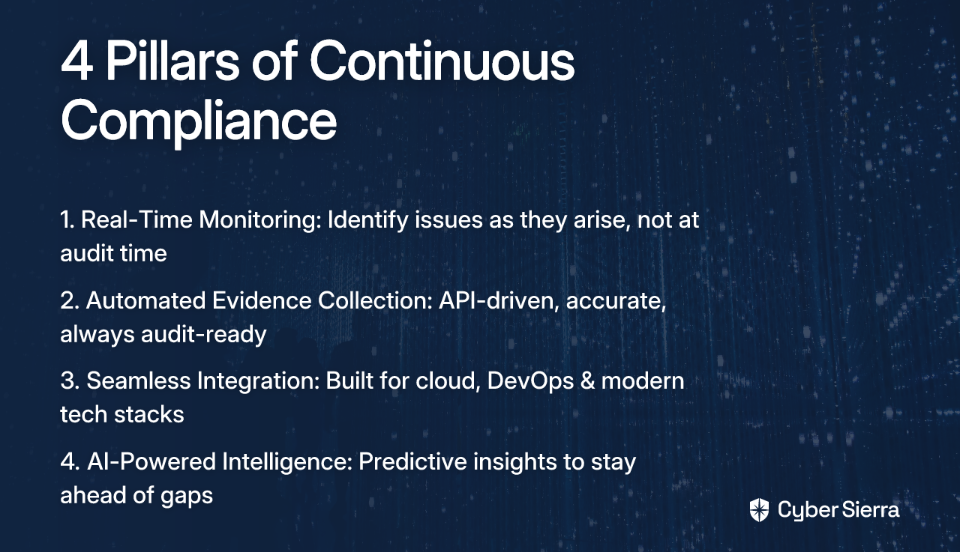
Continuous compliance is the practice of ensuring your organization maintains alignment with regulatory requirements and security standards without lapse — not just at audit time, but every day. It transforms compliance from a periodic event into an always-on business function.
This shift is powered by four core pillars:
Head-to-Head: Traditional GRC vs. Continuous Compliance Tools
| Feature | Traditional GRC Platform | Continuous Compliance Tool |
|---|---|---|
| Monitoring | Point-in-Time: Periodic assessments create dangerous visibility gaps. | Real-Time: Ongoing monitoring provides constant, always-on visibility. |
| Evidence Collection | Manual: Labor-intensive, slow, and prone to human error. | Automated: API-driven, fast, accurate, and always audit-ready. |
| Integration | Siloed: Limited compatibility with modern cloud and DevOps toolchains. | Seamless: Deep integrations across your entire tech stack. |
| AI Capabilities | Historical: Basic reporting and analysis of past data. | Predictive: AI-driven risk forecasting and proactive anomaly detection. |
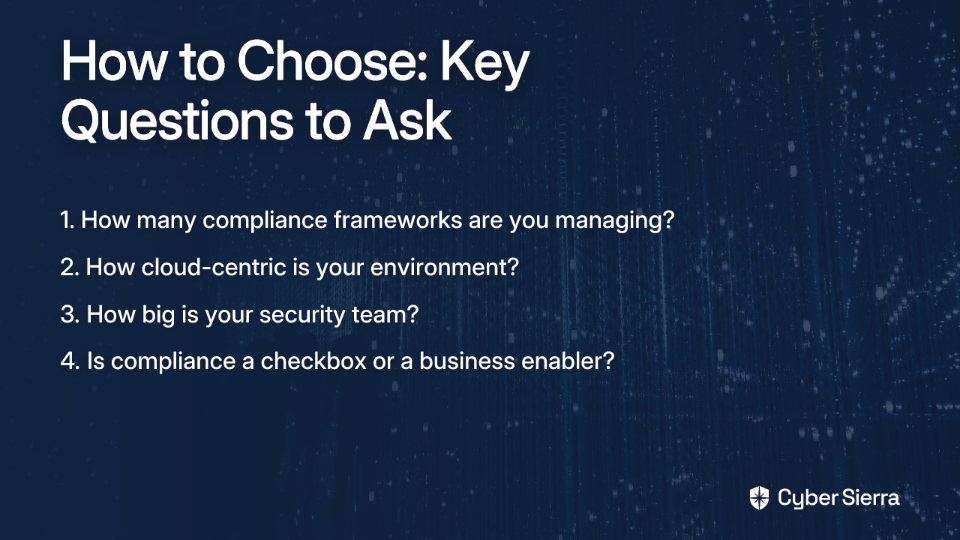
A Decision Framework: Which Approach Is Right for You?
There's no universal answer — the right choice depends on where your organization is today. Here's a practical self-assessment:
Real-World Scenarios: Where Continuous Compliance Delivers Clear Advantages
Let's explore two common situations where a continuous compliance approach provides a significant advantage over traditional GRC.
Scenario A: The Audit-Weary Scale-Up
A fast-growing SaaS company is pursuing SOC 2 Type II and ISO 27001 simultaneously. Their small security team spends three months per year in audit prep, manually gathering evidence from AWS, GitHub, and their HRIS — chasing engineers who don't understand why their pull requests need a screenshot attached.
The fix: With Cyber Sierra's GRC platform, evidence collection is automated directly from their existing tools. The Continuous Control Monitoring (CCM) module provides a live dashboard of control status across both frameworks, flagging exceptions and anomalies in real time. When audit season arrives, there's no scramble — they "just kick out the report," with prep time cut by over 80%. Crucially, this also surfaces the security debt that's been quietly accumulating: the baseline drift, the misconfigured settings, the missing endpoint protections that traditional GRC processes would have missed entirely.
Scenario B: The Enterprise with a Complex Vendor Supply Chain
A financial services firm manages relationships with hundreds of third-party vendors — data processors, cloud subprocessors, marketing agencies, and more. Their current approach involves annual questionnaires that take weeks to process and deliver a point-in-time snapshot that's already stale by the time it's reviewed. When a vendor suffers a breach, they're often among the last to know.
The fix: Cyber Sierra's TPRM module automates vendor assessments and onboarding workflows while providing near real-time, 24/7 visibility into vendor security compliance. Instead of a static spreadsheet of vendor questionnaire responses, the security team has a live risk-ranked vendor inventory, with automated alerts when a vendor's posture degrades. This is the difference between managing third-party risk and just documenting it.
End the Audit Scramble for Good
If your security program relies on periodic, point-in-time assessments, you're operating with dangerous blind spots. The frantic "audit scramble" isn't a sign of a hard-working team; it's a symptom of a broken, inefficient process that leaves you vulnerable between assessments.
The fix is to move from manual spot-checks to automated, continuous compliance. This approach provides real-time visibility into your security posture, turning compliance from a dreaded event into an always-on, proactive function.
As a next step, calculate the engineering hours your team spent on manual evidence collection for your last audit. If that number makes you wince, it’s time to see how automation can reclaim those hours and significantly reduce your risk. When you’re ready to trade audit stress for always-on confidence, explore Cyber Sierra's platform and find out how to make your next audit the easiest one yet.
Frequently Asked Questions
What is the main difference between traditional GRC and continuous compliance?
The primary difference is timing. Traditional GRC relies on periodic, point-in-time assessments, while continuous compliance provides real-time, ongoing monitoring of your security posture. This means issues are caught as they happen, not just during an annual audit scramble.
Why is manual evidence collection a problem for security?
Manual evidence collection is a problem because it's slow, error-prone, and pulls valuable engineering resources away from product development. It creates compliance fatigue and provides a snapshot that can be outdated the moment it's captured, creating dangerous visibility gaps.
How does a continuous compliance tool work?
A continuous compliance tool works by integrating directly with your tech stack via APIs to automate evidence collection and monitor controls in real time. It provides a live dashboard of your compliance status against frameworks like SOC 2 and ISO 27001, alerting you to gaps instantly.
When should our organization switch to a continuous compliance platform?
You should consider switching if your team is constantly in an "audit scramble," your environment is cloud-centric and changes rapidly, or you manage multiple compliance frameworks. If compliance feels like a burden instead of a business enabler, it's time to switch.
How does continuous compliance improve third-party risk management?
Continuous compliance improves third-party risk management by replacing static, annual questionnaires with live monitoring of your vendors' security posture. This provides real-time alerts when a vendor's risk profile changes, allowing for proactive intervention instead of reactive clean-up.
Is continuous compliance suitable for small security teams?
Yes, it is especially suitable for small teams. By automating repetitive tasks like evidence collection and control monitoring, continuous compliance tools free up limited security resources to focus on strategic initiatives and proactive risk reduction, rather than manual audit preparation.
