



10 Continuous Compliance Tools for Multi-Framework Security in 2026
Join thousands of professionals and get the latest insight on Compliance & Cybersecurity.
You're juggling SOC 2, ISO 27001, and HIPAA simultaneously — and audit season feels less like a milestone and more like a fire drill. The manual process of control mapping across overlapping frameworks is eating your team's hours, and the nagging fear of missing a gap before an auditor finds it is always there. Sound familiar?
Managing multiple compliance frameworks has become a baseline expectation for modern enterprises, not an edge case. But the tooling most teams rely on — spreadsheets, shared drives, and point-in-time questionnaires — simply wasn't built for this level of complexity.
The result is compliance fatigue, mounting technical debt, and security teams spending more time chasing evidence than actually improving their security posture.
This article evaluates 10 of the leading continuous compliance tools available in 2026, with a focus on multi-framework management, automation depth, and integration capabilities. Whether you're a Chief Information Security Officer (CISO) trying to get a unified view of your control environment or a compliance manager drowning in duplicate evidence requests, there's a platform here worth your attention.
Why Multi-Framework Compliance Is a Non-Negotiable Challenge
A strong compliance posture isn't just about avoiding penalties — it's a prerequisite for closing enterprise deals, entering regulated markets, and demonstrating that your organization takes security seriously. In fact, according to one study, 71% of consumers would stop doing business with a company that mishandled their data. But as regulatory requirements expand, so does the operational burden of keeping up.
Common framework pairings that security teams manage include:
- SaaS and technology companies. Typically pair SOC 2 with ISO 27001 and GDPR to satisfy both North American and European customer requirements.
- Healthcare organizations. Usually combine HIPAA with HITRUST for comprehensive patient data protection.
- Fintech and e-commerce. Must manage PCI DSS v4.0 alongside SOC 2 to secure payment data and customer records simultaneously.
The core problem with managing these frameworks manually is that they overlap — but not perfectly. SOC 2 Trust Services Criteria and ISO 27001 Annex A controls share significant common ground, but mapping them by hand is error-prone and time-consuming. Miss a mapping, and you've created duplicate work in every future audit cycle.
According to community discussions among compliance practitioners, "what took days now takes minutes" when the right automation is in place — but getting there requires the right platform.
Continuous Control Monitoring (CCM) is the modern answer to this challenge. Rather than treating compliance as a periodic event, CCM shifts the model to ongoing, automated oversight — continuously checking controls, flagging exceptions, and keeping evidence fresh. The goal isn't just to pass the next audit; it's to maintain a state of continuous audit readiness.
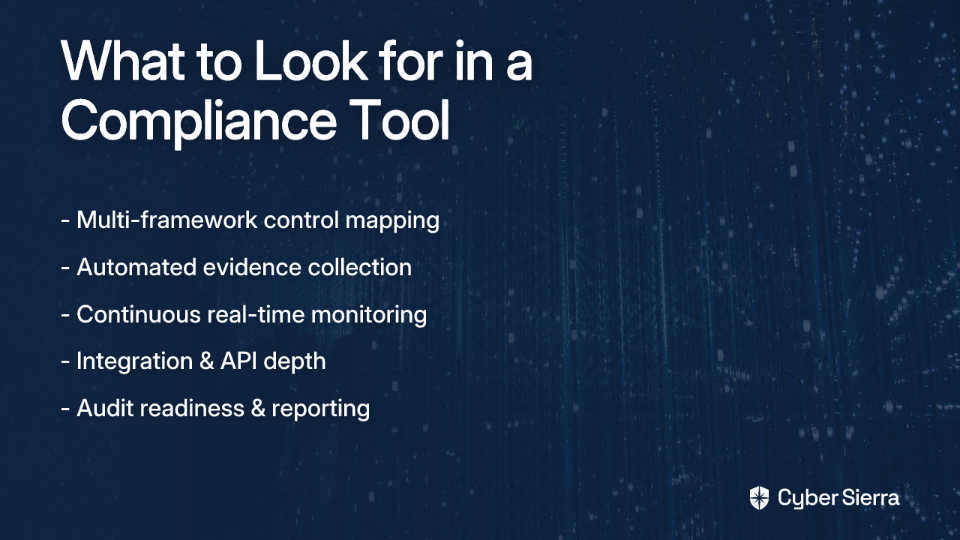
What to Look for in a Continuous Compliance Tool
Not all compliance platforms handle multi-framework complexity equally. When evaluating your options, prioritize the following capabilities:
The Top 10 Continuous Compliance Tools for 2026
Here is our evaluation of the leading continuous compliance platforms for organizations managing multi-framework security programs in 2026.
1. Cyber Sierra
Best for: CISOs and compliance managers seeking a unified, AI-enabled platform for multi-framework Governance, Risk, and Compliance (GRC), Third-Party Risk Management (TPRM), and continuous monitoring. Supported frameworks: SOC 2, ISO 27001, HIPAA, GDPR, PCI DSS, NIST CSF, and more. Deployment: Cloud-based SaaS.
Cyber Sierra takes a fundamentally different approach to compliance than most tools on this list. Rather than treating compliance as an isolated workflow, the platform integrates its CCM module with GRC, TPRM, and Threat Intelligence into a single environment. This gives CISOs and compliance managers a unified view of their entire security posture — not just a checklist of framework requirements.
Its standout capability for multi-framework environments is a centralized controls repository that operates on a "map once, comply many" principle. Teams define controls once and Cyber Sierra maps them across all relevant frameworks automatically. This directly tackles the frustration practitioners describe when manually cross-walking SOC 2 and ISO 27001 requirements.
Recognized as a Sample Vendor in the Gartner® Hype Cycle™ for Cyber-Risk Management, 2024, and accredited by the Cyber Security Agency of Singapore (CSA), Cyber Sierra is purpose-built for the complexity of modern multi-framework compliance. The platform itself is also ISO 27001 certified.
Key features:
- Continuous control monitoring. Provides near real-time visibility into security control effectiveness across digital assets, catching drift before it becomes an audit finding.
- Centralized controls repository. A single source of truth for all controls, mapped across multiple frameworks to eliminate duplicate evidence collection.
- Actionable risk intelligence. Delivers data-driven prioritization so teams remediate the highest-risk gaps first, not just the easiest ones.
- Automated control testing. Automates the validation of controls, dramatically reducing the manual hours spent on evidence gathering each audit cycle.
2. Vanta
Best for: Startups and fast-growing SaaS companies achieving their first certifications such as SOC 2 or ISO 27001. Supported frameworks: SOC 2, ISO 27001, HIPAA, GDPR, PCI DSS. Deployment: Cloud-based SaaS.
Vanta is a dominant player in the compliance automation space and widely recognized for its developer-friendly integrations and polished user experience. It excels at getting tech companies audit-ready quickly by automating large portions of the evidence collection process through its library of over 300 integrations.
For organizations pursuing their first major certification, Vanta provides strong guidance, pre-built policy templates, and clear progress dashboards. Teams adding a second framework on top of an existing one will want to closely evaluate how Vanta's cross-framework control mapping handles their specific overlap scenarios.
Key features:
- Continuous monitoring. Automated checks against hundreds of security controls across integrated systems.
- Automated evidence collection. Pulls data from cloud providers, HR platforms, and developer tools without manual intervention.
- Pre-built policy templates. A library of customizable policies helps teams establish foundational documentation quickly.
- Risk management module. Tools to conduct and document risk assessments as required by frameworks like ISO 27001.
3. Drata
Best for: Cloud-native and SaaS organizations needing deep real-time visibility and robust automation depth. Supported frameworks: SOC 2, ISO 27001, HIPAA, GDPR, PCI DSS. Deployment: Cloud-based SaaS.
Drata is built around a security-first compliance philosophy, with continuous real-time monitoring at its core. Its dashboard gives teams an immediately actionable view of their control environment — failing controls are surfaced clearly, with remediation guidance attached. Drata's approach emphasizes trust: the evidence it collects is structured to give auditors high confidence in its reliability.
It's a strong fit for tech-forward organizations that want compliance embedded into daily operations rather than bolted on at audit time.
Key features:
- Real-time control monitoring. Continuous compliance assurance through automated, scheduled checks.
- Extensive integration ecosystem. Connects to a wide range of cloud services, identity providers, and business applications.
- Automated evidence collection. Gathers and organizes evidence in an audit-ready format with minimal manual input.
- Trust Center. Secure portal for sharing compliance documentation with prospects and customers to accelerate sales cycles.
4. Secureframe
Best for: Organizations that need to manage multiple compliance frameworks and vendor risk within a single platform. Supported frameworks: SOC 2, ISO 27001, HIPAA, PCI DSS, GDPR, California Consumer Privacy Act (CCPA)/California Privacy Rights Act (CPRA). Deployment: Cloud-based SaaS.
Secureframe offers an all-in-one compliance automation platform with solid multi-framework management capabilities. Beyond core compliance automation, it includes vendor risk management and security awareness training, making it a reasonable consolidation play for teams looking to reduce the number of point solutions in their stack.
Key features:
- Automated compliance workflows. Guides teams through control implementation and policy management step by step.
- Vendor risk management. Tracks and monitors the security posture of third-party vendors as part of the compliance program.
- AI-powered policy generation. Accelerates the creation of framework-compliant security policies.
5. Hyperproof
Best for: Enterprises with mature compliance programs requiring advanced orchestration and risk-based prioritization. Supported frameworks: SOC 2, ISO 27001, NIST CSF, PCI DSS, Sarbanes-Oxley (SOX). Deployment: Cloud-based SaaS.
Hyperproof positions itself as a Compliance Operations platform — a distinction that matters for larger organizations with dedicated GRC functions. It focuses on workflow automation, cross-framework evidence deduplication, and risk-based prioritization. Its AI-powered features assist in streamlining control mapping across overlapping frameworks.
Key features:
- Advanced compliance orchestration. Tools to manage complex, multi-team compliance projects with defined ownership and workflows.
- Risk-based prioritization. Surfaces the most critical compliance gaps so teams focus effort where it matters most.
- Centralized evidence repository. A single location to collect, manage, and link evidence to multiple controls and frameworks simultaneously.
6. AuditBoard
Best for: Internal audit, risk, and compliance teams in large enterprises managing SOX, ERM, and IT compliance. Supported frameworks: SOX, NIST CSF, ISO 27001, PCI DSS, Cybersecurity Maturity Model Certification (CMMC). Deployment: Cloud-based SaaS.
AuditBoard is a leader in cloud-based audit and risk management, with roots in serving internal audit teams at large enterprises. Its platform has expanded to cover a broad range of GRC use cases, excelling at centralized audit management and board-level reporting. It's best suited to organizations with dedicated audit departments and complex internal control environments.
Key features:
- Centralized audit management. A unified platform for planning, executing, and tracking both internal and external audits.
- Automated control testing. Workflows to automate testing cycles for frameworks like SOX and ISO 27001.
- Risk reporting dashboards. Provides stakeholders with clear visibility into risk and compliance posture without requiring manual report assembly.
7. LogicGate
Best for: Organizations requiring highly customizable workflows for complex or non-standard GRC needs. Supported frameworks: Highly customizable across ISO 27001, NIST CSF, SOC 2, and more. Deployment: Cloud-based SaaS.
LogicGate's Risk Cloud® stands out for extreme flexibility. Its no-code, drag-and-drop interface allows teams to build GRC workflows tailored to processes that don't fit rigid off-the-shelf templates. For organizations with unique compliance requirements or highly customized control environments, LogicGate's visual process mapping brings clarity that more prescriptive platforms can't offer.
Key features:
- Flexible, customizable modules. Build compliance workflows and applications around specific business processes and requirements.
- Rule-based logic. Automate decisions and task routing based on predefined conditions.
- Visual dashboards and reporting. Create custom reports and views to track compliance and risk metrics relevant to each stakeholder.
8. OneTrust
Best for: Mid-to-large organizations integrating security compliance with privacy, ethics, and ESG programs. Supported frameworks: General Data Protection Regulation (GDPR), CCPA/CPRA, ISO 27001, SOC 2, and hundreds of additional regulations. Deployment: Cloud-based SaaS.
OneTrust operates at a scale that few platforms match, offering a vast suite covering privacy, GRC, ethics, and environmental, social, and governance (ESG). Its Security Assurance Cloud provides robust compliance automation capabilities, making it an excellent choice for organizations that need their security compliance program tightly integrated with a broader privacy management function.
Key features:
- Integrated GRC ecosystem. Connects security compliance workflows with privacy management, vendor risk, and ethics programs.
- Automated audits and control testing. Pre-built templates and automated workflows streamline audit preparation.
- Regulatory intelligence. Keeps teams informed of changes to global regulations that may impact their compliance obligations.
9. JupiterOne
Best for: Security-first teams wanting to tie compliance directly to a comprehensive cyber asset inventory. Supported frameworks: SOC 2, ISO 27001, HIPAA, PCI DSS, NIST CSF. Deployment: Cloud-based SaaS.
JupiterOne takes an asset-centric approach that sets it apart from every other tool on this list. It builds a graph-based model of all cyber assets — users, devices, code repositories, cloud infrastructure — and their relationships. Compliance requirements then map to specific assets, giving teams a precise, contextual view of where gaps exist and why.
Key features:
- Cyber Asset Attack Surface Management (CAASM). Maintains a complete, continuously updated inventory of all digital assets across the environment.
- Graph-based analysis. Enables complex, contextual queries about security posture and compliance status across asset relationships.
- Evidence tracking tied to assets. Links compliance evidence directly to the specific assets it applies to, eliminating ambiguity.
10. Scrut Automation
Best for: Mid-sized companies seeking a cost-effective path to automating compliance for key frameworks. Supported frameworks: SOC 2, ISO 27001, HIPAA, GDPR, PCI DSS. Deployment: Cloud-based SaaS.
Scrut Automation provides a risk-first compliance platform designed for growing organizations that need to move beyond spreadsheets without an enterprise-level budget. It offers continuous control monitoring and evidence automation for the most commonly required frameworks, with a risk-centric approach that helps teams prioritize where to focus.
Key features:
- Continuous control monitoring. Automated checks against SOC 2, ISO 27001, and other framework requirements with ongoing visibility into control status.
- Evidence automation. Significantly reduces the manual preparation burden for audit cycles.
- Risk-centric compliance. Prioritizes compliance efforts based on identified risks rather than treating all controls with equal urgency.
How to Implement a Continuous Compliance Strategy
Selecting the right continuous compliance tool matters — but the platform alone won't solve the problem. Implementing continuous compliance requires a shift in how compliance is actually operated day to day.
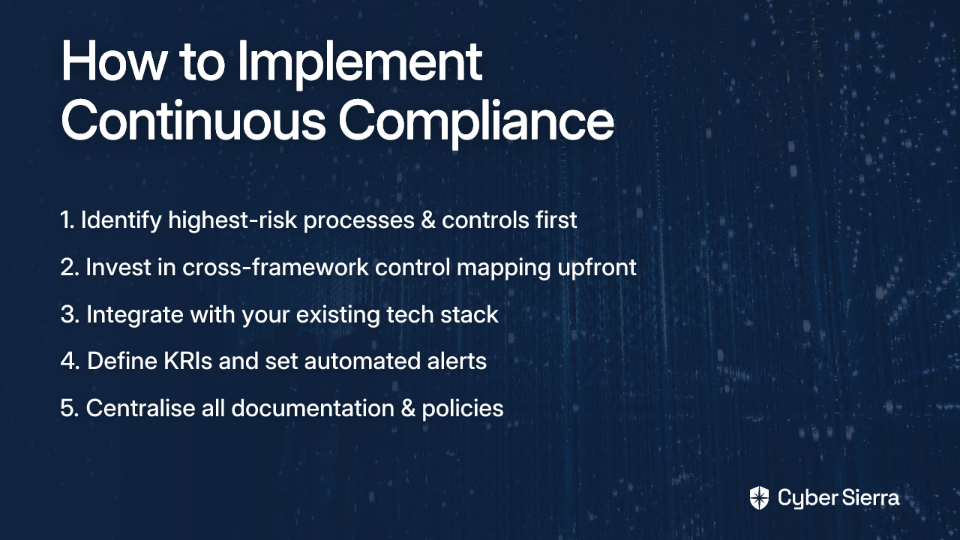
The organizations that get the most from continuous compliance tools are those that treat compliance as an ongoing operational discipline, not an annual event. Regular internal check-ins, continuous team readiness, and automated monitoring together eliminate the scramble that makes audit season so painful.
Stop Treating Audits Like Fire Drills
The manual, periodic approach to compliance is no longer sustainable. Mounting technical debt, fragmented documentation, and duplicated effort across frameworks are symptoms of a model that needs to change — not just better processes, but better tooling.
The platforms evaluated in this article all move in the right direction: away from spreadsheets and toward automation, from point-in-time snapshots toward continuous visibility. The right choice depends on your organization's size, framework requirements, and how tightly you need compliance integrated with broader security operations.
For teams that need compliance, continuous monitoring, and third-party risk managed under one roof, Cyber Sierra's CCM module and GRC platform are worth exploring — particularly for multi-framework environments where unified control mapping and near real-time posture visibility make a material difference in audit readiness.
See how teams are automating multi-framework compliance with a Cyber Sierra demo.
Frequently Asked Questions
What is continuous compliance automation?
Continuous compliance automation uses software to automatically monitor, test, and collect evidence for security controls in near real-time. This shifts compliance from a periodic, manual audit preparation cycle to an ongoing, automated process, ensuring constant audit readiness.
Why is managing multiple compliance frameworks so challenging?
The primary challenge is that frameworks like SOC 2 and ISO 27001 have overlapping but not identical control requirements. Manually mapping these controls is error-prone and time-consuming, leading to duplicated work, inconsistent evidence, and potential gaps during audits.
How does a "map once, comply many" approach save time?
A "map once, comply many" approach centralizes your security controls and maps them to multiple frameworks automatically. This eliminates the need to manually collect and manage separate evidence for each framework, drastically reducing administrative overhead and audit preparation time.
What are the most important features in a multi-framework compliance tool?
Key features include a centralized controls library with automated cross-framework mapping, continuous monitoring to detect gaps in real-time, automated evidence collection from your tech stack, and robust reporting to provide a unified view of your compliance posture to auditors.
How is continuous compliance different from traditional compliance?
Traditional compliance is a periodic, point-in-time activity focused on passing an annual audit. Continuous compliance is an ongoing, automated process that provides real-time visibility into your control environment, making you audit-ready at all times, not just during audit season.
Which companies benefit most from continuous compliance tools?
Companies managing multiple security frameworks (e.g., SOC 2, ISO 27001, HIPAA, PCI DSS) benefit the most. This includes SaaS providers, healthcare organizations, and fintech companies that must prove compliance to close enterprise deals and enter regulated markets.
