



How to Automate Cybersecurity Compliance Across 10+ Frameworks (2026 Guide)

Join thousands of professionals and get the latest insight on Compliance & Cybersecurity.
Summary
- Managing multiple cybersecurity frameworks manually wastes over 2,500 hours annually on redundant tasks, as teams repeatedly map similar controls for different audits.
- Adopt a four-step automated workflow: map overlapping controls, centralize them in a single repository, implement continuous testing, and generate unified reports to end the audit scramble.
- Continuous Control Monitoring (CCM) is key, as it replaces last-minute manual evidence collection with a real-time, always-auditable library.
- Streamline this entire process with Cyber Sierra's Governance, Risk & Compliance platform, which automates control mapping and evidence collection across 10+ frameworks.
You're managing SOC 2, ISO 27001, HIPAA, and NIST Cybersecurity Framework (NIST CSF) simultaneously — and every audit cycle feels like starting from scratch. Your team is on long calls with engineers trying to locate a config file and take a timestamped screenshot. Evidence is stale by the time it's filed. Policies live in three different wikis. Sound familiar?
This isn't just an efficiency problem. It's a structural one.
Most compliance guides cover each framework in isolation. None explain what to do when all of them apply at once — and that gap is exactly where security teams lose weeks of productive time. This guide walks through a four-step workflow to automate cybersecurity compliance automation across 10+ frameworks: from mapping overlapping controls to generating unified audit reports, without rebuilding your process every time a new regulation lands.
The Real Cost of Manual Multi-Framework Compliance
Before the workflow, it helps to name what you're actually fighting against.
Organizations managing multiple frameworks face a specific trap: the overlap between frameworks is real, but imperfect. Most controls for access management, encryption, and incident response appear across SOC 2, ISO 27001, HIPAA, and NIST CSF — but with different language, different scoping, and different evidence requirements. Without a structured approach, teams end up doing the same work three or four times over.
According to CyberSaint's crosswalking guide, manual crosswalking between frameworks can consume over 2,500 hours annually — and that's before a single audit begins. Seceon's compliance automation analysis puts the potential savings from automation at 40–60% of total compliance costs, with audit preparation timelines compressing from months to weeks.
The solution isn't just buying a tool. It's building a methodology — and then automating it.
A Four-Step Workflow for Multi-Framework Compliance Automation
Here's the workflow that transforms compliance from a recurring fire drill into a continuous, auditable process.
Step 1: Control Mapping and Overlap Analysis
The first step is identifying which controls already satisfy requirements across multiple frameworks — what practitioners call "crosswalking." Done manually in spreadsheets, it's error-prone and nearly impossible to maintain as frameworks update. Done with automation, it becomes the foundation for everything that follows.
The key insight: frameworks share far more DNA than most teams realize. Take access management as a concrete example:
- NIST CSF 2.0 (PR.AA-01). Identities and credentials are managed, monitored, and revoked for authorized devices, users, and processes.
- ISO/IEC 27001:2022 (A.5.15 / A.5.18). Access control policy and use of privileged access rights.
- SOC 2 (CC6.1). The entity implements logical access security software, infrastructure, and architectures over protected information assets.
All three address the same underlying control: who has access to what, and is it properly governed? A single, well-documented Identity and Access Management (IAM) implementation — with continuous evidence — satisfies all three simultaneously.
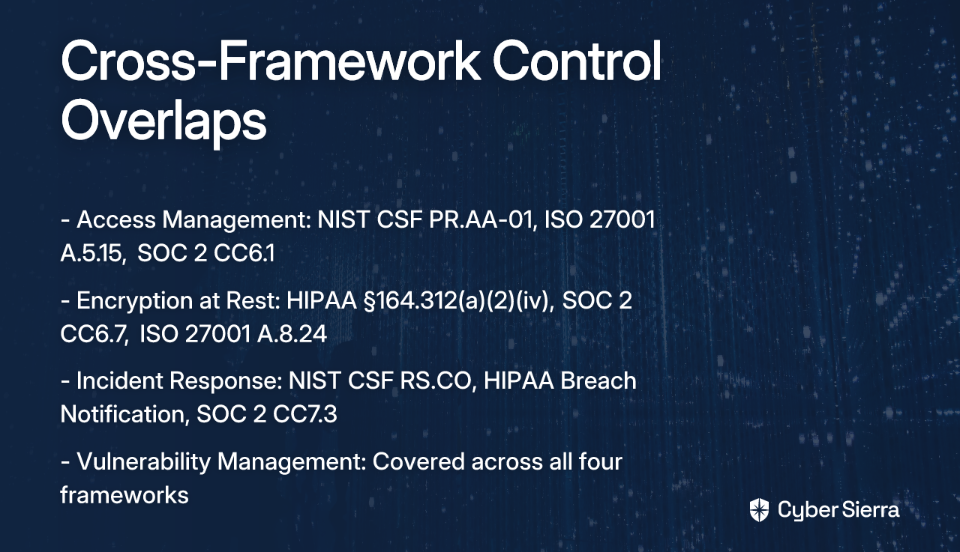
The same pattern holds for encryption at rest (HIPAA §164.312(a)(2)(iv), SOC 2 CC6.7, ISO 27001 A.8.24), incident response (NIST CSF RS.CO, HIPAA Breach Notification Rule, SOC 2 CC7.3), and vulnerability management across all four frameworks. Modern platforms use AI and NLP to analyze the intent behind controls — not just surface-level keyword matching — producing more accurate and maintainable mappings at a fraction of the manual effort.
Output of this step: A documented control crosswalk showing which single controls satisfy multiple framework requirements, and where genuine gaps exist that require separate coverage.
Step 2: Build a Centralized Control Repository
Once you know how your controls map across frameworks, the next step is housing everything in one place — a centralized control repository that serves as the single source of truth for your entire compliance program.
A well-built repository contains:
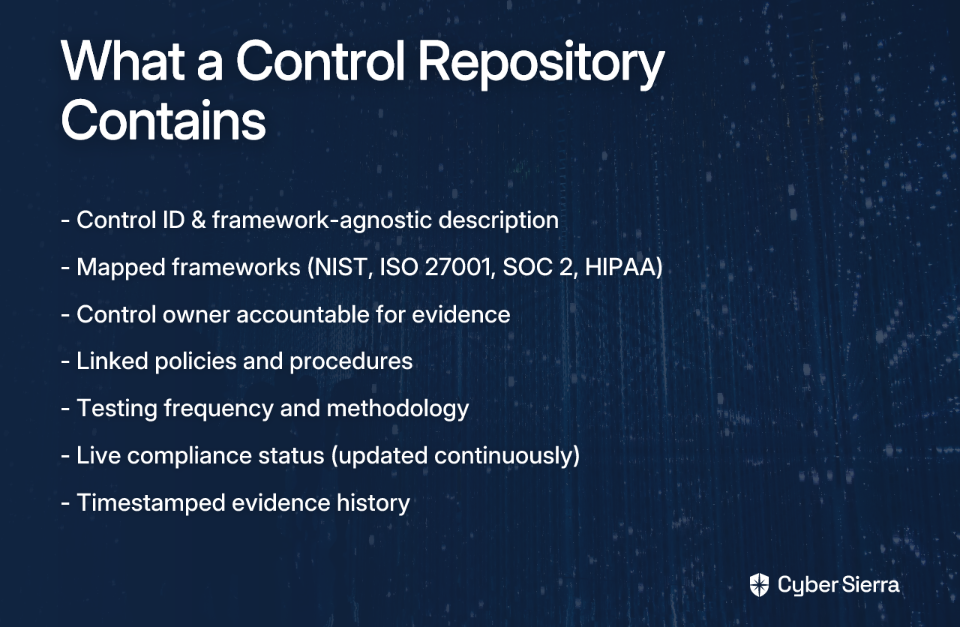
This structure directly solves one of the most common practitioner complaints: policies scattered across wikis, shared drives, and email threads, with no version control and no clear ownership. A centralized repository makes it impossible to have a control "owned" by nobody and makes the impact of a single control failure immediately visible across every applicable framework.
As TrustCloud's UCF guide describes it, a Unified Control Framework (UCF) doesn't just reduce redundancy — it provides the holistic risk visibility that periodic audits fundamentally cannot.

Step 3: Implement Continuous Automated Testing
With the repository in place, the next step is replacing periodic manual checks with Continuous Control Monitoring (CCM) — automated testing that validates controls are operating effectively in real time, not just at audit time.
Here's what the difference looks like in practice, using a common control: MFA on cloud infrastructure.
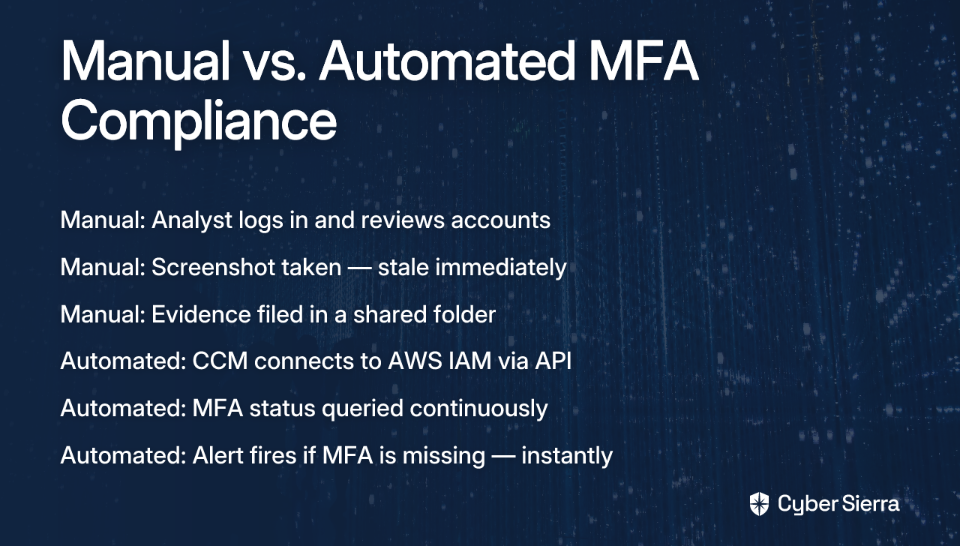
This shift from reactive evidence collection to proactive control validation is the practical heart of cybersecurity compliance automation. As RegScale's CCM overview highlights, CCM platforms can support over 60 compliance frameworks simultaneously — the same integration that validates your AWS MFA control for NIST CSF also satisfies the equivalent SOC 2 and ISO 27001 requirements.
The downstream effect is significant: instead of spending weeks before an audit scrambling to gather evidence, your team has a continuously updated evidence library that's always ready.
Step 4: Generate Unified Audit Reporting
The final step brings everything together into a reporting layer that works for every audience — compliance managers, external auditors, and the board.
Unified audit reporting aggregates data from your centralized repository and continuous testing into a single dashboard. Different stakeholders need different views:
- Compliance managers. A real-time view of control status across all applicable frameworks, with clear visibility into which gaps need remediation before the next audit cycle.
- External auditors. Secure, read-only access to a structured evidence library — often called a "trust portal" — that answers auditor requests before they escalate into back-and-forth email threads. This directly addresses the "communication with auditors can be a bottleneck" pain that practitioners consistently flag.
- CISOs and board. High-level dashboards that translate technical control status into business risk language, satisfying the growing demand for quantified, reportable security posture metrics.
According to CyberSaint's research, automation at this stage can produce 80% faster assessments and a 90% reduction in manual reporting effort. That's not a marginal improvement — it's a structural shift in how compliance teams operate.
End the Audit Scramble for Good
Compliance fatigue isn't a cost of doing business—it's a symptom of a broken, manual process. By treating compliance as a continuous operational state instead of a series of deadlines, you can end the recurring fire drills for good.
The most practical takeaways from this workflow are:
- Map controls once, satisfy many frameworks. Identify and centralize overlapping controls to eliminate redundant work across SOC 2, ISO 27001, and others.
- Shift from manual to continuous. Replace last-minute evidence gathering with automated, real-time control monitoring to stay audit-ready 24/7.
Your next step today? Whiteboard the one control—like access management—that causes the most repetitive work during audits. That’s your starting point for automation.
When you’re ready to automate the entire workflow, from crosswalking to reporting, see automated compliance in action. We’ll show you how to build a compliance program that scales with your business, not your headcount.
Frequently Asked Questions
What is multi-framework compliance automation?
Multi-framework compliance automation uses technology to manage obligations across standards like SOC 2, ISO 27001, and NIST CSF from one platform. It involves mapping overlapping controls, centralizing evidence, and using continuous monitoring to reduce manual effort and ensure audit-readiness.
Why is managing multiple cybersecurity frameworks manually so difficult?
Manual management is difficult because frameworks have overlapping but slightly different requirements, leading to duplicated work. Teams end up recreating evidence and re-mapping controls for each audit, a process that is time-consuming, error-prone, and hard to maintain as standards evolve.
What is control mapping in cybersecurity compliance?
Control mapping, or crosswalking, is the process of identifying a single security control that satisfies requirements across multiple frameworks. For example, one strong access control policy can meet the criteria for NIST, ISO 27001, and SOC 2, eliminating redundant compliance tasks.
How does continuous control monitoring (CCM) improve the audit process?
CCM improves audits by automatically collecting and validating evidence in real-time, ensuring you are always prepared. Instead of manually taking screenshots before an audit, CCM provides a live, timestamped evidence library, drastically reducing preparation time and eliminating stale data.
What are the key steps to automating multi-framework compliance?
The four key steps are: mapping overlapping controls, building a centralized control repository, implementing continuous automated testing (CCM), and generating unified audit reports. This workflow transforms compliance from a series of manual fire drills into a continuous and efficient process.
How does a centralized control repository help with compliance?
A centralized repository acts as the single source of truth for all controls, policies, and evidence across every framework. It eliminates scattered documents, clarifies control ownership, and provides a clear view of your compliance posture, making it easy to manage audits and assess risk.
