



The Best Third Party Risk Management Software To Automate Vendor Questionnaires

Join thousands of professionals and get the latest insight on Compliance & Cybersecurity.
Summary
- Over 29% of data breaches originate from third-party vendors, highlighting the failure of manual, point-in-time security questionnaires.
- Traditional vendor risk management creates security blind spots because it's manual, slow, and lacks objective verification, making it difficult to scale.
- Modern TPRM platforms replace outdated spreadsheets with automated workflows, continuous external monitoring, and AI-assisted assessments.
- Unify vendor risk and compliance by connecting TPRM with continuous control monitoring on a single platform like Cyber Sierra.
You've got a growing vendor list, a compliance deadline on the horizon, and a spreadsheet that hasn't been updated in three weeks. Sound familiar?
Managing vendor risk manually is a grind. Security questionnaires get lost in inboxes, vendors ghost follow-up emails, and by the time you've collected every response, the data is already out of date. Tools that were supposed to fix this — ZenGRC, OneTrust, even ServiceNow — often introduce their own frustrations: manual data entry that defeats the purpose, clunky interfaces, or integrations that don't quite fit your tech stack.
The good news: a new generation of third party risk management software is built specifically to eliminate this overhead.
Why Traditional Vendor Questionnaires Are Failing
Before jumping to solutions, it's worth naming why the old approach breaks down — because the problems run deeper than "it's tedious."
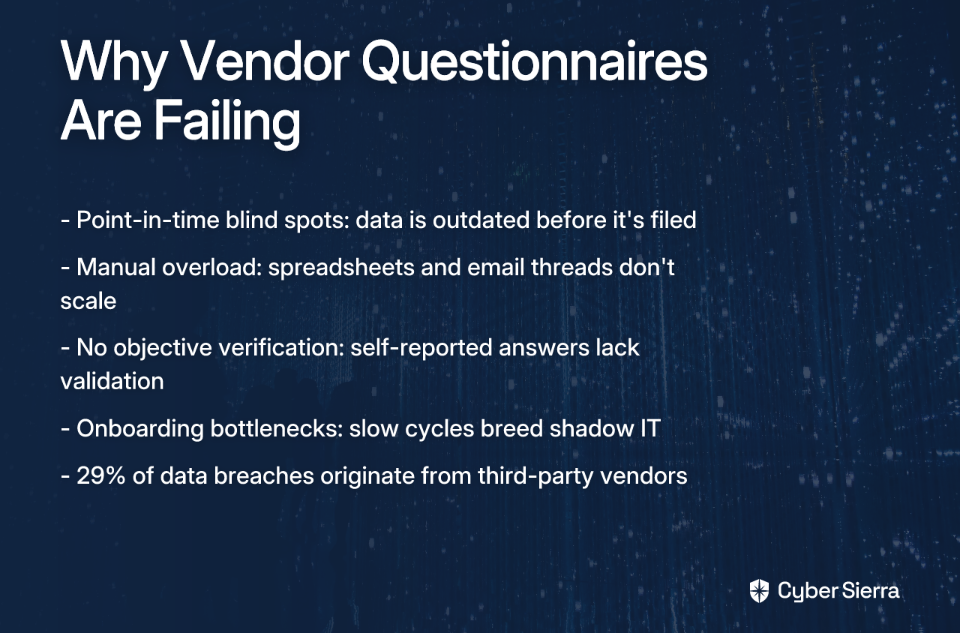
Point-in-time blind spots. A questionnaire captures a snapshot of a vendor's security posture on the day they complete it. According to Bitsight's research, 80% of legal and compliance leaders recognize that third-party risks often surface after initial onboarding — meaning the questionnaire you spent weeks collecting is already outdated before you file it.
Manual overload. Chasing vendors across email threads, tracking completion status in spreadsheets, and reconciling version-controlled documents isn't a risk management program — it's a data entry job. It's error-prone, time-consuming, and scales poorly as your vendor inventory grows.
No objective verification. Self-reported answers are only as trustworthy as the vendor completing them. Without automated, external validation layered on top of questionnaire responses, you're working on good faith.
Onboarding bottlenecks. When assessment cycles take weeks, critical vendor relationships get delayed — or worse, teams bypass the process entirely and spin up unapproved tools. That's a shadow IT problem waiting to happen.
The data reinforces the urgency: SecurityScorecard reports that 29% of all data breaches originate from third-party vendors. A static questionnaire isn't a defense strategy.
Key Features of Modern TPRM Automation Software
Not all Third-Party Risk Management (TPRM) platforms are built the same. When evaluating your options, these are the capabilities that separate genuinely useful tools from glorified form builders.
- Automated questionnaire workflows. The platform should handle the full lifecycle — sending questionnaires, tracking response rates, sending reminders, and flagging incomplete answers — without requiring manual intervention at each step.
- AI-assisted questionnaire completion. Tools like UpGuard's AI Autofill can suggest responses based on prior submissions, cutting vendor completion time from weeks to hours.
- Continuous monitoring. This is the critical capability beyond static forms. Continuous external monitoring for newly discovered vulnerabilities provide the persistent visibility that questionnaires simply can't.
- Pre-built, framework-mapped templates. An editable questionnaire library aligned to GDPR, PCI DSS, ISO 27001, HIPAA, and SOC 2 accelerates compliance gap discovery without building assessments from scratch.
- Automated risk scoring and prioritization. The platform should calculate a vendor's risk level based on both questionnaire data and continuous monitoring signals, so your team focuses on the highest-risk relationships first.
- Centralized vendor lifecycle management. Onboarding, ongoing assessments, remediation tracking, and offboarding should all live in one place — not scattered across email, spreadsheets, and shared drives.
- Integration capabilities. Your TPRM tool needs to connect with existing Governance, Risk, and Compliance (GRC) platforms, Security Information and Event Management (SIEM) systems, and IT tooling. A platform that exists as an isolated silo creates more problems than it solves.
The Best Third Party Risk Management Software for Automating Vendor Questionnaires
Here's a look at the platforms that consistently stand out for automating vendor assessments and delivering continuous visibility into third-party risk.
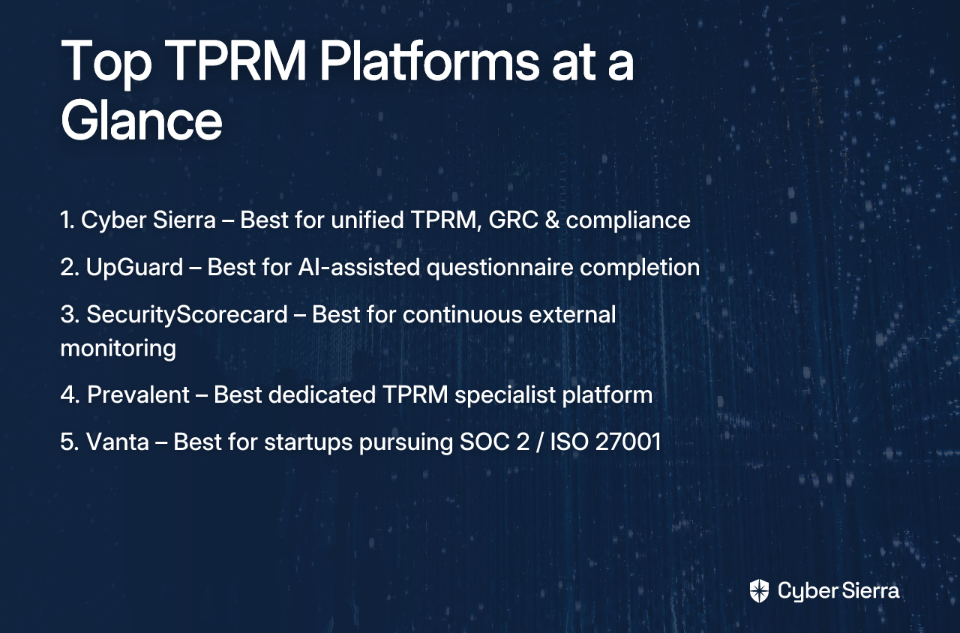
1. Cyber Sierra
Best for: Enterprises needing a unified platform that combines TPRM with continuous compliance, GRC, and threat intelligence. Supported frameworks: SOC 2, ISO 27001, HIPAA, PCI DSS, GDPR, PDPA, MAS TRM. Deployment: Cloud-based SaaS.
Cyber Sierra's TPRM module is designed to move organizations away from periodic, manual assessments toward proactive, near real-time risk management. What sets it apart from standalone questionnaire tools is how deeply it integrates with the rest of the platform — connecting vendor risk data to continuous control monitoring, GRC, and threat intelligence in a single unified environment.
The platform is recognized as a Sample Vendor in the Gartner® Hype Cycle™, and holds accreditation from the Cyber Security Agency of Singapore (CSA).
Key features:
- Comprehensive vendor assessment. Pre-built, customizable questionnaire templates help score vendors based on their specific risk profile and the frameworks you operate under.
- Continuous vendor monitoring. Automated scans assess the effectiveness and currency of vendor security controls on an ongoing basis — not just at onboarding.
- Automated vendor discovery. Pre-built integrations with accounting and IT systems surface vendors automatically, reducing manual inventory work.
- Collaborative remediation workflows. A built-in progress tracker lets teams assign tasks, communicate with vendors, and manage remediation in one place.
2. UpGuard
Best for: Teams looking for a user-friendly interface with strong AI features for accelerating questionnaire completion. Supported frameworks: GDPR, PCI DSS, ISO 27001, NIST Cybersecurity Framework (NIST CSF). Deployment: Cloud-based SaaS.
UpGuard combines security ratings, automated risk detection, and streamlined questionnaire workflows into an intuitive platform. Its standout feature is AI Autofill, which suggests questionnaire responses based on a vendor's prior submissions, significantly reducing the back-and-forth that slows most assessments down.
Key features:
- AI-enhanced questionnaires. AI Autofill helps vendors complete security assessments faster using a secure, curated knowledge base.
- Security ratings. Real-time, data-driven scores of a vendor's external security posture provide objective context alongside self-reported answers.
- Risk remediation workflows. Structured collaboration tools help teams work with vendors to prioritize and resolve identified issues.
- Editable questionnaire templates. A library of framework-aligned assessments makes compliance gap analysis faster to set up and easier to customize.
3. SecurityScorecard
Best for: Organizations that prioritize continuous external monitoring and executive-level risk reporting. Supported frameworks: Various, with mapping to common standards. Deployment: Cloud-based SaaS.
SecurityScorecard is well-established in the security ratings space, providing A–F grades on vendor security posture based on externally observable data — without requiring intrusive scans. Its Atlas product is specifically designed to streamline sending, receiving, and analyzing security questionnaires at scale.
Key features:
- Continuous risk monitoring. Ongoing visibility into vendor risk profiles with alerts triggered by meaningful changes in security posture.
- Automated security ratings. Objective, outside-in measurement of any vendor's security health, independent of their self-reported answers.
- Atlas for questionnaires. Automates the full questionnaire lifecycle, linking responses to continuous monitoring data for a more complete risk picture.
- Board summary reports. Pre-built executive summaries translate technical risk signals into language that resonates with non-technical stakeholders.
4. Prevalent
Best for: Companies seeking a dedicated TPRM specialist with access to a broad vendor risk data network. Supported frameworks: Standard and custom frameworks. Deployment: Cloud-based SaaS.
Prevalent focuses exclusively on third-party and fourth-party risk management — it's what they do, full stop. Practitioners in the community frequently recommend it for organizations that want a purpose-built TPRM solution rather than a feature within a broader GRC platform.
Key features:
- Third-party risk exchange. Access to a network of completed vendor risk reports accelerates due diligence without starting from scratch each time.
- Hybrid assessment model. Blends point-in-time assessments with continuous external monitoring to catch risks that emerge between formal review cycles.
- Remediation guidance. Actionable recommendations help vendors understand what needs to change and how to improve their posture.
5. Vanta
Best for: Startups and SMBs primarily focused on achieving SOC 2 or ISO 27001 certification. Supported frameworks: SOC 2, ISO 27001, HIPAA, GDPR. Deployment: Cloud-based SaaS.
Vanta's strength is compliance automation for growing companies preparing for their first major audit. Vendor risk reviews are included as part of the broader compliance workflow, making it a practical choice for teams that need to satisfy SOC 2 vendor management requirements without building a standalone TPRM program.
Key features:
- Compliance-focused vendor reviews. Streamlines the vendor evaluation process as a component of SOC 2 and ISO 27001 audit preparation.
- User-friendly dashboard. An intuitive layout makes it easy to track outstanding compliance tasks, including vendor assessments, in one place.
- Automated evidence collection. Automates evidence gathering for your own controls, reducing the manual effort required around audit cycles.
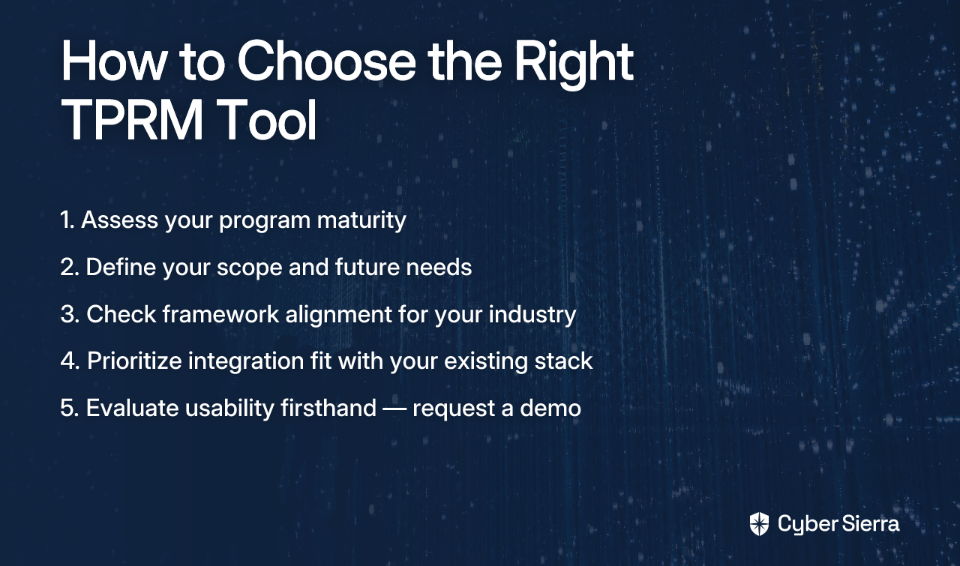
How To Choose the Right TPRM Tool for Your Needs
The right platform depends on where your program is today and what you need it to do. Use this as a practical starting point before committing to a demo or a procurement cycle.
From Manual Checklists to Continuous Confidence
Leaving spreadsheets behind is a start, but the real win isn't just faster paperwork—it's genuine visibility. Effective third-party risk management boils down to two key shifts:
- Moving from static to continuous: A questionnaire is a point-in-time snapshot. Continuous external monitoring shows you what's happening with a vendor's security posture today.
- Unifying vendor and internal risk: Your vendor risk data shouldn't live in a silo. Connecting TPRM to your overall GRC and compliance program gives you a complete, actionable picture.
Here’s a practical next step: This week, identify your top three critical vendors and the last time their security posture was formally reviewed. If it was more than six months ago, you have a visibility gap.
When you're ready to close that gap for good, explore Cyber Sierra's TPRM to see how automation and continuous monitoring turn a reactive process into a proactive advantage.
Frequently Asked Questions
What is third-party risk management (TPRM) software?
TPRM software helps organizations manage and mitigate risks arising from their third-party vendors. It automates tasks like sending security questionnaires, continuously monitoring vendor security posture, and tracking remediation, replacing manual spreadsheets with a centralized, efficient platform.
Why should I automate vendor security questionnaires?
Automating vendor security questionnaires saves time, reduces human error, and provides a more accurate, timely view of vendor risk. Manual processes are slow and create point-in-time blind spots. Automation streamlines the entire lifecycle, from distribution to analysis, freeing your team to focus on high-risk issues.
What are the key features to look for in a TPRM tool?
The most important features for a TPRM tool include automated questionnaire workflows, continuous external monitoring, and integration capabilities with your existing tech stack. Also look for AI-assisted completion, pre-built templates for frameworks like SOC 2 and ISO 27001, and automated risk scoring.
How is TPRM different from GRC?
TPRM focuses specifically on risks from external vendors, whereas GRC (Governance, Risk, and Compliance) is a broader strategy for managing an organization's overall risk. Many modern platforms, like Cyber Sierra, integrate TPRM into a unified GRC solution for a complete view of internal and external risk.
What is continuous vendor monitoring and why is it important?
Continuous vendor monitoring is the ongoing, automated assessment of a vendor's security posture. It is crucial because vendor risks change daily. This provides real-time visibility into new vulnerabilities that static, point-in-time questionnaires would miss, enabling proactive risk management.
How do I choose the best TPRM software for my company?
To choose the best TPRM software, assess your program's maturity, define your scope, ensure it supports your industry's compliance frameworks, and prioritize integrations. Always evaluate usability with a product demo, as a startup's needs for SOC 2 will differ from an enterprise requiring a unified platform.
