



7 Best HIPAA Compliance Tools for Telehealth and Remote Patient Monitoring

Join thousands of professionals and get the latest insight on Compliance & Cybersecurity.
Summary
- The post-COVID grace period for using non-compliant telehealth platforms has ended, requiring all healthcare providers to use vendors that meet strict HIPAA security standards.
- A signed Business Associate Agreement (BAA) is a non-negotiable legal requirement for any vendor handling patient data, and is the first step toward compliance.
- Choosing the right tool depends on your organization's specific gaps, from secure video conferencing and email to integrated EHRs.
- For HealthTech companies scaling their operations, automating compliance with a GRC platform helps manage vendor risk and provides a continuous view of their security posture.
If you've ever sat through a dropped therapy call, a frozen screen mid-consultation, or spent weeks trying to figure out whether your telehealth vendor actually signs a Business Associate Agreement (BAA), you already know the frustration. The tools that clinicians and HealthTech teams rely on daily are held to a legal standard that most general-purpose software simply wasn't built for.
The stakes got higher after the COVID-19 public health emergency ended. The temporary enforcement discretion that allowed providers to use platforms like FaceTime and Skype is gone. The HHS Office for Civil Rights now requires covered entities to use fully HIPAA-compliant vendors, and the 90-day transition period ended in 2023.
That means if your stack isn't locked down, you're exposed.
This guide covers 7 of the best HIPAA compliance tools for telehealth and Remote Patient Monitoring (RPM) — from secure video platforms to full Governance, Risk, and Compliance (GRC) systems — so you can make an informed decision based on your organization's actual needs.
What Makes a Telehealth Tool HIPAA Compliant?
Before diving into specific platforms, it's worth establishing what "HIPAA compliant" actually means in practice.
The BAA is non-negotiable. Any vendor that handles electronic Protected Health Information (ePHI) on your behalf must sign a BAA. This is a legally binding contract requiring them to protect ePHI in accordance with HIPAA standards. Per HHS telehealth guidance, no BAA means no compliance — full stop.
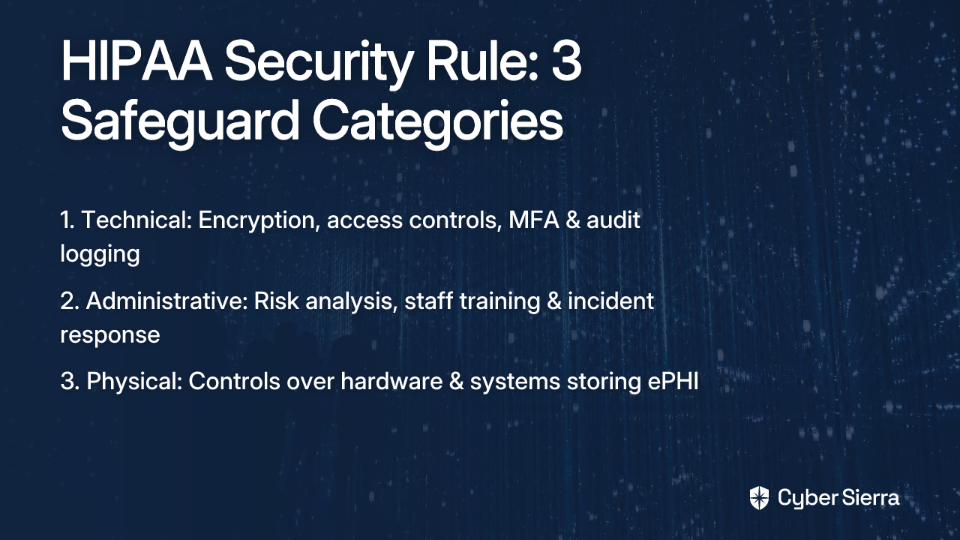
Beyond the BAA, a compliant tool must support your obligations under the HIPAA Security Rule, which covers three categories of safeguards:
One common pitfall: assuming software does the work. As one HealthTech founder put it bluntly, "Compliance is about processes. No tool is gonna design and enforce processes for you." The tool enables compliance — but the covered entity is ultimately responsible for implementing the policies, training staff, and documenting everything.
7 Best HIPAA Compliance Tools for Telehealth and RPM
The tools below span different use cases — from secure video conferencing to comprehensive HIPAA compliance platforms — because "the right tool" depends entirely on your organization's size, structure, and where the gaps are.
1. Cyber Sierra
Best for: CISOs and compliance managers in HealthTech startups and enterprises needing a unified platform for GRC, continuous monitoring, and vendor risk. Supported frameworks: HIPAA, SOC 2, ISO 27001, PCI DSS, GDPR, NIST CSF. Deployment: Cloud-based SaaS.
Cyber Sierra is an AI-enabled cybersecurity platform built for organizations that need to manage HIPAA compliance as part of a broader security program — not just tick a checkbox for a single audit. For HealthTech teams juggling multiple frameworks, the manual evidence collection and scattered documentation that comes with traditional compliance programs creates real risk. Cyber Sierra addresses that directly.
Its Continuous Control Monitoring module automates control testing and evidence collection in near real-time, so compliance posture is visible continuously — not just in the weeks before an audit. The Third-Party Risk Management module is particularly relevant for telehealth organizations, where BAA management and ongoing vendor security assessments are critical obligations under HIPAA.
Key features:
- Continuous control monitoring. Automates evidence collection and tracks HIPAA controls in near real-time, surfacing gaps before they become audit findings.
- GRC automation. Manages policies, risk assessments, and control mapping across overlapping frameworks like HIPAA and SOC 2, reducing duplicated effort.
- Third-party risk management. Automates vendor assessments and provides ongoing visibility into the security posture of telehealth and RPM vendors — core to managing BAA obligations.
- Employee security training. Includes interactive security awareness training and simulated phishing campaigns to support HIPAA's administrative safeguard requirements.
Cyber Sierra is recognized as a Sample Vendor in the 2024 Gartner® Hype Cycle™ and holds ISO 27001 certification.

2. Zoom for Healthcare
Best for: Healthcare providers of all sizes needing a reliable, high-quality video conferencing platform for telehealth sessions. Supported frameworks: HIPAA, HITECH. Deployment: Cloud-based application.
Zoom is one of the most frequently recommended platforms among clinicians — and with good reason. When therapists and providers compare notes, Zoom Healthcare consistently comes up as a very stable option. As one therapist noted, "I tried Doxy and SimplePractice and they were both so glitchy. With Zoom, I can even use the same meeting link for everyone." Connection instability isn't just an inconvenience — it directly compromises the quality of care.
The dedicated Zoom for Healthcare plan includes a signed BAA and applies security configurations specifically designed to meet HIPAA requirements. It's worth noting that standard Zoom accounts are not HIPAA compliant — you need the healthcare-specific plan, and settings must be properly configured. Per Fortinet's analysis of Zoom, the onus is on the organization to enable the right settings, not just subscribe to the plan.
Key features:
- Signed BAA. Included with the Zoom for Healthcare plan, satisfying a foundational HIPAA vendor requirement.
- End-to-end encryption. Protects video, audio, and chat data during sessions.
- Access controls. Waiting rooms, passcodes, and host management controls prevent unauthorized session access.
- EHR integrations. Connects with popular Electronic Health Record (EHR) systems to reduce administrative burden.
3. Doxy.me
Best for: Solo practitioners and small clinics needing a simple, browser-based telehealth solution with a free compliant tier. Supported frameworks: HIPAA, HITECH, GDPR. Deployment: Web-based — no downloads required.
Doxy.me was built specifically for healthcare, and its defining feature is simplicity. Patients join a session by clicking a link — no software download, no account creation required. For solo practitioners and small practices that can't absorb complex onboarding, this matters.
The free tier includes a signed BAA and end-to-end encryption, making it one of the most accessible entry points into HIPAA-compliant telehealth. Some users do report connectivity issues at the free tier, so organizations with higher session volume or more demanding use cases may want to evaluate the paid plans.
Key features:
- No-download patient experience. Reduces friction for patients joining sessions, particularly those with limited technical comfort.
- Free HIPAA-compliant tier. Includes a BAA — suitable for low-volume practices.
- End-to-end encryption. All sessions are encrypted to protect ePHI in transit.
- Virtual waiting room. Lets clinicians manage patient queues and control session timing.
4. Vanta
Best for: HealthTech startups and SaaS companies that need to automate compliance evidence collection across HIPAA and other frameworks simultaneously. Supported frameworks: HIPAA, SOC 2, ISO 27001, GDPR. Deployment: Cloud-based SaaS.
Vanta is a trust management platform that connects to your cloud infrastructure, identity providers, and SaaS tools to continuously monitor your environment against compliance controls. For startups that ship fast and need to demonstrate compliance to enterprise customers or investors, Vanta accelerates the process significantly.
Its automated evidence collection is a standout capability — it reduces the hundreds of manual hours typically spent gathering screenshots and logs before an audit. For HealthTech companies where HIPAA and SOC 2 requirements overlap extensively, Vanta's cross-framework mapping helps avoid redundant work across control sets.
Key features:
- Continuous monitoring. Real-time checks of cloud configurations and system settings against HIPAA controls.
- Automated evidence collection. Significantly reduces manual audit preparation effort.
- Risk assessment module. Supports the documented security risk analysis required under HIPAA's administrative safeguards.
- Employee training tracking. Monitors completion of security awareness training across the team.
5. Compliancy Group
Best for: Small to medium-sized practices that need structured, guided support to achieve and maintain HIPAA compliance — without a dedicated compliance team. Supported frameworks: HIPAA, HITECH. Deployment: Cloud-based software with dedicated compliance coaching.
Compliancy Group takes a different approach to the market: it pairs software with human coaching. Their platform, "The Guard," walks organizations through risk assessments, policy creation, employee training, and BAA management — with a dedicated compliance coach assigned to guide the process. For practices that don't have a Chief Information Security Officer (CISO) or compliance manager on staff, this combination of tooling and expertise is genuinely useful.
Key features:
- Guided compliance coaching. A dedicated coach walks users through the entire compliance process step by step.
- All-in-one platform. Manages risk assessments, policies, BAAs, and employee training in a single environment.
- HIPAA Seal of Compliance. A verifiable indicator that can be displayed to patients and partners to signal compliance status.
- Audit support. Provides assistance navigating government audits if they occur.
6. Paubox
Best for: Organizations that need frictionless, automatic encryption for HIPAA-compliant email communication. Supported frameworks: HIPAA, HITECH. Deployment: Cloud-based email security gateway.
Email is a high-risk channel for ePHI, and standard email services — including default configurations of Google Workspace and Microsoft 365 — are not HIPAA compliant. Paubox addresses this with zero-step email encryption: every outbound email is automatically encrypted without requiring the sender or recipient to use a separate portal, enter an extra password, or change their workflow.
For telehealth organizations where providers regularly communicate test results, appointment details, or care instructions via email, Paubox closes a gap that many teams don't realize exists until after an incident.
Key features:
- Automatic encryption. All outbound emails are encrypted by default — no manual steps required by sender or recipient.
- Seamless inbox delivery. Recipients receive encrypted emails directly in their inbox, with no additional steps to open them.
- HITRUST CSF certified. Demonstrates adherence to a recognized security and compliance standard.
- Inbound email security. Filters phishing attempts, malware, and other email-based threats before they reach staff inboxes.
7. SimplePractice
Best for: Private practice therapists and wellness professionals needing an integrated EHR and telehealth solution in one platform. Supported frameworks: HIPAA. Deployment: Cloud-based SaaS.
SimplePractice combines Electronic Health Record (EHR) functionality with a built-in HIPAA-compliant telehealth platform, making it a practical choice for solo and small group practices that want one tool to handle scheduling, client records, billing, and video sessions together. The integration reduces the risk of ePHI being passed between disconnected systems — a common source of compliance gaps.
Some users report connectivity issues with the video platform, a frustration that echoes across several telehealth tools. But for practices where administrative efficiency and EHR integration matter as much as video quality, SimplePractice remains a strong contender.
Key features:
- Integrated telehealth. Video sessions are built directly into the client portal and scheduling workflow.
- Secure client portal. Enables encrypted messaging, document sharing, and appointment management between sessions.
- Paperless intakes. Clients complete and sign consent forms electronically before sessions.
- Automated billing. Handles invoicing and insurance claims from within the same platform.
How To Choose the Right HIPAA Compliance Tool
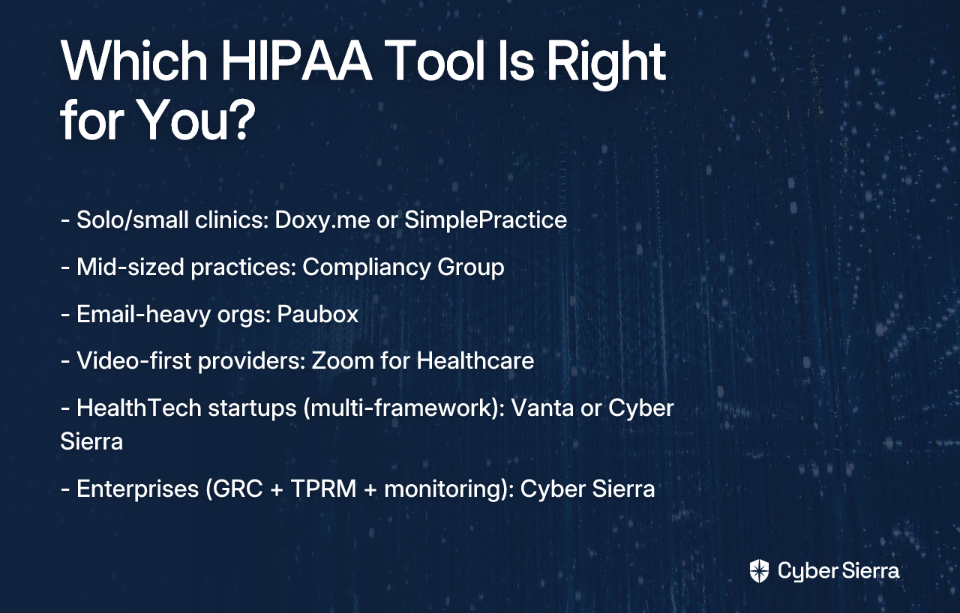
The right tool depends on what problem you're actually trying to solve. Here's a quick framework for choosing:
Don't over-invest in tooling before you've mapped your actual gaps. A security risk analysis — required under HIPAA's administrative safeguards — is the right starting point.
Turn Your Tools Into a Compliance System
Choosing the right HIPAA-compliant tool is a critical first step, but it doesn't end there. True compliance is about building a durable system around those tools, not just ticking a box. Here are the key takeaways:
- The BAA is your foundation. A signed Business Associate Agreement is non-negotiable. If a vendor won't sign one, they cannot handle ePHI.
- Match the tool to the real gap. Don't buy a comprehensive GRC platform if your only problem is unencrypted email. Identify your specific risk before you invest.
Your next step is clear: conduct a thorough security risk analysis. This isn't just a suggestion; it's a HIPAA requirement that provides the blueprint for your entire compliance program by showing you exactly where you're vulnerable.
Once you see where manual vendor checks and endless audit prep create friction, automation is the answer. To see how a unified platform can streamline your HIPAA program, explore Cyber Sierra and turn compliance from a recurring headache into a sustainable advantage.
Frequently Asked Questions
What makes a telehealth tool HIPAA compliant?
A tool is only HIPAA compliant if the vendor signs a Business Associate Agreement (BAA). This legal contract requires them to protect ePHI according to HIPAA rules. Key features like end-to-end encryption, access controls, and audit logs are also necessary to support your compliance obligations.
Can I still use standard tools like FaceTime or Skype for telehealth?
No, you can no longer use consumer-grade tools like FaceTime or Skype. The temporary enforcement discretion from the COVID-19 public health emergency has ended. Healthcare providers must now use vendors that will sign a BAA and meet all HIPAA security and privacy requirements.
Does using HIPAA-compliant software make my organization compliant?
No, software alone does not guarantee compliance. These tools provide the necessary security features, but your organization is ultimately responsible for implementing compliant processes, including conducting risk analyses, training staff, creating policies, and managing vendor BAAs.
How do I choose the right HIPAA compliance tool for my practice?
Start by conducting a security risk analysis to identify your specific gaps. A solo therapist may only need an integrated EHR like SimplePractice, whereas a HealthTech startup may need a GRC platform like Cyber Sierra to manage compliance across multiple frameworks like HIPAA and SOC 2.
What are the main categories of HIPAA compliance tools?
The main types include: dedicated video conferencing platforms (Zoom for Healthcare), all-in-one EHR and practice management systems (SimplePractice), secure email services (Paubox), and comprehensive Governance, Risk, and Compliance (GRC) platforms that automate monitoring and audit prep.
Why is a Business Associate Agreement (BAA) so important?
A BAA is a legally required contract between your organization and any vendor that handles ePHI on your behalf. It contractually obligates the vendor to protect that data according to HIPAA standards, ensuring they are also liable for breaches. Without a BAA, you have no legal assurance of protection.
