



Best Compliance Automation Platforms for Companies With No Compliance Team

Join thousands of professionals and get the latest insight on Compliance & Cybersecurity.
You're an engineer, an IT manager, or maybe a founder wearing a dozen hats — and somewhere along the way, "compliance" landed on your plate. Now audit season rolls around and you're on long calls with engineers who may or may not speak Governance, Risk, and Compliance (GRC), hoping they remember where to find a config and can take a screenshot with a timestamp. It's painful, and it sucks up time no one has.
The problem is compounded for companies without a dedicated compliance team. Every evidence request, every framework update, every audit cycle falls on people who have real jobs to do. Compliance fatigue is real — especially when you're juggling overlapping requirements across SOC 2, ISO 27001, HIPAA, and PCI DSS simultaneously.
The good news: a compliance automation platform doesn't just reduce effort at the margins — it changes how compliance gets done entirely. This guide breaks down what compliance automation actually covers, how to choose the right tool, and which platforms are worth your time.
What Compliance Automation Actually Does
Compliance automation uses software to streamline the repetitive, manual tasks that eat up hours during audit cycles. At its core, it shifts compliance from a periodic fire drill to a continuous, managed process.
Here's what a good platform can automate:
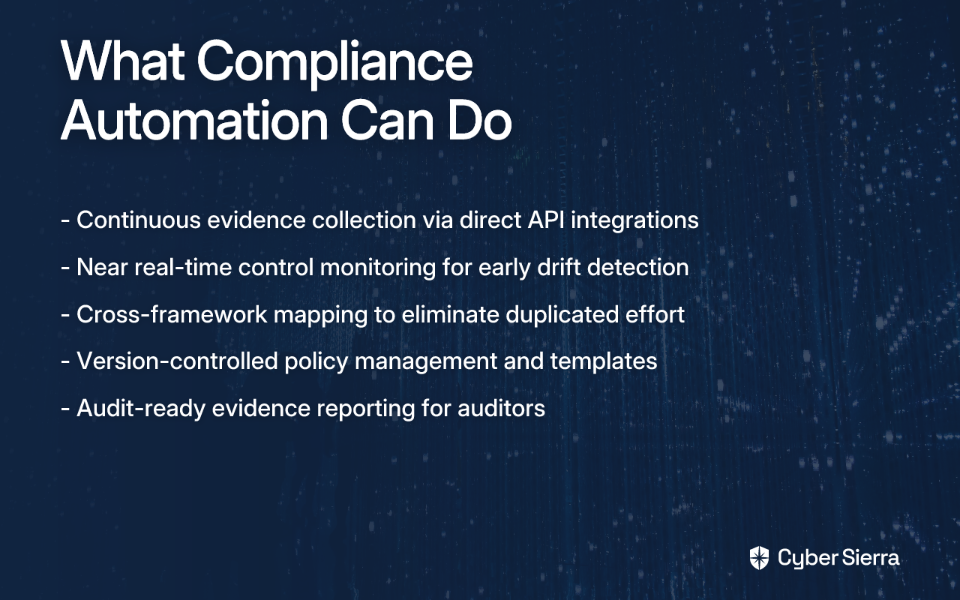
A common misconception is that automation eliminates all the work. It doesn't — someone still needs to configure the platform, review findings, and make decisions. But the manual grunt work that dominates audit prep? That's where automation pays off most.
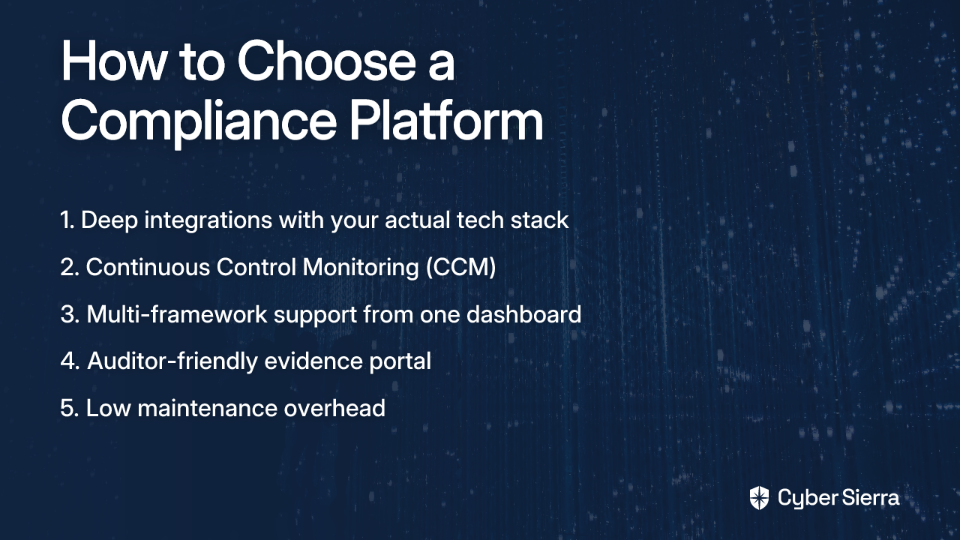
How to Choose the Right Compliance Automation Platform
Not every compliance automation platform is built for lean teams. Some are designed for enterprise security departments with dedicated GRC analysts. If you don't have that, here's what to prioritize.
Best Compliance Automation Platforms for Lean Teams
The platforms below are well-suited for organizations without a full-time compliance team. Each offers a different balance of breadth, depth, and usability.
Here's a look at the top options.
1. Cyber Sierra
Best for: Companies needing a unified platform that combines compliance automation with continuous monitoring, vendor risk, and threat intelligence. Supported frameworks: SOC 2, ISO 27001, HIPAA, PCI DSS, GDPR, NIST CSF, and more. Deployment: Cloud-based SaaS.
Cyber Sierra is an AI-enabled cybersecurity platform built to consolidate what most teams are managing across four or five separate tools. Its GRC module automates evidence collection, control monitoring, and audit reporting across multiple frameworks from a single dashboard — making it particularly practical for IT managers and Chief Information Security Officers (CISOs) who need audit readiness without dedicated compliance headcount.
What sets it apart from point-solution compliance tools is its integration of security operations alongside compliance. Continuous Control Monitoring provides near real-time visibility into your controls, flagging failures before they become audit findings. The Threat Intelligence module connects compliance posture to actual vulnerabilities across your attack surface. And Third-Party Risk Management (TPRM) extends that visibility to your vendor ecosystem — critical for organizations where supply chain risk is a compliance requirement. Cyber Sierra is recognized as a Sample Vendor in the Gartner® Hype Cycle™ for Cyber-Risk Management, 2024, and holds accreditation from the Cyber Security Agency of Singapore (CSA).
Key features:
- Continuous control monitoring. Near real-time tracking of control effectiveness across cloud and SaaS environments.
- Multi-framework GRC automation. Manages SOC 2, ISO 27001, HIPAA, PCI DSS, GDPR, and custom frameworks from one place with automated evidence trails.
- Integrated vendor risk management. Automates third-party assessments and provides ongoing visibility into vendor security posture.
- Employee security training. Built-in training modules and simulated phishing campaigns address the human-layer requirements common across most compliance frameworks.
2. Vanta
Best for: Fast-growing SaaS companies pursuing their first SOC 2 or ISO 27001 certification. Supported frameworks: SOC 2, ISO 27001, GDPR, HIPAA, PCI DSS, and 20+ more. Deployment: Cloud-based SaaS.
Vanta is one of the most widely adopted compliance automation tools in the startup ecosystem. It's known for its broad integration library — over 300 connectors — and its relatively fast time-to-ready for teams that are new to formal compliance programs. The platform automates evidence collection across connected systems and includes a Trust Center feature that lets you share your security posture publicly with customers and prospects.
Vanta works best for companies whose compliance needs center on a well-defined framework like SOC 2. Teams with more complex, multi-framework or risk-heavy requirements may find themselves needing to supplement it with additional tools.
Key features:
- 300+ out-of-the-box integrations. Connects broadly across cloud, identity, and developer tools for automated evidence collection.
- Automated control testing. Continuously checks controls against framework requirements and flags failures.
- Trust Center. A shareable, public-facing security profile that communicates your compliance status to customers.
3. Drata
Best for: Cloud-native companies prioritizing real-time compliance visibility and deep framework automation. Supported frameworks: SOC 2, ISO 27001, HIPAA, PCI DSS, and 22+ frameworks. Deployment: Cloud-based SaaS.
Drata emphasizes continuous, real-time monitoring and an auditor-centric workflow. Its platform is built around minimizing the back-and-forth between security teams and auditors — a friction point that routinely delays audit completion. Drata's risk management module helps teams move beyond just collecting evidence to actively identifying and tracking risks tied to specific controls.
Key features:
- Real-time compliance dashboard. Provides live status of controls across all monitored frameworks.
- Automated evidence collection. Integrates with cloud infrastructure and SaaS tools to gather proof of controls continuously.
- Risk management workflows. Links identified risks directly to controls, supporting a more structured remediation process.
4. Scrut Automation
Best for: Mid-sized tech companies managing risk and compliance without a large in-house security team. Supported frameworks: SOC 2, ISO 27001, GDPR, HIPAA, PCI DSS. Deployment: Cloud-based SaaS.
Scrut Automation is a smart GRC platform that focuses on simplifying information security compliance for companies at the growth stage. It offers continuous control monitoring, a pre-built policy library, and an integrated risk register — all within a single interface. The centralized approach reduces the coordination overhead that typically slows down lean compliance programs.
Key features:
- Centralized control monitoring. Daily compliance checks against framework benchmarks with real-time alerts on failures.
- Pre-built policy library. Policies mapped to popular frameworks, reducing time spent drafting documentation from scratch.
- Integrated risk register. Links risks directly to controls for a connected view of your compliance and risk posture.
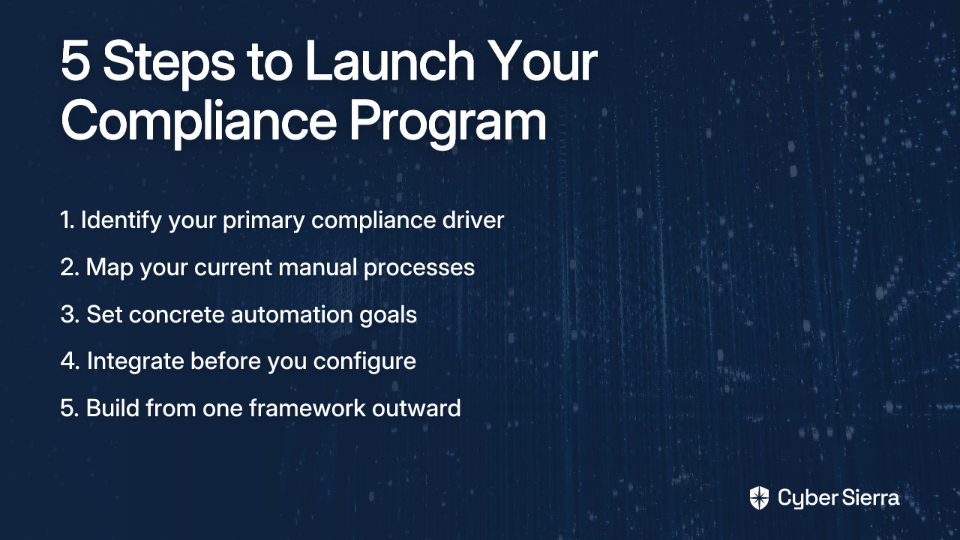
Getting Started: A Practical 5-Step Plan
Choosing a platform is only half the equation. Here's how to launch your program without a dedicated team.
Make Compliance A Background Process
Moving away from manual audit prep isn't just about saving time—it's about fundamentally shifting compliance from a disruptive fire drill to a continuous, managed background process. For lean teams, this transition is critical for maintaining security without burning out key people. The path forward is practical and starts with two core principles:
- Automate the evidence grunt work: Prioritize a platform that integrates deeply with your tech stack to pull evidence automatically. This frees your engineers from screenshot duty and endless data requests.
- Monitor controls in real-time: Continuous Control Monitoring (CCM) gives you a live look at your security posture, letting you detect and fix configuration drift long before an auditor finds it.
Your next step is simple: map out the single most time-consuming task from your last audit. That's your first, highest-impact target for automation.
When you're ready to see how a unified platform automates GRC, vendor risk, and continuous monitoring in one place, we can help. See how lean teams stay audit-ready and explore Cyber Sierra’s platform.
Frequently Asked Questions
What is compliance automation?
Compliance automation uses software to streamline and replace manual compliance tasks. It shifts compliance from a periodic, stressful event to a continuous process by automating evidence collection, control monitoring, and audit reporting, helping teams stay audit-ready year-round.
How does compliance automation help teams without dedicated compliance staff?
It significantly reduces the manual workload on engineers and IT managers. By automating repetitive tasks like evidence gathering and control checks, it frees up technical teams to focus on their core jobs, preventing burnout and making audit preparation far more efficient.
What are the most important features in a compliance automation platform?
Key features include deep integrations with your tech stack, continuous control monitoring (CCM), and multi-framework support. Also look for an auditor-friendly evidence portal and low maintenance overhead, ensuring the tool works for you, not the other way around.
Can one tool manage multiple compliance frameworks like SOC 2 and ISO 27001?
Yes, modern compliance automation platforms are designed to manage multiple frameworks from a single dashboard. They use cross-framework mapping to map a single piece of evidence to multiple controls, saving you from duplicating efforts for different audits like SOC 2, ISO 27001, and HIPAA.
Does compliance automation mean I don't need a compliance expert?
No, it doesn't completely eliminate the need for human oversight. The platform automates the manual "grunt work," but someone still needs to configure the tool, review findings, and make strategic decisions. It makes an expert's job easier, not obsolete.
What is continuous control monitoring (CCM)?
Continuous Control Monitoring (CCM) is an automated process that continuously tests your security controls against compliance requirements. Instead of checking controls only during audit season, CCM provides near real-time visibility, allowing you to detect and fix issues early.
