



10 Continuous Controls Monitoring Solutions That Integrate with SIEM Tools

Join thousands of professionals and get the latest insight on Compliance & Cybersecurity.
Summary
- SIEM tools generate thousands of alerts daily but only tell you what happened, not why a security control failed, leading to alert fatigue.
- Continuous Control Monitoring (CCM) complements SIEM by continuously validating your security controls, providing the essential context to understand the "why" behind an event.
- When choosing a CCM solution, prioritize deep SIEM integration that offers alert enrichment, automated evidence collection, and support for key compliance frameworks like NIST and ISO 27001.
- A unified platform like Cyber Sierra's Continuous Control Monitoring enriches SIEM data with GRC and threat intelligence context, helping teams move from reactive alerts to proactive risk management.
Your Security Information and Event Management (SIEM) tool is generating thousands of alerts a day. Your team is drowning in them — and still, somehow, the most critical control failures slip through unnoticed. As one practitioner noted, most teams are still tracking compliance tasks on "a lovely excel spreadsheet," manually chasing down evidence that's stale by the time it's collected.
The problem isn't your SIEM. The problem is that SIEMs tell you what happened — not why your controls failed to stop it.
That's where Continuous Control Monitoring (CCM) fills the gap. CCM continuously validates that your security controls are operating as intended. When integrated with a SIEM, it transforms raw log data into context-rich, actionable intelligence — so your team spends less time triaging noise and more time remediating real risk.
This article covers 10 leading continuous controls monitoring solutions that integrate well with SIEM tools, what makes each one worth evaluating, and the key features to look for before you commit.
Why Your SIEM Needs a CCM Partner
A SIEM aggregates and correlates log data across your infrastructure to surface security events in near real-time. It pulls from key sources, including:
- Endpoints
- Servers
- Network devices
- Cloud workloads
It answers: what is happening on our network?
CCM answers a different question: are our security safeguards actually working?
Where a SIEM monitors events, CCM monitors the state and effectiveness of controls themselves. It automates testing against specific policies and compliance frameworks like NIST 800-53, ISO 27001, and PCI DSS. As Qmulos describes it, CCM provides automated, real-time insights into control effectiveness — moving organizations beyond the periodic audit snapshot that only shows what was true on one specific day.
The integration between the two creates something neither can achieve alone:
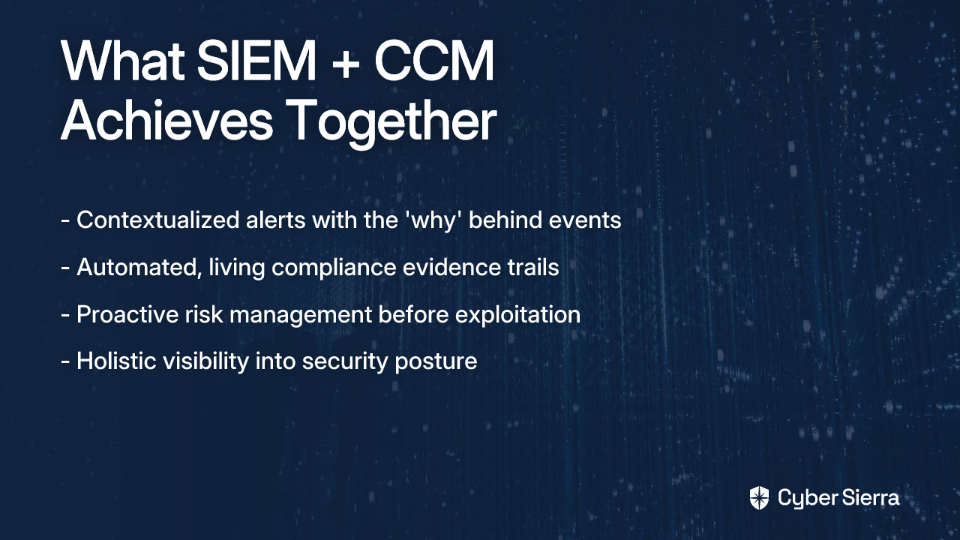
- Contextualized alerts. A SIEM alert for anomalous login attempts is noise. That same alert cross-referenced with a CCM notification that MFA enforcement has failed on a critical system becomes an urgent, high-priority incident. CCM provides the "why" behind the SIEM's "what."
- Automated compliance evidence. Instead of manually pulling SIEM logs before an audit, an integrated CCM platform links control test results to relevant event logs continuously — creating a living, auditable trail that satisfies auditor requirements without the scramble.
- Proactive risk management. CCM identifies control drift before it can be exploited. Feeding these signals into a SIEM lets your Security Operations Center (SOC) act on leading risk indicators — not just lagging indicators of an attack already underway. Ascera notes this is how CCM transforms compliance from reactive to proactive.
- Holistic visibility. Integration provides a single view of both security events and control posture — addressing the CISO's persistent challenge of answering "how secure are we?" with any real confidence.
10 CCM Solutions with Strong SIEM Integration
Each solution below offers meaningful integration capabilities with SIEM platforms. Depth, approach, and use cases differ — evaluate them against your environment and the frameworks you operate under.
1. Cyber Sierra
Best for: Enterprises needing a unified platform covering GRC, TPRM, Threat Intelligence, and CCM — all feeding enriched context into existing SIEM infrastructure.
Supported frameworks: NIST CSF, ISO 27001, PCI DSS, GDPR, HIPAA, SOC 2, and custom controls.
Deployment: Cloud-based SaaS.
Cyber Sierra's continuous control monitoring platform is built around a central controls repository that maintains near real-time updates across all mapped frameworks. Rather than duplicating what a SIEM does, it enriches SIEM data — pushing control failure alerts, compliance status changes, and risk intelligence into the SIEM so teams can build correlation rules that surface genuinely high-priority incidents.
The platform's AI-enabled risk scoring helps SOC teams distinguish signal from noise by adding internal context — asset criticality, associated compliance frameworks, control ownership, and remediation history — to events that would otherwise be low-fidelity alerts. Automated evidence collection runs continuously, pulling data from integrated cloud, identity, and endpoint systems to validate that controls are operating as intended.
Key features:
- Central controls repository. Consolidates all controls in a single source of truth, mapped across multiple frameworks simultaneously.
- AI-enabled alert prioritization. Uses multi-factor risk scoring to surface the alerts that actually matter, reducing the manual triage burden on analysts.
- Automated control testing. Continuously pulls evidence from integrated systems to validate control effectiveness, keeping the organization audit-ready between formal reviews.
- Actionable risk intelligence. Translates control status data into business risk dashboards, enabling data-driven remediation decisions rather than gut-feel prioritization.
Cyber Sierra is recognized as a Sample Vendor in the Gartner® Hype Cycle™ for Cyber-Risk Management, 2024, and is accredited by the Cyber Security Agency of Singapore as a trusted service provider.
2. Quod Orbis
Best for: Organizations focused on cyber asset management and streamlining internal audit workflows.
Deployment: Cloud-based SaaS.
Quod Orbis centers on Cyber Asset Attack Surface Management (CAASM), giving security teams a structured view of what they own and how it maps to control requirements. Its platform automates control auditing and risk management, with the resulting asset and risk posture data shareable to SIEM environments for broader correlation.
Key features:
- Automated control auditing. Reduces manual review cycles by continuously testing controls against policy requirements.
- CAASM capabilities. Maintains an up-to-date inventory of cyber assets, which is foundational for accurate SIEM alert context.
- Comprehensive risk management. Tracks risk across the asset inventory with documented treatment workflows.
3. Panaseer
Best for: Security posture management through multi-source data aggregation and measurement.
Deployment: Cloud-based SaaS.
Panaseer connects to a wide array of security tools, normalizes the data, and measures security posture against defined policies. It's designed specifically for the data aggregation layer — pulling inputs from endpoint, identity, cloud, and vulnerability management tools, then producing control health metrics that can be forwarded to a SIEM for correlation. Its CCM platform is built around the idea that you can't manage what you can't measure.
Key features:
- Automated security posture management. Continuously measures and scores control effectiveness across the technology stack.
- Cyber asset management. Maintains a normalized, deduplicated asset inventory across tool sources.
- Evidenced remediation tracking. Documents remediation actions with supporting evidence for audit and reporting purposes.
4. MetricStream
Best for: Organizations with significant cloud infrastructure, particularly in AWS environments, that need cloud-native control monitoring.
Deployment: Cloud-based SaaS.
MetricStream's CCM product is particularly well-suited for cloud compliance, offering deep integration with AWS and other cloud platforms to monitor configurations and controls in near real-time. For SIEMs monitoring cloud workloads, MetricStream provides a structured, compliance-mapped feed of cloud control status that would otherwise require significant manual effort to produce.
Key features:
- Automated control testing. Tests cloud configurations against policy requirements continuously, not just at audit time.
- Cloud platform integration. Native connectors for AWS simplify evidence collection across cloud infrastructure.
- Efficient evidence collection. Reduces audit preparation time by maintaining a continuous evidence repository linked to cloud configuration data.
5. Pathlock
Best for: Organizations monitoring critical business application controls — particularly those running ERP systems in financial services or manufacturing.
Deployment: Cloud-based SaaS.
Most SIEMs focus on infrastructure and network-layer events, leaving application-layer controls largely unmonitored. Pathlock fills this gap by focusing specifically on business application controls — Segregation of Duties (SoD) violations, risky transactions, and configuration changes within platforms like SAP. Its CCM platform can alert a SIEM when critical changes occur at the application layer, providing a category of visibility most security teams currently lack.
Key features:
- Configuration change monitoring. Tracks changes within business applications and flags deviations from policy.
- Business process control management. Manages SoD controls and enforces access policies across ERP environments.
- Risk quantification. Assigns risk ratings to transactions and configuration states for prioritized remediation.
6. Hyperproof
Best for: Compliance operations teams seeking a flexible, framework-agnostic platform with strong API capabilities.
Deployment: Cloud-based SaaS.
Hyperproof approaches CCM from the compliance operations angle — it integrates with cloud services and security tools to automate evidence collection, then the platform's API allows control status and evidence to be pushed to other systems, including SIEMs. Its continuous controls monitoring capability is configurable by monitoring frequency and scope, giving compliance teams meaningful control over how and when data is collected.
Key features:
- Continuous monitoring with configurable frequency. Teams can define how often controls are tested based on risk level and framework requirements.
- Streamlined assessment processes. Reduces the manual effort of evidence collection by pulling directly from integrated systems.
- API-driven integrations. Enables pushing control status data into SIEMs and other downstream platforms.
7. XM Cyber
Best for: Organizations wanting to prioritize SIEM alert response based on attack path modeling and real-world exploitability.
Deployment: Cloud-based SaaS.
XM Cyber takes a distinctive approach: rather than monitoring controls in isolation, it models how threat actors could chain vulnerabilities and misconfigurations together to reach critical assets. This attack path context can be fed into a SIEM to dramatically elevate the priority of alerts that sit on a viable attack path — turning a medium-severity finding into a critical one when it lies between a compromised endpoint and your crown jewels.
Key features:
- Attack path modeling. Maps how an attacker could move through the environment, providing prioritization context for control failures.
- Risk prioritization by exploitability. Focuses remediation on controls where failure creates real exposure — not just theoretical risk.
- Predefined critical security controls. Ships with thousands of control definitions covering common frameworks and best practices.
8. Qmulos
Best for: Organizations with significant investment in the Splunk ecosystem seeking native CCM capabilities within their existing SIEM.
Deployment: Built on Splunk (cloud and on-premises).
Qmulos is built directly on Splunk, making it the most tightly integrated option on this list for Splunk environments. Rather than adding another integration layer, it extends Splunk's data collection capabilities to provide real-time compliance and control monitoring natively within the SIEM. For teams already living in Splunk, this means unified visibility without additional data pipelines or vendor relationships.
Key features:
- Native Splunk integration. CCM runs within the Splunk environment, eliminating the need for separate data synchronization.
- Real-time control deficiency alerts. Notifies teams immediately when control failures are detected within the data Splunk already collects.
- Scalable architecture. Designed to handle the data volumes that Splunk environments typically generate without significant performance degradation.
9. Ascera
Best for: Bridging the gap between technical security data and compliance requirements using existing SIEM data as input.
Deployment: Cloud-based SaaS.
Ascera's approach inverts the typical CCM flow: rather than pushing data to a SIEM, it pulls from existing security investments — including SIEMs — to compare the actual system state against desired compliance states. The platform's continuous compliance rules engine then generates real-time alerts on compliance drift, using data the organization is already collecting. This makes it particularly practical for teams that don't want to build a parallel data collection infrastructure.
Key features:
- Continuous compliance rules engine. Compares live system state against defined compliance requirements and flags deviations in near real-time.
- Reduces manual audit data collection. Uses data already flowing through existing tools, minimizing additional collection overhead.
- Proactive control effectiveness insights. Surfaces control gaps before they become audit findings or security incidents.
10. KnowBe4 KCG
Best for: GRC and risk management teams looking for a user-friendly platform with familiar tooling for control tracking and compliance workflows.
Deployment: Cloud-based SaaS.
KnowBe4's GRC platform (KCG) is frequently cited by practitioners as a practical choice for continuous monitoring workflows. In community discussions, one user noted they "looked at a demo of KnowBe4 KCG and it looks like it is exactly what we need" — and ultimately purchased it. While it's best known as a security awareness training platform, KCG covers compliance task management, control mapping, policy management, and vendor risk — with the ability to export control status data for integration with broader security tooling.
Key features:
- Compliance and risk assessment workflows. Structured processes for tracking control implementation and managing risk treatment.
- Control mapping and policy management. Maps controls across frameworks and maintains policy documentation in a centralized repository.
- Vendor risk management modules. Tracks third-party compliance alongside internal controls for a broader risk picture.
Key Features to Evaluate in a CCM-SIEM Integration
Not all integrations are created equal. Before selecting a CCM solution, pressure-test each vendor against these criteria:
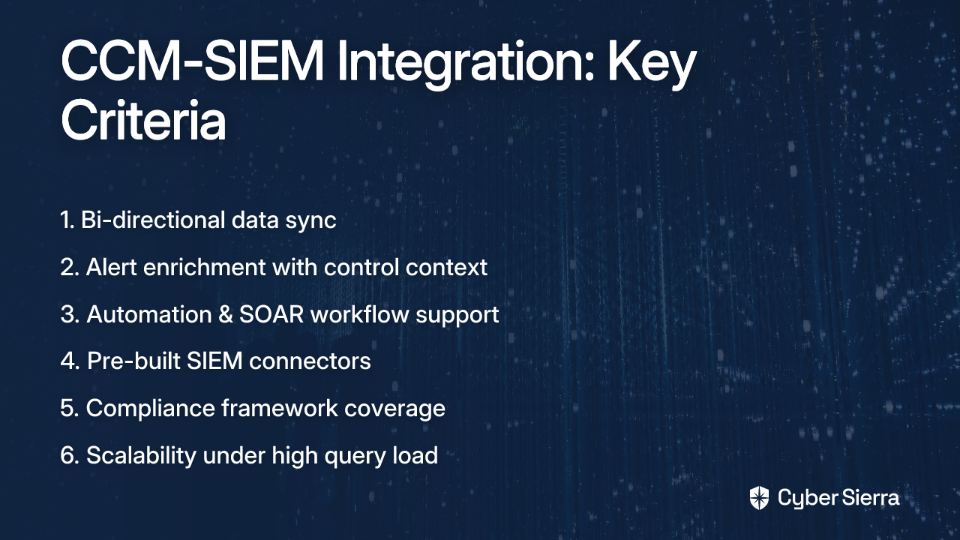
- Bi-directional data sync. Can the CCM tool push control failure alerts to your SIEM and pull relevant log data back to use as evidence for control tests? One-way data flows limit what the integration can actually do for your compliance program.
- Alert enrichment. Does the integration add meaningful context to SIEM events — asset criticality, the associated compliance framework, the control owner, and when the control last passed? Without enrichment, you're just adding another alert source to an already noisy queue.
- Automation and workflow capabilities. Can a critical control failure automatically trigger a high-priority incident ticket in your SOAR platform via the SIEM? Practitioners are actively asking what needs to be automated that current tools can't handle — make sure the platform you choose has a real answer.
- Pre-built SIEM connectors. Does it offer connectors for Splunk, Microsoft Sentinel, and IBM QRadar out of the box — or does it require extensive custom API work to get running? A significant integration project before you see value is a real cost.
- Compliance framework support. Does the tool cover the specific frameworks you operate under — NIST 800-53, ISO 27001, PCI DSS, HIPAA? Framework confusion is a genuine pain point, and a tool that covers some but not all of your requirements creates gaps you'll need to manage manually.
- Scalability under query load. As one practitioner flagged, there may be a "performance hit on queries" when ingesting high volumes of log data. Confirm the integration is designed to handle your data scale without degrading SIEM performance.
Turn SIEM Data Into Decisive Action
Your SIEM is doing its job, but it only answers half the question. It tells you what happened, but not why a control failed. That missing context is the root cause of alert fatigue and the reason critical risks get missed.
To move from reactive to proactive, focus on two key principles:
- Enrich events with control context. A SIEM alert for anomalous logins is noise. That same alert, enriched with a CCM notification that MFA enforcement has failed on a critical system, becomes a high-priority incident.
- Automate evidence collection. An integrated CCM links control test results to event logs continuously, creating a living, auditable trail that keeps you ready for any audit without the last-minute scramble.
Here's a practical next step: Pick your top three noisiest alerts from the last week. For each one, ask, "Which specific control failure is causing this, and how can we monitor that control's health directly?"
When you're ready to get those answers automatically, Cyber Sierra's unified platform enriches your SIEM data with the control intelligence you need to manage risk, not just alerts. To see how we connect control assurance to security operations, request a platform demo.
Frequently Asked Questions
What is the main difference between SIEM and CCM?
A SIEM monitors events to tell you what happened, while CCM monitors control effectiveness to tell you why it happened. An integrated CCM validates that controls are working as intended, providing crucial context to SIEM alerts so your team can prioritize real risks over noise.
Why should I integrate a CCM tool with my SIEM?
Integrating a CCM tool enriches raw SIEM data with control-level context. This transforms noisy alerts into actionable intelligence, automates compliance evidence collection, and allows your team to proactively manage risk by identifying control gaps before they are exploited.
How does continuous control monitoring help with compliance audits?
CCM automates the collection of evidence for compliance audits. Instead of manually pulling logs, a CCM platform continuously validates controls against frameworks like NIST or ISO 27001, creating a living, auditable trail that keeps your organization audit-ready at all times.
What are the key features to look for in a CCM solution?
Look for a CCM solution with bi-directional SIEM integration, automated control testing, and support for your specific compliance frameworks. Key features include a central controls repository, AI-powered alert prioritization, and pre-built connectors to reduce custom development work.
How can CCM reduce alert fatigue for my SOC team?
CCM reduces alert fatigue by adding context to SIEM alerts. It flags when a control related to an alert has failed, instantly elevating its priority. This helps your SOC team focus on genuinely critical incidents instead of chasing low-fidelity alerts or false positives.
What is the difference between GRC and CCM?
GRC (Governance, Risk, and Compliance) is a broad strategy for managing an organization's overall risk posture. CCM is a specific technology that automates the "Compliance" and "Risk" parts by continuously testing the effectiveness of technical security controls.
