



8 Best Enterprise Compliance Management Software Platforms Ranked

Join thousands of professionals and get the latest insight on Compliance & Cybersecurity.
Summary
- Managing multiple compliance frameworks like SOC 2 and ISO 27001 with manual processes leads to significant "compliance fatigue" for enterprise teams.
- Modern compliance management requires a shift from periodic audits to continuous monitoring, focusing on multi-framework support, deep automation, and integrated third-party risk management (TPRM).
- Before committing to a platform, verify its control mapping capabilities in a live demo and test the practical depth of its "continuous monitoring" features.
- A unified platform can solve these challenges. Cyber Sierra integrates GRC, continuous monitoring, and TPRM to help enterprises stay audit-ready and proactively manage risk.
If you're a compliance leader at a large enterprise, you already know the feeling: a growing stack of frameworks to maintain — SOC 2, ISO 27001, HIPAA, PCI DSS, GDPR — each with its own evidence requirements, control sets, and audit timelines. Add in siloed tools, manual evidence collection, and a vendor risk program that still runs on spreadsheets and email threads, and you've got a recipe for serious compliance fatigue.
Many compliance practitioners find that software alone isn't enough — the real challenge is finding a tool that adapts to how their team works, not the other way around. The most effective platforms are those that can be configured to fit existing workflows. That's the bar we're holding every platform in this list to.
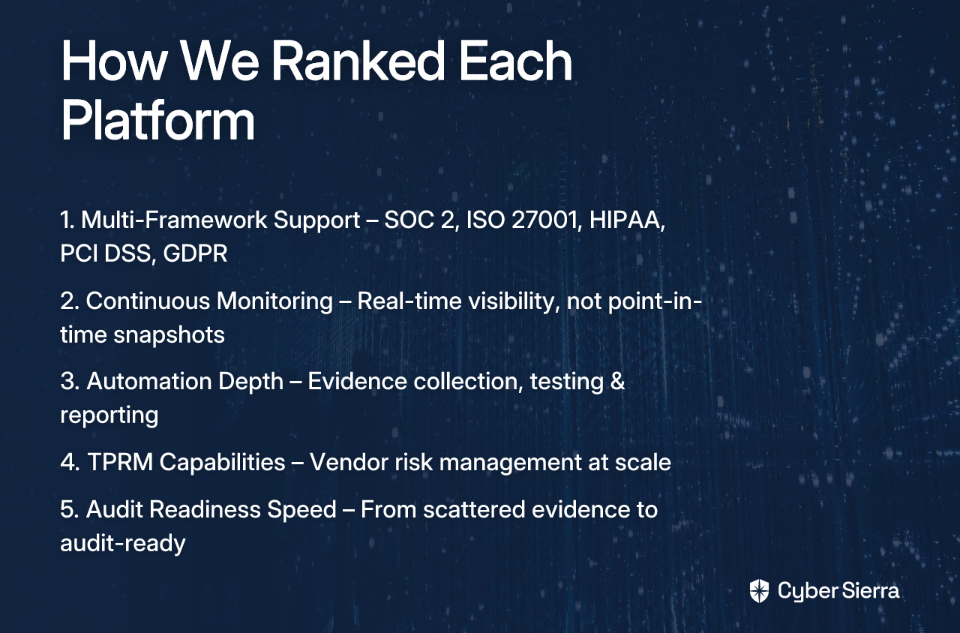
To cut through the noise — and the wave of "AI features" every GRC vendor is bolting onto their dashboards — we ranked eight platforms on what actually matters at enterprise scale:
- Multi-Framework Support – Can it manage SOC 2, ISO 27001, HIPAA, PCI DSS, and GDPR simultaneously? Can it map controls across frameworks to eliminate duplicate work?
- Continuous Monitoring – Does it provide real-time control visibility, or is it just a series of infrequent point-in-time snapshots?
- Automation Depth – How far does automation actually go for evidence collection, control testing, and reporting?
- TPRM Capabilities – Can it manage and continuously monitor third-party vendor risk at scale?
- Audit Readiness Speed – How fast can the platform get you from scattered evidence to audit-ready?
Let's get into it.
1. Cyber Sierra
Best for: Enterprises needing AI-enabled continuous compliance across multiple frameworks in a single unified platform
Cyber Sierra's AI-enabled cybersecurity platform is purpose-built to move enterprises away from periodic, manual compliance checks toward proactive, near real-time risk management. It's designed for CISOs, Compliance Managers, and IT leaders operating in regulated industries like BFSI, HealthTech, Manufacturing, and Technology.
What puts Cyber Sierra at the top of this list is its depth across every evaluation criterion — not just one or two.
- Multi-Framework Support. Cyber Sierra's GRC module manages SOC 2, ISO 27001, HIPAA, PCI DSS, GDPR, NIST, and custom controls in a single unified platform. Control mapping across frameworks means you're not duplicating evidence collection for overlapping requirements.
- Continuous Monitoring. The platform's standout feature is its Continuous Control Monitoring (CCM) module. It builds a centralized controls repository with near real-time updates, automates control testing and validation, and detects exceptions and anomalies as they happen.
- Automation Depth. AI-driven automation handles data collection, risk assessments, and reporting with minimal manual input and is designed to help teams reduce audit preparation time. For compliance teams drowning in spreadsheets, this is a meaningful shift.
- TPRM Capabilities. The integrated Third-Party Risk Management module goes beyond one-time vendor questionnaires. It automates vendor assessments, prioritizes your vendor inventory by risk level, and provides continuous monitoring of third-party security compliance.
- Audit Readiness Speed. Comprehensive reports and detailed audit trails are generated automatically, so when an auditor comes knocking, you're not scrambling.
Beyond core GRC, the platform's integrated modules — Threat Intelligence, Employee Security Training, and Cyber Insurance — give enterprises a genuinely holistic view of their security posture rather than stitching together five different vendor dashboards.
2. Drata
Best for: Cloud-native companies investing heavily in compliance automation
Drata is an AI-native compliance automation platform with strong brand recognition, particularly among SaaS companies and cloud-native enterprises. It supports over 20 frameworks and offers extensive integrations with cloud services and SaaS tools, making it easy to pull evidence automatically from your existing stack. Its Trust Center feature — a shareable compliance posture page — is a useful differentiator for sales-led compliance use cases.
Where it falls short at enterprise scale: Drata lacks robust asset discovery features, which can create blind spots in larger, more complex environments.
3. Archer (RSA Archer)
Best for: Large enterprises with complex, highly customized GRC requirements
RSA Archer has been a fixture in enterprise GRC for years, and for good reason. It's highly configurable, capable of handling deeply customized risk data models, and scales well across large organizations with intricate compliance programs. Its audit management and third-party risk capabilities are mature and battle-tested.
The tradeoff is implementation complexity and cost. Archer is a platform you configure extensively — which means it fits your processes well once deployed, but getting there requires significant investment in time and internal resources.
4. MetricStream
Best for: Enterprises needing predictive risk intelligence and regulatory change management
MetricStream is a unified GRC platform that leans heavily into AI for predictive risk insights — making it a good fit for enterprises that need to stay ahead of shifting regulatory landscapes. Its regulatory intelligence module tracks changes in compliance requirements and flags what needs to be updated in your control environment.
Low-code customization lets compliance teams adapt workflows without waiting on IT, and its audit automation capabilities are comprehensive. MetricStream is a strong choice for global enterprises managing complex, cross-jurisdictional compliance programs.
5. AuditBoard
Best for: Teams that prioritize usability and cross-functional audit collaboration
AuditBoard started as an audit management platform and has grown into a broader risk and compliance suite. The differentiator here is user experience — it's consistently recognized for having one of the most intuitive interfaces of any enterprise compliance management software on this list.
If getting control owners outside the compliance team to actually use the tool is a recurring headache (and it is for most enterprises), AuditBoard's UI reduces that friction. Evidence management, issue tracking, and workflow collaboration are all well-executed. It's less dominant on the continuous monitoring front, but strong as a core audit and risk management hub.
6. LogicGate Risk Cloud
Best for: Compliance teams that need maximum workflow flexibility without engineering support
LogicGate's no-code, drag-and-drop workflow builder is its headline feature. Teams can build and deploy custom risk and compliance applications tailored to their exact processes — without writing a line of code. This directly addresses the frustration practitioners often voice about tools that force them to adapt their workflows to the software rather than the other way around.
LogicGate also brings solid capabilities in cyber risk quantification and vendor management. It's particularly well-suited for enterprises where compliance requirements vary significantly across business units and a rigid out-of-the-box structure doesn't cut it.
7. Hyperproof
Best for: Continuous compliance tracking and multi-stakeholder evidence collaboration
Hyperproof is built specifically for teams running continuous compliance programs. Its real-time compliance tracking and flexible continuous controls monitoring capabilities allow teams to set up automated tests around specific control scenarios — for example, monitoring whether access is revoked for terminated employees within policy timelines, or verifying that critical vulnerabilities are patched according to SLA.
Task automation for evidence collection and stakeholder reminders reduces the manual legwork that burns out compliance teams. Hyperproof sits in a sweet spot for mid-to-large enterprises that want structured, continuous compliance without the complexity of a full-scale GRC platform.
8. IBM OpenPages
Best for: Global enterprises requiring deep analytics and advanced risk modeling
IBM OpenPages is the heavyweight option for organizations with mature risk management programs and the need for advanced analytics. It leverages IBM's AI capabilities for cognitive risk intelligence and supports automated workflows for regulatory and compliance management at global scale.
It's not the most agile platform for fast-moving compliance teams, and the implementation scope reflects its enterprise positioning. But for organizations running complex, data-heavy GRC programs across multiple geographies, OpenPages delivers a depth of risk modeling and reporting that few platforms can match.
Decision Guide: What to Verify Before You Sign a Contract
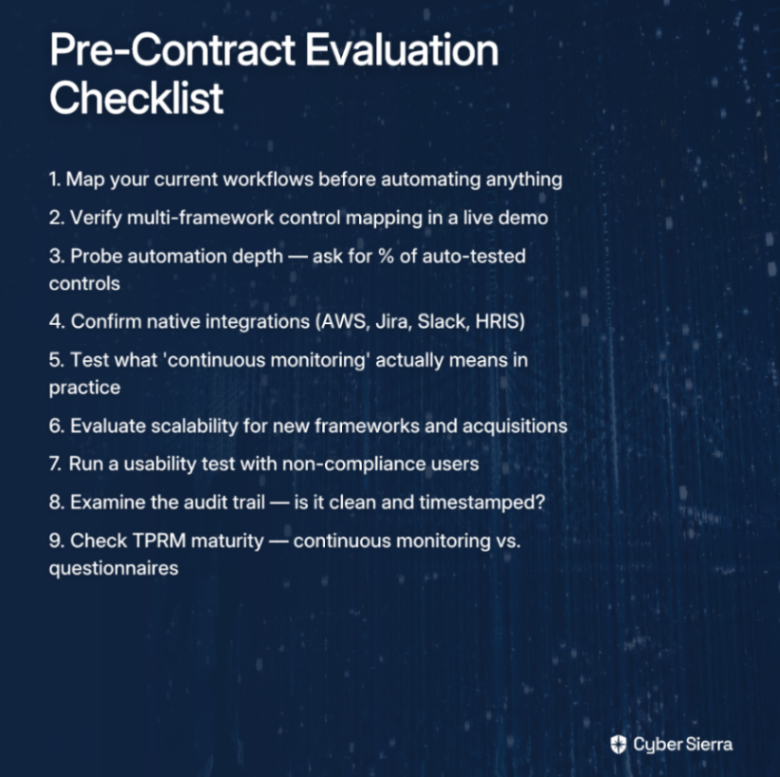
If you're actively evaluating enterprise compliance management software, use this checklist before committing:
Your Next Move in Enterprise Compliance
Choosing the right compliance platform isn't about more features; it's about finding the right workflow to eliminate compliance fatigue for good. The key takeaway is clear: enterprise compliance has moved beyond point-in-time audits. Staying ahead of risk requires a unified approach built on two pillars:
- Continuous Monitoring: Shift from reactive audit prep to proactive, real-time visibility into your security controls.
- Integrated GRC and TPRM: Eliminate duplicate work by mapping controls across frameworks and managing vendor risk in the same system you manage your own.
Your immediate next step? Before you look at another demo, identify the single biggest bottleneck in your current audit process. Is it manual evidence collection? Chasing down control owners? Knowing your exact pain point is crucial.
When you're ready to see how a truly unified platform automates that specific workflow, book your personalized demo and see how Cyber Sierra transforms compliance from a cost center into a strategic advantage.
Frequently Asked Questions
What is enterprise compliance management software?
Enterprise compliance management software is a centralized platform that helps large organizations manage multiple regulatory frameworks like SOC 2 and GDPR. It automates evidence collection, control testing, and reporting to simplify audits and reduce manual effort across the entire compliance program.
Why is continuous monitoring crucial for compliance?
Continuous monitoring is crucial because it provides real-time visibility into your security controls, shifting from periodic checks to proactive risk management. Instead of discovering issues during an audit, it helps you detect and fix compliance gaps and anomalies as they happen, ensuring you stay audit-ready.
How do platforms manage multiple compliance frameworks?
Platforms manage multiple frameworks by mapping shared controls across standards like SOC 2, ISO 27001, and PCI DSS. This "map once, comply many" approach eliminates redundant work, as evidence for one control can be automatically applied to similar requirements in other frameworks, saving time and effort.
What role does AI play in modern compliance automation?
AI plays a significant role by automating complex tasks that typically require manual effort. This includes automated evidence collection, AI-driven risk assessments, and predictive insights into emerging threats. This helps teams reduce audit preparation time and focus on strategic risk management.
What is the difference between GRC and TPRM?
GRC (Governance, Risk, and Compliance) is a broad strategy for managing an organization's overall risk and compliance posture. TPRM (Third-Party Risk Management) is a specific component of GRC focused solely on identifying and mitigating risks associated with external vendors and suppliers.
How do I choose the right compliance platform for my enterprise?
Choose the right platform by evaluating its multi-framework support, depth of automation, and continuous monitoring capabilities. Verify its native integrations with your tech stack and test its usability with non-compliance users. A live demo is essential to confirm it fits your team's specific workflows.
