



8 Best Governance Risk Compliance Tools for Enterprise Security Teams

Join thousands of professionals and get the latest insight on Compliance & Cybersecurity.
Summary
- Traditional GRC practices, reliant on manual spreadsheets and point-in-time audits, are inefficient and create a false sense of security.
- An effective modern GRC strategy requires a shift towards continuous, automated risk management for real-time visibility across frameworks like SOC 2, ISO 27001, and PCI DSS.
- When selecting a GRC tool, prioritize essential features like Continuous Control Monitoring (CCM), integrated Third-Party Risk Management (TPRM), and AI-driven automation.
- Cyber Sierra's unified platform automates these processes, transforming security from a periodic burden into a proactive, strategic function that keeps you audit-ready.
If you're a CISO, compliance manager, or security analyst, this scenario might sound familiar: it's audit season. Your team is frantically stitching together evidence from a dozen different systems, exporting .csv files that auditors reject, and cross-referencing controls across three separate spreadsheets for SOC 2, ISO 27001, and PCI DSS simultaneously.
This reliance on manual processes and point-in-time snapshots creates compliance fatigue, introduces human error, and leaves dangerous security gaps between audits.
The answer isn't a better spreadsheet. It's a modern governance risk compliance tool built on automation, continuity, and intelligence.
This guide evaluates eight of the best GRC platforms available today, using criteria that actually matter for enterprise security teams in 2025:
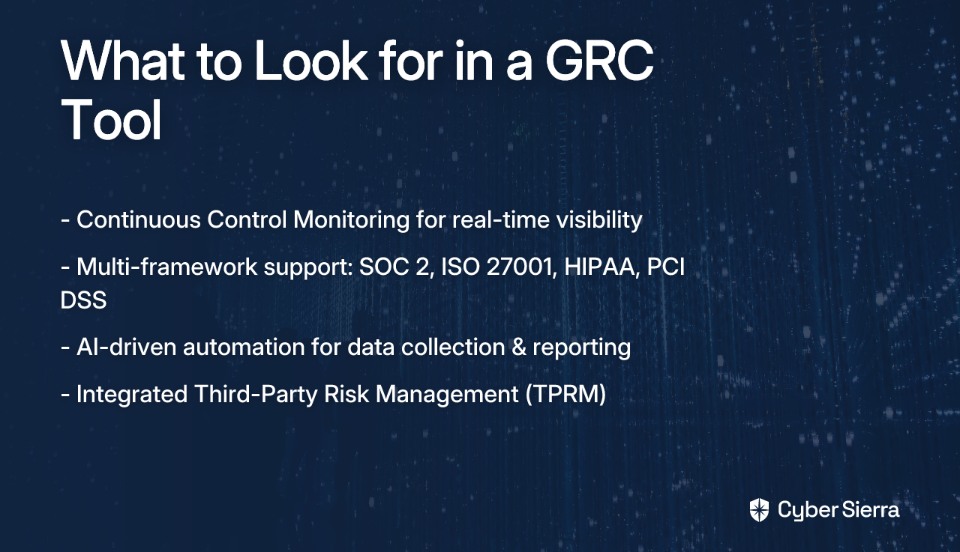
- Continuous Control Monitoring (CCM). Real-time visibility instead of periodic snapshots.
- Multi-Framework Support. Manage SOC 2, ISO 27001, HIPAA, PCI DSS, and NIST from a single pane of glass.
- AI-Driven Automation. Eliminate repetitive manual tasks across data collection, control testing, and reporting.
- Integrated Third-Party Risk Management (TPRM). Because your security is only as strong as your weakest vendor.
Each tool below includes a Best For label and an honest one-line limitation — so you can make a real buying decision, not just read another vendor comparison.
What is GRC and Why Does It Matter?
Governance, Risk, and Compliance (GRC) refers to the integrated approach organizations use to align their IT and security strategies with business goals, manage risks proactively, and meet regulatory obligations.
- Governance (G): The policies, procedures, and accountability structures that guide decision-making.
- Risk Management (R): The processes and tools for identifying, assessing, and mitigating threats — from operational risk to cyber vulnerabilities.
- Compliance (C): Adherence to external regulations and internal standards, supported by technology that automates and documents controls.
The traditional GRC model is broken, a problem highlighted by security practitioners themselves. As one bluntly put it on Reddit: "Security teams are drowning in spreadsheets, siloed frameworks, and point-in-time audits that leave real gaps."
This frustration points to fundamental flaws:
- Point-in-time audits give you a snapshot of compliance, not a true picture of your risk posture.
- Manual evidence gathering creates compliance fatigue and leaves room for human error. As one community thread noted, "most auditors will not accept .csv files — they want screenshots," turning evidence generation into a painful, manual bottleneck.
- Siloed frameworks mean your team duplicates work across every new regulation.
The critical shift happening right now is from periodic GRC checks to continuous, integrated programs. With emerging threats — including unregulated AI usage like employees feeding sensitive data into LLMs — the old quarterly-audit model simply can't keep pace.
The 8 Best Governance Risk Compliance Tools
1. Cyber Sierra — Best For: Enterprises Seeking a Unified, AI-Driven GRC Platform
Cyber Sierra is purpose-built for the modern compliance challenge: continuous, automated, and intelligent. Rather than bolting on compliance as an afterthought, it integrates GRC, CCM, and TPRM into a single platform. This transforms security from a reactive, periodic burden into a proactive, strategic function.
Governance, Risk & Compliance (GRC) Automation
Cyber Sierra's GRC module automates data collection, risk assessments, control monitoring, and audit reporting — all from one dashboard. It supports multiple compliance frameworks including SOC 2, ISO 27001, HIPAA, PCI DSS, GDPR, and custom controls, so your team isn't rebuilding evidence packages for every new audit. Audit trails are maintained automatically, and policy management is built in, making enterprises genuinely audit-ready rather than just audit-aspiring.
Continuous Control Monitoring (CCM)
The CCM module builds a central controls repository with near real-time updates, giving CISOs and compliance managers a single source of truth for control effectiveness. Instead of waiting for an annual pen test or quarterly review to discover a gap, Cyber Sierra detects exceptions and anomalies continuously. This enables proactive remediation before they become audit findings. Natively, this process dramatically increases efficiency, reduces remediation costs through early detection, and enhances overall security posture.
Third-Party Risk Management (TPRM)
The TPRM module moves beyond point-in-time vendor questionnaires to provide 24/7 visibility into vendor security compliance. It automates vendor assessments, prioritizes your vendor inventory by risk level, and streamlines onboarding and offboarding — directly addressing the challenge that TPRM managers face when drowning in manual questionnaire processes.
⚠️ Limitation: Cyber Sierra's AI-first approach and continuous monitoring capabilities are a leap forward — but teams firmly rooted in traditional, checkbox-based compliance workflows may face a short adjustment period when adopting its automation-heavy model.
2. MetricStream — Best For: Large Enterprises Needing Comprehensive, Integrated Risk Management
MetricStream is one of the most established names in enterprise GRC. It integrates risk, compliance, audit, and cyber risk functions into a single platform, using AI to send alerts on regulatory changes and automate continuous control monitoring. It also offers risk quantification capabilities, helping organizations translate risk into financial terms for executive reporting.
⚠️ Limitation: Its extensive feature set makes MetricStream powerful, but the initial configuration and setup can be complex and time-consuming for teams without dedicated GRC program management resources.
3. ServiceNow GRC — Best For: IT-Centric Organizations Already in the ServiceNow Ecosystem
ServiceNow GRC is the natural choice for organizations that have built their IT operations around the ServiceNow platform. It integrates GRC directly with IT Service Management (ITSM), embeds workflow automation into compliance processes, and ties incident response into the broader risk management lifecycle — making it a highly coherent experience for teams already living in that ecosystem.
⚠️ Limitation: ServiceNow GRC carries a premium price tag that often makes it inaccessible for mid-market organizations, and its value diminishes significantly if you're not already a ServiceNow shop.
4. Archer — Best For: Mature Organizations With Complex, Multi-Domain Risk Programs
Archer has long been the enterprise standard for organizations with sophisticated, multi-domain risk management needs — particularly those managing critical infrastructure. It offers deep customization for risk assessment workflows, strong policy management capabilities, and a broad library of use cases spanning IT risk, operational risk, and regulatory compliance.
⚠️ Limitation: Archer's power comes at the cost of usability — non-technical users often find it cumbersome, and the platform carries a steep learning curve that demands dedicated resources to configure and maintain effectively.
5. AuditBoard — Best For: Internal Audit and SOX Compliance Teams
AuditBoard is specifically designed for internal audit teams and excels at SOX compliance workflows. Its intuitive interface, automated audit workflows, and cross-functional collaboration tools make it a favorite among audit professionals who need to coordinate evidence collection across multiple business units quickly and efficiently.
⚠️ Limitation: AuditBoard is primarily an audit management tool — if your team needs broader operational risk management, cybersecurity control monitoring, or TPRM capabilities, you'll likely need to supplement it with additional platforms.
6. LogicGate (Risk Cloud) — Best For: Teams That Need Highly Customizable, No-Code Workflows
LogicGate's Risk Cloud stands out for its no-code workflow builder, which lets risk and compliance teams design, modify, and automate their GRC processes without requiring IT support. It also features robust analytics and reporting dashboards that provide clear visibility into risk trends over time — making it a strong fit for teams who need flexibility without engineering overhead.
⚠️ Limitation: While Risk Cloud's customization is a strength, it lacks some of the deeper, dedicated audit management features found in more specialized platforms like AuditBoard, which can be a gap for teams with heavy audit workloads.
7. OneTrust — Best For: Organizations Prioritizing Privacy, Ethics, and Data Governance
OneTrust has evolved from a privacy management tool into a broader governance, risk, and ethics platform — incorporating whistleblower management and compliance culture tools through its Convercent acquisition. Its automated data discovery, classification capabilities, and strong privacy workflow automation make it an industry leader for organizations navigating GDPR, CCPA, and similar data protection regulations.
⚠️ Limitation: OneTrust's automation is best suited to privacy and ethics use cases. For teams whose primary need is technical security control monitoring and cybersecurity-focused GRC, its capabilities are less robust compared to security-first platforms.
8. Workiva — Best For: Finance, Audit, and Risk Teams Focused on Regulatory and ESG Reporting
Workiva excels at connecting data from disparate enterprise systems — ERP, CRM, financial systems — into a single, auditable source for regulatory and ESG reporting. It streamlines the workflow for finance-focused compliance requirements, including SEC reporting, internal controls over financial reporting (ICFR), and sustainability disclosures.
⚠️ Limitation: Workiva is not a pure-play cybersecurity GRC tool. Organizations seeking technical security control monitoring, TPRM, or CCM capabilities will find it underpowered for those use cases — and its pricing can be prohibitive for smaller teams.
How to Choose the Right GRC Tool for Your Team
With so many governance risk compliance tools on the market, the right choice ultimately comes down to your organization's specific maturity, needs, and workflows. As community members note, "Make sure you really know what you want before buying any of them." A poorly defined process will make even the best platform ineffective.
Here's a quick decision framework:
| If you need… | Consider… |
|---|---|
| End-to-end AI-driven GRC with CCM + TPRM | Cyber Sierra |
| Enterprise-wide integrated risk management | MetricStream |
| GRC inside an existing ServiceNow environment | ServiceNow GRC |
| Complex, multi-domain risk workflows | Archer |
| Internal audit and SOX automation | AuditBoard |
| No-code, customizable risk workflows | LogicGate Risk Cloud |
| Privacy, data governance, and ethics management | OneTrust |
| Finance and ESG regulatory reporting | Workiva |
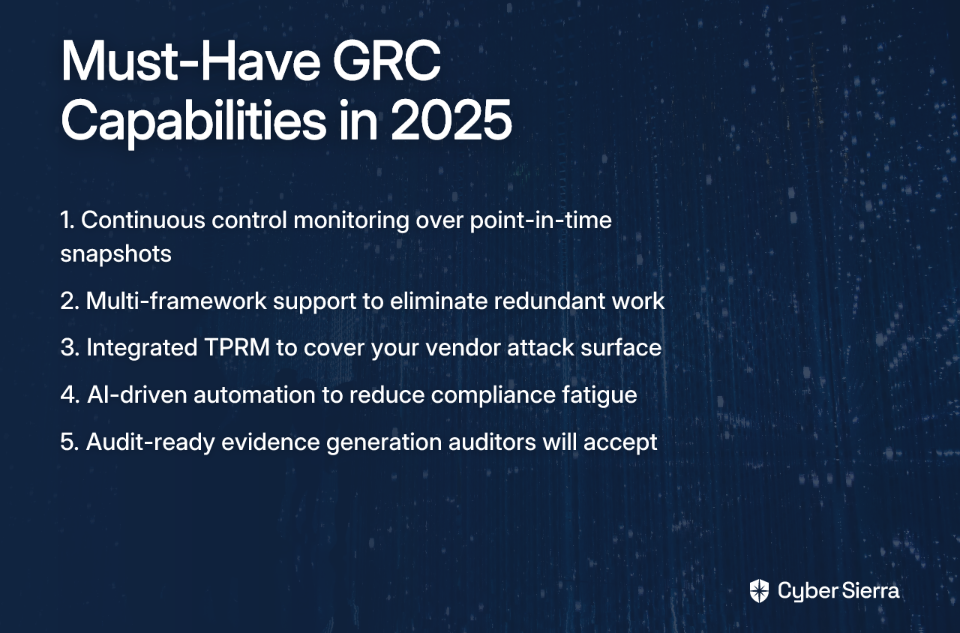
Before signing any contract, prioritize platforms that offer continuous control monitoring over point-in-time snapshots, multi-framework support to eliminate redundant work across SOC 2, ISO 27001, HIPAA, and PCI DSS, and integrated TPRM — because your vendor ecosystem is part of your attack surface whether you monitor it or not.
From Compliance Burden to Strategic Advantage
Choosing the right GRC platform means moving beyond the compliance-as-a-checklist mindset. The most critical shift is from point-in-time audits to continuous control monitoring for a real-time view of your security posture. A modern tool should also centralize evidence across frameworks like SOC 2 and ISO 27001, eliminating the redundant, manual work that burns out your team.
Your first step today? Identify the single biggest bottleneck in your current audit prep process. Is it chasing down screenshots or cross-referencing controls in spreadsheets? Once you've pinpointed the pain, you can see how automation solves it directly. If you're ready to trade compliance fatigue for confidence, book your personalized demo and see how our unified platform makes you audit-ready, year-round.
Frequently Asked Questions
What is a GRC tool and why do I need one?
A GRC tool is software that centralizes and automates governance, risk management, and compliance activities. You need one to replace inefficient spreadsheets, gain real-time visibility into your risk posture, streamline audits, and reduce manual compliance fatigue.
How do modern GRC platforms improve on traditional spreadsheets?
GRC platforms replace manual, error-prone spreadsheets with automated, continuous monitoring. They provide a single source of truth, automate evidence collection, and manage multiple compliance frameworks without duplicating work, making you audit-ready year-round.
What is Continuous Control Monitoring (CCM)?
Continuous Control Monitoring (CCM) is the automated process of gathering evidence to verify that security controls are effective in near real-time. Unlike point-in-time audits, CCM provides ongoing visibility, allowing for proactive remediation of gaps before they become critical findings.
How does a GRC tool help with multiple compliance frameworks?
A GRC tool maps controls to multiple frameworks, allowing you to test a single control and use the evidence for various audits like SOC 2, ISO 27001, and PCI DSS. This "test-once, apply-many" approach eliminates redundant work and saves significant time.
What is the role of AI in GRC automation?
AI in GRC tools automates repetitive tasks like evidence collection, control testing, risk assessment, and reporting. It helps identify potential risks, prioritizes alerts, and reduces the manual burden on security teams, allowing them to focus on strategic initiatives.
How do I choose the best GRC tool?
Choose the best GRC tool by assessing your organization's specific needs, maturity, and primary use case. Prioritize platforms with continuous monitoring, multi-framework support, and integrated TPRM to ensure you get a solution that solves your core challenges.
