



How to Choose a Governance Risk Compliance Tool Without Getting Burned

Join thousands of professionals and get the latest insight on Compliance & Cybersecurity.
Let me be blunt: I've been burned before.
We spent six figures on what was marketed as a leading governance, risk, and compliance (GRC) tool. Six months in, my team was drowning in manual spreadsheets, the "automations" only worked if our environment was perfectly cookie-cutter, and the GRC module felt like a privacy platform with half-baked IT features awkwardly bolted on.
Sound familiar? You're not alone. Practitioners across Reddit forums echo this frustration, with one user flatly stating: "OneTrust sucks. It's a Privacy tool with half-baked IT GRC modules."
The GRC vendor landscape is full of glossy demos, buzzword-heavy slide decks, and promises that dissolve the moment you go live. It's easy to overbuy, as one practitioner put it, if you're a small team, some tools are like "trying to throw away money." The challenge isn't just finding a capable platform; it's finding the right-fit tool by asking the questions vendors dread.
This guide is the cheat sheet I wish I had. It focuses on five critical, often-overlooked evaluation criteria that separate genuinely mature GRC platforms from expensive shelf-ware. For each, I'll explain why it matters and what red flags to watch for during vendor demos.
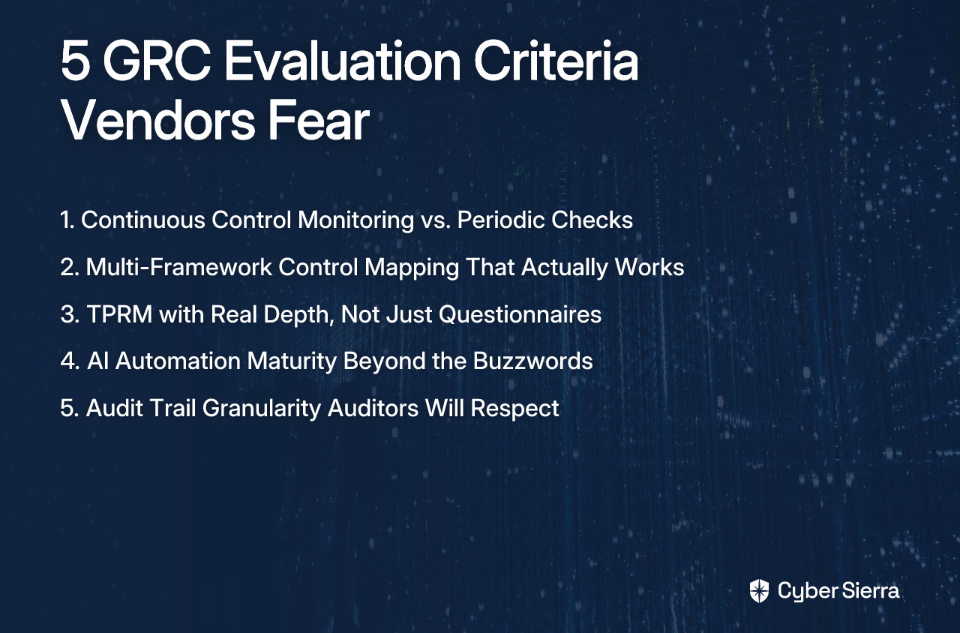
Criterion #1: Continuous Control Monitoring vs. Periodic Checks
Traditional GRC relies on periodic, point-in-time checks. Here’s why a continuous approach is now table stakes.
Why It Matters
The annual audit mindset is a relic. Point-in-time assessments create dangerous blind spots — your environment changes daily, and a control that was green last quarter could be critically misconfigured today. Continuous compliance monitoring transforms GRC from a reactive, calendar-driven event into an ongoing, living program with near real-time visibility into your actual security posture.
The practical benefit? You catch gaps before auditors do — and before threat actors do.
Red Flags to Watch For
- The vendor's core workflow revolves around manual checklists and quarterly review cycles.
- Their integrations are shallow — they pull data from your cloud or identity provider, but updates are batched nightly or weekly, not in near real-time.
- The dashboard looks like a static PowerPoint slide, not a live control health feed. Ask them directly: "How quickly does your platform reflect a new S3 bucket misconfiguration in AWS?" Watch how they answer.
What Good Looks Like
Cyber Sierra's CCM module is purpose-built for this, building a central controls repository with near real-time updates, automating control testing and validation, and detecting exceptions and anomalies the moment they occur. Instead of reactive fire-fighting, you get proactive, data-driven remediation. That's the baseline your governance risk compliance tool should meet — not a bonus feature.
Criterion #2: Multi-Framework Control Mapping That Actually Works
Most organizations manage multiple compliance frameworks. Without smart mapping, this leads to duplicated work and burnout.
Why It Matters
Your organization doesn't live in a single-framework world. You're simultaneously managing SOC 2, ISO 27001, PCI DSS, HIPAA, and possibly GDPR. Without intelligent cross-framework control mapping, your team ends up testing the same control five times for five different audits — a colossal waste of effort that accelerates compliance fatigue and team burnout.
The good news: there's enormous overlap between frameworks. SOC 2 and ISO 27001 share roughly 80% of their requirements, while HIPAA and HITRUST overlap by approximately 85%. A mature governance risk compliance tool lets you "test once, satisfy many" — mapping a single piece of evidence across multiple frameworks automatically.
Red Flags to Watch For
- The vendor claims "multi-framework support," but each framework is configured in a separate silo with no shared control library.
- They can't demonstrate, live in the demo, how a single MFA enforcement policy simultaneously satisfies SOC 2 CC6.1, ISO 27001 A.9.4.2, and PCI DSS Requirement 8. If they fumble this, walk away.
- Multi-framework setup requires expensive professional services or weeks of manual configuration.
What Good Looks Like
Look for a platform that treats frameworks as different views of a single, unified control set. Cyber Sierra's GRC platform manages controls across NIST, ISO 27001, SOC 2, PCI DSS, GDPR, HIPAA, and custom frameworks from one source of truth — automatically reducing the redundant evidence collection work that burns out compliance teams.

Criterion #3: TPRM with Real Depth, Not Just Questionnaires
Your supply chain is part of your attack surface. A GRC platform’s TPRM module can’t just be a survey tool.
Why It Matters
Your vendors are an extension of your attack surface — arguably one of the most under-managed risks in any enterprise security program. A Third-Party Risk Management (TPRM) process built primarily around annual self-attested questionnaires is, frankly, a compliance theater exercise. Vendors can claim anything on a form.
As one practitioner on Reddit put it: "You need to have a closer look and there is no way around asking questions and asking for evidence." But real TPRM goes further — it continuously validates whether a vendor's claimed security posture holds up against their actual external exposure. The same thread noted how valuable it is to "check if a vendor says they've patched X, [and] see if that's reflected in their external exposure." That's the standard now.
Red Flags to Watch For
- The TPRM module is essentially a survey distribution tool — it sends questionnaires and tracks responses, full stop.
- No capability to continuously monitor a vendor's external security posture between assessments.
- The platform can't help you prioritize vendors by criticality and risk level, leaving you treating a low-stakes SaaS tool the same as a mission-critical infrastructure partner.
- Vendor onboarding and offboarding are manual, poorly documented processes.
What Good Looks Like
An effective TPRM solution layered within your governance risk compliance tool should combine automated assessments with ongoing external monitoring. Cyber Sierra's TPRM module provides near real-time, 24/7 visibility into vendor security compliance, automates risk assessments, and allows you to prioritize your vendor inventory based on actual risk levels — giving you substantive, continuous insights rather than a static annual snapshot.
Criterion #4: AI Automation Maturity Beyond the Buzzwords
Every vendor claims to use AI, but few can prove it does more than send email reminders. Here's how to spot the difference.
Why It Matters
Ask any GRC vendor if they have AI, and the answer will be yes. Ask them what the AI actually does, and the conversation gets uncomfortable fast. Mature AI in GRC isn't about replacing human judgment — it's about eliminating the high-friction, low-value grunt work: evidence collection, control testing, risk scoring, status updates. When automation is genuinely working, as one practitioner described, "what took days now takes minutes."
But as users on Reddit note, "Too many limitations in the current AI implementations hinder its effectiveness in automation." The frustration is real. Many vendors use AI as a marketing label for simple rules-based logic that breaks down the moment your environment isn't perfectly standard. Truly effective AI in GRC provides faster analysis, centralized intelligence, and decision support based on historical patterns — not just automated form-filling.
Red Flags to Watch For
- "AI" in the demo amounts to auto-populating a text field or sending a scheduled email reminder.
- The automation workflows are rigid — they break or require manual overrides for non-standard configurations. Remember: "Their automations won't work if yours is anything other than cookie cutter."
- The vendor can't show a specific, documented example of their AI reducing evidence collection time or surfacing a risk that manual processes would have missed. Ask them for a case study or a live proof of concept.
What Good Looks Like
Demand specifics. An AI-enabled governance risk compliance tool should be able to demonstrate automated data collection, anomaly detection, and predictive risk insights in the demo itself. Cyber Sierra's platform is built with AI at its core to automate manual compliance tasks, correlate events across your environment, and surface actionable intelligence — moving your program from reactive manual effort to proactive, data-driven risk management without requiring your environment to be perfectly standardised.
Criterion #5: Audit Trail Granularity Auditors Will Respect
When the audit is on the line, your platform’s logs must be irrefutable. Many are not.
Why It Matters
When an auditor asks, "Who changed this control, when was it changed, and what was the business justification?" — you need a definitive, documented answer. Not a vague log entry. Not a spreadsheet with a timestamp. A granular, immutable audit trail is your ultimate proof of due diligence and accountability.
This is where many tools quietly fail. Practitioners have flagged that evidence outputs matter enormously — "Most auditors I've talked to will not accept .csv files, they want screenshots." If your governance risk compliance tool can't produce evidence in the formats auditors actually accept, or if its audit logs are high-level and context-free, you'll be scrambling to fill gaps manually under audit pressure.
Red Flags to Watch For
- Audit logs only show high-level events with no ability to drill into before/after states of a specific control change.
- Exporting audit evidence is a multi-step, cumbersome process — or worse, it only exports in formats auditors regularly reject.
- There is no dedicated, read-only auditor interface where external reviewers can access relevant controls and evidence without navigating the full platform.
What Good Looks Like
Your GRC tool should be your system of record — always audit-ready, never scrambling. Cyber Sierra's GRC platform generates comprehensive, structured reports and maintains detailed audit trails where every action is logged, time-stamped, and attributed to a specific user. The result is an irrefutable evidence chain that satisfies even the most rigorous external auditors — produced automatically, not assembled manually the night before an audit.
Your GRC Tool Decision-Making Checklist
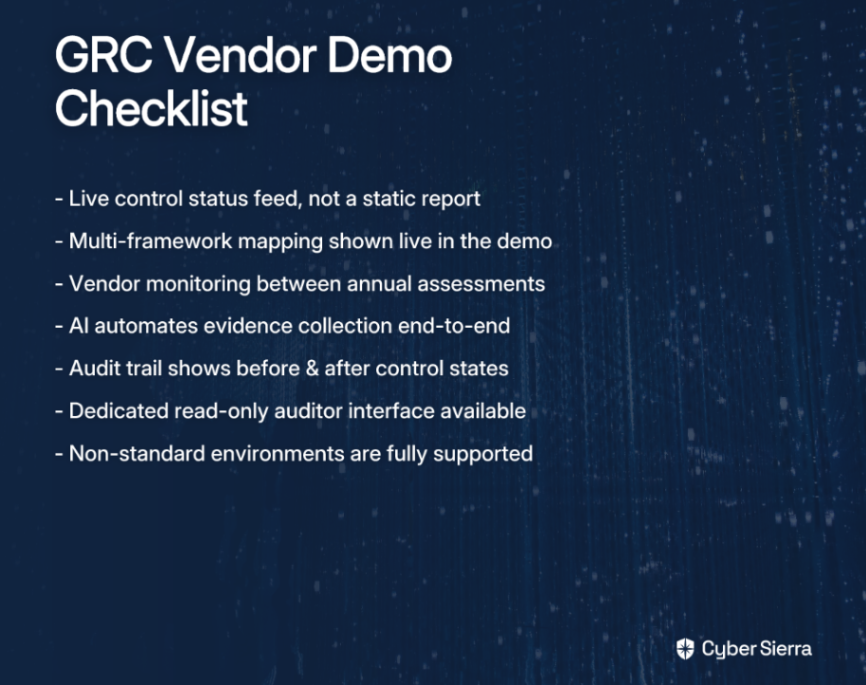
If a vendor stumbles on more than two of these questions, that's your answer.
Your GRC Platform Should Work For You
Choosing a GRC platform is a high-stakes decision. The right tool transforms compliance from a manual, reactive burden into a strategic, automated asset that gives you time back. The wrong one becomes expensive shelf-ware that burns out your team.
Before your next demo, cut through the noise and focus on what truly matters:
- Periodic to Continuous. Does the platform provide a live, real-time view of your security posture, or just static, periodic reports?
- Duplication to Efficiency. Can you test a control once and map it across multiple frameworks (like SOC 2 and ISO 27001) automatically?
Your next step is simple: take the checklist from this guide into your next vendor call. Don't settle for slide decks and promises—ask them to prove these critical capabilities live on screen.
If you're tired of tools that create more manual work, see how Cyber Sierra helps teams achieve continuous compliance without the complexity. Book a personalized demo to see the platform in action.
Frequently Asked Questions
What is the most important feature to look for in a GRC tool?
The most important feature is continuous control monitoring (CCM), which provides real-time visibility into your security posture. This shifts GRC from a periodic, reactive task to a proactive, ongoing program, helping you find and fix gaps before auditors or attackers do.
Why is multi-framework mapping critical for a GRC platform?
Multi-framework mapping is critical because it saves significant time and effort by eliminating redundant work. It lets you "test once, satisfy many," mapping a single control and its evidence across multiple frameworks like SOC 2, ISO 27001, and PCI DSS that have overlapping requirements.
How can you identify mature AI in a GRC tool versus marketing buzzwords?
You can identify mature AI by asking for specific demonstrations of how it automates high-effort tasks. A genuine AI-enabled tool automates evidence collection, detects anomalies, and provides predictive insights, not just send email reminders or auto-populate text fields.
What makes a Third-Party Risk Management (TPRM) module effective?
An effective TPRM module goes beyond questionnaires by providing continuous external monitoring of your vendors' security posture. This combines self-attested data with real-time validation, offering a more accurate and dynamic view of third-party risk between annual assessments.
How does a good GRC tool simplify the audit process?
A good GRC tool simplifies audits by maintaining a granular, immutable audit trail for every action. It should generate comprehensive, auditor-respected reports and provide a dedicated, read-only interface for auditors, making evidence collection automatic and irrefutable.
What is the difference between continuous monitoring and periodic checks?
Continuous monitoring provides near real-time visibility into your control status, detecting misconfigurations as they happen. In contrast, periodic checks are point-in-time assessments (e.g., quarterly) that create dangerous blind spots and leave you vulnerable between reviews.
