



5 Best Third-Party Risk Management Tools for PDPA-Regulated Enterprises


Join thousands of professionals and get the latest insight on Compliance & Cybersecurity.
Summary
- Under Singapore's PDPA, your organization is fully liable for vendor data breaches, with fines reaching up to 10% of annual turnover or S$1 million.
- Traditional vendor risk management based on manual spreadsheets and annual questionnaires is insufficient, as it fails to provide the continuous oversight regulators expect.
- To effectively manage risk, prioritize TPRM tools that offer continuous monitoring, multi-framework support (PDPA, ISO 27001, MAS TRM), and automated audit trails.
- For an integrated solution, Cyber Sierra's TPRM platform combines continuous vendor monitoring with GRC capabilities to streamline compliance and strengthen your supply chain security.
A vendor you trusted with your customers' personal data suffers a breach. The Personal Data Protection Commission (PDPC) comes knocking — and the fine lands on you.
This isn't a hypothetical. The PDPC has consistently held organisations accountable for breaches caused by their third-party vendors, reinforcing a hard truth: outsourcing data processing does not outsource liability. Under Section 4(2) of the PDPA, your organisation remains fully responsible for the personal data you collect, regardless of who handles it on your behalf.
And yet, most organisations are still managing vendor risk the wrong way. Security teams are bogged down by manual processes — spreadsheets, questionnaires, and risk-ranking vendors by perceived impact rather than validated evidence. There's also a nagging frustration around validating actual controls and processes inside vendors — a self-attested questionnaire response tells you what a vendor claims, not what they do. And with many TPRM tools defaulting to cumbersome SIG questionnaire formats, both your team and your vendors can quickly hit analysis paralysis.
The stakes are high. Post-2021 amendments to the PDPA raised penalties to up to 10% of annual Singapore turnover or S$1 million, whichever is higher. With enforcement actions on the rise, the question isn't whether you need a proper vendor risk management PDPA strategy — it's which tool will actually help you execute it.
This article cuts through the noise to evaluate the 5 best TPRM tools for PDPA-regulated enterprises, based on five criteria that matter most in Singapore's regulatory context.
What to Look for in a TPRM Tool for PDPA Compliance
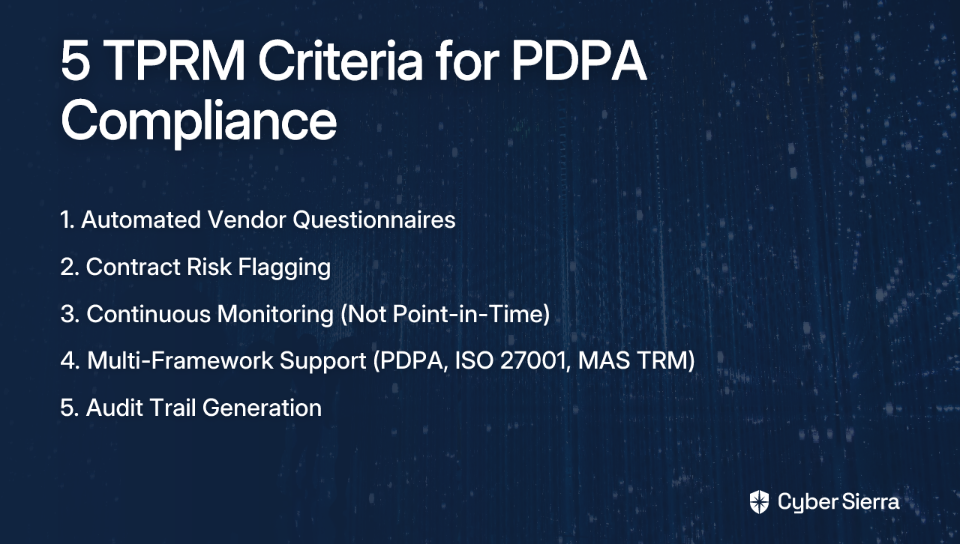
Not all TPRM platforms are built with Singapore's regulatory stack in mind. Before diving into the tools, here are the five criteria used to evaluate them:
- Automated Vendor Questionnaires — Eliminates manual follow-up, maps to relevant standards, and reduces the burden of managing hundreds of assessments.
- Contract Risk Flagging — The PDPC has cited inadequate data protection provisions in vendor contracts as a key compliance gap. A good tool helps you catch missing clauses before they become a liability.
- Continuous Monitoring vs. Point-in-Time Assessments — A vendor's security posture can change overnight. Continuous monitoring validates claims against real-world data in near real-time, something a once-a-year questionnaire simply cannot do.
- Multi-Framework Support (PDPA + ISO 27001 + MAS TRM) — Singapore enterprises, especially in finance, operate under layered regulatory obligations. A tool that unifies these frameworks reduces duplication and compliance fatigue.
- Audit Trail Generation — When the PDPC investigates, you need timestamped proof of due diligence. Comprehensive audit logs aren't optional.
The 5 Best TPRM Tools for PDPA-Regulated Enterprises
Here's how five leading TPRM platforms stack up against the core requirements for PDPA compliance.
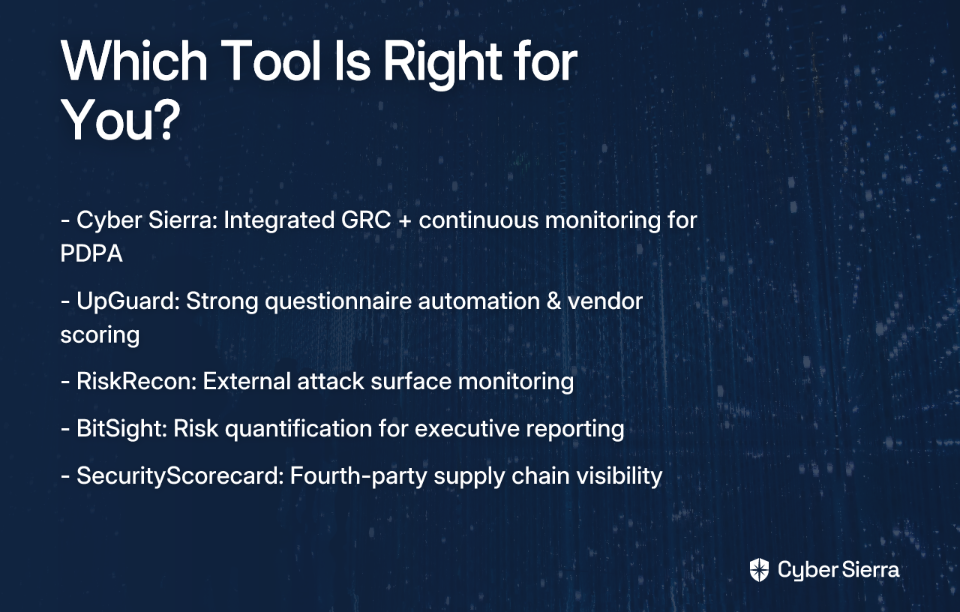
1. Cyber Sierra — Best for Integrated PDPA Compliance & Continuous Monitoring
Overview: Cyber Sierra is an AI-enabled cybersecurity platform that integrates Third-Party Risk Management with a full Governance, Risk & Compliance (GRC) suite and Continuous Control Monitoring (CCM). Recognized as a Sample Vendor in the Gartner® Hype Cycle™ for Cyber-Risk Management, 2024, Cyber Sierra is purpose-built to move enterprises away from periodic, manual checks toward proactive, near real-time risk management.
How it performs against PDPA criteria:
- Automated Vendor Questionnaires. Cyber Sierra streamlines the full assessment lifecycle — from vendor onboarding and questionnaire distribution to risk scoring and remediation tracking — eliminating the spreadsheet chaos that plagues so many TPRM programs.
- Continuous Monitoring. This is where Cyber Sierra truly differentiates itself. Rather than relying on self-attested snapshots, it offers near real-time visibility into your vendors' live security posture via an "outside-in" scanning approach. If a vendor claims they've patched a vulnerability, you can see whether that's actually reflected in their external exposure — no more taking answers at face value.
- Multi-Framework Support. The integrated GRC module natively supports ISO 27001, SOC 2, GDPR, PCI DSS, and can be customised for PDPA and MAS TRM requirements. This is critical for enterprises managing multiple overlapping compliance obligations without duplicating effort.
- Audit Trail Generation. Cyber Sierra automates data collection, maintains detailed audit trails, and generates comprehensive compliance reports — making you audit-ready at any point in time.
- Contract Risk Flagging. While not a standalone contract analysis module, its risk assessment capabilities can be configured to evaluate contractual controls as part of the overall vendor risk profile.
Why it's the top pick: Cyber Sierra solves the core challenge that most TPRM tools don't: the gap between what vendors say and what's actually happening. By tightly integrating continuous real-world monitoring with deep GRC capabilities, it gives PDPA-regulated enterprises a single, unified platform to manage vendor risk management under PDPA, ISO 27001, and MAS TRM — without the organisational silos or manual overhead that come with stitching together point-in-time tools.
2. UpGuard — Best for Data-Driven Security Ratings
Overview: UpGuard is a well-established vendor risk management platform known for its security ratings engine and extensive questionnaire library. It's a solid choice for organisations that want quantifiable, data-driven insights into their vendors' security posture.
How it performs against PDPA criteria:
- Automated Vendor Questionnaires: UpGuard offers a comprehensive library of customisable questionnaires that map to industry standards, significantly reducing the manual effort of chasing vendors for responses.
- Continuous Monitoring: Vendors are scored on a scale of 0–950, with continuous scanning of their public-facing digital footprint to flag new risks.
- Multi-Framework Support: UpGuard supports various frameworks, though it functions more as a standalone TPRM tool than an integrated GRC platform — meaning multi-framework compliance management may require additional tooling.
- Audit Trail Generation: Assessment records and vendor communications are maintained for compliance reporting purposes.
- Contract Risk Flagging: Limited native contract risk analysis capabilities.
Best for: Organisations that prioritise a quantifiable, ratings-based approach to vendor risk and want a robust questionnaire automation engine.
3. RiskRecon (a Mastercard Company) — Best for External Threat Surface Visibility
Overview: RiskRecon is a cybersecurity monitoring platform that provides continuous, objective assessments of vendor security risk by analysing their public internet footprint. Backed by Mastercard, it carries strong credibility in enterprise and financial services contexts.
How it performs against PDPA criteria:
- Automated Vendor Questionnaires: RiskRecon complements its monitoring capabilities with assessment tools, though questionnaire automation is not its primary strength.
- Continuous Monitoring: This is RiskRecon's core focus — providing ongoing visibility into vendor risk based on real-world, externally observable data rather than self-reported answers.
- Multi-Framework Support: Supports automated compliance checks against common cybersecurity frameworks, though deep multi-framework GRC management is not its primary use case.
- Audit Trail Generation: Captures assessment data and risk history for reporting purposes.
- Contract Risk Flagging: Not a core feature.
Best for: Enterprises that want deep, continuous, externally-sourced visibility into their vendors' security posture — particularly those in financial services where MAS TRM oversight demands rigorous third-party scrutiny.
4. BitSight — Best for Risk Quantification & Executive Reporting
Overview: BitSight is a leader in the security ratings space, built around helping organisations quantify the financial impact of third-party cyber risk and benchmark vendor performance against industry peers.
How it performs against PDPA criteria:
- Automated Vendor Questionnaires: Integrates questionnaire-based assessments with its security ratings to provide a more complete view of vendor risk.
- Continuous Monitoring: Daily security ratings and continuous scanning give ongoing visibility into vendor risk, with benchmarking capabilities against industry standards.
- Multi-Framework Support: Offers compliance tracking capabilities, but like most ratings-focused platforms, it is less comprehensive than an integrated GRC tool for multi-framework compliance management.
- Audit Trail Generation: Maintains vendor risk histories and supports compliance reporting.
- Contract Risk Flagging: Not a native feature.
Best for: Organisations that need to communicate third-party risk in financial terms to executive leadership, or those that want to benchmark their vendor portfolio against industry peers.
5. SecurityScorecard — Best for Extended Supply Chain (Fourth-Party) Visibility
Overview: SecurityScorecard offers a straightforward, intuitive approach to vendor security through an A–F grading model across 10 risk factor categories. Its standout feature is fourth-party risk visibility — understanding the risks posed by your vendors' vendors.
How it performs against PDPA criteria:
- Automated Vendor Questionnaires: Features automated tools for distributing and managing security questionnaires alongside its scoring engine.
- Continuous Monitoring: Continuously monitors and scores vendors across categories like network security, endpoint security, and patching cadence.
- Multi-Framework Support: Limited native multi-framework GRC capabilities; best used as a monitoring layer rather than a compliance management hub.
- Audit Trail Generation: Captures risk data and vendor assessments for ongoing reporting.
- Contract Risk Flagging: Not a core feature.
Best for: Companies that want an easy-to-understand security scoring system and need visibility into their extended supply chain risks, including fourth-party exposure.
At-a-Glance Comparison
Here's a quick comparison of how each tool stacks up against key PDPA compliance criteria.
| Feature | Cyber Sierra | UpGuard | RiskRecon | BitSight | SecurityScorecard |
|---|---|---|---|---|---|
| Continuous Monitoring | ✅ Yes | ✅ Yes | ✅ Yes | ✅ Yes | ✅ Yes |
| Automated Vendor Questionnaires | ✅ Yes | ✅ Yes | ⚠️ Limited | ✅ Yes | ✅ Yes |
| Multi-Framework Support (PDPA, ISO 27001, MAS TRM) | ✅ Integrated GRC | ⚠️ Partial | ⚠️ Partial | ⚠️ Limited | ⚠️ Limited |
| Audit Trail Generation | ✅ Comprehensive | ✅ Yes | ✅ Yes | ✅ Yes | ✅ Yes |
| Contract Risk Flagging | ⚠️ Configurable | ❌ No | ❌ No | ❌ No | ❌ No |
| Integrated GRC Platform | ✅ Yes | ❌ No | ❌ No | ❌ No | ❌ No |
| Fourth-Party Risk Visibility | ⚠️ Partial | ⚠️ Partial | ❌ No | ⚠️ Partial | ✅ Yes |
From Liability to Control: Your Next Steps
Managing vendor risk under Singapore's PDPA isn't just about compliance—it's about taking ownership of your data, no matter where it lives. Waiting for an annual questionnaire to flag a critical vulnerability is no longer a viable strategy. The PDPC expects continuous oversight, and your customers expect their data to be secure.
Here’s how to move forward with confidence:
- Own your liability: The law is clear—your vendor’s breach is your responsibility. Shift your mindset from outsourcing tasks to extending your security perimeter.
- Swap manual checks for continuous monitoring: Static spreadsheets and self-attested answers don't reflect real-time risk. You need live visibility to validate what vendors claim.
As a practical first step, identify your top three vendors with access to sensitive personal data. Are you confident in their security posture right now?
If that question gives you pause, it might be time to see how an integrated platform can automate oversight and provide the evidence you need. See how Cyber Sierra unifies TPRM and GRC to give you 24/7 visibility into your supply chain. Book your personalized demo to see how it works.
