



9 Best Security Compliance Platforms for Enterprises in 2026

Join thousands of professionals and get the latest insight on Compliance & Cybersecurity.
Summary
- The right security compliance platform can reduce audit preparation workload by an estimated 30–40% by automating manual evidence collection and control monitoring.
- The industry standard has shifted from periodic audits to continuous compliance, providing real-time visibility into your security posture to keep pace with evolving threats and cloud infrastructure.
- When evaluating platforms, focus on five key criteria: multi-framework coverage, automation depth, continuous monitoring, third-party risk management (TPRM), and audit-readiness speed.
- For enterprises needing to manage multiple frameworks without stitching together separate tools, Cyber Sierra provides an integrated platform that unifies GRC, continuous monitoring, and TPRM.
You just opened your inbox to find a 400-question security questionnaire from your biggest enterprise prospect. Or maybe your board just handed you a mandate: "We need SOC 2 by Q3." Either way, you're staring down a mountain of evidence requests, framework mappings, and vendor assessments — and your team is already stretched thin just keeping the lights on.
The modern compliance landscape doesn't make this easier. Enterprises today are expected to maintain simultaneous adherence to NIST CSF, SOC 2, ISO 27001, PCI DSS, GDPR, and HIPAA — often with overlapping controls and non-overlapping toolsets. And as Qualys notes, the rapid pace of change in cloud infrastructure means the old model of periodic, point-in-time audits is no longer sufficient. Continuous compliance is the new bar.
The right security compliance platform can reduce audit prep workload by an estimated 30–40% for small to midsize businesses — and significantly more for enterprises with mature programs. But "right" depends on your context: your industry, your team size, your stack, and how many frameworks you're juggling.
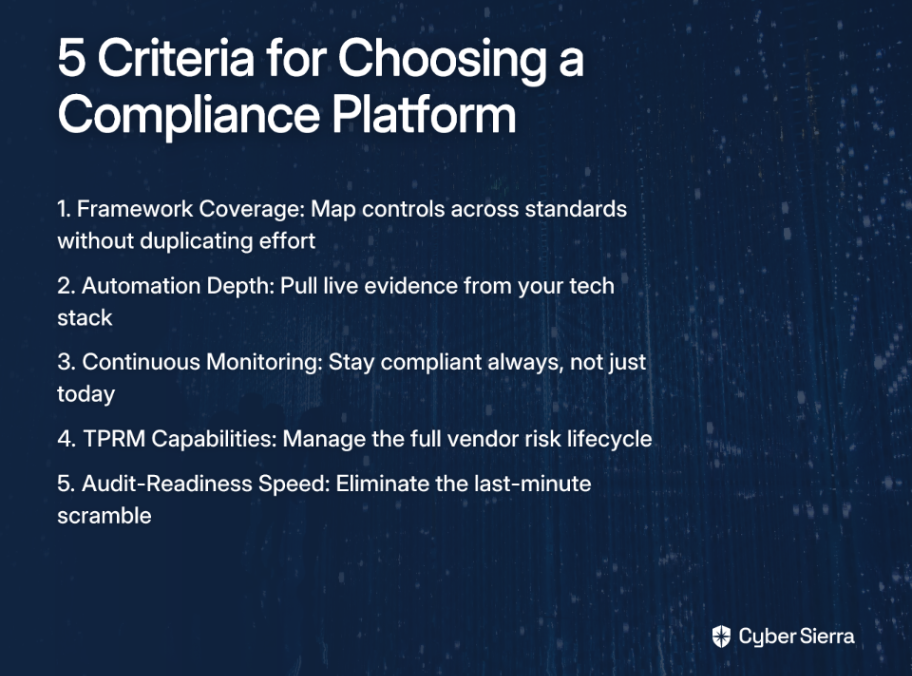
This list was built around five criteria that actually matter for enterprise compliance in 2026:
- Framework Coverage — Can it map controls across multiple standards without duplicating effort?
- Automation Depth — Does it pull live evidence from your tech stack, or just create prettier checklists?
- Continuous Monitoring — Does it answer "are we compliant always?" not just "are we compliant today?" As FireMon explains, real-time adherence enables faster violation detection and proactive risk management.
- TPRM Capabilities — Can it manage your entire vendor risk lifecycle, not just send questionnaires?
- Audit-Readiness Speed — Does it eliminate the scramble, or just move the scramble earlier?
Let's get into it.
If that sounds familiar, you're not alone. As one CISO put it on Reddit: "The most painful part of an audit is typically evidence gathering. You end up on long calls with engineers who may or may not speak GRC and hope they remember where to find a config and take a screenshot with a timestamp. It's painful and sucks up a lot of time."
The Top 9 Security Compliance Platforms for Enterprises
1. Cyber Sierra
Overview: For enterprises tired of stitching together point solutions, Cyber Sierra delivers an AI-enabled, integrated platform that covers GRC, Continuous Control Monitoring, TPRM, and Threat Intelligence under one roof. Rather than bolting on separate tools for each compliance requirement, Cyber Sierra instills automation, continuity, and intelligence across the entire security program — shifting teams from reactive, periodic checks to proactive, near real-time risk management.
Key Features:
- Governance, Risk & Compliance: Automates data collection, risk assessments, control monitoring, and reporting across frameworks including SOC 2, ISO 27001, HIPAA, GDPR, and PCI DSS. Maintains detailed audit trails and supports policy management, so you're never scrambling for documentation when auditors arrive.
- Continuous Control Monitoring (CCM): Builds a centralized controls repository with near real-time updates, automates control testing and validation, and detects exceptions as they happen — directly eliminating the painful, manual evidence-gathering process.
- Third-Party Risk Management (TPRM): Automates vendor assessments and onboarding, prioritizes your vendor inventory by risk level, and provides 24/7 visibility into third-party security posture — far beyond what a point-in-time questionnaire can offer.
- Threat Intelligence: Combines a comprehensive security scorecard with network and cloud vulnerability scanning for an outside-in view of your attack surface, enabling proactive remediation before threats are exploited.
- Employee Security Training: Interactive modules and simulated phishing campaigns to strengthen your human firewall — critical given that human error remains a leading cause of breaches.
- Cyber Insurance: Helps you demonstrate robust cyber hygiene to insurers, automates required documentation, and streamlines the coverage application process.
Best for: Mid-to-large enterprises in regulated industries — particularly BFSI, HealthTech, and Manufacturing — that need a unified, automated, and intelligent security compliance platform instead of managing five separate tools with five separate dashboards.
2. MetricStream
MetricStream is a heavyweight in the enterprise GRC space, built for large organizations with complex, multi-layered compliance requirements. It integrates risk, compliance, and audit management on a centralized platform with a strong emphasis on regulatory change management.
Key features:
- An AI-first approach with pre-built regulatory content libraries, AI-powered analytics, and real-time risk dashboards.
- Excels at navigating regulatory complexity across sectors like banking, healthcare, and energy.
- Offers strong audit management workflows and policy lifecycle management.
Best for: Large enterprises in highly regulated sectors with mature, often siloed GRC programs and significant implementation budgets. Best suited for organizations that have dedicated GRC teams to configure and manage the platform.
3. Drata
Drata is an AI-native compliance automation platform purpose-built for fast-growing technology companies. Its core promise is hyper-automating the evidence collection and control monitoring processes that traditionally eat up weeks of engineering time.
Key features:
- Deep integrations with cloud services (AWS, GCP, Azure) and SaaS tools to automatically pull compliance evidence.
- Continuous control monitoring with real-time alerts.
- Pre-built policy templates and a streamlined auditor collaboration portal.
Best for: Cloud-native tech startups and scale-ups that need to achieve SOC 2 or ISO 27001 certification quickly to unblock enterprise sales deals. Less optimized for organizations with complex multi-framework or TPRM requirements.
4. Qualys TotalCloud
Qualys TotalCloud is a cloud-native security compliance platform focused on providing continuous visibility, assessment, and remediation across multi-cloud environments. It's designed for organizations where the compliance risk lives primarily in cloud infrastructure configurations.
Key features:
- Unified asset visibility across hybrid and multi-cloud environments.
- Supports over 100 frameworks, automated evidence generation, and risk-based prioritization.
- Automated monitoring and risk-prioritized remediation workflows.
Best for: Organizations with complex, multi-cloud environments that need deep, granular visibility into cloud configurations and want a security-first lens on their compliance posture.
5. Wiz
Wiz is a leading Cloud Native Application Protection Platform (CNAPP) that has become a go-to for security teams managing sprawling cloud estates. It correlates misconfigurations, vulnerabilities, identities, and malware into a contextual risk graph that helps teams understand what's actually exploitable.
Key features:
- Agentless scanning for rapid visibility across IaaS and PaaS environments.
- A unique "toxic combinations" risk graph that highlights chained risks.
- Strong integrations with developer workflows for shift-left security.
Best for: Security-first organizations that prioritize deep cloud risk context and want to understand the compounded impact of interconnected vulnerabilities — particularly engineering-led teams in cloud-native environments.
6. RSA Archer
RSA Archer is a long-standing pillar of the enterprise GRC market, offering a comprehensive and highly configurable risk management solution. It's built for organizations that have outgrown simpler tools and need a platform that can model complex risk relationships and regulatory requirements.
Key features:
- Centralized risk tracking across business units and advanced workflow management.
- Robust audit-ready control testing capabilities and extensive framework coverage.
- Highly configurable platform to model complex risk relationships.
Best for: Large, established enterprises with mature GRC programs, dedicated risk management teams, and the internal resources to configure and maintain a highly customizable platform over time.
7. Vanta
Vanta is one of the most recognized names in compliance automation, particularly among tech companies pursuing their first formal certification. It focuses on making the SOC 2 and ISO 27001 journey accessible and fast for teams without a large GRC function.
Key features:
- Automated evidence collection via integrations with AWS, GitHub, GCP, Okta, etc.
- Pre-built policy templates.
- A vendor risk management module and a dedicated auditor-facing portal.
Best for: Tech startups and SMBs targeting their first SOC 2 or ISO 27001 certification to build customer trust and unblock enterprise deals. Scales less gracefully for organizations managing five or more overlapping compliance frameworks simultaneously.
8. LogicGate Risk Cloud
LogicGate takes a different approach from most GRC platforms: rather than offering a fixed solution, it provides a no-code platform that allows organizations to build their own risk and compliance workflows from the ground up.
Key features:
- A drag-and-drop workflow builder (Risk Cloud®) for custom applications.
- Centralized policy management and cross-functional risk visibility.
- Strong integration capabilities to adapt to unique organizational structures.
Best for: Organizations that need high levels of GRC customization and want to empower business-side risk owners to build and manage their own workflows. Works well for mid-market companies with non-standard compliance program structures.
9. ServiceNow GRC
ServiceNow GRC integrates governance, risk, and compliance functions directly into the broader ServiceNow platform — making it a natural fit for large organizations that already run IT operations, HR, and service management on ServiceNow.
Key features:
- Real-time compliance monitoring through native ITSM integrations.
- Unified dashboards across business and IT risk.
- Strong workflow orchestration and centralized policy governance.
- Relies on other platforms for evidence generation, acting as a strong orchestration layer.
Best for: Large organizations that are deeply invested in the ServiceNow ecosystem and want to consolidate GRC within their existing operational platform rather than introducing a standalone tool.
Decision Guide: Which Platform Is Right for Your Organization?
Not every platform suits every enterprise. Here's a practical map to help you match your situation to the right tool:
| Company Profile | Best Fit |
|---|---|
| Tech startup, first SOC 2 or ISO 27001 | Vanta, Drata |
| Cloud-native, multi-cloud security risk focus | Wiz, Qualys TotalCloud |
| Large enterprise, siloed/mature GRC program | MetricStream, RSA Archer |
| ServiceNow-first organization | ServiceNow GRC |
| Flexible GRC with custom workflows | LogicGate Risk Cloud |
| Mid-to-large enterprise in BFSI, HealthTech, or Manufacturing needing integrated GRC + CCM + TPRM + Threat Intelligence | Cyber Sierra |
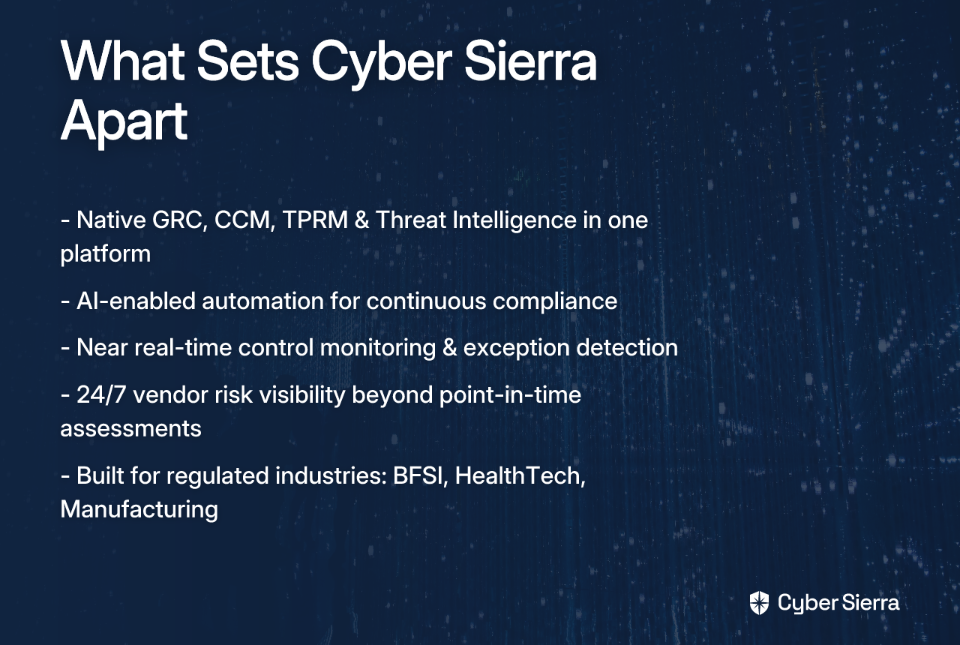
If you're a regulated enterprise managing overlapping frameworks, a growing vendor ecosystem, and a board demanding real-time compliance visibility — and you're exhausted by the patchwork of point solutions that still leaves gaps — Cyber Sierra is built for exactly that scenario. It's the only platform on this list that natively integrates GRC, Continuous Control Monitoring, TPRM, and Threat Intelligence in a single AI-enabled environment, so your compliance program becomes a continuous, connected system rather than a series of disconnected audits.
Go From Reactive Audits to Real-Time Readiness
Choosing the right compliance platform boils down to a few core truths. First, manual evidence gathering is no longer sustainable; true automation frees up your team to focus on security, not screenshots. Second, the goal has shifted from passing periodic audits to maintaining continuous, real-time compliance. For enterprises juggling multiple frameworks, this means an integrated platform will always outperform a patchwork of disconnected tools that create data silos and operational drag.
Ready for a practical next step? This week, identify the single most time-consuming evidence collection task from your last audit cycle. Pinpointing that bottleneck is the first move toward eliminating it for good.
When you’re ready to see how a unified platform solves that problem and transforms your entire compliance program, we can show you how Cyber Sierra replaces manual work with automated, audit-ready workflows. Book a personalized demo and see how you can trade the audit scramble for always-on readiness.
Frequently Asked Questions
What is a security compliance platform?
A security compliance platform is a software solution that automates the tasks required to meet regulatory standards like SOC 2, ISO 27001, and HIPAA. It centralizes evidence collection, control monitoring, and reporting to reduce manual effort and ensure your organization remains audit-ready.
Why is continuous compliance better than periodic audits?
Continuous compliance provides real-time visibility into your security posture, whereas periodic audits only offer a point-in-time snapshot. This proactive approach helps you detect and remediate compliance gaps as they occur, reducing risk and preventing last-minute audit scrambles.
How does automation help with SOC 2 or ISO 27001 audits?
Automation drastically reduces audit preparation time by automatically collecting evidence from your cloud and SaaS tools. Instead of manually taking screenshots, platforms connect to your tech stack to continuously monitor controls, track evidence, and generate audit-ready reports.
What are the key features to look for in an enterprise compliance tool?
Look for broad framework coverage, deep automation for evidence collection, continuous control monitoring, third-party risk management (TPRM), and features that speed up audit-readiness. These capabilities ensure the platform can scale with your organization's complex compliance needs.
What is the difference between an integrated platform and point solutions?
An integrated platform combines Governance, Risk, and Compliance (GRC), Continuous Control Monitoring (CCM), and TPRM into a single system. Point solutions address each function separately, which can create data silos, increase overhead, and leave security gaps between tools.
Who is Cyber Sierra best for?
Cyber Sierra is designed for mid-to-large enterprises in regulated industries like BFSI, HealthTech, and Manufacturing. It's ideal for teams needing to manage multiple overlapping frameworks with a unified platform that integrates GRC, CCM, TPRM, and Threat Intelligence.
