



7 GRC Solutions Built for BFSI and HealthTech Compliance Teams


Join thousands of professionals and get the latest insight on Compliance & Cybersecurity.
Key Takeaways
- BFSI and HealthTech firms face intense regulatory pressure, but generic GRC tools often lack pre-mapped controls for frameworks like HIPAA and PCI DSS, leading to manual overload and compliance gaps.
- The most critical feature for these industries is Continuous Control Monitoring (CCM), which provides real-time visibility into security posture and ensures year-round audit readiness.
- AI-powered GRC platforms can improve compliance efficiency by up to 62% by automating manual evidence collection, control testing, and reporting.
- To move from periodic checks to continuous confidence, select an integrated platform with native CCM and pre-built frameworks like Cyber Sierra's GRC solution.
If you work in compliance at a bank, insurer, fintech, or healthtech company, you already know the feeling: buried under alerts, emails, PDFs, and checks that never seem to end. One analyst on Reddit described it perfectly — they're spending so much time on manual audits and log collection that there's nothing left for actual high-value work.
And yet, the regulatory pressure keeps mounting.
BFSI teams in India must satisfy the RBI's cybersecurity framework, which mandates prompt incident reporting and robust data governance. SEBI demands real-time risk detection and quarterly Vulnerability Assessment and Penetration Testing (VAPT). PCI DSS layers on strict cardholder data security standards that require continuous control validation.
HealthTech teams face a different but equally demanding gauntlet. HIPAA requires stringent technical safeguards — encryption, audit logs, access controls — to protect Protected Health Information (PHI). GDPR imposes global data privacy obligations. And ISO 27001 demands a mature, fully documented Information Security Management System (ISMS). As one healthcare compliance professional noted on Reddit, "Healthcare is the second most regulated industry in the U.S. — the stakes for data privacy and security are extraordinarily high."
The real problem? Most generic GRC platforms aren't built for this level of regulatory specificity. They ship without pre-mapped controls for RBI, SEBI, HIPAA, or PCI DSS — forcing your team to spend months building custom frameworks from scratch. That creates compliance fatigue, audit-cycle panic, and a false sense of security between assessments.
The GRC solutions below are different. Each is evaluated on two critical dimensions: which compliance frameworks it supports out of the box, and whether it offers continuous control monitoring (CCM) or point-in-time assessments. For BFSI and HealthTech, that distinction isn't academic — it's the difference between being audit-ready year-round and scrambling every quarter.
Top 7 GRC Platforms for BFSI and HealthTech
1. Cyber Sierra — Best for BFSI & HealthTech Audit Readiness
Frameworks supported: PCI DSS, HIPAA, GDPR, ISO 27001, SOC 2, NIST
Monitoring type: ✅ Continuous Control Monitoring (CCM)
Cyber Sierra is an AI-enabled cybersecurity platform built specifically for regulated industries. Rather than forcing compliance teams to configure controls from scratch, it ships with pre-mapped controls for the frameworks that BFSI and HealthTech teams actually need — PCI DSS, HIPAA, GDPR, ISO 27001, SOC 2, and NIST — eliminating months of setup work.
What sets Cyber Sierra apart is its native Continuous Control Monitoring (CCM) engine. Instead of periodic, point-in-time snapshots that leave gaps between audits, CCM provides near real-time visibility into your control posture. It centralizes your control repository, automates evidence collection and testing, and flags exceptions as they happen — not days before your auditor arrives.
For BFSI and HealthTech firms juggling multiple frameworks simultaneously, this matters enormously. AI-powered GRC platforms like Cyber Sierra can improve compliance efficiency by up to 62%, freeing your analysts from the manual treadmill.
Beyond GRC, the platform integrates Third-Party Risk Management (TPRM) for continuous vendor monitoring, Threat Intelligence for attack surface visibility, and Employee Security Training — a unified suite that directly addresses a common industry pain point.

Best for: BFSI and HealthTech compliance teams that need out-of-the-box framework coverage, continuous audit readiness, and a consolidated platform that replaces multiple point solutions.
2. MetricStream — Best for Large Enterprise GRC Programs
Frameworks supported: Broad framework library with customizable workflows
Monitoring type: ✅ Continuous Monitoring
MetricStream is a well-established, enterprise-grade GRC platform that integrates risk, compliance, audit, and regulatory management into a unified system. It's a strong fit for large BFSI organizations — global banks, insurance conglomerates, and asset managers — that need a highly configurable platform capable of handling complex, multi-entity risk programs.
Its continuous monitoring capabilities help maintain compliance between formal audits, and its deep audit trail features align well with the documentation requirements of RBI and SEBI. That said, MetricStream is built for organizations with mature GRC programs and dedicated implementation teams; smaller or mid-size firms may find the setup investment significant.
Best for: Large BFSI enterprises with complex, cross-jurisdictional GRC requirements and the resources to support an enterprise implementation.
3. Drata — Best for HealthTech & FinTech Startups
Frameworks supported: SOC 2, ISO 27001, HIPAA, PCI DSS
Monitoring type: ✅ Continuous Monitoring
Drata has built a strong reputation among technology-driven startups that need to achieve compliance certifications quickly — often to satisfy enterprise customers or investor due diligence. It automates control monitoring and evidence collection by integrating directly with cloud providers (AWS, GCP, Azure), source control, HR systems, and hundreds of other SaaS tools.
For a HealthTech startup facing a common compliance dilemma, Drata offers a relatively fast path to HIPAA and SOC 2 readiness. Its continuous monitoring model means you're not just passing an audit — you're maintaining evidence automatically in the background.
One important note: Drata's strength is in cloud-native tech environments. Organizations with hybrid infrastructure or highly customized security architectures may find the integrations require more setup than advertised — a common frustration highlighted by compliance practitioners who warn that "platforms claiming 'no integration' usually still need significant setup for compliance workflows."
Best for: HealthTech and FinTech startups and scale-ups that primarily operate in cloud-native environments and need rapid SOC 2 or HIPAA certification.
4. RegScale — Best for Compliance-as-Code Environments
Frameworks supported: NIST 800-53, FedRAMP, SOC 2, PCI DSS, CMMC
Monitoring type: ✅ Continuous Controls Monitoring
RegScale takes a distinctive approach: it treats compliance as code, embedding controls and evidence directly into digital workflows and CI/CD pipelines. This makes it particularly compelling for regulated organizations with mature DevOps practices — a growing cohort in both BFSI (think: digital-first banks and payment processors) and HealthTech.
Its continuous controls monitoring capability delivers real-time compliance tracking, and its framework library covers NIST 800-53 and PCI DSS comprehensively. If your team is already asking about DevOps compliance practices, RegScale's model — where audit logs and change approvals are built into the deployment pipeline — is a natural extension of how your engineers already work.
Best for: BFSI and HealthTech teams with strong DevOps practices that want compliance integrated directly into their development and infrastructure workflows.
5. OneTrust — Best for Data Privacy-Led Compliance
Frameworks supported: GDPR, CCPA, HIPAA, ISO 27001
Monitoring type: ✅ Continuous Monitoring
OneTrust is the market leader in privacy and data governance management. It's built from the ground up for organizations where data privacy is the primary compliance driver — which describes virtually every HealthTech company handling PHI and every BFSI firm operating under GDPR in European markets.
OneTrust's continuous monitoring capabilities focus on data practices: consent management, privacy impact assessments (PIAs), data subject request workflows, and cross-border data transfer compliance. For HealthTech teams navigating the overlap between HIPAA and GDPR — a complex compliance challenge — having a platform that handles both natively is a meaningful advantage.
Where OneTrust is weaker is in broader security control monitoring (e.g., PCI DSS or NIST). It's best paired with a platform like Cyber Sierra when full-spectrum GRC coverage is needed.
Best for: HealthTech and global BFSI firms where GDPR and HIPAA data privacy obligations are the central compliance challenge.
6. LogicGate (Risk Cloud®) — Best for Custom Compliance Workflows
Frameworks supported: Highly customizable; supports various frameworks and custom internal controls
Monitoring type: ⚠️ Primarily point-in-time assessments with some continuous features
LogicGate's Risk Cloud® is a no-code GRC platform that lets organizations build compliance and risk applications tailored to their exact processes. Its flexibility is genuine — if your compliance program has unique processes, regulatory carve-outs, or internal controls that don't map neatly to standard frameworks, LogicGate can accommodate them without forcing a compromise.
That flexibility comes with a caveat: LogicGate is more oriented toward structured risk assessment cycles and policy management workflows than toward automated continuous evidence collection. Teams that need real-time control monitoring will find themselves doing more manual work compared to automation-first platforms. It's a solid choice if your primary pain is workflow management and reporting, but less ideal if audit readiness between assessment cycles is the priority.
Best for: Organizations with highly specific or non-standard compliance requirements that need configurable workflows over automated continuous monitoring.
7. ZenGRC (by Reciprocity) — Best for Audit Cycle Management
Frameworks supported: SOC 2, ISO 27001, PCI DSS, HIPAA
Monitoring type: ⚠️ Primarily point-in-time assessments with some continuous monitoring integrations
ZenGRC is a user-friendly GRC platform designed to make compliance management accessible to teams without deep compliance engineering backgrounds. It simplifies audit management, risk visualization, and control documentation — making it a reasonable starting point for mid-sized organizations that are formalizing their GRC program for the first time.
It connects to existing tools to pull evidence, but its model is more audit-cycle-oriented than continuously automated. For BFSI teams that need quarterly VAPT reporting or HealthTech firms managing annual HIPAA attestations, ZenGRC provides a structured environment to manage those cycles without the complexity of an enterprise platform.
Best for: Mid-sized BFSI and HealthTech organizations that need an intuitive, accessible tool to manage structured audit cycles rather than continuous, automated monitoring.
Decision Checklist: How to Shortlist the Right GRC Solution for Your Regulated Industry
Not every GRC platform is built for the realities of BFSI or HealthTech compliance. Before requesting a demo or starting a trial, run through this checklist:
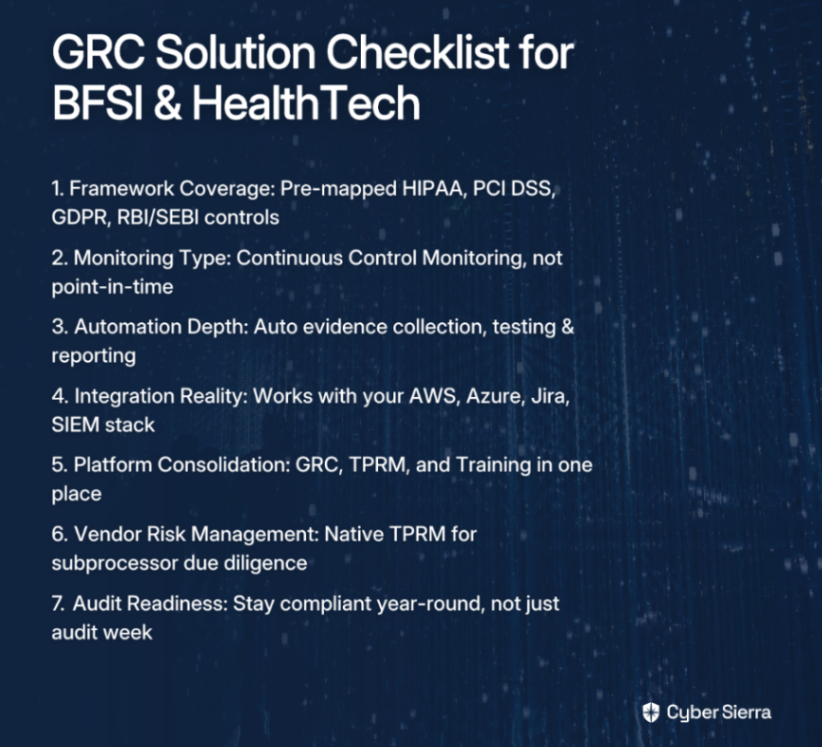
- ✅ Framework Coverage — Out of the Box. Does the platform ship with pre-mapped controls for your specific mandates — HIPAA, PCI DSS, GDPR, ISO 27001, or RBI/SEBI frameworks? Or will your team spend months building custom control sets from scratch? Avoid platforms that charge you separately for each framework version — that cost model penalizes you for growing your compliance program.
- ✅ Continuous vs. Point-in-Time Monitoring. Does the platform offer genuine Continuous Control Monitoring (CCM), or is it built around audit cycles and periodic assessments? For BFSI and HealthTech, where regulators expect ongoing evidence of control effectiveness, point-in-time tools leave dangerous gaps between audits.
- ✅ Automation Depth. To what extent does the platform automate evidence collection, control testing, and reporting? The goal is to free your analysts from the manual treadmill — not just digitize it. Look for automated audit trails, real-time exception detection, and auto-generated reports.
- ✅ Integration Reality. Does it integrate with your actual environment — AWS, Azure, GCP, your ticketing system (Jira), your SIEM, your HR platform? Be skeptical of "no-code" or "no integration required" claims. As compliance practitioners have noted, these platforms usually still require significant setup for real-world compliance workflows.
- ✅ Platform Consolidation. Does it solve more than one problem? If you're currently paying for four separate tools for GRC, TPRM, threat intelligence, and training, a unified platform reduces overhead, eliminates context-switching, and gives you a single source of truth across your compliance and risk program.
- ✅ Vendor Risk Management. Does it include native Third-Party Risk Management (TPRM)? Both BFSI and HealthTech compliance programs require proof of vendor due diligence — especially for subprocessors handling PHI or cardholder data. TPRM shouldn't be an afterthought bolted on via a separate tool.
- ✅ Audit Readiness, Not Just Audit Prep. The best grc solutions don't just help you survive an audit — they keep you audit-ready every day of the year. Ask vendors: how does your platform ensure I'm compliant on a Tuesday in March, not just the week before my assessor arrives?

From Audit Panic to Permanent Readiness
For compliance teams in BFSI and HealthTech, the goal isn't just to pass an audit—it's to eliminate the quarterly scramble entirely. Relying on generic GRC tools and point-in-time assessments creates a cycle of manual evidence collection and last-minute panic.
The shift to continuous confidence comes down to two key principles:
- Insist on Pre-Mapped Frameworks: Don’t waste months building controls for HIPAA, PCI DSS, or RBI from scratch. Your GRC platform must support them out of the box.
- Prioritize Continuous Monitoring: Real-time visibility into your controls is the only way to stay audit-ready every day, not just during audit week.
As a next step today, use the checklist in this article to score your current GRC solution. Does it automate evidence collection or just digitize your manual workflows?
When you’re ready to see how a platform built for regulated industries can end the audit cycle for good, request a personalized demo. See how you can maintain compliance year-round, without the panic.
Frequently Asked Questions
What is the most important feature in a GRC tool for regulated industries like BFSI and HealthTech?
The most critical feature is Continuous Control Monitoring (CCM). Unlike point-in-time assessments that create audit gaps, CCM provides real-time visibility into your security controls, ensuring you remain compliant and audit-ready year-round, which is essential for BFSI and HealthTech.
Why are generic GRC platforms a poor fit for BFSI and HealthTech companies?
Generic GRC platforms often lack pre-mapped controls for specific regulations like HIPAA, PCI DSS, or RBI frameworks. This forces your team to spend months on manual configuration, increasing setup time, creating compliance fatigue, and risking gaps in regulatory adherence.
How can a GRC platform help manage compliance with multiple frameworks simultaneously?
Modern GRC platforms help by mapping controls across multiple frameworks in a centralized repository. This "test once, comply many" approach allows you to automate evidence collection for a single control and apply it to satisfy requirements for HIPAA, PCI DSS, and ISO 27001 simultaneously.
What is the difference between continuous monitoring and point-in-time assessments?
Continuous monitoring provides real-time, automated checks on your security controls, offering a constant view of your compliance posture. Point-in-time assessments are periodic snapshots, like annual audits, which can miss control failures that occur between assessments.
How do modern GRC tools automate evidence collection for audits?
GRC tools automate evidence collection by integrating directly with your tech stack (e.g., AWS, Azure, Jira). They automatically pull logs, screenshots, and configuration data to validate security controls, eliminating manual work and keeping your evidence repository audit-ready.
Can a GRC platform also help with vendor risk management?
Yes, many advanced GRC solutions include a native Third-Party Risk Management (TPRM) module. This consolidates vendor assessments, due diligence, and continuous monitoring into the same platform, which is critical for meeting BFSI and HealthTech requirements for subprocessor oversight.
