



7 Enterprise GRC Solutions Built for Continuous Monitoring (Not Just Audits)


Join thousands of professionals and get the latest insight on Compliance & Cybersecurity.
Summary
- Traditional GRC tools focus on periodic audits, leading to last-minute scrambles and leaving significant security gaps between assessments.
- The shift to Continuous Control Monitoring (CCM) is essential for dynamic cloud environments, as it automates control testing and provides near real-time security visibility.
- Many GRC solutions claim "continuous monitoring" but are just audit-prep tools; this guide evaluates 7 platforms to distinguish true CCM from enhanced periodic checks.
- Cyber Sierra's Continuous Control Monitoring (CCM) platform automates evidence collection and provides near real-time anomaly detection to keep you audit-ready every day.
Picture this: it's three weeks before your SOC 2 audit. Your team is in a fire drill, chasing engineers for screenshots, hunting down access logs, and updating a spreadsheet that was outdated the moment it was created.
This pre-audit chaos isn't a people problem — it's a tooling problem. Most enterprise GRC solutions are built for point-in-time assessments, not for maintaining a verifiable security posture 365 days a year. The moment an audit ends, compliance starts to erode as misconfigurations creep in and access controls drift, often unnoticed until the next audit cycle begins.
In today's dynamic cloud environments, a quarterly or annual check is no longer sufficient. A single misconfigured S3 bucket can expose PII for months before anyone flags it. The solution is a fundamental shift from periodic GRC to Continuous Control Monitoring (CCM).
As Audithink defines it, CCM is "an automated process for collecting and analyzing data on internal controls, security, and compliance to ensure they function effectively in near real-time." But not all tools that claim "continuous monitoring" actually deliver. Many are just audit-prep platforms with live dashboards.
This guide cuts through the noise, evaluating 7 enterprise GRC solutions to see if they offer genuine, automated CCM — or just a cleaner-looking audit scramble.
Continuous vs. Periodic: The Feature Table
Before diving into the list, here's a quick-reference comparison to anchor the conversation:
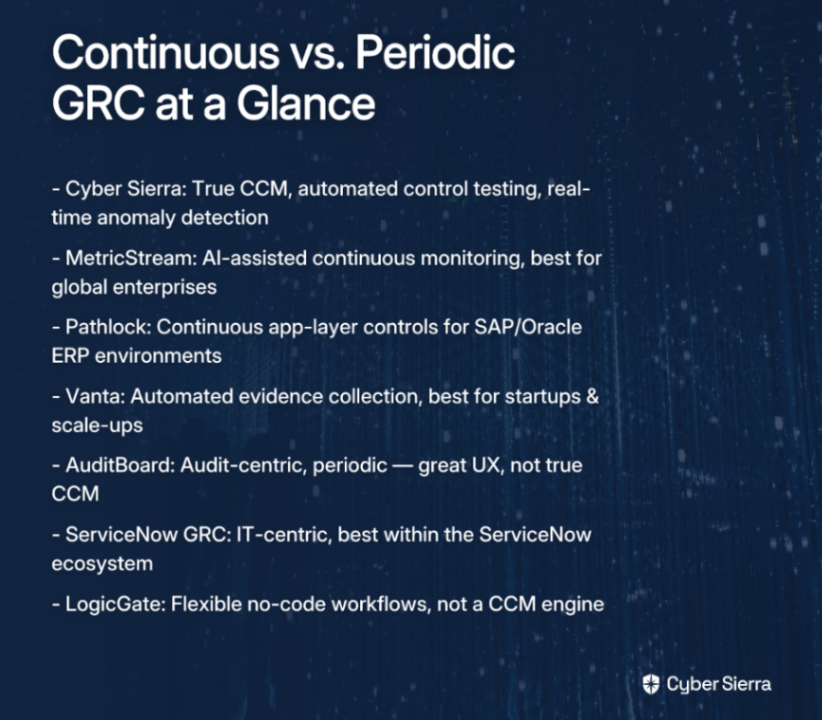
| Tool | Monitoring Type | Automated Control Testing | Real-Time Anomaly Detection | Best For |
|---|---|---|---|---|
| Cyber Sierra | ✅ Continuous | ✅ Yes | ✅ Yes | Mid-to-large enterprises needing true CCM |
| MetricStream | ✅ Continuous (AI-assisted) | ✅ Yes | ⚠️ Partial | Large global enterprises |
| Pathlock | ✅ Continuous (app-layer) | ✅ Yes (ERP-focused) | ⚠️ Partial | Financial controls in SAP/Oracle |
| Vanta | ⚠️ Periodic + Alerts | ✅ Yes (framework-based) | ⚠️ Partial | Startups achieving SOC 2 / ISO 27001 |
| AuditBoard | ⚠️ Periodic | ❌ Limited | ❌ Limited | Internal audit and SOX teams |
| ServiceNow GRC | ⚠️ Periodic + IT-centric | ⚠️ Partial | ❌ Limited | ServiceNow-embedded enterprises |
| LogicGate | ⚠️ Periodic + Workflow | ❌ Limited | ❌ Limited | Agile teams building custom GRC workflows |
The 7 Enterprise GRC Solutions
Here’s how seven of the leading enterprise GRC solutions stack up when evaluated for true continuous control monitoring capabilities.
1. Cyber Sierra — The Benchmark for Continuous Control Monitoring
If you're serious about moving beyond audit prep, Cyber Sierra's CCM module is the clearest example of what a purpose-built continuous monitoring platform actually looks like in practice.
Unlike tools that bolt "continuous" onto a fundamentally periodic architecture, Cyber Sierra is built from the ground up for operational continuity. It connects directly to your cloud provider (AWS, Azure, GCP), identity systems, and endpoint security stack to automatically test and validate controls — not on a schedule, but continuously.
Key capabilities that set it apart:
- Central Controls Repository with Near Real-Time Updates: A single source of truth for all your controls, eliminating the spreadsheet chaos that plagues most compliance teams.
- Automated Control Testing & Validation: Controls are tested by pulling data directly from your tech stack, not by asking someone to fill out a form.
- Near Real-Time Anomaly Detection: AI-driven detection of misconfigurations and exceptions as they happen — before they become incidents or audit findings.
- Actionable Risk Intelligence: Goes beyond a simple pass/fail status to prioritize what actually needs your attention and why.
- Efficient Multi-Framework Mapping. Test a control once and map that evidence to multiple frameworks simultaneously — drastically cutting redundant work. Supports:
- SOC 2
- ISO 27001
- PCI DSS
- GDPR
- HIPAA
Cyber Sierra also directly addresses the user pain of managing exceptions. Instead of getting the same failing control flagged every week for a legacy system, you can document it as a known issue, attach a risk assessment, and link a remediation plan — removing noise while maintaining accountability.
The bottom line: Cyber Sierra transforms GRC from a periodic, manual chore into a continuous, automated security function. It's purpose-built for compliance teams who want a reliable tool that works in the background without constant oversight.
2. MetricStream — Unified Enterprise GRC at Scale
MetricStream is a heavyweight in the enterprise GRC space, particularly for large, global organizations that need a highly configurable, all-in-one platform.
Its AiSPIRE module applies AI-driven insights across risk, compliance, and audit functions, providing a degree of continuous control monitoring. It also does well with automating regulatory change management — useful for enterprises operating across multiple jurisdictions with shifting compliance requirements.
Strengths
- Integrates risk, compliance, audit, and cyber risk into a single platform.
- AI-assisted insights for control monitoring and risk quantification.
- Strong regulatory change management for global enterprises.
- Low-code configurability for customizing workflows without heavy IT involvement.
Limitations
MetricStream's continuous monitoring is AI-assisted but can feel more reactive than proactive compared to CCM-native platforms. For organizations that need a deeply embedded, real-time control engine, it may require significant configuration to get there.
Best for: Large, global enterprises that need a comprehensive, configurable GRC platform and can invest in the setup required to activate its more advanced monitoring capabilities.
3. Pathlock — Continuous Controls Monitoring for Business Processes
Pathlock takes a different and highly specialized approach: it focuses on automating financial and application-level controls within critical business systems like SAP and Oracle.
For organizations where the biggest compliance risk lives inside ERP systems — think SOX controls over financial reporting, segregation of duties, and access governance — Pathlock provides genuine continuous visibility that most generic GRC platforms simply can't match at that layer.
Strengths
- Continuous monitoring of controls within SAP, Oracle, and other ERP environments.
- Centralized oversight of business process controls with real-time violation detection.
- Risk quantification for control exceptions and violations.
- Automates financial controls testing that would otherwise require significant manual effort.
Limitations
Pathlock's strength is also its constraint. It's excellent at the application control layer, but it's not a full-spectrum GRC platform. You'd likely need to pair it with a broader GRC solution for policy management, risk registers, and multi-framework compliance.
Best for: Enterprises with complex ERP environments (particularly SAP or Oracle) where financial and business process controls require continuous, automated oversight.
4. Vanta — Automated Compliance for Frameworks
Vanta has become a go-to platform for tech companies and startups that need to achieve and maintain compliance across a wide variety of frameworks, including:
- SOC 2
- ISO 27001
- HIPAA
- GDPR
- PCI DSS
- And over 35 others
It earns a spot on this list because it genuinely automates evidence collection by connecting to your tech stack and pulling data continuously, rather than relying on manual uploads. Real-time alerts notify your team when a control falls out of compliance.
Strengths
- Automates evidence collection across 35+ frameworks.
- Real-time alerts for control failures and policy violations.
- Vendor risk management features built in.
- Intuitive UX that makes it accessible for teams without dedicated GRC headcount.
Limitations
Where Vanta leans more "periodic" is in the depth of its control testing. It excels at checking whether the right configurations and policies exist, but its anomaly detection and automated remediation workflows are less sophisticated than CCM-native platforms. It's also better suited for SMBs and fast-growing startups than for complex enterprise environments with bespoke compliance requirements.
Best for: Startups and scale-ups that need to get SOC 2 or ISO 27001 certified quickly and maintain ongoing compliance without a large GRC team.
5. AuditBoard — Audit-Centric Automation
AuditBoard is a well-regarded platform for internal audit teams, and it does an excellent job of modernizing the audit process itself — streamlining workflows, managing evidence, and handling SOX compliance efficiently.
However, it's important to be honest about where it sits on the continuous vs. periodic spectrum: AuditBoard is primarily an audit management platform. Its workflows are fundamentally organized around audit cycles, not continuous control operation.
Strengths
- Strong audit management UX, widely praised by internal auditors.
- Streamlined evidence collection and auditor collaboration.
- SOX compliance management and PCAOB audit support.
- Unified control environment for cross-functional audit teams.
Limitations
AuditBoard doesn't offer genuine, automated continuous control testing in the CCM sense. It makes the periodic audit process more efficient, which is valuable — but it doesn't eliminate the compliance gap that opens up between audit cycles. For enterprises that want true operational continuity, AuditBoard is a partial solution.
Best for: Internal audit and SOX compliance teams in mid-to-large enterprises who need to run more efficient, better-organized audit programs.
6. ServiceNow GRC — IT Risk in the ServiceNow Ecosystem
ServiceNow GRC makes the most sense for enterprises that are already deeply embedded in the ServiceNow ITSM ecosystem and want to unify their IT risk and compliance data within that same environment.
The integration with ServiceNow's incident management, change management, and asset management modules creates a genuinely useful loop: a GRC finding can automatically generate an ITSM ticket, and a resolved incident can feed back into the compliance record.
Strengths
- Native integration with ServiceNow ITSM, CMDB, and security operations.
- Single pane of glass for IT risk, policy compliance, and incidents.
- Connects GRC findings directly to change and incident workflows.
- Strong for large enterprises with mature ServiceNow deployments.
Limitations
ServiceNow GRC is powerful within its ecosystem but can feel limited outside of it. Its continuous monitoring capabilities are IT-infrastructure-centric and lack the broad multi-framework CCM coverage that security-focused GRC teams often need. Implementation is also typically complex and resource-intensive.
Best for: Large enterprises with significant ServiceNow investments that want GRC integrated into their existing ITSM and security operations workflows.
7. LogicGate — Agile, No-Code Risk Workflows
LogicGate takes a distinctly different approach from the rest of this list: it's a flexible, no-code risk and compliance workflow builder rather than a purpose-built CCM platform.
For mid-market organizations that have unique GRC processes or need to build workflows that don't fit neatly into pre-packaged frameworks, LogicGate provides a level of customization that more rigid platforms can't match. You can centralize your enterprise risk register, build custom assessment workflows, and reduce manual effort through automation.
Strengths
- Highly customizable, no-code workflow builder.
- Centralizes enterprise risk register and risk assessment processes.
- Flexible enough to support custom compliance frameworks and controls.
- Reduces manual effort through configurable automation.
Limitations
LogicGate's flexibility is its greatest strength and its biggest limitation for continuous monitoring use cases. It's a workflow tool, not a continuous control monitoring engine. It doesn't natively connect to your cloud infrastructure to test controls — it automates the human workflows around compliance, not the technical validation of controls themselves. For many teams, this level of flexibility can be a drawback, as they often prefer fewer decisions and clearer guardrails.
Best for: Mid-market organizations that need to build custom, agile GRC workflows and have unique compliance processes that don't fit standard frameworks.
What Continuous GRC Actually Looks Like in Practice
The concept of CCM can sound abstract. So let's make it concrete with a day-in-the-life scenario for Alex, a Compliance Manager at a mid-sized enterprise running on AWS with SOC 2 and ISO 27001 obligations.
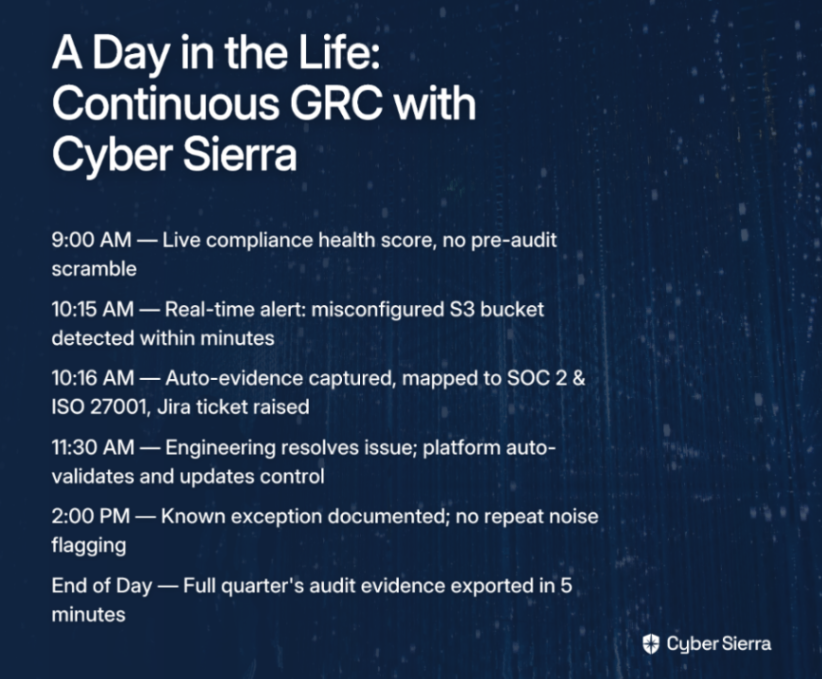
- 9:00 AM — Morning Check-in. Alex opens the Cyber Sierra dashboard to a live compliance health score, not a static list from the last audit. Evidence for 94% of controls is collected automatically, making every day audit-ready.
- 10:15 AM — Real-Time Alert. A notification appears. The CCM module has detected a critical S3 bucket was set to public within minutes of the misconfiguration, not hours or days later during a scheduled scan.
- 10:16 AM — Automated Evidence & Ticketing. The platform captures the non-compliant configuration as timestamped evidence, maps it to the relevant SOC 2 and ISO 27001 controls, and creates a high-priority Jira ticket for engineering.
- 11:30 AM — Closed Loop Remediation. After engineering resolves the issue, the CCM module automatically re-scans the asset, validates the fix, and updates the control status to "Compliant" with a full audit trail.
- 2:00 PM — Exception Management. Alex reviews a failing control for a legacy system. She documents it as a known exception with a risk acceptance form and remediation timeline. The platform stops flagging the issue, reducing noise while maintaining accountability for the documented plan.
- End of Day — Audit Evidence in 5 Minutes. An auditor requests user access reviews for the quarter. Alex generates a complete report from Cyber Sierra in five minutes, not five days.
This is what genuine enterprise GRC built for continuous monitoring looks like: not a dashboard you check before an audit, but an operational layer that runs continuously in the background — catching gaps, closing loops, and maintaining a provably secure posture every day of the year.

From Audit-Ready to Always-Ready
The most critical question for any GRC platform isn't "Can it help us pass our next audit?" but rather, "What is our security posture on the 200+ days between audits?" The shift from periodic checks to true resilience hinges on two key takeaways.
First, genuine Continuous Control Monitoring (CCM) isn't a dashboard; it's an engine. It automates control testing by pulling data directly from your tech stack. Second, many platforms claiming "continuous" are simply audit-prep tools in disguise. They don't provide the near real-time anomaly detection needed to catch misconfigurations before they become incidents.
Your next step is simple. When evaluating any GRC tool, ask vendors this one question: "Does your platform test controls automatically via API, or does it just help manage manual evidence?" The answer will reveal whether you're buying a continuous solution or a better-looking spreadsheet.
If you're ready to move from periodic fire drills to an always-ready posture, see how Cyber Sierra's purpose-built CCM platform can help.
Explore the CCM platform to learn how to transform your GRC program from a reactive chore into a continuous security function.
Frequently Asked Questions
What is the main difference between traditional GRC and Continuous Control Monitoring (CCM)?
The main difference is timing and automation. Traditional GRC is periodic, focusing on point-in-time audits. CCM is a real-time, automated process that continuously tests and validates security controls, providing an ongoing view of your compliance posture between audits.
Why is continuous monitoring important for modern cloud environments?
Modern cloud environments are dynamic and complex. Continuous monitoring is crucial because it detects misconfigurations and security gaps in near real-time, preventing prolonged data exposure that periodic checks can easily miss in environments like AWS, Azure, or GCP.
How does a CCM platform automate evidence collection?
A CCM platform automates evidence collection by directly integrating with your tech stack (e.g., cloud providers, identity systems). It programmatically pulls data, screenshots, and logs to validate controls automatically, eliminating the need for manual, last-minute evidence chasing.
Who benefits most from implementing a Continuous Control Monitoring tool?
Compliance, security, and internal audit teams benefit most. CCM tools reduce their manual workload, eliminate audit fire drills, and provide engineers with actionable, real-time feedback. This shifts GRC from a periodic chore to a continuous, collaborative security function.
What should I look for when choosing an enterprise GRC solution?
Look for genuine continuous monitoring capabilities. Key features include direct API integrations for automated control testing, near real-time anomaly detection, and multi-framework mapping. Ask vendors if their tool validates controls continuously or just runs scheduled scans.
How can our organization transition from periodic GRC to a continuous model?
Start by identifying your most critical controls and systems. Implement a CCM tool to automate monitoring for a single high-risk area, like your primary cloud environment. This phased approach demonstrates value quickly and builds momentum for a broader rollout across the organization.
