



Continuous Monitoring Tools vs. Point-in-Time Assessments: ROI Comparison


Join thousands of professionals and get the latest insight on Compliance & Cybersecurity.
Key Takeaways
- Point-in-time security assessments create visibility gaps and often require over 200 hours of manual prep time per audit.
- Continuous monitoring is designed to reduce audit prep time significantly and can help lower average breach costs.
- Match monitoring frequency to asset risk: monitor critical systems like cloud environments in near real-time, and low-risk assets annually.
- Cyber Sierra's CCM platform automates evidence collection to help you stay audit-ready.
You've just wrapped up your annual security audit. The report came back clean — no critical findings, a few medium-risk items flagged for remediation. You breathe a sigh of relief and move on.
Then, three weeks later, a misconfiguration quietly slips into your cloud environment during a routine deployment. A new vendor is onboarded without a proper risk review. A phishing campaign targets employees whose training lapsed months ago. None of these surface in your next audit — because that's six months away.
This is the hidden cost of point-in-time thinking. And for CISOs, compliance managers, and IT security teams already stretched thin, it's a cost that rarely shows up on a spreadsheet — until it's too late.
The debate between continuous monitoring tools and point-in-time assessments isn't really about methodology. It's about whether your security program is designed to keep pace with reality, or just look good on paper once a year.
This article breaks down the true ROI of each approach, gives you a practical framework for calculating costs and benefits, and offers a decision guide for determining the right monitoring frequency for different controls and asset types.
Point-in-Time Assessments: A Snapshot in a Shifting Landscape
Point-in-time assessments — annual penetration tests, quarterly vulnerability scans, periodic audits — have been the compliance industry standard for decades. And to be fair, they serve a purpose: they establish baselines, satisfy auditors, and are relatively simple to scope for initial vendor evaluations.
But they come with a fundamental flaw: the world doesn't pause while you prepare your report.
Modern IT environments are dynamic by nature. Cloud infrastructure spins up and down in minutes. Code is deployed multiple times a day. SaaS tools are added without formal procurement processes. A "clean" penetration test report can be rendered inaccurate within hours of delivery, as The Hacker News notes, because point-in-time assessments are static in an environment that is anything but.
The operational costs compound this problem:
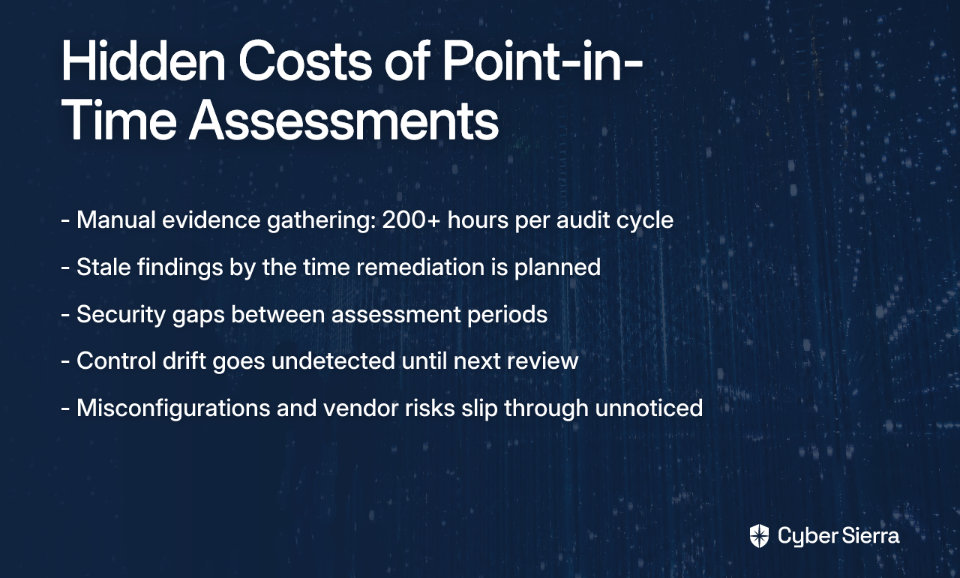
- High manual overhead. Gathering evidence, coordinating across teams, and scheduling assessors consumes hundreds of hours per cycle. Many security teams report spending 200+ hours preparing for a single compliance audit.
- Stale findings. By the time remediation is planned and resourced, the threat landscape has already shifted.
- Security gaps between assessments. Vulnerabilities and misconfigurations can emerge — and be exploited — in the weeks or months between reviews.
- Control drift. Without ongoing validation, controls that pass one audit can degrade quietly until the next review cycle.
For teams already struggling with fragmented documentation and chaotic compliance tracking, point-in-time assessments add complexity without solving the root problem.
Continuous Monitoring: The Proactive Security Paradigm
Continuous monitoring is the operational shift from periodic snapshots to an ongoing, automated process of discovering, assessing, and mitigating risk across your entire digital footprint — in near real-time.
Rather than asking "what did our security posture look like last quarter?", continuous monitoring answers the question: "What does our security posture look like right now?"
This distinction matters enormously, both operationally and financially. Research from Perimeter highlights that continuous monitoring eliminates security blind spots by adapting to evolving threats and drastically reducing incident response times.
The core advantages include:
- Real-time visibility. Vulnerabilities and compliance failures are flagged as they emerge, not months later.
- Operational efficiency. Automated data collection and alerting integrates directly with existing workflows, reducing manual effort and the dreaded alert fatigue that plagues overextended teams.
- Faster response. Cutting Time to Detection (TTD) and Time to Response (TTR) from months to hours or minutes dramatically limits the blast radius of any given incident.
- Reduced control drift. Controls are validated continuously, not just before auditors arrive.
Yes, there's an upfront investment. But when you factor in the total cost of ownership — and the cost of what you're not catching — the math shifts decisively.
A Framework for ROI: Calculating the True Cost of Security
One of the most common pain points for CISOs is justifying cybersecurity spending to executives who want to see tangible returns. The key is to reframe security as risk mitigation and cost avoidance — not a cost center.
The Cost Side of the Equation
Point-in-time assessment costs:
- External consultant and assessor fees (recurring per cycle)
- Internal labor: evidence gathering, report review, and remediation planning
- Audit preparation time — commonly 200+ hours per engagement
- Opportunity cost of security staff diverted from proactive work
Continuous monitoring costs:
- Tool licensing or subscription fees
- Initial implementation and configuration time
- Personnel training
While the line-item subscription cost of a continuous monitoring platform may look larger than a one-off assessment, the total cost of ownership — when manual labor is properly accounted for — typically favors automation significantly.
The Return Side of the Equation
This is where continuous monitoring makes a compelling case:
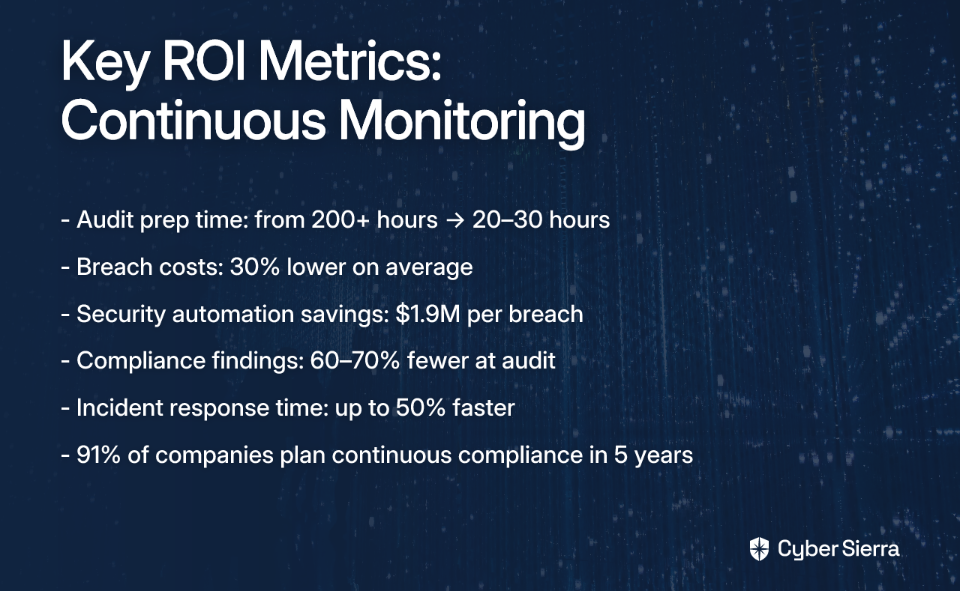
- Audit preparation time can drop from 200+ hours to 20–30 hours when control evidence is collected automatically and continuously, according to Secure.com. This represents a significant efficiency gain.
- Organizations using continuous monitoring report 30% lower average breach costs due to faster detection and containment, and those with extensive security automation save an average of $1.9 million per data breach (Apiiro).
- Compliance-related findings drop by 60–70% when issues are caught and remediated before auditors ever arrive (Secure.com).
- 91% of companies are planning to implement continuous compliance within five years — a clear signal that the industry has already made its verdict (Secure.com).
For a more structured budget justification, consider the Gordon-Loeb Model, an economic framework suggesting organizations should invest no more than 37% of the expected loss from a cyber event into preventive security measures. This gives security leaders a defensible, quantitative approach when presenting to the board. More on applying this model can be found via NordLayer's breakdown.
Quantifiable Metrics to Prove Your Case
Demonstrating ROI requires tracking the right metrics before and after implementing continuous monitoring. These KPIs give you the data points to justify investment and measure progress:
| Metric | What to Track | Expected Direction |
|---|---|---|
| Mean Time to Detect (MTTD) | How long from a vulnerability appearing to discovery | ↓ Decrease significantly |
| Mean Time to Repair (MTTR) | Average time from detection to remediation | ↓ Decrease by 50%+ |
| Audit Preparation Hours | Staff hours spent per audit cycle | ↓ From 200+ to 20–30 |
| Compliance Findings per Audit | Number of issues flagged by auditors | ↓ Reduce by 60–70% |
| Audit Pass Rate | % of controls passing on first review | ↑ Improve over time |
| Critical Vulnerabilities Open | Count of unresolved high/critical issues | ↓ Trending downward |
| Vendor Risk Scores | Average security posture of third-party ecosystem | ↑ Improve with active monitoring |
| Incident Response Time | Time from alert to active containment | ↓ Up to 50% faster |
Track these consistently, and you'll have a board-ready narrative that transforms cybersecurity from a budget line item into a measurable business function.
Decision Guide: How Often Should You Monitor Each Control Type?
Not all assets carry equal risk, and not all controls require the same scrutiny. The key is matching monitoring frequency to risk exposure — a challenge that many teams struggle with when determining "the appropriate frequency for assessments."
Here's a practical framework:
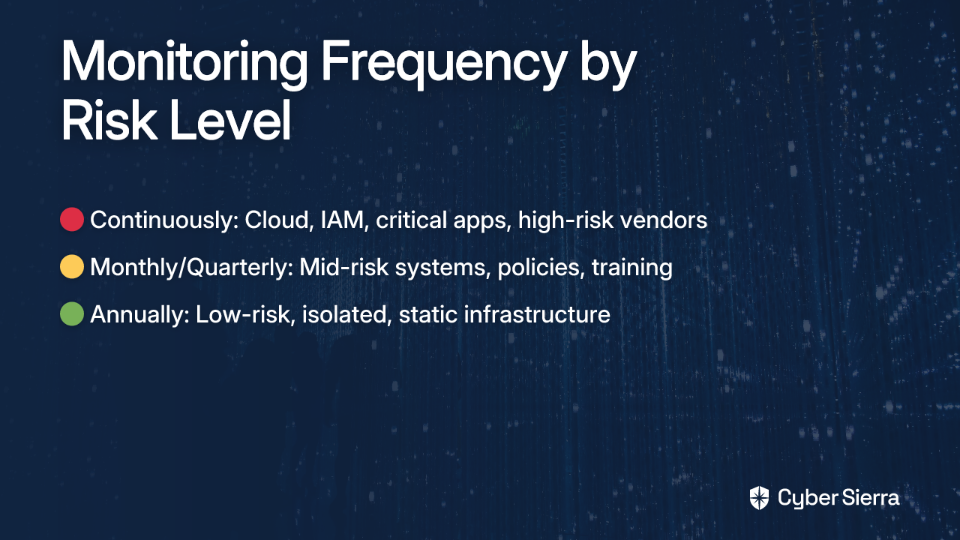
🔴 Monitor Continuously (Near Real-Time)
- Critical applications and high-value data assets
- Cloud environments and CI/CD pipelines with frequent code or configuration changes
- Identity and access management controls
- High-risk third-party vendors with access to sensitive data or systems
This last point is especially critical. Verizon's DBIR found that digital supply chains are involved in 62% of system intrusion incidents — and with 60% of organizations working with more than 1,000 third-party vendors, manually reviewing vendor risk on an annual basis is simply no longer viable.

🟡 Assess Periodically (Monthly or Quarterly)
- Medium-risk internal systems with moderate change frequency
- Mid-tier vendors without direct access to sensitive data
- Policy and procedure review cycles
- Employee security training completion and phishing simulation results
🟢 Review Annually
- Low-risk, isolated systems with infrequent changes
- Low-risk vendors with minimal data access
- Static infrastructure with no internet exposure
The goal isn't to monitor everything continuously — it's to allocate your monitoring intensity proportionally to the actual risk each asset or control represents.
Implementing Continuous Monitoring: Moving from Theory to Practice
Understanding the ROI case is one thing. Operationalizing continuous monitoring — across controls, frameworks, vendors, and teams — is where many organizations stall. The challenge isn't conviction; it's execution without the right platform.
Start with a Central Controls Repository
The foundation of any effective continuous monitoring program is a single source of truth for all your controls. Without it, you're back to fragmented documentation, siloed teams, and compliance gaps that emerge between reviews.
Cyber Sierra's CCM platform is built specifically to solve this. It builds a centralized controls repository with near real-time updates, automates control testing and evidence collection across frameworks like NIST 800-53, ISO 27001, and PCI DSS, and delivers actionable risk intelligence so teams can prioritize what actually needs attention — not just what's easiest to fix.
For compliance managers spending hundreds of hours on manual evidence gathering before every audit, this is the shift that turns audit season from a crisis into a routine.
Unify Your GRC Program
Coordinating compliance checks across IT, HR, legal, and operations is one of the most frequently cited pain points in compliance-heavy organizations. When each team is working from different tools, spreadsheets, or email chains, accountability breaks down and tasks fall through the cracks.
Cyber Sierra's GRC module addresses this directly by automating data collection, streamlining multi-framework management (SOC 2, ISO 27001, GDPR, HIPAA), and providing a unified dashboard where compliance tasks can be delegated, tracked, and reported on — without chasing people down for updates.
Extend Monitoring to Your Supply Chain
Third-party risk management is where point-in-time thinking creates the most dangerous gaps. Annual vendor questionnaires give you a snapshot of a vendor's security posture at one moment in time — but a vendor that passes today can introduce critical risks tomorrow through a misconfiguration, a breach, or a change in their own supply chain.
Cyber Sierra's TPRM module automates vendor assessments and provides near real-time visibility into vendor security compliance, helping organizations move beyond the questionnaire-and-forget model toward genuine, continuous third-party risk oversight. Given that DORA and other regulations increasingly mandate ongoing oversight of third-party vendors, this isn't just an efficiency play — it's a compliance requirement in many industries.
From Snapshot Security To Real-Time Resilience
Relying on annual audits to manage risk is like navigating with a map that's six months out of date. It's a high-effort, low-impact cycle that leaves your organization vulnerable between assessments. The good news is, breaking free from this reactive loop is more straightforward—and more cost-effective—than you think.
The shift begins with two core ideas from this article:
- Stop over-investing in manual prep: Continuous monitoring automates evidence collection, cutting audit prep time from 200+ hours down to a manageable few.
- Focus on real-time visibility: Knowing your security posture right now is the key to reducing breach costs by 30% and catching compliance drift before it becomes a finding.
Your next step today? Whiteboard your top five most critical assets—the cloud environments, vendor integrations, or data repositories where a blind spot would be most damaging. That’s your starting point.
When you’re ready to automate visibility for those critical assets and prove a clear ROI to your board, Book a personalized demo. We’ll show you how to turn audit season into business as usual.
Frequently Asked Questions
What is the main difference between continuous monitoring and point-in-time assessments?
Continuous monitoring provides real-time visibility into your security posture, while point-in-time assessments offer a static snapshot. This means continuous monitoring catches risks as they emerge, not just during scheduled audits, preventing security gaps and control drift between reviews.
Why is continuous monitoring a better investment than traditional audits?
Continuous monitoring delivers a higher ROI by drastically reducing manual audit preparation time (from 200+ hours to under 30), lowering average breach costs by 30%, and cutting compliance findings by up to 70%. It shifts security from a cost center to a proactive, cost-saving function.
How does continuous monitoring improve operational efficiency?
It improves efficiency by automating the evidence collection and control testing that teams perform manually. This frees up hundreds of hours, reduces alert fatigue, and allows security teams to focus on proactive risk mitigation instead of just reactive audit preparation.
What are the first steps to implement a continuous monitoring program?
Start by establishing a central controls repository as a single source of truth. From there, you can begin automating evidence collection for key frameworks (like NIST or ISO 27001) and integrate tools to gain a unified view of your risk posture across all assets and vendors.
Can continuous monitoring replace annual audits entirely?
No, continuous monitoring does not replace formal audits, which are often required for compliance certifications. Instead, it complements them by ensuring your organization remains compliant between audits and makes the actual audit process faster, smoother, and far less costly.
How often should different controls be monitored?
Monitoring frequency should match the risk level. Critical assets like cloud environments and high-risk vendors should be monitored continuously (near real-time). Medium-risk systems can be assessed monthly, while low-risk, static systems may only require an annual review.
