



Best AI Control Testing Tools for Continuous Controls Monitoring (2026)


Join thousands of professionals and get the latest insight on Compliance & Cybersecurity.
Key Takeaways
- Manual control testing often covers a small sample of controls, which may not meet regulatory demands for continuous assurance.
- Autonomous AI control testing can monitor a much larger set of controls continuously, while many GRC tools offer AI features that assist with manual tasks.
- When adopting AI for compliance, a transparent and traceable audit trail is essential for auditor acceptance.
- Cyber Sierra’s Continuous Control Monitoring module uses AI to help teams move toward continuous control coverage and automate audit evidence review.
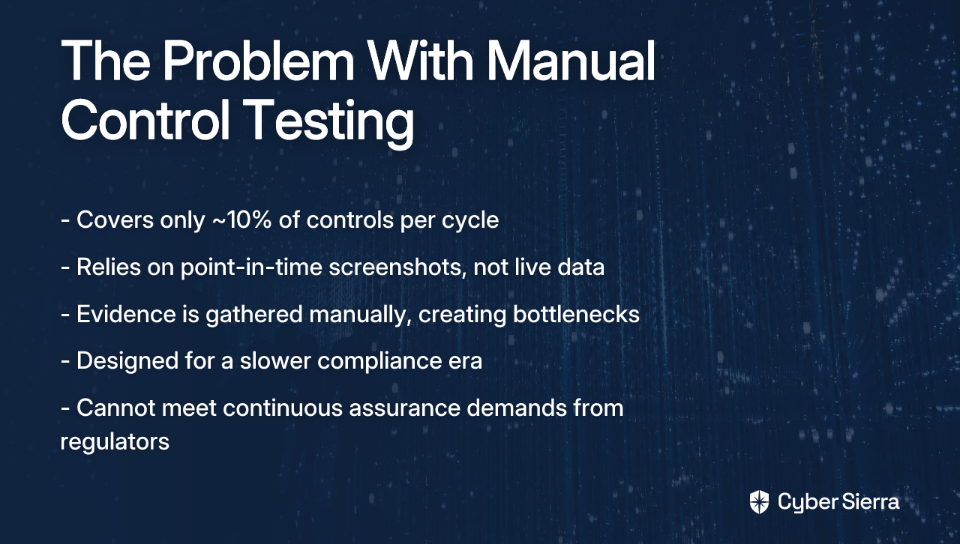
Your team may review only 10% of your controls each cycle, leaving the other 90% unchecked. When auditors want evidence of continuous monitoring, point-in-time screenshots from last quarter are not enough.
Regulators for frameworks like MAS, PCI DSS, ISO 27001, and IM8 now expect continuous assurance, creating a gap between traditional programs and modern requirements. That gap is a tooling problem, not a resourcing problem. Manual control testing, with its small sample sizes and quarterly cycles, was designed for a compliance era that no longer exists.
AI changes the economics of compliance. With the right platform, broad control coverage becomes achievable without adding headcount. This article defines AI control testing, then reviews the leading tools built to deliver it.
What Is AI Control Testing?
Not all tools marketed as "AI" perform the same function. The distinction matters enormously when regulators ask for evidence of continuous monitoring and your platform only automates a spreadsheet.
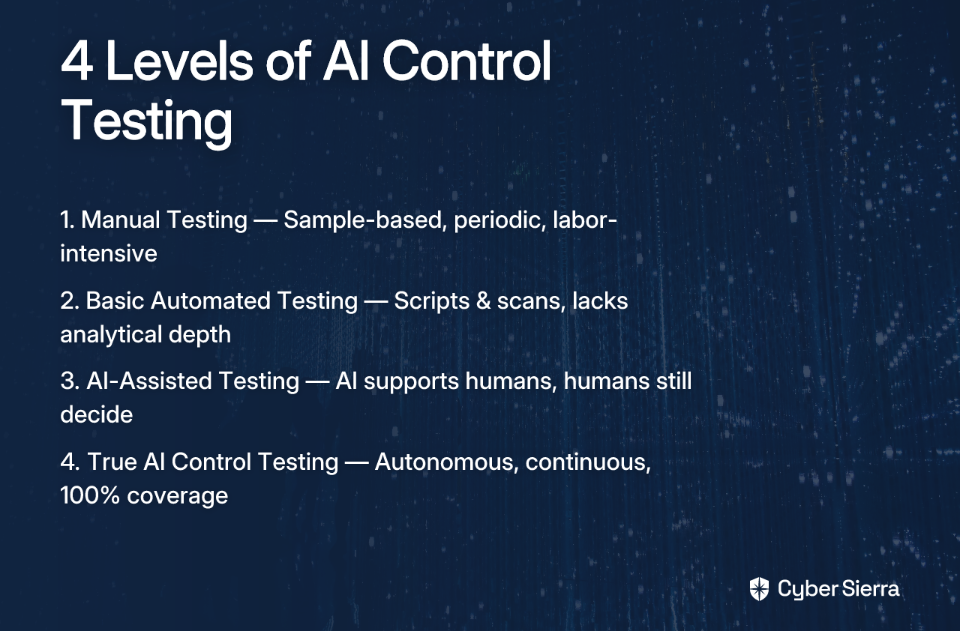
- Manual control testing is sample-based, periodic, and labor-intensive. A human analyst selects a subset of controls, collects evidence manually, reviews it, and records a finding. At best, you cover 10% per cycle.
- Basic automated testing runs scripts and scans to check configurations, such as if encryption is enabled or a port is open. It is faster than manual review but lacks analytical depth. It cannot interpret unstructured evidence or reason across controls.
- AI-assisted testing is where most enterprise GRC platforms currently sit. AI helps humans design tests, organize evidence, or draft summaries. A human still executes the test and makes the final compliance judgment. Many platforms marketed as "AI-powered" fall into this category.
- True AI control testing is categorically different. The AI performs the work of a human analyst autonomously. It maps controls to asset properties, monitors continuously for deviations, and flags control breaks without human sampling.
This is the model that enables continuous controls monitoring at scale, moving compliance from a periodic project to a live, embedded capability.
The Best AI Control Testing Tools
1. Cyber Sierra
Cyber Sierra is a purpose-built platform for autonomous AI control testing. Its AI-enabled capabilities work together to provide continuous control visibility without requiring manual sampling.
The platform connects directly to your asset environment through CMDB integrations or individual asset onboarding. It maps each control in your library to its corresponding asset properties, such as firewall rules, user access entitlements, and encryption settings. From there, it continuously monitors for deviations.
When a configuration drifts or a privilege is granted outside of policy, the platform detects the break and provides alerts in near-real-time. This approach helps teams find and address issues as they occur, rather than waiting for the next audit cycle.
Cyber Sierra also automates a time-consuming part of any audit: evidence review. The platform can ingest evidence files like screenshots, configuration exports, and policy documents, reviewing them against specific control questions.
It assigns a compliance rating and provides written reasoning for each finding, creating a transparent, auditor-ready record. Each finding is timestamped and traceable.
Key capabilities include:
- Continuous Control Monitoring. The platform is designed to provide visibility across controls and assets, helping to eliminate the blind spots of periodic sampling.
- Automated Evidence Review. AI-driven analysis of evidence files can reduce the manual work required for audit preparation.
- Broad Integrations. The platform connects with major cloud providers like AWS, Azure, and GCP, along with Kubernetes, HR systems, and other security tools.
- Recognized by Gartner. Cyber Sierra was recognized as a Sample Vendor in the Gartner® Hype Cycle™ for Cyber-Risk Management, 2024.
These capabilities also connect to Cyber Sierra's broader GRC module, giving governance teams a unified view across controls, risk, and policy, all supported by the same continuous monitoring engine.
2. IBM OpenPages
IBM OpenPages is a long-established enterprise GRC platform with Watson-based AI integrated across its risk and compliance workflows. For organizations already running IBM infrastructure, it provides a familiar environment for managing risk taxonomies, control libraries, and issue tracking.
Watson's role within OpenPages is primarily assistive in AI control testing workflows. It surfaces insights from large datasets, helps categorize risks, and recommends actions to human analysts. It does not autonomously detect control breaks or continuously monitor asset configurations. Human execution remains central.
Deployment can be complex and the setup curve is steep. The platform works best for organizations with dedicated IBM resources and existing Watson infrastructure.
3. MetricStream
MetricStream positions itself as an "AI-first" enterprise GRC platform and serves large regulated organizations across financial services, healthcare, and energy. Its AI capabilities include the MetricStream Assistant for in-app guidance and AI Survey Autofill for third-party risk questionnaires. These features help reduce manual effort in GRC workflows.
For AI control testing specifically, MetricStream's capabilities remain in the assistive tier. Tests are designed and executed within structured workflows that require human oversight. The platform covers broad GRC scope but is resource-intensive to configure and maintain.
Organizations looking for GRC coverage alongside a dedicated control monitoring layer often find they need to supplement MetricStream with a specialized CCM tool. It is not a purpose-built continuous monitoring engine.
4. ServiceNow IRM (with Now Assist)
ServiceNow's Integrated Risk Management module is built on one of the most widely deployed workflow platforms in the enterprise. For organizations already running ServiceNow, IRM offers a logical extension with control libraries, testing workflows, and risk dashboards inside the same environment the IT operations team uses daily.
Now Assist adds generative AI capabilities including summarization and recommendation. In a control testing context, it can help an analyst understand the context of a flagged issue or draft a response narrative. It does not autonomously execute control tests or detect breaks in real-time. The human remains the analyst; Now Assist accelerates their work.
Configuring ServiceNow IRM for AI control testing properly requires substantial systems integrator investment. Organizations without an established ServiceNow practice should factor in setup cost and timeline. The platform excels at workflow orchestration but is not a substitute for a purpose-built AI control testing engine.
5. Hyperproof
Hyperproof is a compliance operations platform designed to make audit preparation and evidence management more efficient. It provides structured workflows for assigning control owners, tracking evidence, and mapping requirements across frameworks like SOC 2, ISO 27001, and PCI DSS.
AI features in Hyperproof focus on organization: helping teams map evidence to controls and reduce administrative overhead. There is no autonomous control break detection and no continuous monitoring of asset configurations. AI control testing, in the true sense, is outside Hyperproof's scope.
Control tests are designed by humans, run by humans, and reviewed by humans. Hyperproof makes that process cleaner and faster, but it does not replace periodic testing with continuous AI coverage.
For teams that want to professionalize a manual compliance program, Hyperproof is a solid choice. For teams whose regulators want evidence of continuous assurance, it does not close the gap.
6. Tugboat Logic (by OneTrust)
Tugboat Logic, now part of the OneTrust platform, offers compliance automation for organizations pursuing SOC 2, ISO 27001, and similar framework certifications. Its strength is a pre-built control library and streamlined evidence request workflows that accelerate the path to audit readiness.
AI features primarily focus on workflow automation, such as triggering evidence requests, mapping controls from a library, and reducing repetitive administrative steps. Autonomous, continuous AI control testing is outside the platform's current scope. It is a tool for managing periodic testing cycles more efficiently, not for replacing them with a continuous monitoring model.
The OneTrust platform does extend into vendor risk management, a discipline closely related to third-party control assurance. Organizations evaluating Tugboat Logic for CCM purposes should be clear that it addresses compliance workflow, not AI control testing.
Key Considerations Before You Adopt
Governance and the Black Box Problem
Practitioners are right to raise accountability concerns. As discussed in the GRC community, you cannot cite an AI when a control finding is wrong, because accountability remains with your team. The most successful AI control testing programs are built around governance first, not technology first.
Before deploying any AI control testing tool, establish confidence in the model's logic. Tools aligned with the NIST AI Risk Management Framework provide a structured basis for evaluating transparency and accountability.
Look for platforms that document their reasoning for each finding: not just a pass/fail flag, but the written rationale behind it.
Evidence Provenance for Auditors
Auditors care about how evidence was gathered, when, and from which system. AI-generated findings require the same lineage as manually collected evidence or they will not pass scrutiny. Any platform you evaluate must provide a transparent, tamper-proof audit trail for every piece of evidence it collects and every decision it makes.
This is not optional. It is the difference between a finding your auditor will accept and one they will reject.
Integration Depth
Your AI control testing tool is only as accurate as the data it can access. Integrating AI tools with legacy systems can create data silos when the platform's connectivity is shallow.
Prioritize platforms with deep, pre-built integrations into your authoritative sources: cloud providers, security toolchains, HR systems, and CMDBs, rather than those requiring custom API development to reach core data.
Close the Gap With Continuous Assurance
Relying on small manual samples is like guarding a building by watching only one entrance. Regulators now expect broad, continuous visibility, and the path forward is about tooling smarter, not working harder. AI control testing helps teams move from periodic sampling to more continuous coverage.
For auditors to accept the results, the AI-generated evidence must come with a clear, traceable audit trail. Calculating your team's actual control coverage percentage is a good first step. The gap between that number and full visibility is your audit risk.
Cyber Sierra's Continuous Control Monitoring platform is built for this shift. Book a demo to see how your team can move from periodic checks to continuous coverage.
Frequently Asked Questions
What is true AI control testing?
True AI control testing is the autonomous monitoring and validation of controls without human sampling. It uses AI to continuously analyze asset configurations against control requirements, detect deviations in real-time, and provide auditable evidence for every finding.
How does AI control testing solve the problem of manual sampling?
AI control testing eliminates manual sampling by providing broad, continuous coverage. Instead of reviewing a small subset of controls periodically, an AI control testing platform monitors all controls across all assets, closing the assurance gap left by the traditional 10% review cycle.
Will auditors accept AI-generated evidence?
Yes, auditors accept AI-generated evidence if it has clear provenance. Leading AI control testing platforms provide a transparent, timestamped audit trail for every finding, documenting the AI's reasoning. This keeps evidence traceable, reliable, and ready for audit scrutiny.
What is the difference between AI-assisted and true AI control testing?
AI-assisted tools help humans work faster by organizing evidence or drafting summaries, but a human still performs the test. True AI control testing platforms work autonomously, performing the analyst's work of monitoring, detection, and evidence review without human intervention.
How long does it take to implement an AI control testing platform?
Modern, purpose-built AI control testing platforms can be deployed quickly. Platforms with extensive pre-built integrations to your cloud environments, CMDBs, and security tools can start monitoring assets and controls within days, not months.
What are the key features to look for in an AI control testing tool?
Look for autonomous control break detection, continuous monitoring (not periodic scans), deep integrations with your tech stack, and detailed evidence provenance. The tool must explain its findings with a clear, traceable audit trail to support auditor acceptance and governance.
