



5 Best AuditBoard Alternatives for Enterprise GRC Teams (2026)


Join thousands of professionals and get the latest insight on Compliance & Cybersecurity.
Summary
- AuditBoard is a leading platform for managing audit projects but relies on manual processes for core GRC tasks like evidence review and control testing.
- Teams often seek alternatives for capabilities AuditBoard lacks, such as AI-driven automation, deep third-party risk management (TPRM), and continuous control monitoring.
- The key decision is choosing between a tool that organizes manual work and a platform that automates it; Cyber Sierra uses AI-enabled automation to support GRC tasks, shifting your team from manual effort to strategic oversight.
AuditBoard (now rebranded as Optro) is a legitimate audit management platform. It is used by many Fortune 500 companies for internal audit project management, SOX workflows, and SOC compliance, and it earns that adoption. The platform is particularly well-suited to Big 4 alumni-led audit teams that need structured workpaper management, audit scheduling, and regulator-ready reporting.
The core limitation is this: AuditBoard helps auditors manage their work, but it does not automate the work itself. Users on GRC forums note it is solid for generating reports but falls short for day-to-day risk management. Its AI is primarily generative, drafting policies and summarizing findings, not fully automated for execution.
For enterprises that need AI to help execute evidence review, run gap assessments, or continuously monitor controls, looking at an AuditBoard alternative is the right call. Here is a direct comparison of AuditBoard and five enterprise GRC platforms worth evaluating.
5 Best AuditBoard Alternatives for Enterprise GRC Teams
Quick Comparison: AuditBoard vs. Alternatives
| GRC Platform | AI Automation | TPRM Depth | CCM Capabilities | Deployment |
|---|---|---|---|---|
| AuditBoard | Assistive (Generative) | Limited | Basic | Cloud |
| Cyber Sierra | AI-Powered Execution | Comprehensive | Advanced, Continuous | Cloud |
| MetricStream | Advanced (AI-first) | Extensive | Full Integration | Cloud / On-prem |
| Archer GRC | Low to Moderate | Moderate | Limited | Cloud / On-prem |
| ServiceNow IRM | Moderate (Workflow-based) | Moderate | High (Platform-native) | Cloud |
| Diligent | Basic | Basic | Moderate | Cloud |
Sources: ComplyJet, MetricStream, Vero AI
Who Typically Looks for AuditBoard Alternatives
Before the list, it helps to know who is evaluating these platforms. Three buyer profiles show up consistently.
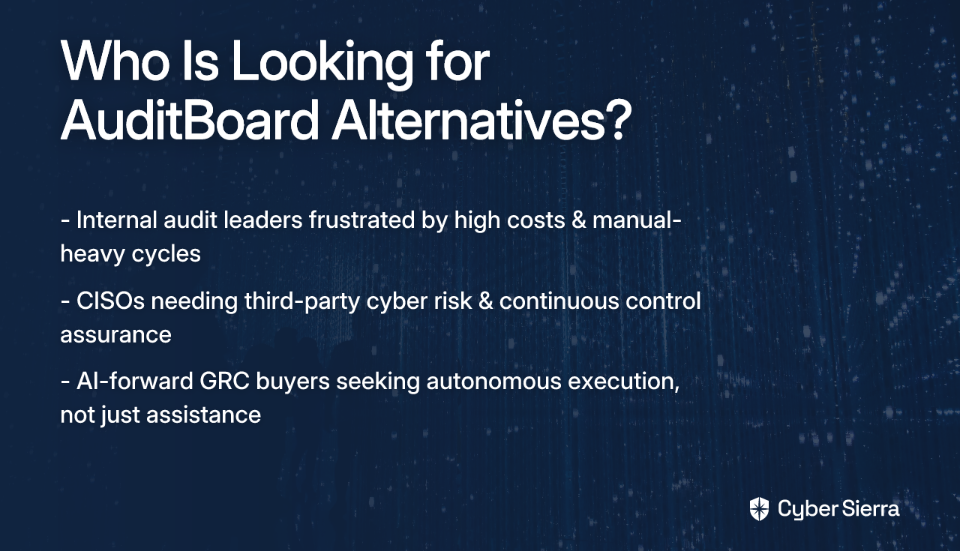
- Internal audit leaders at Fortune 1000 companies. These leaders are often frustrated by high subscription costs and inconsistent customer support. Their audit cycles remain manual-heavy, and they are looking for platforms that increase team output without proportionally increasing headcount.
- CISOs and enterprise security leaders. They need more than audit workflow management. They are dealing with third-party cyber risk, continuous control assurance, and board-level reporting. As noted in cybersecurity community discussions, AuditBoard provides "inadequate depth of assessments for cybersecurity practices" and may not confirm if third parties are doing code review or have employee offboarding policies.
- AI-forward GRC buyers. They understand that data quality determines automation quality ("garbage in, garbage out applies to AI too," as one forum user notes) and they are specifically seeking AI-powered execution, not just generative assistance layered on top of manual workflows.
1. Cyber Sierra: AI-Powered Automation for Cyber GRC
Best for: CISO-led enterprise teams that want AI to help execute GRC work, not just manage it.
Cyber Sierra's core differentiator is its AI-powered automation. Where AuditBoard assigns tasks to auditors, Cyber Sierra's GRC platform is designed to execute those tasks directly. The platform uses AI-enabled automation across Cyber GRC, TPRM, and Continuous Control Monitoring, performing evidence review, gap assessments, and third-party security analysis without waiting for a human to initiate each step.
This can lead to significant speed improvements. The platform's AI-powered evidence review can compress work that takes audit teams days into minutes. Full audit readiness is built into the platform rather than treated as an end-of-cycle exercise. For CISOs worried about third-party cyber depth, Cyber Sierra assesses whether vendors actually have controls in place, not just whether they checked a questionnaire box.
Cyber Sierra is a strong alternative for enterprises that have moved past needing an audit management tool and want a platform that does the analytical work.
2. MetricStream: Deep Framework Mapping and Risk Quantification
Best for: Large enterprises in finance, healthcare, and other highly regulated industries that need sophisticated risk quantification across multiple overlapping frameworks.
MetricStream is a mature, AI-first GRC platform with a reputation for handling complexity that most tools cannot. Its framework mapping capabilities are particularly strong — it excels when organizations must demonstrate controls coverage across ISO 27001, NIST, SOC 2, and sector-specific regulations simultaneously.
A Forrester Total Economic Impact study found MetricStream delivered a 133% ROI for enterprise GRC customers. The platform supports both cloud and on-premise deployment, which matters for regulated industries with strict data residency requirements. MetricStream is consistently recognized by industry analysts as a leader in enterprise GRC.
Key capabilities:
- Cross-framework control mapping for complex regulatory environments
- Advanced risk quantification with financial impact modeling
- Cloud and on-premise deployment options
- Proven enterprise ROI with analyst-backed recognition
If the primary need is translating risk into business-level financial exposure across a dense regulatory stack, MetricStream is one of the strongest alternatives to AuditBoard available at enterprise scale.
3. Archer GRC: Mature and Configurable for Large Regulated Organizations
Best for: Very large, established enterprises with unique and complex GRC processes that require deep customization and have the implementation resources to support it.
Archer is a long-standing platform in the GRC market, and its primary advantage is configurability. It can be shaped around highly specific regulatory requirements and operational workflows that off-the-shelf platforms cannot accommodate. Organizations in defense, financial services, and critical infrastructure often choose Archer specifically because its flexibility allows it to fit their processes rather than the other way around.
That flexibility comes with tradeoffs. Archer implementations tend to be long and resource-intensive. Its AI capabilities are limited compared to modern platforms, and the user experience reflects its legacy architecture. Gartner Peer Insights reviewers note the AI in legacy GRC tools like Archer as underdeveloped relative to newer entrants. It remains a sound choice for enterprises prioritizing customization and process fidelity over speed of deployment.
Key capabilities:
- Extensive customization across modules and workflows
- Supports on-premise and cloud deployment
- Wide breadth of GRC use case coverage
- Trusted in highly regulated sectors with complex compliance requirements
4. ServiceNow IRM: GRC for Organizations Already on ServiceNow
Best for: Enterprises that run IT service management, security operations, and vendor risk on ServiceNow and want GRC integrated into that same platform.
ServiceNow IRM is a workflow-centric alternative to AuditBoard that makes the most sense when an organization is already a ServiceNow customer. Rather than deploying a standalone GRC tool, IRM connects risk management, policy and compliance, and audit management directly to the ServiceNow ecosystem — including IT operations, security incident response, and vendor risk workflows.
The integration advantage is real. Risk data flows across departments without requiring manual exports or duplicate entry. For organizations with a mature ServiceNow footprint, this creates a consolidated view of risk that siloed tools cannot replicate. That said, as noted in sysadmin community discussions, ServiceNow IRM "has its fair share of bugs," and licensing costs scale with the broader ServiceNow ecosystem, making it expensive for organizations not already invested in the platform.
Key capabilities:
- Native GRC integration within the ServiceNow platform
- Connects audit, risk, policy, and vendor management in a single workflow engine
- Strong continuous monitoring capabilities through platform-native automation
- Well-suited for organizations with existing ServiceNow ITSM or SecOps deployments
As an AuditBoard alternative, ServiceNow IRM trades audit-specific depth for broader operational integration. It is the right call when GRC needs to live where the organization's business processes already run.
5. Diligent: Board-Level Governance and Audit Committee Management
Best for: Organizations where the primary GRC need is high-quality reporting to the board of directors and structured oversight for audit committees.
Diligent is positioned around the governance layer of GRC. While AuditBoard handles the operational work of audit teams, Diligent focuses on what happens with the output of that work — presenting risk and compliance data to board members, managing audit committee materials, and providing the executive-level dashboards that senior leadership needs.
Its audit committee management tools are designed specifically for the rhythms of board governance: meeting agendas, document distribution, action item tracking, and conflict of interest disclosure. Diligent consolidates complex risk and compliance data into formats that board members can engage with without requiring GRC expertise. It is not a replacement for an operational GRC platform — it sits above it. But for organizations that need to improve transparency and demonstrate governance quality to stakeholders, it fills a gap that AuditBoard does not address.
Key capabilities:
- Audit committee meeting management and materials distribution
- Executive-level dashboards for board governance reporting
- Consolidation of risk and compliance data for senior leadership
- Focused on the "G" in GRC — governance structure and board oversight
As an alternative to AuditBoard at the leadership reporting layer, Diligent is the most specialized option on this list.
How to Choose: The Right Platform for Your Team
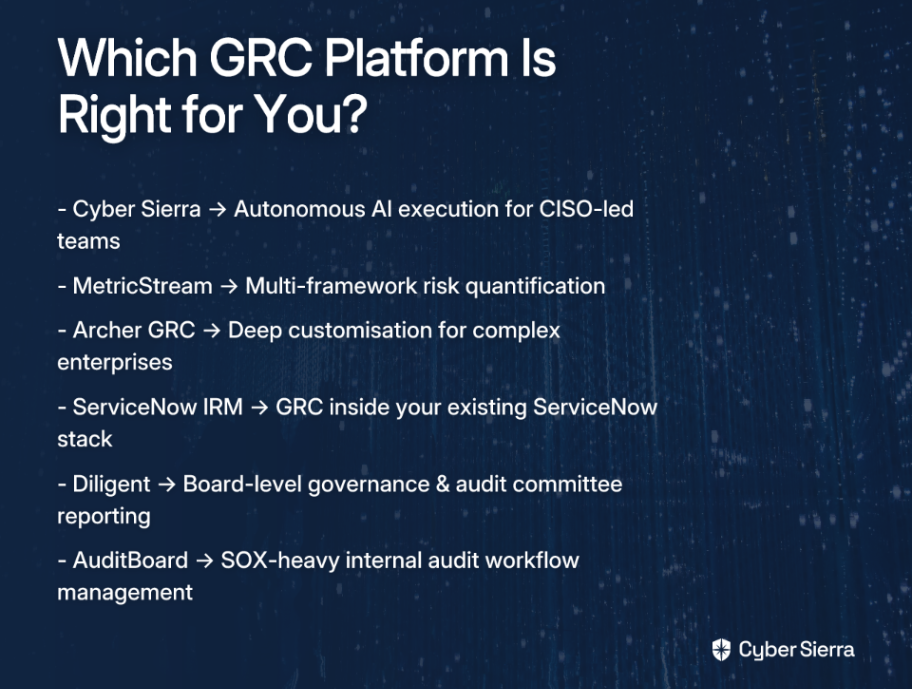
The decision between these platforms comes down to what kind of GRC work your team actually needs done.
Choose AuditBoard if your team is led by Big 4 alumni, your primary workload is SOX-heavy internal audit project management, and you need a structured, user-friendly tool to manage compliance workflows. AuditBoard excels at organizing audit work and keeping teams aligned on deliverables.
Choose Cyber Sierra if you are a CISO-led team and your goal is to automate GRC execution — not just organize it. If you need an AuditBoard alternative that deploys autonomous AI Analysts to execute evidence review, perform gap assessments, and continuously monitor controls without waiting on human initiation, Cyber Sierra is built for that use case.
Choose MetricStream if your organization operates across multiple regulatory frameworks in a highly regulated industry, and your top priority is sophisticated risk quantification with financial impact modeling backed by analyst validation.
Choose Archer GRC if you are a large, mature enterprise with deeply specific GRC processes that require extensive customization, and you have the internal resources and timeline to support a complex implementation.
Choose ServiceNow IRM if your organization is already running on ServiceNow and you want GRC integrated directly into your existing IT and security operations workflows rather than managed in a separate tool.
Choose Diligent if your primary objective is improving governance reporting to the board of directors and providing your audit committee with well-structured, accessible oversight tools.
Shift From Managing GRC to Automating It
The choice between AuditBoard and an alternative comes down to your team's core function. AuditBoard is a strong choice for organizing manual audit projects, while other platforms focus on automating the work itself. This means choosing between a tool that helps assign tasks and a platform with AI-powered automation to help complete them.
To see how AI-enabled automation can reduce manual workloads in evidence review, TPRM, and continuous control monitoring, see automated GRC in action. A demo can show how Cyber Sierra's platform helps execute the work your team may be doing by hand.
Frequently Asked Questions
What is the primary limitation of AuditBoard?
The primary limitation is that AuditBoard helps manage audit work but does not automate the work itself. Its AI is generative, assisting with tasks like drafting policies, but it doesn't autonomously execute evidence reviews or continuous control monitoring.
Why would a CISO seek an alternative to AuditBoard?
CISOs often need more than audit workflow management. They require platforms with deep third-party risk management (TPRM) and continuous control monitoring. AuditBoard is often found to have inadequate depth for assessing specific cybersecurity practices of third parties.
How does an AI-powered GRC platform differ from AuditBoard?
An AI-powered automation platform like Cyber Sierra helps execute GRC tasks directly, using AI to support evidence reviews and gap assessments. AuditBoard, in contrast, is a project management tool that assigns these tasks to human auditors to complete manually.
When is AuditBoard the best GRC tool for a team?
AuditBoard is the best choice for teams focused on internal audit project management, particularly for SOX compliance. It excels in structured workpaper management and creating regulator-ready reports, making it ideal for teams that need to organize manual audit workflows.
What should I consider when choosing an AuditBoard alternative?
Consider your primary need: Is it AI-powered execution (Cyber Sierra), complex risk quantification (MetricStream), deep customization (Archer), platform integration (ServiceNow), or board-level reporting (Diligent)? The key is to decide if you need a tool to manage work or a platform to help execute it.
