



OneTrust vs Top Competitors: Which GRC Platform Is Right for Your Enterprise?

Join thousands of professionals and get the latest insight on Compliance & Cybersecurity.
If you've invested in a GRC platform only to find your team is still running audits from spreadsheets, you're not alone. Many platforms promise automation but leave teams with manual vendor reviews and unexpected renewal quotes. This is a common pain point for teams whose compliance needs grow beyond a platform's core capabilities.
OneTrust is a market leader in privacy, but as compliance scope expands into operational risk and continuous monitoring, a privacy-first platform may not be the right long-term fit. For CISOs, GRC leaders, and compliance managers evaluating OneTrust against modern alternatives, this guide compares the top platforms for enterprise GRC.
OneTrust: What It Is and Where It Shines
OneTrust was founded in 2016 as a direct response to GDPR and has since grown into one of the most recognized names in privacy and compliance technology, serving thousands of customers globally. For organizations where privacy is the primary compliance driver, it remains a strong choice.
Its core strength is privacy management. OneTrust delivers strong capabilities for GDPR, CCPA, PDPA, and LGPD compliance, including consent management, DSAR automation, data mapping, and privacy-by-design workflows. If your compliance program is anchored in privacy regulations, OneTrust's depth here is hard to match.
The platform's breadth of modules is also a genuine advantage. The suite covers IT and Security Risk Management, Policy Management, Audit Management, Vendor Risk Management, Incident Management, cookie compliance, and ethics. Add to that hundreds of pre-built integrations with tools like ServiceNow, Microsoft Purview, and AWS, and you have a platform built for enterprises with diverse toolstacks.
OneTrust also carries real weight in the enterprise buying process. It appears in Gartner Magic Quadrants for TPRM and related categories, which matters when you're building a business case internally. For organizations where privacy is job one, OneTrust earns its position.
Where OneTrust Falls Short for Enterprise GRC
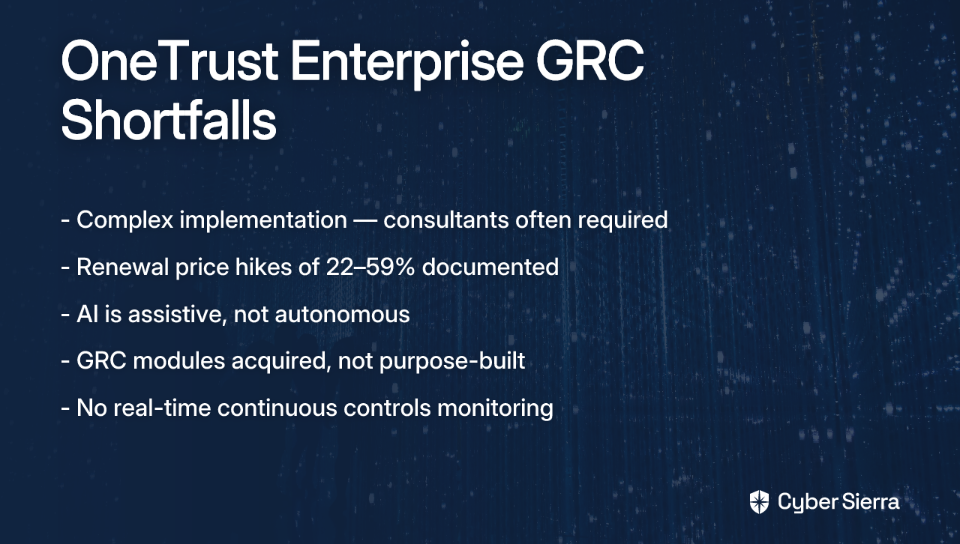
OneTrust expanded into GRC largely through acquisition rather than ground-up design. For programs that go beyond privacy, the cracks can become visible. User forums reflect common complaints about GRC tools, with one practitioner noting: "GRC tools have made promises for years that they are effective. Yet, so far, not one tool has surpassed the ability to use a spreadsheet to accomplish the same thing more effectively."
Implementation complexity is a consistent pain point. Users on Gartner Peer Insights repeatedly flag the need for an external consultant just to unlock baseline value. Another frequent complaint is that GRC tools often require a dedicated person to maintain them. This suggests implementation can take weeks to months, with significant resource investment before teams see returns.
Renewal pricing is a documented enterprise risk. The licensing structure can be opaque, and enterprise users on Gartner Peer Insights have documented renewal price hikes of 22% to 59%. Some users on Reddit have reported receiving sudden, large renewal quotes just days before their contracts expire. For any CISO, this unpredictability is a governance risk in itself.
AI features are assistive, not autonomous. OneTrust has invested in AI, but what exists today helps with recommendations and summarization. It does not execute workflows end-to-end, which means your team still owns the coordination, follow-up, and evidence management. A genuinely automated GRC platform should be able to initiate tasks and manage workflows on its own. OneTrust's AI does not close this execution gap.
GRC depth trails dedicated platforms. Because OneTrust's risk and compliance modules were acquired rather than purpose-built, they can be thinner than what you'd find in a platform designed for operational risk at scale. The risk register and control testing capabilities, in particular, lag dedicated GRC platforms. The platform is designed for periodic assessments, not for the continuous controls monitoring needed for real-time detection of control breaks.
The Best OneTrust Alternatives for Enterprise GRC
For enterprises whose GRC needs go beyond privacy, several platforms offer a more focused approach to automation and risk management. Here are the top alternatives to consider.
1. Cyber Sierra: The AI-Native GRC Choice
What it is: Cyber Sierra is an AI-native GRC platform built for enterprises that need automation across GRC, TPRM, and Continuous Controls Monitoring.
Best for: Enterprises operating under MAS TRM, IM8, ISO 27001, or PCI DSS that need continuous control monitoring, automated evidence review, and visibility into control gaps.
Key differentiator vs. OneTrust: Where OneTrust offers AI assistance, Cyber Sierra deploys a suite of AI Analysts that execute full workflows. These analysts, which include the Gap Assessment Analyst and Evidence Auditor, run the process instead of just surfacing recommendations for a human to act on. The platform can deploy in the customer's own cloud for data sovereignty and is LLM-agnostic.
This approach can significantly accelerate evidence review, and the TPRM module is designed to generate documented savings. Cyber Sierra is recognized as a Sample Vendor in the Gartner® Hype Cycle™ for Cyber-Risk Management, 2024, and is accredited by the Cyber Security Agency of Singapore (CSA).
Key limitation: Cyber Sierra is a newer platform and does not carry OneTrust's legacy brand recognition. For teams where a Gartner Magic Quadrant placement is a procurement checkbox, this is a consideration.
2. ServiceNow IRM: The Ecosystem Play
What it is: ServiceNow Integrated Risk Management (IRM) is an enterprise GRC module embedded within the ServiceNow platform, connecting GRC data to ITSM, CMDB, and operational workflows.
Best for: Organizations already deeply invested in ServiceNow that want GRC to live natively within that ecosystem.
Key differentiator vs. OneTrust: ServiceNow IRM offers deeper, native integration with operational workflows than OneTrust's acquired modules can provide. If your IT operations already run on ServiceNow, IRM adds risk and compliance visibility directly into those workflows without a separate data silo.
Key limitation: The AI (Now Assist) is assistive, not autonomous, a limitation noted by some ServiceNow practitioners. More significantly, implementation often requires a substantial systems integrator engagement, making the true cost of ownership much higher than the license fee suggests.
3. MetricStream: The Legacy Enterprise Option
What it is: MetricStream is a long-established GRC platform with broad coverage across enterprise risk, compliance, audit, and regulatory change management.
Best for: Very large enterprises with mature GRC programs, dedicated IT resources, and the budget to configure and maintain a highly flexible platform.
Key differentiator vs. OneTrust: MetricStream's risk management capabilities extend well beyond privacy into operational risk, financial risk, and enterprise-wide risk aggregation, making it more comprehensive for broad GRC mandates.
Key limitation: Users on Gartner Peer Insights describe MetricStream as needing developer help to assemble into a functional system. It is expensive, has a steep learning curve, and its implementation complexity can rival or exceed OneTrust's.
4. Hyperproof: The User-Friendly Compliance Hub
What it is: Hyperproof is a compliance operations platform focused on multi-framework compliance tracking with a clean, accessible user interface.
Best for: Compliance teams who have been burned by the complexity of OneTrust or legacy tools and want faster time-to-value with better user adoption rates.
Key differentiator vs. OneTrust: Hyperproof is significantly easier to deploy and use, leading to higher adoption across compliance teams who are not dedicated platform administrators.
Key limitation: AI capabilities are early-stage. Hyperproof does not offer automated control testing or evidence review, which limits its value for enterprises with mature, high-volume GRC programs.
5. AuditBoard: The Audit-First Solution
What it is: AuditBoard is a platform purpose-built for internal audit, SOX compliance, and audit workflow management.
Best for: Internal audit teams that need a dedicated, structured tool for managing their specific workflows.
Key differentiator vs. OneTrust: AuditBoard's internal audit capabilities are far more specialized than what OneTrust's audit module provides, making it the stronger choice for audit-led compliance programs.
Key limitation: AuditBoard is not a full GRC replacement. Gartner Peer Insights users have noted its AI is underdeveloped, and its risk management features are not comprehensive enough to serve as an enterprise GRC backbone on their own.
Head-to-Head Comparison: OneTrust vs Cyber Sierra vs ServiceNow IRM
This table summarizes the key differences for enterprise GRC use cases.
| Feature | OneTrust | Cyber Sierra | ServiceNow IRM |
|---|---|---|---|
| Autonomous AI Analysts | ❌ | ✅ | ❌ |
| Continuous Control Monitoring | Partial | ✅ | Partial |
| Autonomous TPRM Workflow | ❌ | ✅ | ❌ |
| Deploy in Own Cloud | ❌ | ✅ | ❌ |
| Multi-Framework Support | ✅ | ✅ | ✅ |
| No Consultant Required | ❌ | ✅ | ❌ |
| MAS TRM / IM8 / APAC Regulatory Depth | Partial | ✅ | Partial |
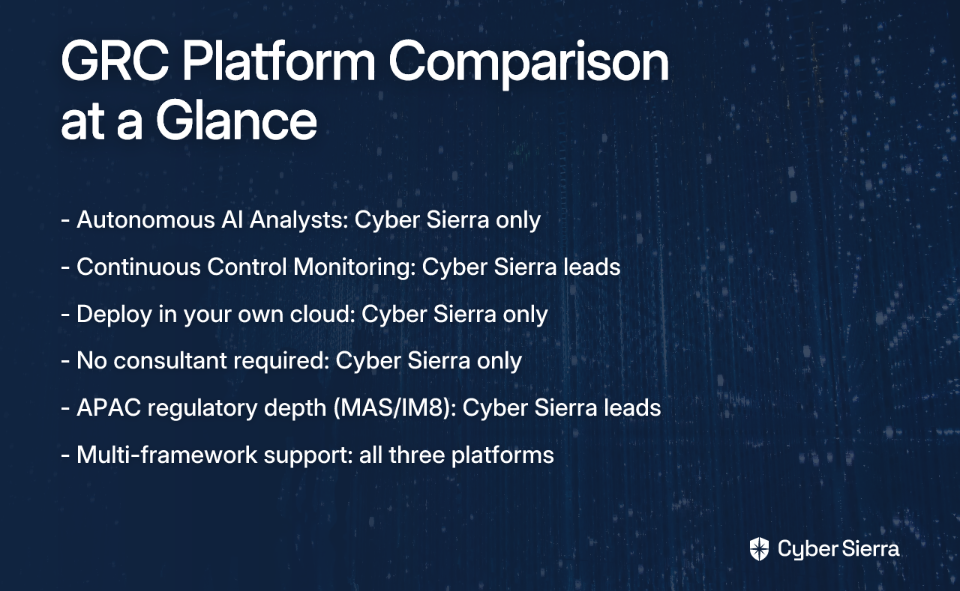
OneTrust holds its own in multi-framework support, particularly for privacy-driven frameworks. But for capabilities tied to AI execution, deployment flexibility, and APAC regulatory depth, Cyber Sierra leads. ServiceNow IRM sits between them, offering strength for organizations in that ecosystem but constrained by the same assistive-AI model and a higher total cost of implementation.
For a deeper look at what separates assistive AI from automated GRC, the Cyber Sierra GRC platform page walks through how AI Analysts execute each workflow stage.
How to Choose the Right GRC Platform for Your Enterprise
Use these three buyer profiles to match your primary compliance driver to the right platform.
Profile 1: "Privacy is my primary driver. I need best-in-class GDPR, CCPA, and PDPA compliance."
OneTrust may still be the right choice for your core privacy program. Its depth in consent management, DSAR automation, and privacy-by-design workflows is genuine and hard to replicate. Where it falls short is in operational risk and continuous monitoring. Consider augmenting OneTrust with a purpose-built platform like Cyber Sierra's GRC module for the GRC and TPRM layers that OneTrust's acquired modules underfill.
Profile 2: "I need true GRC automation. My team is drowning in manual evidence collection and control testing."
Cyber Sierra is purpose-built for this scenario. OneTrust's assistive AI and periodic-assessment architecture will not solve a manual evidence backlog or a lack of real-time control visibility. Cyber Sierra's AI Analysts are designed to absorb exactly this workflow overhead, executing evidence review, gap assessment, and control testing autonomously. If the 530x evidence review benchmark at a Fortune 500 insurer is relevant to your program, the Cyber Sierra CCM platform is worth a close look.
Profile 3: "My entire organization runs on ServiceNow. GRC has to live there."
ServiceNow IRM is the logical path for maintaining a single-platform strategy. The native integration with ITSM and CMDB provides a risk and compliance data layer that is valuable for operationally mature ServiceNow shops. Be clear about the SI engagement cost and the fact that Now Assist does not deliver the automated execution you might be expecting from "AI-powered GRC."
Choose the Right GRC Platform for Your Program
Choosing a GRC platform comes down to your core driver. OneTrust excels at privacy-first compliance, but if your needs include operational risk and continuous monitoring, its acquired GRC modules and assistive AI can become a bottleneck. The key difference is between assistive AI, which recommends, and automated platforms that execute tasks. For teams managing heavy manual workloads, only the latter solves the problem.
If your team is ready to move beyond spreadsheets and recommendations, see how Cyber Sierra's AI Analysts can close the execution gap. See automated GRC in action and learn how your team can get back to strategic work.
Frequently Asked Questions
What is OneTrust best used for?
OneTrust is best used for privacy-first compliance programs. Its platform excels at managing GDPR, CCPA, and PDPA requirements, offering deep capabilities in consent management and DSAR automation. It is a strong choice for organizations where privacy is the primary compliance driver.
Why look for a OneTrust alternative for enterprise GRC?
Consider an alternative if your needs extend beyond privacy into operational risk and automation. OneTrust's GRC modules were acquired, which can lead to implementation complexity, lagging features in continuous monitoring, and documented renewal price hikes of 22% to 59%.
How is AI in Cyber Sierra different from OneTrust's AI?
Cyber Sierra's AI is autonomous, while OneTrust's AI is assistive. Cyber Sierra's AI Analysts execute entire workflows like evidence review and control testing without human prompts. OneTrust's AI provides recommendations and summaries but requires your team to perform the actions.
What is continuous controls monitoring (CCM)?
Continuous controls monitoring (CCM) is an automated process that tests security controls in real-time, not just periodically. It provides immediate alerts on control failures, unlike traditional platforms. This approach significantly reduces enterprise risk and manual audit preparation effort.
Who should choose ServiceNow IRM over OneTrust?
Enterprises already deeply invested in the ServiceNow ecosystem should choose ServiceNow IRM. It offers native integration with ITSM and CMDB workflows for a unified operational view. However, be prepared for a high total cost of ownership due to expensive system integrator fees.
