



What Is an AI Compliance Analyst? A Complete Guide for Enterprise GRC Teams

Join thousands of professionals and get the latest insight on Compliance & Cybersecurity.
Summary
- Key Learning: Unlike AI copilots that only assist with tasks, an AI Compliance Analyst is an autonomous agent that executes entire GRC workflows end-to-end, eliminating entire categories of manual work.
- Key Takeaway: The practical starting point is to deploy an AI analyst for a single high-volume task, such as evidence review or vendor assessments, to measure the time savings and build a case for broader adoption.
- Solution: Cyber Sierra's AI-powered GRC platform offers specialized analysts that automate gap assessments, evidence review, and third-party risk to help make your enterprise audit-ready faster.
Your analysts are buried under alerts, emails, PDFs, and checks that slow everything down. Your GRC tools promised automation but delivered complexity — and your team is still spending more time navigating portals and email chains than making actual risk decisions. The term "AI compliance analyst" is starting to appear in conversations at the board level and in vendor pitches, but no one has clearly defined what it actually means.
This guide does exactly that. It is written for CISOs and Heads of GRC at regulated enterprises who need a clear, technically grounded answer to a single question: what is an AI compliance analyst, and how does it differ from other AI tools?
Here is what you need to evaluate this emerging category with confidence.
What Is an AI Compliance Analyst?
An AI compliance analyst is an autonomous digital worker that executes Governance, Risk, and Compliance workflows end-to-end, not just assists with them. It does not suggest the next step and wait for your approval. It receives a defined task, performs the multi-step process required to complete it, and delivers a finished output with a full decision trail.
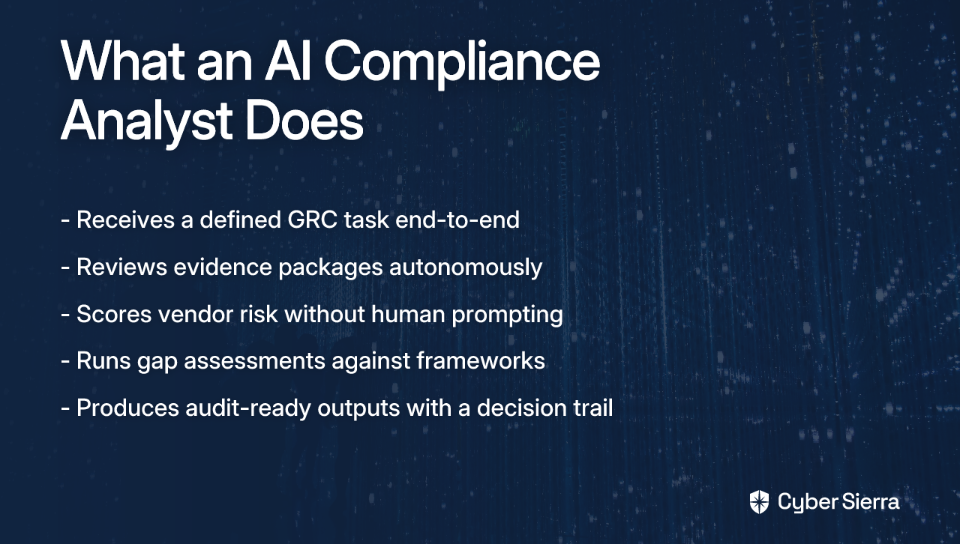
This is a meaningful distinction. Most AI tools in the GRC space operate as productivity aids. They surface relevant clauses, auto-fill forms, or summarize documents. An AI compliance analyst goes further: it reviews evidence packages, scores vendor risk, runs gap assessments against frameworks like SOC 2, ISO 27001, or PCI DSS, and produces audit-ready outputs without a human directing each individual step.
Think of it as a digital team member with a defined portfolio of GRC responsibilities. It works within the parameters and guardrails you set, but it owns the execution of those tasks independently.
AI Compliance Analyst vs. AI Copilot: The Critical Difference
The confusion between copilots and agents is widespread, and it matters more in compliance than in almost any other domain. Some GRC practitioners express frustration, noting that the distinction between a bot, a copilot, and an AI agent is unclear. That confusion has real operational consequences when evaluating tooling.
An AI copilot assists. It drafts a vendor questionnaire response for you to review, highlights a potential control gap for you to investigate, or suggests a risk rating for you to approve. The human analyst remains the primary actor.
Every consequential step still requires your input, which means the workload reduction is marginal. For some, it can feel like they are doing work for the AI, not the other way around.
An AI compliance analyst operates differently. You define the scope (for example, assess a vendor against your TPRM control framework, run a gap assessment against MAS TRM, or review an evidence batch) and the analyst executes the full workflow. It gathers the relevant data, applies the appropriate logic, flags exceptions, and delivers a structured output. Your team reviews the result and acts on exceptions, rather than driving each step.
The practical implication is that a copilot reduces time per task, while a compliance AI analyst eliminates entire categories of manual work from your team's queue.
What Tasks Does an AI Compliance Analyst Handle?
The scope of work a mature AI compliance analyst can own is broader than most GRC leaders initially expect. These are not fringe automation use cases. They are the core workflows your team currently executes manually, repeatedly, and at significant cost.
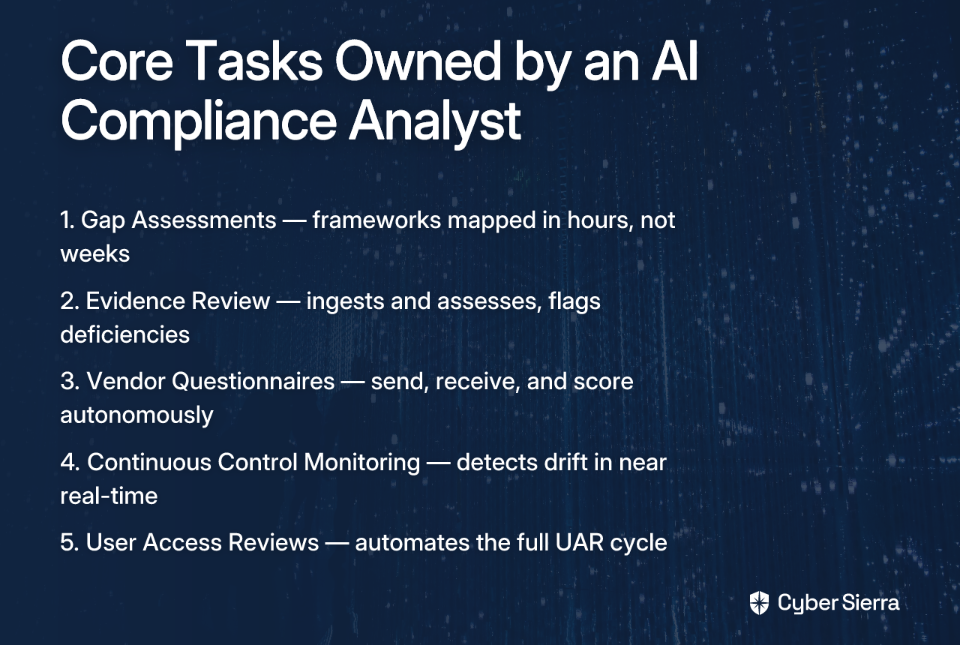
Gap Assessments
Manual gap assessments against frameworks like ISO 27001, SOC 2, PCI DSS, or IM8 typically run four to eight weeks. An AI-powered compliance analyst maps your current control posture against the target framework requirements, identifies gaps, prioritizes remediation, and produces a structured findings report in hours, not weeks.
Evidence Review
Evidence review is one of the highest-volume, lowest-value activities in any compliance program. An analyst ingests screenshots, configuration exports, policy documents, and system logs, then assesses each piece against the relevant control requirement. It flags deficiencies and passes clean evidence through with a full audit trail.
Vendor Questionnaires
Both sending and receiving questionnaires consume disproportionate analyst time. An AI compliance analyst ingests your existing security documentation and responds to incoming questionnaires autonomously. For outbound assessments, it reviews vendor responses, scores risk, and escalates exceptions for human review.
Continuous Control Monitoring
Rather than point-in-time audits, a CCM-integrated analyst monitors controls continuously. It detects drift, misconfigurations, or policy violations as they occur and generates alerts that are already triaged and contextualized.
User Access Reviews
User access reviews (UAR) are mandatory under frameworks including SOC 2, IM8, and CCOP. An AI analyst automates the full cycle: pulling access data, comparing it against approved roles and the principle of least privilege, flagging anomalies, and generating the documentation your auditors require.
These capabilities directly address some of the most pressing challenges facing GRC teams today.
Why Top Enterprises Are Deploying AI Compliance Analysts Now
The timing of this category's emergence is not coincidental. Four converging pressures have made autonomous compliance execution a strategic priority, not a future-state aspiration.
Board AI Mandates
Boards at regulated enterprises are no longer asking whether AI should be used. They are asking for specificity on how it is being applied and what returns it is generating. GRC is one of the highest-cost, highest-volume operational functions, making it a natural target for AI-driven transformation.
CIOs and CISOs are under direct pressure to demonstrate measurable productivity gains from AI investments.
The Compliance Talent Shortage
Qualified GRC professionals are expensive and difficult to retain. The supply of analysts who understand both technical controls and regulatory frameworks across MAS, IM8, SOC 2, and PCI DSS simultaneously is structurally limited. AI compliance analysts extend the capacity of your existing team without requiring additional headcount.
Chronic Audit Fatigue
Compliance teams at $300M+ revenue enterprises are running continuous audit cycles. The manual workload of evidence collection, control testing, and report generation creates burnout and increases the risk of errors. Automation removes the repetitive execution burden and lets your senior analysts focus on judgment-intensive work.
The Unsustainable Cost of External GRC Consulting
Big 4 consulting engagements for compliance readiness assessments and framework implementations are expensive and slow. Enterprises are increasingly looking to build internal capability that can execute at consulting-grade quality, without the consulting-grade invoice. An AI-powered compliance analyst makes that feasible.
Evaluating an AI Compliance Analyst: What Actually Matters
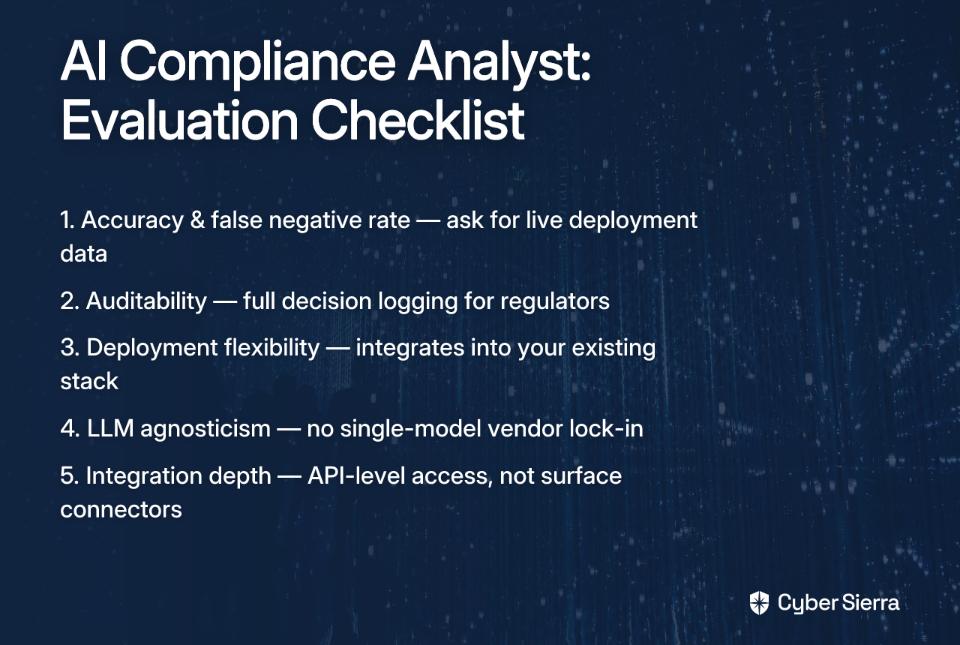
The market will produce many tools that claim to be AI compliance analysts. Most will be copilots with better marketing. Here is the evaluation framework that separates genuine autonomous execution from assisted workflows.
Accuracy and False Negative Rate
In compliance, a false negative (missing a control gap or a vendor risk) is more costly than a false positive. Evaluate vendors on first-draft accuracy and, critically, on false negative rates across live enterprise deployments. Ask for documented evidence, not benchmark claims.
Auditability and Decision Logging
This is non-negotiable for regulated enterprises. You need real observability, decision logging, and a safe review layer before an agent action becomes final. Every assessment, every evidence review, and every risk rating must produce a logged, reproducible decision trail that a regulator or external auditor can interrogate.
Deployment Flexibility
Your environment is complex. You likely run a mix of cloud, on-premise, and SaaS systems across multiple geographies and regulatory jurisdictions. The AI analyst must integrate into your existing stack, not replace it. Avoid platforms that require rip-and-replace deployments or restrict you to their proprietary data connectors.
LLM Agnosticism
A platform locked to a single Large Language Model creates vendor dependency and limits your ability to adopt better models as the field advances. Evaluate whether the platform can operate across multiple LLMs and whether it isolates your compliance data from model training pipelines.
Integration Depth
Surface-level integrations are insufficient for autonomous execution. The analyst needs API-level access to your cloud environments, HRIS, ticketing systems, and identity platforms to gather evidence, monitor controls, and complete workflows without manual data handoffs. Review a platform's integration library before committing.
How Cyber Sierra's AI Analysts Work
Cyber Sierra has built specialized AI Analysts deployed across three core modules: Third-Party Risk Management, Governance, Risk and Compliance, and Continuous Control Monitoring. Each analyst is purpose-built for a specific GRC domain rather than being a general-purpose agent applied to compliance tasks.
The architecture that enables autonomous execution is Cyber Sierra's Context Graph. This is the operational intelligence layer that maps relationships between your assets, controls, policies, evidence, vendors, and people. It gives each AI analyst the organizational context that generic LLM tools lack.
This "situational awareness" is what a human analyst normally provides. Without this context layer, agentic workflows produce generic outputs that require significant human rework.
Cyber Sierra's analysts also operate as reflective agents. They evaluate their own outputs against defined quality thresholds, incorporate feedback from human reviews, and improve accuracy over time. This reduces the supervisory burden on your team as deployment matures. Every action is logged in a structured audit trail, giving your team full observability into what each analyst did, why, and when.
What Enterprises Are Seeing in Production
The proof points from live deployments answer the question that matters most to GRC leaders evaluating this category: does it actually work at enterprise scale? The results focus on transforming high-volume, time-intensive GRC workflows.
Accelerated Evidence Review
For many organizations, using an AI analyst for evidence review can dramatically reduce the time spent on manual checks. The analyst can review evidence packages for completeness and accuracy, freeing up human teams to focus only on exceptions. The combination of speed and accuracy is the benchmark for a production-grade compliance AI analyst.
Faster Vendor Questionnaire Completion
An AI analyst can ingest an organization's existing security documentation to respond to incoming questionnaires autonomously. For outbound assessments, it can review vendor responses, score risk, and escalate exceptions. This approach can turn a weeks-long manual process into a much shorter, more efficient workflow.
Compressed Gap Assessments
Compliance readiness cycles that typically run for weeks, involving evidence gathering, control mapping, and gap identification, can be completed far more quickly. For enterprises preparing for MAS TRM, IM8, CCOP, or SOC 2 audits, this changes the economics of audit readiness.
Measurable Financial ROI
Enterprises that deploy AI analysts often see a clear return on investment. The savings come primarily from reduced consulting spend and analyst time redirected from manual processing to higher-value risk analysis. This allows GRC to move from a cost center to a more strategic business function.
Make Autonomous Compliance Your Reality
An AI compliance analyst is no longer a concept on a roadmap. It is deployed technology delivering proven results for GRC teams facing audit fatigue and board pressure for AI-driven wins. Remember the key difference: while copilots assist, AI analysts autonomously execute entire workflows, transforming compliance from a manual cost center into a strategic function.
The results are not marginal, compressing weeks of evidence review and gap assessments into hours with audit-ready outputs. Your first step is simple: identify one repetitive task that consumes the most analyst time, such as evidence collection or vendor risk assessments. Once you have a target, you have a data-driven starting point for automation.
If your team is ready to move beyond manual GRC, see an AI analyst live. Cyber Sierra can demonstrate how a specialized analyst handles your specific use case, using your frameworks, in under 30 minutes.
Frequently Asked Questions
What is the primary difference between an AI compliance analyst and an AI copilot?
An AI compliance analyst autonomously executes entire GRC workflows from start to finish, while an AI copilot only assists a human analyst with individual tasks. The analyst delivers a finished output, whereas a copilot requires a human to drive each step of the process.
How does an AI compliance analyst maintain accuracy and auditability?
It maintains accuracy through specialized training and a context graph that understands your specific environment. Every action is logged in a reproducible decision trail, ensuring every assessment and risk rating is fully auditable for regulators and internal review.
What are the main GRC tasks an AI compliance analyst can automate?
An AI compliance analyst can fully automate core GRC tasks like gap assessments against frameworks (e.g., SOC 2, ISO 27001), evidence review, vendor questionnaire processing, continuous control monitoring, and user access reviews, handling the entire workflow independently.
Why should my organization consider an AI compliance analyst now?
Organizations adopt AI compliance analysts now to address board-level AI mandates, combat the GRC talent shortage, and reduce audit fatigue and expensive consulting fees. The technology scales your team's capacity and delivers a measurable and rapid return on investment.
Can an AI compliance analyst integrate with our existing tools?
Yes, a true AI compliance analyst is designed to integrate with your existing technology stack. It uses deep, API-level access to your cloud environments, HRIS, and ticketing systems to perform tasks autonomously, avoiding the need for a "rip-and-replace" deployment.
What is the first step to getting started with an AI compliance analyst?
The best first step is to identify a high-volume, repetitive workflow, such as vendor questionnaire processing or evidence review. Deploy a single analyst against that task to measure its accuracy and time savings, providing clear data to build a business case for scaling.
