



The 7 Best User Access Review Software Tools for Enterprise Compliance (2026)

Join thousands of professionals and get the latest insight on Compliance & Cybersecurity.
- Weak access review processes are a major liability, leading to compliance fines and security incidents.
- Manual, periodic user access reviews (UAR) are no longer sufficient for enterprises; the standard is now continuous, automated monitoring that provides audit-ready evidence.
- Key features to prioritize include deep multi-system integration, AI-powered anomaly detection, and coverage for regulations such as SOC 2, ISO 27001, and PCI DSS.
- For organizations needing continuous compliance, the right tool automates user access reviews with AI to help teams stay audit-ready.
Your IT team is manually gathering user data from Okta, LDAP, GitHub, and Workday, compiling it into a spreadsheet, and then chasing managers through endless email threads for approvals. Sound familiar?
For large enterprises in regulated industries, financial services, healthcare, defence, and government, periodic manual reviews are an audit liability. The right user access review software replaces that spreadsheet-and-email cycle with continuous monitoring, automated evidence generation, and multi-system reconciliation that holds up under regulatory scrutiny.
Here is how to find the tool that fits your environment.
The 7 Best User Access Review Software Tools for Enterprise
The risks of outdated access review processes are clear. According to the Identity Defined Security Alliance, 90% of organizations faced an identity-related security incident in the past year. Another report found that 65% of companies have faced compliance fines directly tied to weak access review processes.
Before the deep dives, here is a side-by-side view of how each tool performs against the criteria that matter most to compliance and security teams in regulated industries.
| Tool | Continuous Review | Integration Depth | Auditability | AI-Powered Detection | Key Regulations | Deployment |
|---|---|---|---|---|---|---|
| Cyber Sierra | Yes | High (SaaS, IaaS, DBs, Multi-country HR) | Very High | Yes (UAR AI Analyst) | ISO 27001, SOC 2, MAS TRM, PCI DSS | Customer's Cloud, SaaS |
| SailPoint | Yes | Very High (Broad connectors) | Very High | Yes | SOX, HIPAA, GDPR | Cloud, On-Prem |
| Saviynt | Yes | High (Cloud-focused) | High | Yes | SOC 2, SOX | Cloud (IGAaaS) |
| Omada | Yes | High (Strong SAP/ERP) | Very High | Yes | GDPR, SOX | Cloud, On-Prem |
| CyberArk | Yes (Privileged Access) | Medium (PAM/IT/OT focus) | Very High | Yes | PCI DSS, SOX | Cloud, On-Prem |
| AuditBoard | Periodic | Medium | Very High | No | SOX, ISO 27001 | Cloud |
| OneTrust | Periodic | Medium (Privacy-focused) | High | No | GDPR, CCPA | Cloud |
What Enterprise UAR Software Must Do
Enterprise UAR requirements are categorically different from what lighter tools are built for. When your organisation spans multiple countries, HR systems, and hundreds of applications, you need access review software that reconciles data across all of them continuously, not just once per quarter.
The six criteria below reflect what procurement and compliance teams at 1,000-plus-user organisations consistently require. Use them to evaluate any tool on this list or any vendor you speak with.
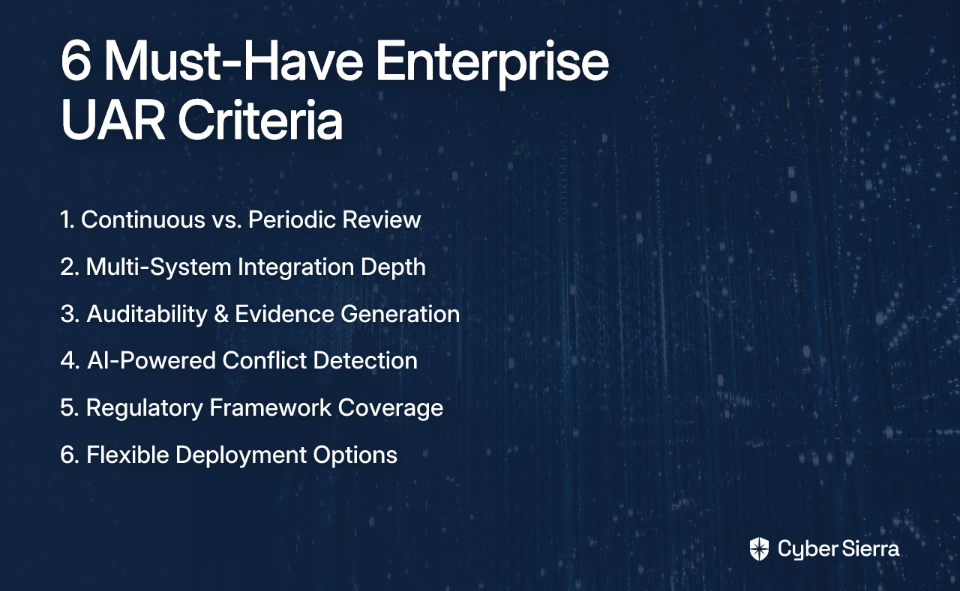
Continuous vs. Periodic Review: Quarterly review cycles create security gaps that attackers and auditors both notice. Continuous review detects access anomalies as they occur, enforcing the principle of least privilege without waiting for the next campaign.
Multi-System Integration Depth: Enterprise environments are hybrid. A tool that only reads from Azure AD but not from your on-prem databases, SaaS applications, or legacy ERP misses a significant share of your access risk. Look for connectors across your full application estate.
Auditability and Evidence Generation: Auditors require proof. The platform must generate immutable logs of every review decision, including approvals, revocations, and justifications, formatted for the frameworks your regulators care about.
AI-Powered Conflict Detection: Manual review of thousands of entitlements is where Separation of Duties (SoD) violations hide. AI surfaces outliers, peer-group anomalies, and dormant accounts that reviewers would otherwise approve by default.
Regulatory Framework Coverage: Your tool should ship with pre-built controls for ISO 27001, SOC 2, PCI DSS, HIPAA, SOX, GDPR, GLBA, and MAS TRM, depending on your industry.
Deployment Options: Financial services, defence, and government agencies frequently cannot use a public multi-tenant SaaS product. Customer-hosted, on-premises, and air-gapped options are non-negotiable for those environments.
Tool-by-Tool Breakdown
Here is a detailed look at each platform's approach, strengths, and ideal use case.
1. Cyber Sierra
Cyber Sierra is a full GRC platform that treats UAR as a continuous data reconciliation challenge rather than a periodic campaign. Its UAR AI Analyst continuously reconciles user access across critical systems against authoritative sources of truth, including multi-country HR platforms like Workday.
The platform generates audit-ready evidence mapped to MAS TRM, SOC 2, and ISO 27001 controls. This output is designed to go directly to your auditors without reformatting. UAR findings sit within the broader GRC context, linking access control gaps to registered risks and compliance obligations. Deployment in the customer's own cloud environment keeps sensitive access data under your jurisdiction.
Learn more about Cyber Sierra's Governance, Risk and Compliance platform.
Best for: Global enterprises in financial services and regulated tech that need continuous, audit-defensible UAR integrated with their GRC programme.
2. SailPoint
SailPoint IdentityIQ is one of the longest-standing platforms in Identity Governance and Administration (IGA). It provides a comprehensive workflow engine for launching and managing access certification campaigns, enforcing Role-Based Access Control (RBAC), and detecting Separation of Duties violations at scale.
Its connector library is among the broadest in the market, supporting both on-premises systems and cloud applications. The Joiner-Mover-Leaver (JML) lifecycle management is mature, and its AI-driven identity recommendations reduce reviewer burden during large campaigns. On-premises and SaaS deployment options are both available.
Best for: Large, mature enterprises that require a dedicated, full-featured IGA platform and have the internal resources to configure and operate a complex system.
3. Saviynt
Saviynt is a cloud-native IGA platform with a strong focus on cloud security posture and intelligent access analytics. It competes directly with SailPoint for organisations that are cloud-forward and prefer a SaaS-delivered governance model.
Its Application Access Governance module covers SOC 2 and SOX with pre-built control packs. Saviynt's analytics layer applies peer-group comparison to flag over-provisioned accounts before reviewers miss them. Integration depth is strong for AWS, Azure, GCP, and major SaaS platforms, though on-premises application coverage is lighter than SailPoint.
Best for: Cloud-forward enterprises that need a SaaS-delivered IGA platform with built-in compliance automation and do not have significant on-prem application estates to govern.
4. Omada
Omada is a European-origin IGA vendor with a strong track record in regulated industries including financial services, pharmaceuticals, and public sector organisations. Its IdentityPROCESS+ framework provides a structured, best-practice approach to implementing UARs and broader identity governance programmes.
Omada covers GDPR requirements in particular depth, which is important for organisations operating in or serving the EU. Its connectivity to on-premises systems like SAP is stronger than most cloud-native competitors. Both SaaS and on-premises deployments are supported.
Best for: European-based or globally operating enterprises in regulated sectors that value a process-driven approach to IGA and need strong SAP/ERP integration alongside modern cloud applications.
5. CyberArk
CyberArk is the recognised market leader in Privileged Access Management (PAM). While not a general-purpose IGA platform, its privileged access review capabilities are unmatched for organisations where the primary audit focus is on administrator accounts, service accounts, and operational technology (OT) systems.
Its Just-in-Time (JIT) access model reduces standing privileges, which directly simplifies UAR scope by minimising what requires continuous review. Session recording provides an immutable audit trail of what privileged users did with their access, a requirement under PCI DSS and SOX. Both cloud and on-premises deployment options exist.
Best for: Enterprises in critical infrastructure, defence, industrial IT/OT, or any environment where privileged account security is the primary UAR and audit concern.
6. AuditBoard
AuditBoard approaches UAR from the internal audit team's perspective rather than the IT security team's. It is a GRC and audit management platform where user access controls are one component of a broader control testing and evidence collection programme.
Its workflows are built around gathering evidence, tracking review completion rates, and presenting results to audit committees. It is particularly strong for SOX compliance workflows and for organisations where the internal audit function owns the UAR process end to end. Real-time access governance depth is limited compared to dedicated IGA platforms.
Best for: Audit and compliance teams who need to manage the UAR process and evidence collection within a broader audit management platform, rather than IT teams seeking real-time access governance.
7. OneTrust
OneTrust is the market leader in privacy and trust management. Its UAR capabilities are real but are built specifically to support data privacy compliance, confirming that access to sensitive personal data is appropriate under GDPR, CCPA, and similar frameworks.
Its data discovery and classification features help identify where personal data lives and who can reach it. That privacy-forward framing means it has less depth in traditional IT security UAR use cases, such as reviewing server administrator rights or database permissions. It is a cloud-only deployment.
Best for: Organisations whose primary UAR driver is data privacy compliance and governance over sensitive personal information rather than broader IT security access governance.
Decision Guide: Choosing the Right UAR Tool
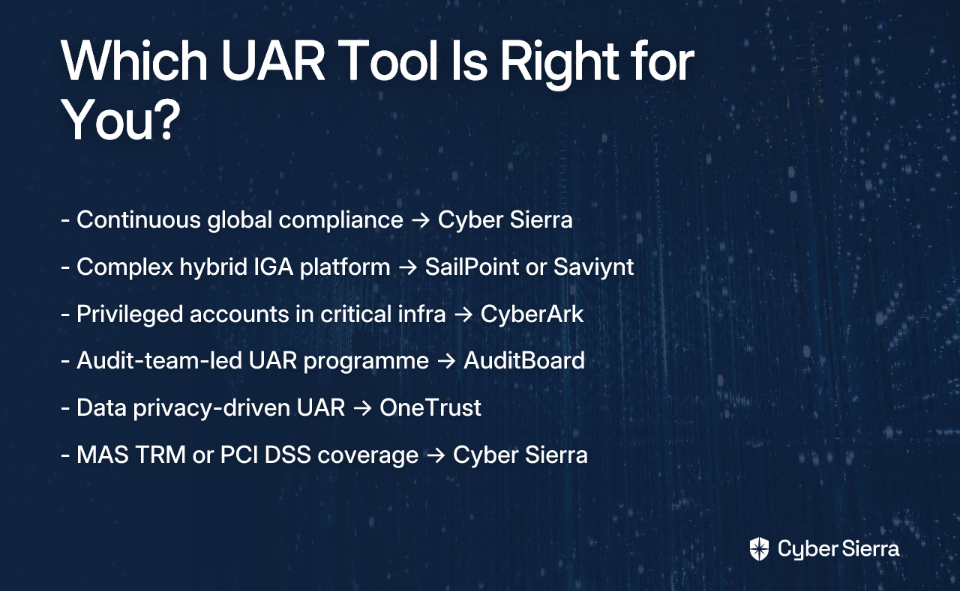
The right UAR software depends on where your primary compliance risk sits and what your existing environment looks like. Use these scenarios to narrow your shortlist.
You need continuous compliance and audit defence across a global organisation. Cyber Sierra's continuous reconciliation model and multi-country HR integration address this directly. Its UAR AI Analyst produces audit-ready evidence that removes the pre-audit scramble from your calendar.
You need a full-featured, dedicated IGA platform for a complex hybrid environment. SailPoint remains the traditional market leader for depth and connector breadth. Saviynt is the stronger alternative if your estate is predominantly cloud-hosted.
Your primary UAR challenge is privileged accounts in critical infrastructure. CyberArk has no peer for managing and reviewing privileged access in IT, OT, and DevOps environments. Pair it with a broader IGA tool if you also need general access governance.
Your UAR programme is run by the internal audit function. AuditBoard speaks that team's language. It frames user access controls within audit testing workflows, making evidence collection and reporting natural rather than retrofitted.
Your UAR requirement is driven by data privacy regulations. OneTrust covers GDPR and CCPA compliance well. If you also need IT security-depth access governance, plan to pair it with a dedicated access review tool.
You are in financial services and need MAS TRM or PCI DSS coverage. Cyber Sierra includes pre-built controls for both frameworks within its GRC platform. SailPoint and CyberArk also address PCI DSS, but MAS TRM coverage requires verification with each vendor.
Move From Manual Reviews to Continuous Compliance
If your user access review process still lives in spreadsheets and email threads, it's not just inefficient—it's an audit finding waiting to happen. For regulated enterprises, manual, periodic reviews no longer meet the standard of care.
To meet modern compliance standards, access reviews must be continuous, not quarterly, closing security gaps where risks accumulate. Your tool must generate audit-ready evidence automatically, reconciling identities across your entire tech stack, from multi-country HR systems to on-prem databases. It also needs AI-driven detection to surface the SoD violations and entitlement creep that tired human reviewers inevitably miss.
The next step is to map your current process against the six enterprise criteria in this guide and identify where the manual work and compliance gaps are hiding.
When you are ready to replace spreadsheet chaos with automated, audit-defensible governance, see how Cyber Sierra's UAR AI Analyst provides continuous compliance. Book a personalized demo to see it in action.
Frequently Asked Questions
What is user access review (UAR) software?
User access review software automates the process of verifying that users have appropriate access rights to company systems and data. It replaces manual spreadsheets by connecting to applications to provide a centralized view of permissions, track approvals, and generate audit-ready reports.
Why is automating user access reviews important for compliance?
Automating user access reviews is important for compliance because it creates an auditable trail of evidence that access rights are regularly checked. Manual processes are error-prone and hard to prove to auditors, leading to non-compliance fines from regulations like SOX and HIPAA.
How does continuous review differ from periodic review?
Continuous review monitors access rights in near real-time, while periodic reviews happen at set intervals, like quarterly. The gap between periodic reviews creates security risks. Continuous review detects inappropriate access as it happens, constantly enforcing the principle of least privilege.
What key features should enterprise UAR software have?
Enterprise UAR software must have continuous review capabilities, deep integration with diverse systems, strong audit evidence generation, and AI-powered conflict detection. It should also cover major regulatory frameworks like ISO 27001, SOC 2, and PCI DSS to meet security needs.
How does AI improve the user access review process?
AI improves user access reviews by automatically identifying high-risk access patterns, such as dormant accounts or Separation of Duties (SoD) violations. It analyzes permission data to surface anomalies human reviewers might miss, reducing fatigue and improving accuracy.
Which regulations mandate user access reviews?
Several major regulations mandate user access reviews, including Sarbanes-Oxley (SOX), HIPAA, PCI DSS, GDPR, and ISO 27001. These frameworks require organizations to prove they are managing and restricting access to sensitive financial, health, and personal data.
