



GRC Automation in Cybersecurity: 3 Case Studies With Real ROI


Join thousands of professionals and get the latest insight on Compliance & Cybersecurity.
Key Takeaways
- AI-powered GRC automation delivered a 10x ROI in 12 months for one Fortune 500 firm by cutting third-party risk assessment time by 67%.
- Another organization increased its vendor assessment capacity by 80% without adding headcount, demonstrating how automation scales compliance programs efficiently.
- Automating audit evidence review proved 530x faster than manual checks, moving a company from 10% sampling to 100% control coverage and true audit readiness.
- By targeting high-volume manual tasks first, organizations can achieve rapid, measurable returns with GRC automation tools like Cyber Sierra.
Most articles on GRC automation ROI hand readers a framework and ask them to fill in the blanks. They offer multipliers, cost-per-hour estimates, and theoretical returns that sound compelling in a slide deck but mean nothing when a CISO is defending a budget line.
Security leaders know this reality all too well. GRC tools often "over promise and under deliver," and too many implementations become "another IT project that requires constant KTLO due to bugs in integrations." This article skips the frameworks entirely.
What follows are three documented outcomes from enterprise cybersecurity teams that deployed AI-powered GRC automation. The text includes specific figures across third-party risk management, assessment scaling, and audit evidence review. The numbers are real, the ROI is calculated, and the goal is to give any CISO or Head of GRC the documented proof they need to make an informed decision.
Case Study 1: Fortune 500 Insurer: TPRM Automation
The Problem
A Fortune 500 insurance company was running a third-party risk management program entirely on manual effort. The cybersecurity team was processing over 150 vendor security assessments per year, and each assessment required approximately 60 hours of analyst time to complete. This equates to more than 9,000 analyst hours annually. It was a staggering resource drain that left the team perpetually behind on onboarding timelines and unable to focus on higher-order risk decisions.
The situation reflects a pattern well-documented in TPRM research: manual processes cannot keep pace with expanding vendor portfolios, and the result is either a growing backlog or a false sense of coverage. For this insurer, the cycle time from initiating an assessment to closing it out stretched to over one month per vendor.
The Solution
The organization deployed Cyber Sierra's TPRM automation platform. The platform's AI capabilities took over the full assessment lifecycle: distributing questionnaires, parsing vendor responses, validating evidence, scoring risk, and generating reports. Human analysts were redirected to exception handling and strategic vendor engagement on high-risk findings.
The Outcome
The results within the first 12 months were unambiguous:
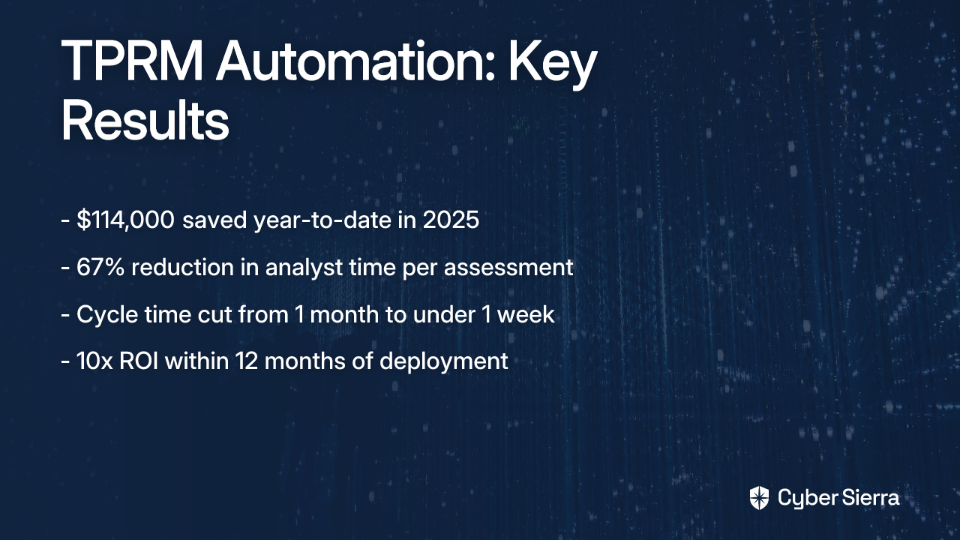
- US$114,000 saved year-to-date in 2025 from reduced manual analyst effort
- 67% reduction in analyst time spent per assessment
- Cycle time cut from over one month to under one week
- 10x ROI achieved within 12 months of deployment
This is what focused GRC automation cybersecurity looks like in practice. The ROI did not come from a platform reconfiguration project or a multi-year transformation program. It came from deploying AI directly into the highest-volume, most time-intensive execution task the team performed. GRC automation ROI arrived fast because the use case was precise.
Case Study 2: Indian Financial Institution: Scaling Without Headcount
The Problem
A rapidly growing Indian financial institution faced a familiar constraint: their vendor portfolio was expanding, but headcount approval was not coming. The cybersecurity GRC team was managing 84 third-party vendor assessments annually and was being asked to absorb a significantly larger volume without any new hires. This is a pressure point that resonates across the GRC community, where teams are routinely expected to do more with less while maintaining audit readiness.
The institution needed to scale its cybersecurity compliance automation without building a larger team. Buying a traditional GRC platform was not an option, as many complex tools require dedicated internal resources just to maintain them. This would have compounded the problem rather than solved it.
The Solution
The institution used Cyber Sierra's TPRM module to augment its existing team. The AI handled the repetitive, high-volume work of reviewing vendor questionnaires, cross-referencing evidence, scoring findings against the institution's risk framework, and surfacing only the exceptions that required human judgment.
Analysts were freed from administrative tasks and able to focus on what requires human expertise: interpreting borderline risk findings, engaging vendors on remediation, and advising business stakeholders. The full capability set is detailed on Cyber Sierra's TPRM platform page.
The Outcome
The results validated the approach:
- Assessment capacity grew from 84 to 150+ vendors annually, an 80% increase in throughput
- 75% reduction in assessment cycle time
- Zero new hires required to achieve that growth
This case demonstrates what cybersecurity GRC automation actually enables at a strategic level. The value is not only financial — it is the organizational flexibility to scale a compliance program in response to business growth without triggering a headcount debate. RegScale's analysis of GRC in cybersecurity identifies this capacity multiplication as one of the core value drivers of automation, and this case puts real numbers behind that claim.
For any GRC leader presenting a case for automated GRC cybersecurity to finance or the board, the throughput argument is often more compelling than cost savings alone. Scaling from 84 to 150+ assessments with the same team is a concrete productivity story that does not require a spreadsheet to understand.

Case Study 3: Fortune 500 Insurer: Evidence Review at 530x Speed
The Problem
For a second Fortune 500 insurer, the biggest bottleneck in the compliance cycle was not vendor assessments; it was audit evidence review. Before every audit, analysts spent weeks manually combing through screenshots, configuration exports, policy documents, and system logs to verify that controls were operating as designed. Some in the GRC community call this "documentation theater," where enormous effort is directed at producing evidence artifacts rather than improving security posture.
The deeper problem was coverage. Given the manual time required per control, the team was only able to sample approximately 10% of controls during each review cycle. The other 90% went unreviewed, creating a gap between the audit report and what had actually been validated. This is a structural limitation of manual GRC processes, as human reviewers cannot scale to full control coverage at the pace compliance programs demand.
The Solution
The insurer deployed Cyber Sierra's AI-powered continuous compliance platform. The platform's AI parses evidence artifacts, including documents, screenshots, and system configuration data, and maps them against the relevant control requirements. It provides an immediate pass/fail determination for each piece of evidence, flags gaps, and generates audit-ready summaries.
This approach differs from tools that describe AI-assisted GRC primarily as task routing or report generation from pre-structured data. Instead, the AI reads and interprets unstructured evidence artifacts the same way an analyst would, but orders of magnitude faster.
The Outcome
The numbers from this deployment make the case for AI evidence review more clearly than any framework could:
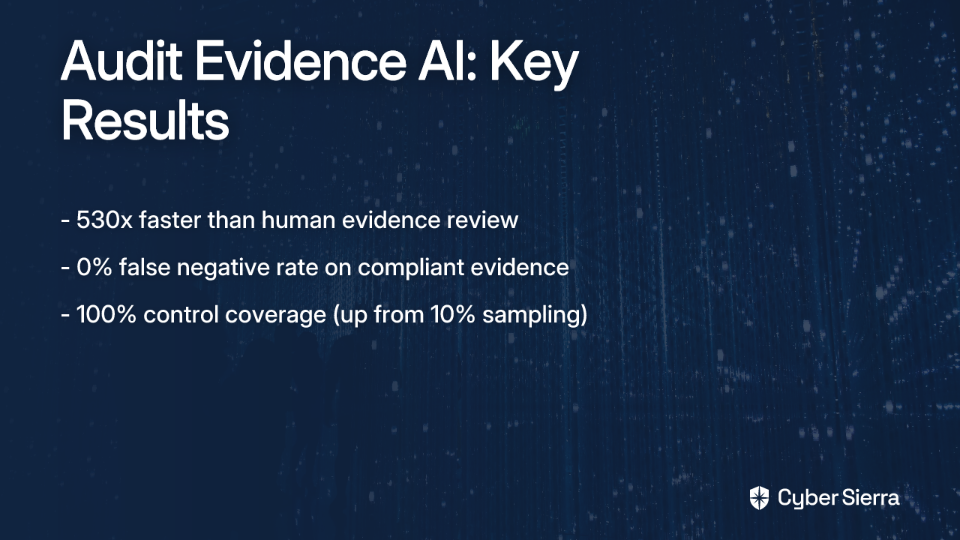
- 530x faster than human evidence review
- 0% false negative rate, so no compliant evidence was incorrectly rejected
- 100% control coverage achieved, up from 10% manual sampling
The shift from 10% to 100% coverage is the figure that most directly changes how the business should think about audit readiness. Previous audits were passing based on a 10% sample. That is not a risk posture; it is a gap with paperwork on top of it. GRC automation that delivers complete coverage fundamentally changes the conversation between the compliance team and the board.
For context, comparable implementations in healthcare have reported 82% efficiency gains in control evidence automation. The 530x speed improvement documented here suggests that AI evidence review is maturing rapidly, and early deployments are producing results well beyond initial benchmarks.
What These Case Studies Tell Us About GRC Automation ROI
These case studies show a consistent pattern: GRC automation delivers measurable returns when the deployment targets execution work, not platform configuration.
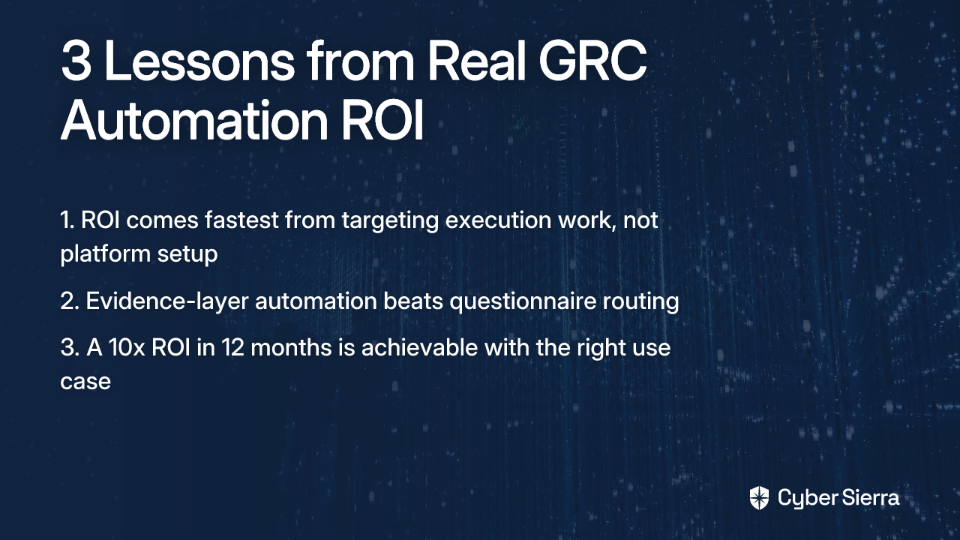
ROI comes fastest from execution, not setup. All three cases saw returns in well under 18 months because none began with a platform overhaul. Each targeted a specific, high-volume execution task like TPRM assessments, vendor scaling, or evidence review and applied AI directly to that task.
Complex platform implementations are where GRC automation ROI most often stalls. The setup cost and maintenance burden can consume the budget before actual workflow improvements take hold.
Evidence depth matters more than questionnaire routing. The third case study makes this point sharply. Moving from 10% to 100% control coverage is not a marginal improvement; it changes the risk posture entirely. Traditional GRC tools focus on routing questionnaires and tracking completion. Automation that operates at the evidence layer to parse artifacts, validate controls, and flag gaps is what moves teams from compliance theater to actual assurance.
A 10x GRC automation ROI within 12 months is a realistic target. It is not a marketing claim if it comes with a documented figure: US$114,000 saved, 67% time reduction, cycle time under one week. The condition is choosing a use case with high volume, repetitive manual work, and a clear before/after metric. Teams that attempt to automate everything at once rarely see returns that fast. Teams that focus on one high-impact workflow first, and measure it rigorously, consistently do.
For any CISO evaluating cybersecurity compliance automation, the question is not whether the ROI is achievable. These three cases confirm it is. The question is which use case in your existing GRC program carries the same characteristics: high volume, high manual burden, and a measurable output. That is where automated GRC cybersecurity should start.

Make Your GRC Automation ROI Tangible
The data is clear: waiting for a multi-year transformation project to deliver GRC automation ROI is no longer necessary. The fastest returns come from targeting specific, high-volume execution work first, such as TPRM assessments or evidence review. This approach allows teams to scale capacity without adding headcount and move from risky audit sampling to 100% control coverage.
Your next step is to identify the single most time-consuming manual task your GRC team performs. Once you have that use case in mind, you can build a business case with a clear ROI. To see how Cyber Sierra's AI-powered platform tackles that exact problem, schedule a custom demo.
Frequently Asked Questions
What is GRC automation in cybersecurity?
GRC automation in cybersecurity uses technology, particularly AI, to streamline and execute repetitive governance, risk, and compliance tasks. This includes automating processes like third-party risk assessments and audit evidence collection to improve efficiency, accuracy, and coverage.
How is ROI calculated for GRC automation?
ROI for GRC automation is calculated by measuring direct cost savings, efficiency gains, and risk reduction against the investment. Key metrics include reduced analyst hours, faster assessment cycles, increased assessment capacity, and the financial impact of improved control coverage.
What are the best use cases for starting with GRC automation?
The best use cases for GRC automation are high-volume, repetitive, and manual tasks. Prime examples include third-party risk management (TPRM), scaling vendor assessments, and automating audit evidence review, as these offer the fastest and most measurable returns.
How quickly can you see returns from AI-powered GRC automation?
Teams can see significant returns from AI-powered GRC automation within 12 months. By targeting specific execution tasks rather than complex platform setups, one Fortune 500 insurer achieved a 10x ROI in the first year by automating its third-party risk management process.
How does AI improve on traditional GRC platforms?
AI improves on traditional GRC platforms by automating execution-level work, not just workflow routing. While traditional tools manage processes, AI analysts can read unstructured evidence, score risks, and validate controls—tasks that previously required human analysts.
Can GRC automation really improve audit readiness?
Yes, GRC automation significantly improves audit readiness by enabling 100% control coverage. Instead of relying on manual sampling (e.g., 10% of controls), AI can review all evidence artifacts continuously, providing complete assurance and eliminating gaps before an audit begins.
