



AI vs. Compliance Consulting: What Enterprises Get From Each

Join thousands of professionals and get the latest insight on Compliance & Cybersecurity.
- High Consulting Costs. Big 4 GRC consulting engagements are a significant expense, with much of the budget often spent on automatable execution tasks.
- AI for Operational Work. AI platforms excel at high-volume operational work, performing tasks like audit evidence review significantly faster than manual efforts and providing continuous control monitoring.
- The Hybrid GRC Model. The optimal approach uses expert consultants for high-value strategic advice and an AI platform for continuous, automated execution and monitoring.
- Budget Reallocation. Teams can reallocate their GRC budget by automating operational tasks with a platform like Cyber Sierra's GRC suite to improve coverage and reduce costs.
A Big 4 GRC consulting engagement can be a six-figure investment for initial scoping, gap analysis, and program design, and that is before the annual refresh cycle begins. When the engagement ends, the regulatory landscape has often already shifted, leaving organizations with a point-in-time snapshot that ages quickly.
AI GRC platforms have fundamentally changed what is automatable in compliance, creating a genuine Big 4 GRC consulting alternative for a meaningful portion of that spend. The question is not whether to replace every consultant on the roster. It is which parts of a consulting engagement can now be handled by an AI alternative to compliance consulting, and which still require human expertise.
The answer matters most to the CISO or CFO staring down a $180,000 engagement proposal. Understanding the functional breakdown of how consultants spend their hours — and where AI can absorb that work — is the fastest path to a defensible budget decision. This article provides that breakdown, with real cost data and specific performance benchmarks.
What Compliance Consulting Actually Delivers
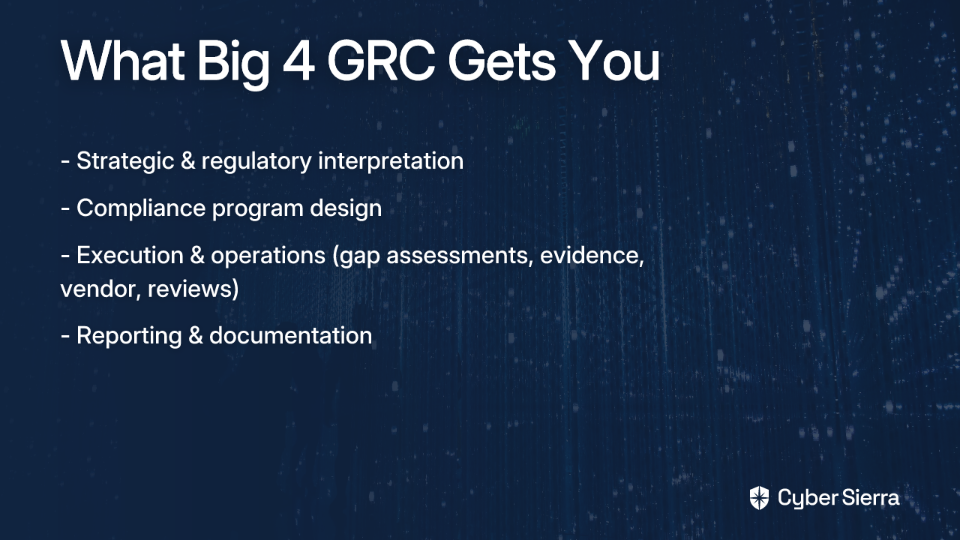
Before making the case for any AI vs compliance consulting reallocation, it is worth understanding exactly what a Big 4 or specialist GRC firm actually provides. The work falls into four distinct categories, each with a different automation profile.
Strategic and Regulatory Interpretation. This is where senior consulting partners earn their fees. Interpreting emerging regulation, such as new SEC cybersecurity disclosure rules, evolving DORA requirements, or the latest NIST framework revision, requires contextual judgment that draws on years of regulatory practice.
CoreStream GRC's research specifically identifies this as the category most resistant to automation because it requires nuanced human reasoning, not pattern matching. Board-level risk advisory and regulatory negotiation also live here. This work is genuinely high-value and hard to replace.
Compliance Program Design. Frameworks, control libraries, policy templates, and governance structures. Consultants build these from scratch or adapt existing templates to a client's specific operating model. This category is partially automatable: AI platforms can generate baseline control sets and map them to multiple frameworks simultaneously, but the strategic decisions about program scope, risk appetite, and organizational fit still benefit from experienced human input.
Execution and Operations. This is the largest category by billable hours in most engagements, and it is where the AI alternative to compliance consulting case is strongest. Gap assessments, evidence collection and review, vendor questionnaire management, and control testing are semi-structured, high-volume tasks.
As Bain Capital Ventures frames it, this is the "sludge" of regulatory compliance. It is repetitive work that is well-defined enough for automation but currently consumes analyst hours at consulting rates. User research confirms the pain: analysts spend more time navigating PDFs, portals, and email chains than actually making decisions.
Reporting and Documentation. Audit-ready reports, control evidence packages, and board-facing risk summaries. This category is increasingly automatable as AI tools become capable of compiling structured data into formatted outputs. Platforms like Cyber Sierra already support continuous report generation across frameworks.
Where AI Replaces Consulting Spend
The execution layer is where the AI alternative to compliance consulting delivers its clearest ROI. The shift is not marginal. Avalara describes it as a move from "AI-assisted to AI-executed" workflows.
This represents a fundamental change in who (or what) performs the work, not just a speed improvement on the same process. Here is what that looks like across each execution category.
Gap Assessment Execution. In a traditional consulting engagement, a gap assessment takes 4 to 8 weeks. Consultants schedule interviews, collect documentation, manually review controls against framework requirements, and compile findings into a report.
An AI GRC platform connects to existing systems, like cloud environments, ticketing tools, and identity providers, to execute a comprehensive gap assessment in hours. Cyber Sierra's automated gap assessments compress the same scope from weeks to a fraction of a working day. Outputs are mapped to frameworks like SOC 2, ISO 27001, and NIST CSF 2.0 simultaneously.
Audit Evidence Review. Junior consultants in large GRC engagements spend significant hours manually reviewing screenshots, PDFs, and policy documents to validate that controls are operating as designed. The work is necessary but not intellectually demanding, and it bills at full consulting rates.
Cyber Sierra's Audit Evidence AI handles the same review significantly faster than consultant-led evidence collection. It reads, parses, and validates evidence against control requirements in minutes rather than hours. This single capability displaces a meaningful portion of engagement hours.
Vendor Questionnaire Management. Third-party risk assessments involve sending, tracking, and reviewing hundreds of vendor security questionnaires. A consultant drafting a first response to a 150-question security questionnaire typically takes two weeks.
Cyber Sierra's Assessment Response AI completes the same task in 15 minutes, drawing on existing security documentation to generate accurate, context-aware answers. AI-driven Third-Party Risk Management can deliver significant savings on TPRM execution alone, not including the full program.
Continuous Control Testing. Consulting engagements are inherently point-in-time. A firm completes a control testing cycle and delivers findings, but the organization's environment continues to change. Consultants typically sample a small percentage of controls due to time constraints.
AI platforms provide continuous coverage, monitoring controls in near-real-time and flagging drift as it occurs rather than at the next engagement cycle. CoreStream GRC's analysis cites 80 percent time savings on execution tasks. Continuous testing takes that further by eliminating the re-engagement cycle altogether.
Taken together, these four capabilities represent Cyber Sierra's model of 10 AI Analysts operating around the clock. This provides a standing execution capacity that replaces the episodic, hourly-billed execution work that dominates most GRC consulting engagements.
Replacing compliance consulting with AI at the execution layer does not degrade quality. In most cases, continuous coverage is a better outcome than periodic sampling.
Where Consultants Still Add Value
An honest AI vs compliance consulting comparison requires acknowledging where human expertise remains irreplaceable. The argument for using AI instead of compliance consulting for execution tasks is not an argument for eliminating consulting relationships entirely. There are specific categories of work where experienced consultants consistently outperform any current AI platform.
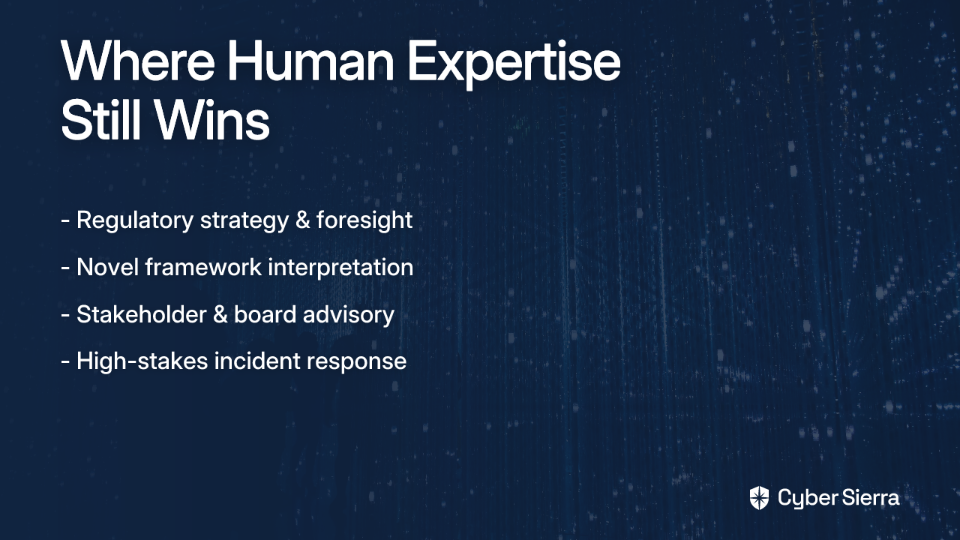
Regulatory Strategy and Foresight. When a new regulation is published with ambiguous implementation guidance, a senior compliance partner who has navigated previous interpretive cycles can provide strategic advice that no AI system trained on historical data can replicate.
Ocorian's research found that while 92 percent of alternative fund managers now use AI for risk and compliance procedures, they explicitly cite the continued need for human oversight in high-stakes interpretive decisions. The data point is instructive: adoption of AI is nearly universal, but it does not mean the elimination of human judgment.
Novel Framework Interpretation. AI operates on existing labeled data. When an organization faces a genuinely novel compliance scenario, such as a new business model, a cross-jurisdictional edge case, or a first-of-kind regulatory inquiry, consultants provide the contextual reasoning that AI cannot.
User research from compliance practitioners confirms this: "most failures in compliance automation come from edge cases, silent UI changes, or missing context that a human analyst would normally catch." That observation applies to AI platforms too. The execution layer is well-suited for automation; novel interpretation is not.
Stakeholder Management and Board Advisory. Communicating risk posture to a board, negotiating with a regulatory examiner, or managing a complex discussion with external auditors requires empathy, persuasion, and professional credibility that AI cannot provide. These interactions carry relational and reputational weight that belongs in human hands.
High-Stakes Incident Response. Guiding an organization through a material breach, a regulatory investigation, or a significant control failure requires the kind of experienced, adaptive judgment that consulting firms develop over decades of practice. As practitioners note, "full decision automation is not realistic" for compliance scenarios where regulatory accountability matters. This is the right frame for the boundary between AI and human roles.
The practical implication: organizations should retain consulting relationships for strategy, novel interpretation, and stakeholder-facing advisory work. They should replace compliance consulting with AI for the execution and operational monitoring tasks that currently consume the majority of engagement hours and budget.
AI vs. Consulting: The 3-Year Cost Comparison
The financial case for a GRC consulting alternative rests on two structural differences: the cost model and the delivery model. Consulting engagements are priced as discrete projects; AI platforms are annual subscriptions. Consulting delivers a point-in-time assessment; AI platforms deliver continuous coverage.
Luthor.ai's cost research confirms that traditional compliance costs are rising. Half of advisory firms expect costs to exceed $100,000 annually due to new regulatory requirements, while AI-enhanced compliance services provide 30 to 40 percent cost savings compared to traditional methods.
The practical 3-year cost profile looks like this:
| Cost Model | Year 1 | Year 2 | Year 3 | Delivery Model |
|---|---|---|---|---|
| Big 4 GRC Consulting | Project-based cost | Refresh cost | Refresh cost | Point-in-time snapshots |
| AI GRC Platform | Annual subscription | Annual subscription | Annual subscription | Continuous coverage |
Cost structures are directional and should be validated against specific vendor proposals.
The financial delta over three years is significant, and that gap understates the full picture. The consulting model delivers three discrete point-in-time snapshots, while the AI model delivers continuous coverage across all three years.
For a CISO or CFO re-evaluating a GRC consulting engagement proposal, the question is not just whether the AI alternative is cheaper. It is whether the organization is better served by episodic expert attention or continuous automated execution, and at what price for each. The answer, for most enterprises, is both: AI handling execution continuously, with consultants engaged selectively for high-value strategic work. See what an AI-powered GRC platform can automate across the full GRC lifecycle.
Putting Your Hybrid GRC Model Into Action
The most effective path forward is not choosing between AI and consultants, but using both for what they do best. Your GRC program becomes stronger when you focus expensive human expertise on high-value strategy and delegate high-volume execution to AI. This hybrid approach delivers better outcomes, moving you from periodic snapshots to continuous monitoring.
Here’s your next step: review your latest GRC consulting proposal. Identify every line item for execution and operations—gap assessments, evidence collection, vendor questionnaires, and control testing. This is the 60-70% of your budget that is now automatable.
Once you have that number, see precisely how AI replaces those manual hours while improving your compliance posture. Book your platform demo to watch Cyber Sierra’s AI analysts handle the GRC tasks that are costing you the most.
Frequently Asked Questions
What are the main differences between an AI GRC platform and a Big 4 consultant?
The primary differences are in cost, delivery model, and scope. AI platforms offer a continuous, subscription-based service focused on automated execution, while consultants provide project-based, point-in-time strategic advice and manual execution at a much higher hourly cost.
How does an AI platform automate compliance tasks like gap assessments?
AI platforms automate gap assessments by directly connecting to an organization's systems, like cloud environments and ticketing tools. They continuously collect data and map it against compliance frameworks like SOC 2 or ISO 27001, completing in hours what takes consultants weeks to do manually.
When should our company still hire a GRC consultant?
You should still hire GRC consultants for high-value strategic work that requires human judgment. This includes interpreting new regulations, navigating novel compliance scenarios, providing board-level advisory, and managing high-stakes incident response where nuanced expertise is irreplaceable.
Why is an AI GRC platform more cost-effective than traditional consulting?
AI GRC platforms are more cost-effective because they replace the most time-consuming and expensive part of consulting engagements—manual execution. By automating tasks like evidence collection and control testing, AI platforms reduce billable hours and offer a predictable subscription fee.
Can AI completely replace the need for GRC consultants?
No, AI cannot completely replace GRC consultants. AI excels at automating repetitive, high-volume execution tasks, but it cannot replicate the strategic foresight, novel problem-solving, and stakeholder management skills of an experienced human consultant. The most effective approach is a hybrid model.
