



Why ISO/IEC 42001 Is the New Gold Standard for AI Governance


Join thousands of professionals and get the latest insight on Compliance & Cybersecurity.
You've integrated AI solutions into your enterprise infrastructure, seeing promising efficiency gains. But now your board is asking pointed questions about AI governance controls, regulators are announcing new frameworks, and you're lying awake at night wondering if your organization is one harmful AI decision away from headline news. Without a structured approach to AI governance, you're navigating in the dark.
The recently introduced ISO/IEC 42001 standard offers a beacon of clarity in this complex landscape. As the first internationally recognized, certifiable standard specifically for AI Management Systems (AIMS), it represents a crucial development for CISOs and security leaders tasked with governing AI technologies.
The AI Governance Challenge for CISOs
The rapid proliferation of AI technologies across enterprises presents a unique governance challenge. According to IBM's Global AI Adoption Report, 82% of companies are now implementing AI solutions in some capacity, creating an urgent need for robust governance frameworks. Unlike traditional IT systems, AI solutions introduce distinctive risks including:
- Algorithmic bias leading to unfair or discriminatory outcomes
- Lack of transparency in decision-making processes
- Data privacy concerns with training data
- Potential for unexpected system behaviors
- Challenges in maintaining ongoing performance integrity
As a CISO, you're expected to address these risks while enabling innovation—a balancing act that requires a structured approach to governance.
What is ISO/IEC 42001?
ISO/IEC 42001 provides a management system framework tailored to the unique risks of artificial intelligence. It helps organizations:
- Ensure responsible AI development and deployment
- Address ethical, legal, and societal concerns
- Build transparency and accountability into their AI systems
Unlike advisory frameworks like NIST’s AI RMF, ISO/IEC 42001 is certifiable—meaning your organization can be audited and accredited for compliance.
Released in December 2023, ISO/IEC 42001 is the first international standard specifically designed for AI Management Systems. The standard builds upon the foundation laid by ISO/IEC 42001's predecessor, the ISO/IEC 23894 guidance on AI risk management, but goes further by offering certifiable requirements that organizations can be audited against. This certification element makes ISO/IEC 42001 particularly valuable for demonstrating compliance to stakeholders, regulators, and customers.
Who Should Consider ISO/IEC 42001?
While the standard is voluntary (for now), it’s especially relevant if your organization:
- Builds or deploys AI models at scale
- Operates in regulated industries like BFSI, healthcare, or government
- Uses AI for automated decision-making, such as credit scoring, fraud detection, or hiring
- Faces third-party risk scrutiny from clients or auditors

Core Principles of ISO/IEC 42001
At its heart, ISO/IEC 42001 emphasizes several key principles:
- Risk-based approach: Identifying, assessing, and mitigating AI-specific risks throughout the system lifecycle
- Stakeholder-centric: Considering the needs and expectations of all parties affected by AI systems
- Continuous improvement: Establishing mechanisms for ongoing monitoring and enhancement of AI governance
- Transparency and accountability: Creating clear lines of responsibility for AI systems
- Integration with existing frameworks: Aligning with established management systems like ISO/IEC 27001 (Information Security) and ISO/IEC 27701 (Privacy)
ISO/IEC 42001 vs Other Frameworks
Here’s how ISO/IEC 42001 compares with other popular AI or security frameworks:
| Framework | Focus | AI-Specific? | Certifiable? |
|---|---|---|---|
| ISO/IEC 27001 | Information Security | ❌ | ✅ |
| NIST AI RMF | AI Risk Management | ✅ | ❌ |
| ISO/IEC 42001 | AI Management Systems | ✅ | ✅ |
Already working toward ISO/IEC 27001? You’ll find ISO/IEC 42001 shares many foundational elements—especially around controls, monitoring, and documentation.
The PDCA Structure of ISO/IEC 42001
Like other ISO management systems, ISO/IEC 42001 follows the Plan-Do-Check-Act (PDCA) cycle, providing a structured approach to implementation:
1. Plan
- Define the scope of your AI Management System
- Identify and analyze stakeholder requirements and expectations
- Establish AI governance policies and objectives
- Develop a statement of applicability outlining which controls are relevant
- Conduct initial risk assessments for AI systems
2. Do
- Implement the controls and processes defined in the planning phase
- Allocate resources and responsibilities for AI governance
- Develop competencies and awareness among staff
- Establish documentation and information management processes
- Deploy monitoring mechanisms for AI systems
3. Check
- Monitor and measure the effectiveness of the AIMS
- Conduct internal audits to verify compliance
- Perform management reviews of the system's performance
- Evaluate the continued suitability and effectiveness of controls
4. Act
- Address non-conformities and implement corrective actions
- Continuously improve the AIMS based on performance data
- Update risk assessments and controls as AI technologies evolve
- Adapt to changing regulatory requirements
Key Controls in ISO/IEC 42001
The standard outlines several critical control areas that organizations must address:
AI Risk Management
Organizations must establish a comprehensive process for identifying, analyzing, and mitigating risks throughout the AI system lifecycle. This includes:
- Identifying potential impacts on individuals, organizations, and society
- Assessing the likelihood and severity of identified risks
- Implementing appropriate controls to mitigate risks
- Continuously monitoring and reviewing risk status
As one CISO noted in a recent discussion: "If you are starting - start with understanding the risk and create the policy; do NOT rush to get a technical solution."
AI Impact Assessment
ISO/IEC 42001 requires organizations to conduct thorough assessments of potential AI impacts, considering both technical and societal implications:
- Evaluating potential consequences for end users
- Assessing fairness and non-discrimination in AI outputs
- Analyzing transparency and explainability of AI decisions
- Considering privacy implications and data protection requirements
System Lifecycle Management
The standard emphasizes comprehensive governance across all stages of AI system development:
- Planning and design considerations for responsible AI
- Development practices that incorporate ethical principles
- Testing and validation procedures to ensure reliability
- Deployment controls to prevent unintended consequences
- Monitoring and maintenance to ensure continued compliance
- Decommissioning processes that address data concerns
Supplier and Partner Management
For organizations relying on third-party AI solutions, ISO/IEC 42001 requires robust supplier management:
- Due diligence in selecting AI suppliers and partners
- Contractual requirements aligned with organizational AI policies
- Ongoing monitoring of supplier compliance
- Collaborative incident response mechanisms
Benefits of Adopting ISO/IEC 42001
Enhanced Risk Management
By implementing ISO/IEC 42001, organizations gain a structured approach to identifying and mitigating AI-related risks before they materialize. This proactive stance helps prevent issues such as algorithmic bias, privacy violations, and security vulnerabilities that could lead to reputational damage or regulatory penalties.
Competitive Advantage
Organizations certified to ISO/IEC 42001 can differentiate themselves in an increasingly AI-driven marketplace. As discussions on Reddit indicate, "these frameworks are gaining traction across industries," suggesting early adopters may gain significant competitive advantages.
Regulatory Readiness
ISO/IEC 42001 aligns with emerging regulatory requirements such as the EU AI Act, positioning organizations to adapt smoothly to evolving compliance landscapes. Rather than scrambling to react to new regulations, certified organizations can demonstrate they already have robust governance mechanisms in place.
Increased Stakeholder Trust
Certification provides tangible evidence of commitment to responsible AI practices, building trust with customers, investors, and partners. In an era of increasing scrutiny around AI ethics, this trust becomes a valuable business asset.
Operational Efficiency
The structured approach to AI governance helps prevent costly rework and system failures. By addressing potential issues early in the development lifecycle, organizations can avoid significant downstream costs associated with fixing problematic AI systems after deployment.
Implementing ISO/IEC 42001: A Practical Approach
Many organizations struggle with the practical aspects of implementing new standards. Based on insights from security professionals, here's a structured approach to ISO/IEC 42001 implementation:
1. Conduct a Gap Analysis
Start by assessing your current AI governance practices against the requirements of ISO/IEC 42001. This analysis will help you identify areas requiring attention and prioritize implementation efforts.
Many organizations are seeking efficient tools for this assessment, with preferences for "interactive platforms over Excel templates and PDFs" that provide "a hands-on feel for where you are vs. where you need to be."
2. Develop an Implementation Roadmap
Based on your gap analysis, create a phased implementation plan that:
- Prioritizes high-risk areas and quick wins
- Allocates necessary resources for implementation
- Establishes realistic timelines for certification readiness
- Identifies key stakeholders and responsibilities
3. Integrate with Existing Management Systems
Rather than creating a siloed approach to AI governance, look for opportunities to integrate with existing management systems like ISO/IEC 27001 (Information Security) or ISO 9001 (Quality Management). This integrated approach, as one security professional noted, avoids the pitfall of "managing AI governance separately from the rest of your governance."
4. Build Internal Competencies
Ensure your team has the knowledge and skills necessary to implement and maintain the AI Management System. As one CISO emphasized, "My team has a min of 3 hours a week of dedicated training time" to stay current with evolving security requirements.
5. Leverage Technology Solutions
Consider solutions that can automate aspects of compliance monitoring and documentation. Platforms like Cybersierra's Continuous Control Monitoring (CCM) can be particularly valuable, as they provide ongoing visibility into control effectiveness and automate evidence collection—addressing the common pain point of manual assessment processes.
How Cybersierra Supports ISO/IEC 42001 Implementation
For organizations seeking to implement ISO/IEC 42001 efficiently, Cybersierra's AI-enabled cybersecurity platform offers several relevant capabilities:
- Centralized Controls Repository: Cybersierra's CCM module maintains a comprehensive repository of controls that can be mapped to ISO/IEC 42001 requirements, providing a single source of truth for your AI governance framework.
- Continuous Monitoring: Rather than relying on point-in-time assessments, Cybersierra enables ongoing monitoring of control effectiveness, helping organizations maintain compliance between formal audit cycles.
- Automated Evidence Collection: The platform automates the collection and organization of evidence required for ISO/IEC 42001 certification, significantly reducing the manual effort typically associated with compliance activities.
- Third-Party Risk Management: For organizations relying on external AI providers, Cybersierra's TPRM module simplifies vendor assessment and monitoring, ensuring third parties align with your ISO/IEC 42001 requirements.
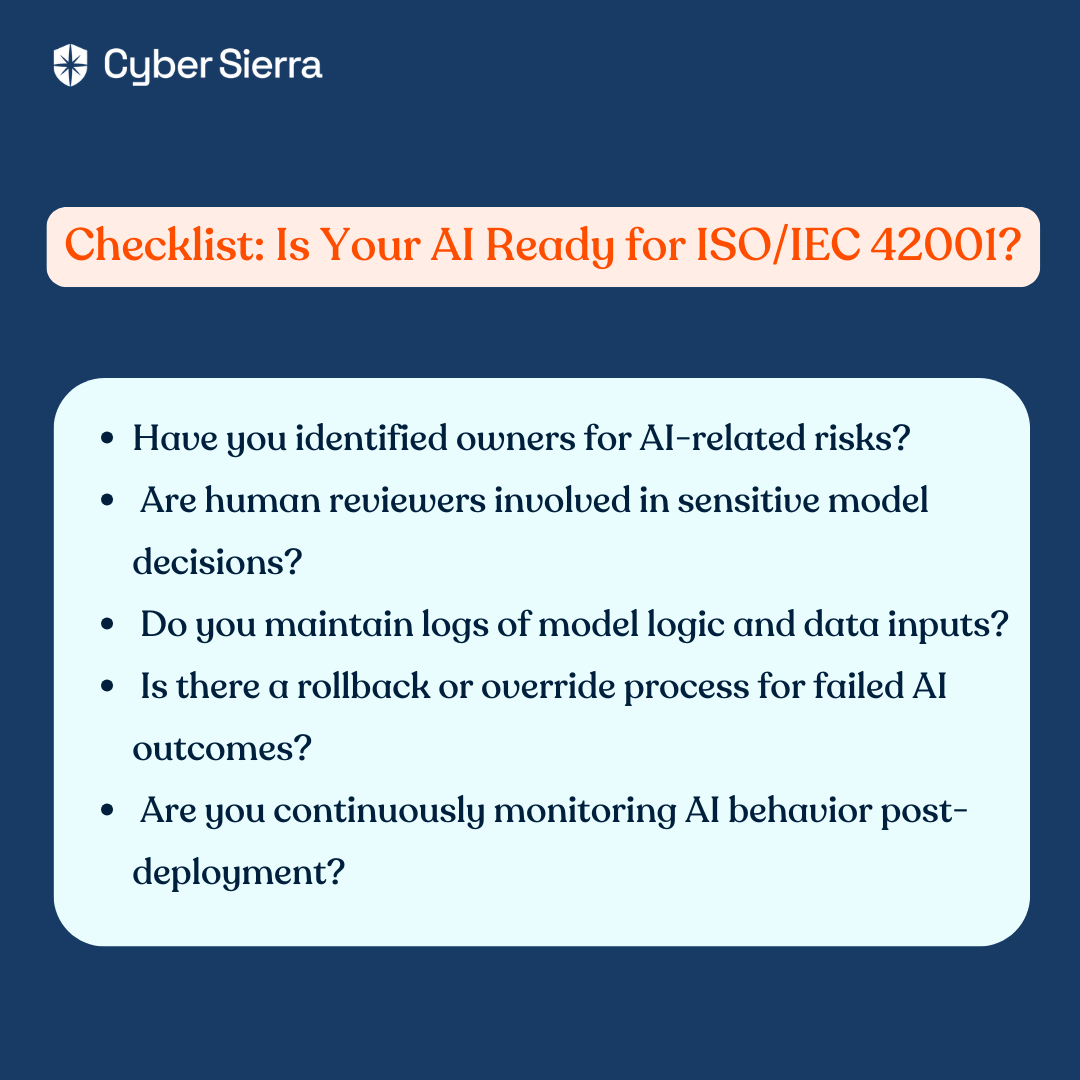
If you didn’t check all five, it might be time to take action.
Schedule a discovery call to see where your current AI stack stands and how Cyber Sierra can close the gaps.
Conclusion: Preparing for an AI-Governed Future
ISO/IEC 42001 isn’t just another compliance checkbox—it’s a shift toward more responsible, transparent, and risk-aware AI systems. And as governments, customers, and stakeholders demand greater assurance, aligning with this standard will move from optional to essential.
By implementing this standard, organizations can:
- Build trust with stakeholders through demonstrated commitment to responsible AI
- Prepare for emerging regulatory requirements
- Create competitive differentiation in an increasingly AI-driven marketplace
- Reduce risks associated with AI deployment
While the implementation journey requires investment, the alternative—operating AI systems without robust governance—presents far greater risks in terms of potential regulatory penalties, reputational damage, and operational failures. Hope you make the right choice.
