Digital Operational Resilience Act (DORA) Explained: What Financial Institutions Need to Know


Join thousands of professionals and get the latest insight on Compliance & Cybersecurity.
You've just received another email about upcoming regulatory compliance requirements—this time it's DORA. Your team is already stretched thin managing existing frameworks like GDPR, PCI DSS, and ISO 27001. The thought of implementing yet another set of complex regulations by January 2025 feels overwhelming, especially when you're unsure how it differs from your current compliance efforts.
Sound familiar? You're not alone.
The Digital Operational Resilience Act (DORA) represents one of the European Union's most significant regulatory shifts for the financial sector in recent years. While its intentions are sound—creating a more resilient financial ecosystem—many organizations are struggling with the practical implications of implementation.
What Exactly Is DORA?
DORA is a comprehensive EU regulation designed to strengthen the digital operational resilience of the financial sector. Rather than focusing solely on data protection (like GDPR) or payment security (like PCI DSS), DORA takes a holistic approach to ICT risk management across financial services.
At its core, DORA aims to:
- Ensure financial entities can withstand, respond to, and recover from ICT-related disruptions
- Harmonize digital resilience requirements across the EU, replacing fragmented national regulations
- Establish oversight frameworks for critical third-party ICT service providers
- Create a consistent incident reporting mechanism
Unlike previous regulations that treated cybersecurity as a technical issue, DORA positions digital resilience as a fundamental organizational capability that requires board-level attention and cultural adoption.
Who Does DORA Apply To?
DORA casts a wide net, covering virtually all regulated financial entities operating within the EU, including:
- Banks and credit institutions
- Payment service providers
- Electronic money institutions
- Investment firms and trading venues
- Insurance and reinsurance companies
- Credit rating agencies
- Crypto-asset service providers
- Central securities depositories
- Central counterparties
Importantly, DORA also extends to critical third-party ICT service providers to these entities, regardless of where they're headquartered. This means cloud providers, software vendors, and other technology partners serving EU financial institutions will also fall under DORA's oversight.
The 5 Key Pillars of DORA Compliance
DORA is built around five fundamental pillars that organizations must address to achieve compliance:
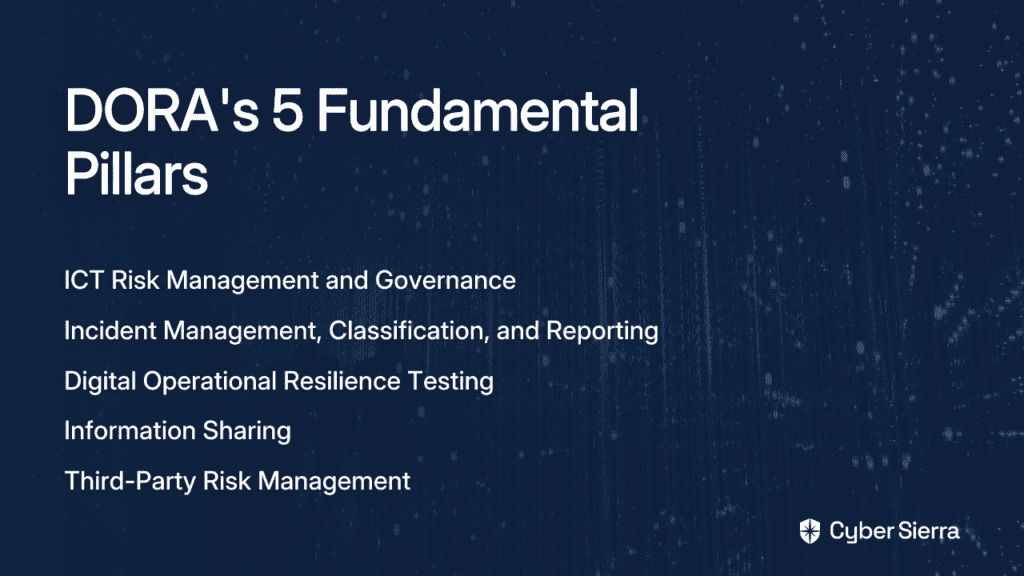
1. ICT Risk Management and Governance
The foundation of DORA is establishing a comprehensive ICT risk management framework that is fully integrated into your overall risk management systems. This means:
- The management body must take explicit responsibility for defining, approving, and overseeing the ICT risk management framework
- Regular assessment and documentation of all ICT systems and their dependencies
- Risk mapping and documentation of critical ICT assets
- Implementation of security strategies, policies, and procedures
- Adoption of sound security practices including vulnerability management, network segmentation, and encryption
As one frustrated compliance manager shared on Reddit: "Following stupid rules only based on compliancy (reporting) which keeps us away from implementing actual security." This highlights a common challenge—balancing documentation requirements with practical security implementation.
2. Incident Management, Classification, and Reporting
DORA mandates the establishment of robust management systems for monitoring, logging, and classifying ICT-related incidents. Key requirements include:
- Implementing processes to detect and monitor anomalous activities
- Establishing clear classification procedures for ICT incidents
- Reporting major incidents to competent authorities within strict timeframes:
- Initial notification: within 24 hours of detection
- Intermediate report: within 72 hours
- Final report: within one month
One CISO noted on an industry forum: "Adapting to the incident reporting requirements seems complicated and time-consuming. We're working to integrate automated detection and classification to streamline compliance without adding manual overhead."
3. Digital Operational Resilience Testing
Regular testing of ICT systems is a cornerstone of DORA compliance. The regulation requires:
- Basic testing of all ICT systems at least annually
- Advanced testing, including penetration testing, for critical entities at least every three years
- Addressing vulnerabilities discovered during testing
- Testing the effectiveness of backup arrangements and recovery procedures
A key pain point reported by organizations is uncertainty around third-party testing: "One thing we are not clear on is whether we will be required to either allow clients to perform a vulnerability assessment/penetration test on our service, or whether we may have to share with them results from our vendor."
4. Information Sharing
DORA encourages the voluntary sharing of cyber threat information among financial entities to strengthen the sector's collective resilience. This includes:
- Participating in information-sharing arrangements with trusted counterparts
- Exchanging cyber threat intelligence and indicators of compromise
- Contributing to industry-wide defense mechanisms
While information sharing is largely voluntary under DORA, participating can help organizations stay ahead of emerging threats and demonstrate a commitment to proactive security.
5. Third-Party Risk Management
Perhaps the most extensive new requirement under DORA is the comprehensive oversight of ICT third-party providers. Financial entities must:
- Maintain a register of all contractual arrangements with ICT third-party service providers
- Assess the risk of these arrangements before contracting and periodically thereafter
- Ensure contracts include comprehensive provisions related to security, data protection, audit rights, and exit strategies
- Implement ongoing monitoring of third-party compliance
- Develop exit strategies for critical service arrangements
As one compliance professional noted: "We lack clarity on the specific implications of vendor oversight in our operations. With hundreds of vendors, the practicality of implementing such extensive oversight is daunting."
DORA Compliance Timeline and Key Dates
DORA entered into force on January 16, 2023, with a two-year implementation period. All organizations within scope must be fully compliant by January 17, 2025.
Here's a breakdown of the key dates and implementation timelines:
- January 16, 2023: DORA entered into force
- Throughout 2023-2024: Development of technical standards and implementation guidelines
- January 17, 2025: Compliance deadline for all organizations
- 2025 onwards: Ongoing compliance monitoring and enforcement
Many organizations have expressed concern about the timeline, particularly given that some aspects of the regulation are still being clarified: "European Commission is even still discussing some parts of DORA, yet we would need to comply by the 17th of January."
Common Challenges in DORA Implementation
Based on industry feedback and discussions, several key challenges have emerged as organizations prepare for DORA compliance:
1. Overwhelming Requirements
The comprehensive nature of DORA means organizations must review and potentially overhaul multiple aspects of their operations simultaneously. With penalties for non-compliance potentially reaching up to 2% of total annual turnover, the stakes are high.
"DORA's requirements are overwhelming and can feel like a burden on our existing processes," shared one IT risk manager.
2. Integration with Existing Frameworks
Many organizations already comply with frameworks like ISO 27001, NIST, or industry-specific regulations. A common concern is how to efficiently integrate DORA requirements without duplicating efforts.
"We're unsure how to integrate DORA requirements effectively into our existing IT strategies," noted a security professional on Reddit.
3. Technical Implementation Challenges
DORA includes specific technical requirements that may be challenging to implement, particularly for smaller organizations.
"There are many technical challenging requirements like encryption of data in use or automatic isolation of ICT assets when infected, but nobody talks about these," pointed out one cybersecurity specialist.
4. Documentation and Strategy Development
Creating the necessary documentation to demonstrate compliance is a significant undertaking. As one compliance manager asked: "How to write digital operational resilience strategy, and other documents?"
5. Cultural Shift from Compliance to Resilience
Perhaps the most profound challenge is the mindset shift required. As one industry expert observed: "The challenge will be moving from box-ticking compliance to building a resilient-by-design mindset across the enterprise."
Best Practices for Achieving DORA Compliance
Based on early adopters and industry experts, here are key strategies for successfully navigating DORA implementation:

1. Conduct a Gap Assessment
Start by understanding where your organization stands today relative to DORA requirements. This assessment should:
- Map existing controls against DORA requirements
- Identify gaps and prioritize remediation efforts
- Determine resource and budget requirements
- Establish a realistic implementation roadmap
2. Leverage Existing Frameworks
Rather than building compliance from scratch, look for alignment with frameworks you already use. For example:
- ISO 27001 provides a solid foundation for many ICT risk management requirements
- NIST Cybersecurity Framework offers comprehensive guidance on incident response
- Cloud Security Alliance controls can support third-party oversight requirements
3. Prioritize Critical Services First
Focus initial efforts on your most critical services and their supporting ICT systems. This approach allows you to:
- Demonstrate progress on high-risk areas quickly
- Build implementation experience before tackling less critical systems
- Allocate resources efficiently
4. Engage Legal and Compliance Teams Early
As one practitioner advised: "Engage with legal and compliance teams early in the process to understand the implications of DORA and ensure your IT strategies are compliant from the outset."
This collaboration helps ensure technical implementations meet legal requirements and can prevent costly rework.
5. Automate Where Possible
Manual processes for monitoring, testing, and reporting are likely to be unsustainable under DORA. Consider:
- Implementing automated control monitoring solutions
- Deploying tools that streamline incident detection and classification
- Utilizing GRC platforms that can track compliance across multiple frameworks
6. Develop a Third-Party Risk Management Program
Given DORA's emphasis on third-party oversight, developing a comprehensive program is essential:
- Create a complete inventory of ICT service providers
- Implement risk-based assessment procedures
- Develop standardized contractual clauses
- Establish ongoing monitoring mechanisms
7. Foster a Culture of Resilience
As one expert noted: "DORA pushes us to view digital resilience not as a technical silo, but as a strategic and cultural capability."
To build this culture:
- Secure executive sponsorship and board-level engagement
- Provide training on resilience concepts throughout the organization
- Incorporate resilience considerations into system design and business processes
- Run regular tabletop exercises to test response capabilities
How Cyber Sierra Can Support Your DORA Compliance Journey
While DORA compliance ultimately remains the responsibility of each financial institution, technology solutions can significantly streamline implementation. Cyber Sierra's integrated platform offers several capabilities specifically aligned with DORA requirements:
Continuous Control Monitoring
Cyber Sierra's Continuous Control Monitoring (CCM) module directly addresses DORA's requirements for ongoing visibility into security controls. By providing near real-time updates on control effectiveness, it helps organizations:
- Build a centralized controls repository that maps to DORA requirements
- Automate control testing and validation
- Detect exceptions and anomalies that could indicate security weaknesses
- Manage controls across multiple compliance frameworks simultaneously
This capability is particularly valuable for organizations struggling with the "overwhelming requirements" of DORA, as it transforms what would otherwise be manual checks into automated, continuous processes.
Third-Party Risk Management
DORA's extensive third-party oversight requirements align perfectly with Cyber Sierra's Third-Party Risk Management (TPRM) module, which helps organizations:
- Identify and assess key risks associated with ICT vendors
- Automate vendor assessments and risk management processes
- Provide near real-time visibility into vendor security compliance
- Prioritize vendor inventory based on risk levels
For organizations facing the challenge of "lack of clarity on the specific implications of vendor oversight," Cyber Sierra's TPRM module provides a structured approach to managing these requirements.
Governance, Risk & Compliance
Cyber Sierra's Governance, Risk & Compliance (GRC) module helps address the documentation and strategy challenges many organizations face with DORA:
- Automates data collection and risk assessments
- Ensures ongoing compliance through continuous control monitoring
- Generates comprehensive reports and maintains detailed audit trails
- Manages multiple compliance frameworks simultaneously
This is particularly valuable for organizations asking "How to write digital operational resilience strategy and other documents," as the platform provides templates and structures aligned with regulatory expectations.
Threat Intelligence and Testing
To support DORA's testing requirements, Cyber Sierra's Threat Intelligence capabilities include:
- Network vulnerability scanning
- Cloud infrastructure scanning for misconfigurations
- Comprehensive security scorecards for posture insights
- Vulnerability management through an outside-in scanning approach
These capabilities help address the "technical challenging requirements" of DORA by providing structured approaches to identifying and remediating vulnerabilities.
Conclusion: Beyond Compliance to True Resilience
While DORA presents significant implementation challenges, it also offers an opportunity to transform how financial institutions approach digital resilience. As one industry leader observed: "The challenge will be moving from box-ticking compliance to building a resilient-by-design mindset across the enterprise."
Successful organizations will view DORA not merely as a regulatory hurdle, but as a framework for building true operational resilience that can:
- Protect against increasingly sophisticated cyber threats
- Minimize service disruptions and their business impact
- Build customer trust through demonstrated resilience
- Create competitive advantage through superior risk management
By taking a strategic approach to DORA implementation—leveraging existing frameworks, prioritizing critical services, engaging stakeholders across the organization, and utilizing appropriate technology solutions—financial institutions can turn compliance into an opportunity for meaningful organizational improvement.
The countdown to January 2025 has begun. Is your organization prepared for the digital operational resilience journey ahead?