



Zero Trust Implementation in NIST: A CISO's Comprehensive Guide



Join thousands of professionals and get the latest insight on Compliance & Cybersecurity.
In today's rapidly evolving threat landscape, traditional perimeter-based security models have become increasingly inadequate. As a Chief Information Security Officer (CISO), you're likely facing mounting pressure to adapt your security strategy to address both external and internal threats. The National Institute of Standards and Technology (NIST) offers a robust framework for implementing Zero Trust Architecture (ZTA) through Special Publication 800-207, providing a blueprint for modern security architectures that assumes no implicit trust, regardless of location.
Understanding Zero Trust: Beyond the Marketing Hype
Zero Trust is not merely a buzzword or product—it's a strategic approach to cybersecurity that eliminates implicit trust and continuously validates every stage of digital interaction. But what does this mean in practice?
As one security professional aptly noted, "Just because something is on the internal network does not mean it can be inherently trusted." This fundamental shift in thinking challenges the conventional wisdom that once relied heavily on perimeter defenses.
Zero Trust operates on the principle that threats exist both inside and outside traditional network boundaries. Rather than assuming that everything behind the corporate firewall is safe, Zero Trust requires verification for anyone trying to access resources, regardless of their location.
NIST's Approach to Zero Trust Architecture
NIST Special Publication 800-207 provides the authoritative guidance on Zero Trust Architecture, defining it as an approach where:
- No implicit trust is granted based on network location or asset ownership
- Authentication and authorization are required before establishing access
- All resource access is determined by dynamic policy, including the observable state of client identity, application, and the requesting asset
- All communication is secured regardless of network location
The publication outlines several core tenets that form the foundation of any successful Zero Trust implementation:
Core Tenets of Zero Trust According to NIST
- All data sources and computing services are considered resources - This includes networks, infrastructure, devices, APIs, and data.
- All communication is secured regardless of network location - Network location alone is not sufficient for determining trust. Communications must be encrypted and authenticated.
- Access to resources is granted on a per-session basis - Trust in the requester is evaluated continuously, not just at login.
- Access to resources is determined by dynamic policy - Policies incorporate multiple attributes including user identity, device health, service or workload, data classification, and anomalies.
- The enterprise monitors and measures the integrity and security posture of all owned and associated assets - Monitoring must be continuous and comprehensive.
- Resource authentication and authorization are dynamic and strictly enforced before access - This is a constant cycle of access, verification, and continuous validation.
- The enterprise collects as much information as possible about the current state of assets, network infrastructure, and communications - This information feeds into improving security posture.

Common Implementation Challenges
Many CISOs encounter significant challenges when implementing Zero Trust principles. Based on feedback from security professionals, several common concerns emerge:
Access Control and User Experience
"Won't this mess with how easily employees can get stuff done?" This question reflects a legitimate concern about the potential impact on productivity. Implementing strict verification can create friction for users accustomed to seamless access.
Solution: A phased approach is crucial. Begin with critical systems and gradually expand. Invest in technologies that balance security with usability, such as single sign-on (SSO) solutions that minimize authentication fatigue while maintaining security.
Understanding the NIST Framework
Security professionals often report: "My biggest problem: I find myself frequently questioning whether or not I actually comprehended what I just read and what the control is asking for."
The complexity of NIST documentation can be overwhelming, with controls that sometimes provide limited context for implementation.
Solution: Leverage interpretive guides and communities of practice. The Children's Guide to Zero Trust offers simplified explanations, while professional forums can provide practical insights from peers who have successfully navigated implementation.
Cloud Environment Challenges
"Cloud environments are dynamic, scalable, and often shared across multiple teams and services. Without robust security, they are vulnerable to misconfigurations, unauthorized access, and insider threats."
This observation highlights the unique challenges of implementing Zero Trust in cloud environments, where traditional network boundaries are even more fluid.
Solution: Implement cloud-specific Zero Trust controls including:
- Cloud workload protection platforms (CWPPs)
- Cloud access security brokers (CASBs)
- Identity and access management (IAM) with strong governance
- Continuous compliance monitoring
Practical Implementation Steps for Zero Trust
Following NIST guidelines, here's a pragmatic approach to implementing Zero Trust Architecture in your organization:
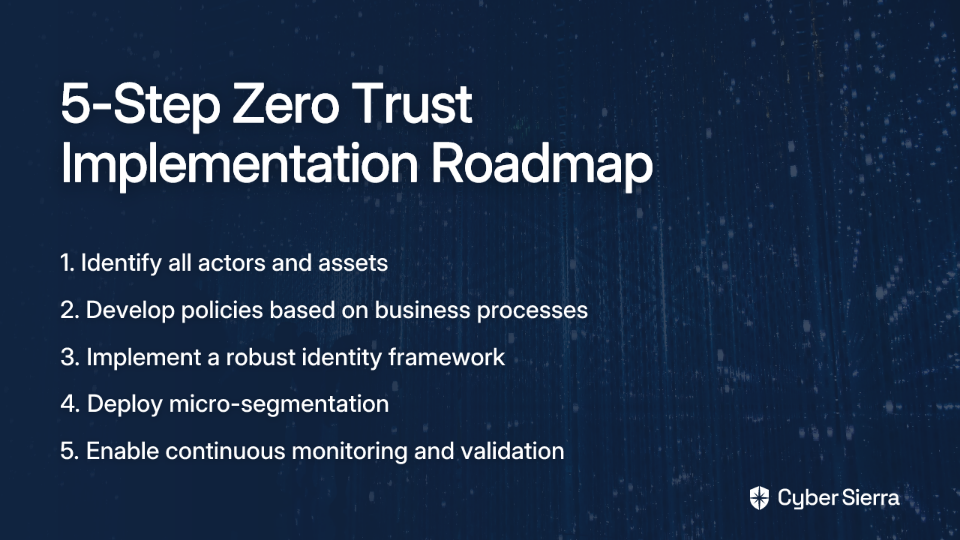
1. Identify Actors and Assets
Begin by conducting a comprehensive inventory of:
- Users and identities (both human and non-human)
- Devices (managed and unmanaged)
- Applications and services
- Data assets and their classification
- Network flows and dependencies
This inventory forms the foundation of your Zero Trust strategy by establishing what needs protection and verification.
2. Develop Policies Based on Business Processes
Create fine-grained policies that reflect:
- Who should access what resources
- Under what conditions access should be granted
- How access should be authenticated and authorized
- What level of monitoring is appropriate for different resources
These policies should be aligned with business objectives while enforcing security requirements.
3. Implement a Robust Identity Framework
Identity is the new perimeter in Zero Trust. Implement:
- Strong multi-factor authentication (MFA)
- Risk-based conditional access policies
- Just-in-time and just-enough access provisioning
- Continuous authentication throughout sessions
As one practitioner noted, "IP address is not an identity and is not a form of authentication." Modern Zero Trust approaches must move beyond network-based controls to focus on identity verification.
4. Deploy Micro-segmentation
Implement network segmentation that:
- Isolates critical assets
- Restricts lateral movement
- Enforces least-privilege access
- Provides granular visibility into east-west traffic
Micro-segmentation creates security boundaries around specific resources rather than relying on perimeter defenses.
5. Enable Continuous Monitoring and Validation
Establish systems for:
- Real-time visibility into all resource access attempts
- Continuous assessment of device security posture
- Behavioral analytics to detect anomalies
- Automated policy enforcement based on risk signals
This continuous validation approach transforms security from periodic assessment to constant vigilance.
How Cyber Sierra Can Support Your Zero Trust Journey
For organizations seeking to streamline their Zero Trust implementation, Cyber Sierra's platform offers several capabilities aligned with NIST's framework:

Continuous Control Monitoring
Cyber Sierra's Continuous Control Monitoring (CCM) module directly addresses a key challenge in Zero Trust implementation by providing real-time visibility into security controls. This capability:
- Centralizes your control repository with near real-time updates
- Delivers actionable risk intelligence for data-driven remediation
- Automates control testing against NIST standards
- Detects exceptions and anomalies that could indicate compromise
This continuous monitoring approach is essential for the dynamic policy enforcement required by Zero Trust.
Third-Party Risk Management
Zero Trust principles must extend to your supply chain. Cyber Sierra's Third-Party Risk Management (TPRM) module enables:
- Continuous monitoring of vendor security posture
- Automated assessment of third-party compliance with Zero Trust principles
- Prioritization of vendor risks based on access levels and data sensitivity
- Streamlined onboarding and ongoing verification of partners
This capability addresses the often-overlooked extension of Zero Trust to third parties with access to your systems and data.
Conclusion: Beyond Implementation to Maturity
Implementing Zero Trust is not a one-time project but an evolutionary journey. NIST's SP 800-207 provides the architectural foundation, but successful implementation requires continuous refinement and adaptation.
As you progress in your Zero Trust journey:
- Start with critical assets - Identify your crown jewels and implement Zero Trust controls around them first.
- Measure and communicate success - Track improvements in security posture and communicate wins to stakeholders.
- Iterate and expand - Gradually extend Zero Trust principles across your environment.
- Maintain business alignment - Ensure security controls enhance rather than impede business operations.
By following NIST's guidance and leveraging appropriate technology solutions, your organization can build a security architecture that meets today's challenges while remaining adaptable for tomorrow's threats.
Remember that Zero Trust is ultimately about shifting from "trust but verify" to "never trust, always verify" - a principle that, when properly implemented, can significantly reduce your attack surface and enhance your organization's security posture in an increasingly complex threat landscape.
Frequently Asked Questions (FAQ)
What is Zero Trust in simple terms?
Zero Trust is a cybersecurity strategy that assumes no user or device should be inherently trusted, regardless of whether they are inside or outside the corporate network. It requires continuous verification of every access request. This means that instead of relying on traditional perimeter defenses like firewalls, Zero Trust scrutinizes every interaction, demanding authentication and authorization for each resource access attempt based on dynamic policies.
Why is NIST SP 800-207 important for implementing Zero Trust?
NIST Special Publication 800-207 is important because it provides an authoritative and standardized framework for Zero Trust Architecture (ZTA). It offers a common language, core tenets, and logical components for designing and implementing ZTA, helping organizations move beyond marketing hype to a structured approach. This guidance is crucial for CISOs aiming to build a robust and consistent security posture based on verified principles.
What are the main challenges when adopting a Zero Trust model?
The main challenges include potential impacts on user experience due to increased verification, the complexity of understanding and applying frameworks like NIST SP 800-207, and adapting Zero Trust principles to dynamic cloud environments. Organizations often struggle with balancing security with productivity, interpreting detailed guidelines, and ensuring comprehensive visibility and control in distributed systems.
How can Zero Trust impact employee productivity?
Zero Trust can initially impact employee productivity if implementation is not carefully planned, as stricter verification processes might seem cumbersome. However, this can be mitigated by adopting a phased rollout, starting with critical systems, and investing in user-friendly technologies like Single Sign-On (SSO) and adaptive multi-factor authentication (MFA). The goal is to make security as seamless as possible while maintaining a strong posture.
What is the recommended first step for implementing Zero Trust according to NIST guidelines?
The recommended first step is to identify all actors (users, systems) and assets within your organization. This involves creating a comprehensive inventory of users, devices, applications, services, and data, along with understanding their network flows and dependencies. This foundational step is crucial for defining the scope of your Zero Trust strategy and developing appropriate access policies.
Is Zero Trust a specific product or technology?
No, Zero Trust is not a single product or technology that can be purchased and deployed. It is a strategic approach and a security framework that involves a combination of principles, processes, and various technologies working together. These technologies can include identity and access management (IAM), multi-factor authentication (MFA), micro-segmentation, endpoint security, and continuous monitoring tools, all configured to enforce Zero Trust principles.
How does Zero Trust apply to cloud environments?
Zero Trust is particularly crucial for cloud environments because they are inherently dynamic, often involve shared responsibility, and lack traditional network perimeters. Applying Zero Trust in the cloud involves implementing strong identity and access management (IAM), using cloud workload protection platforms (CWPPs), cloud access security brokers (CASBs), enforcing micro-segmentation for cloud resources, and ensuring continuous monitoring and compliance for all cloud assets and communications.
For more information on implementing Zero Trust architecture following NIST guidelines, refer to the official NIST Special Publication 800-207.
