



Top Compliance Automation Tools for CISOs Managing Multi-Framework Audits in 2025

Join thousands of professionals and get the latest insight on Compliance & Cybersecurity.
You've been there—the dreaded "audit season" approaches, and suddenly your team is scrambling to gather evidence across multiple compliance frameworks. Spreadsheets multiply like rabbits. Your inbox overflows with frantic requests. That security engineer you can't afford to lose is muttering about updating their resume.
"With lean teams, gathering evidence is tedious and time-consuming," reports one security leader on Reddit. Another laments, "Preparation for audits is labor-intensive, and the communication with auditors can be a bottleneck."
Welcome to the multi-framework compliance challenge of 2025, where organizations no longer operate under a single standard. You need SOC 2 for US clients, ISO 27001 for global markets, PCI DSS for payments, HIPAA for healthcare data—and the list keeps growing. Managing these frameworks in silos is no longer sustainable.
This article explores how modern compliance automation tools are transforming this landscape, helping CISOs move from reactive, point-in-time audit preparation to a state of continuous compliance readiness.
The Multi-Framework Challenge: Why Compliance is Now a 365-Day Job
The business imperatives driving multi-framework compliance are clear:
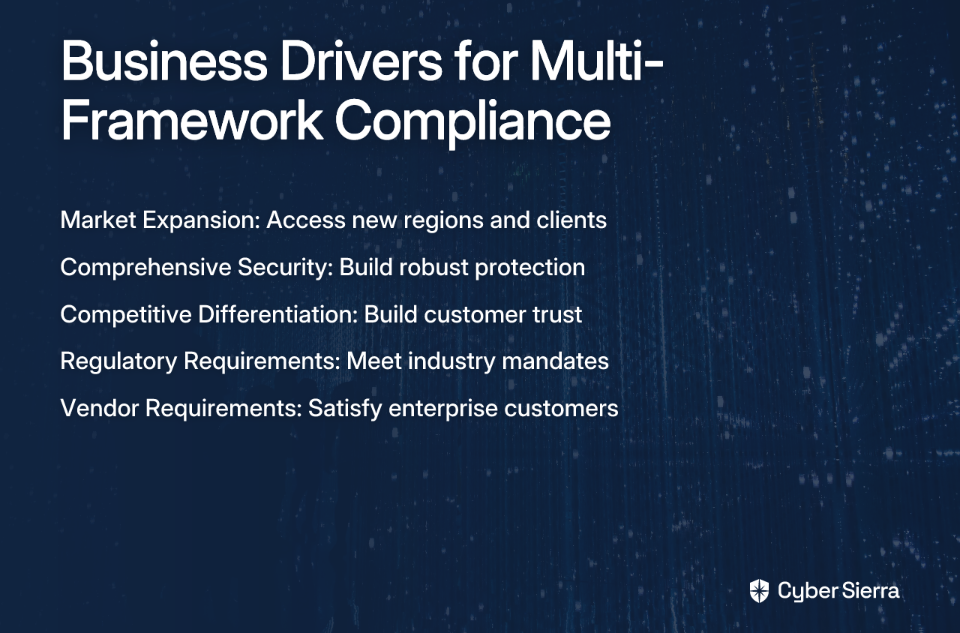
Market Expansion: Different regions and clients demand different certifications. Having multiple frameworks like SOC 2 and ISO 27001 removes regulatory barriers to entry and opens new market opportunities.
Comprehensive Security: No single framework covers all security aspects. By implementing controls across multiple standards, you build a more robust and resilient security program.
Competitive Differentiation: Compliance is a powerful trust signal to customers. According to research, 71% of consumers would stop doing business with a company that mishandled their data.
The traditional approach to managing these frameworks—manual evidence collection, spreadsheet tracking, and siloed processes—comes with significant costs:
Redundant Efforts: Manually collecting evidence for SOC 2, then repeating similar processes for ISO 27001, wastes precious resources.
Resource Drain: This approach consumes valuable time from security, engineering, and IT teams who could be focused on proactive security initiatives.
Point-in-Time Weakness: Manual audits provide a snapshot that is outdated the moment it's completed, offering no real-time assurance.
The good news? Integrated compliance platforms can cut down evidence requests by 60% and reduce audit time by 67% by eliminating this redundancy.
The CISO's Checklist: 5 Must-Have Capabilities in a Modern Compliance Automation Platform
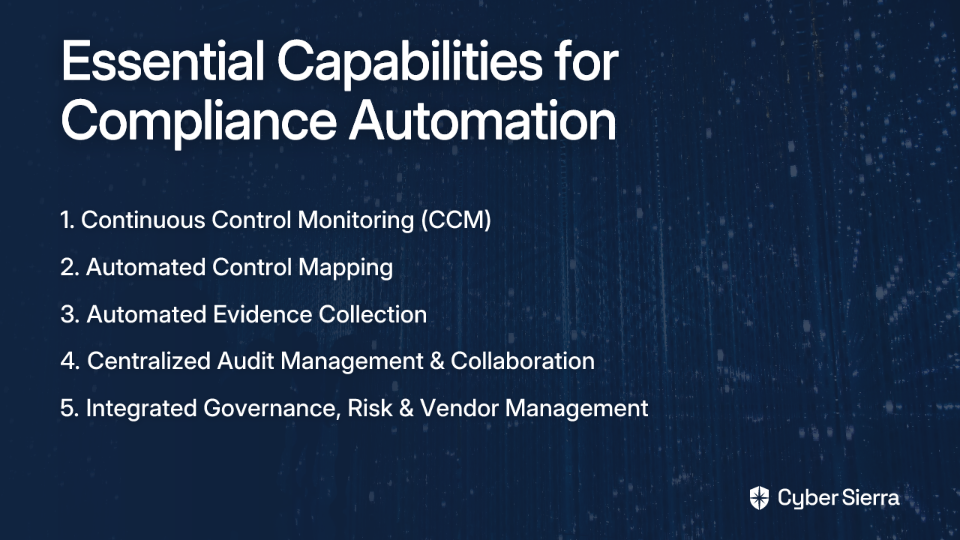
Before diving into specific tools, let's outline the essential capabilities that should be on every CISO's checklist when evaluating compliance automation solutions.
1. Continuous Control Monitoring (CCM)
What it is: The automation of testing and monitoring security controls to validate their effectiveness in near real-time.
Why it matters: CCM provides proactive risk management, moving security from periodic checks to continuous assurance. This is the core engine that powers modern compliance.
As one security leader put it, "We went from spending 2-3 days every month gathering evidence to maybe 30 minutes" after implementing continuous monitoring.
2. Automated Control Mapping
What it is: The ability to map a single control or piece of evidence to multiple requirements across different frameworks. For example, one MFA policy can satisfy controls in NIST CSF, ISO 27001, and PCI DSS simultaneously.
Why it matters: This directly combats the "redundant efforts" pain point and is the key to efficiently managing multiple frameworks. Look for tools with pre-built templates for common pairings like SOC 2 + ISO 27001.
3. Automated Evidence Collection
What it is: Direct integrations with your tech stack (AWS, Azure, GCP, GitHub, Jira, HRIS systems) to automatically pull evidence of control implementation.
Why it matters: This is the #1 time-saver. Manual evidence gathering has consistently been cited as the most tedious aspect of compliance. Automation transforms this painful process from days of work into a background task.
4. Centralized Audit Management & Collaboration
What it is: A single portal to manage audit planning, evidence, documentation, and communication.
Why it matters: It addresses the user pain that "communication with auditors can be a bottleneck." Providing auditors with read-only access to a pre-organized evidence library dramatically streamlines the audit process.
5. Integrated Governance, Risk & Vendor Management
What it is: A platform that extends beyond compliance checklists to include comprehensive GRC, Third-Party Risk Management (TPRM), and policy management.
Why it matters: A CISO's job is to manage risk, not just pass audits. A tool that integrates these functions provides a holistic view of the organization's risk posture and helps avoid the "complexity of some TPRM tools leading to inefficiency" by unifying the process.
A Curated List: Top Compliance Automation Tools for 2025
Based on the capabilities above, here's our analysis of the leading compliance automation platforms for CISOs managing multi-framework audits in 2025:
Vanta
Key Features: Broad framework coverage (SOC 2, HIPAA, ISO 27001, PCI DSS), automated evidence collection, real-time monitoring.
Best for: Startups and tech companies looking for a fast, streamlined path to their first compliance certification, particularly SOC 2.
Why it stands out: Vanta excels at simplifying the initial compliance journey with an intuitive UI and extensive integration library that can quickly connect to most modern tech stacks.
Drata
Key Features: Strong focus on continuous monitoring, vendor compliance management, audit-ready documentation.
Best for: Organizations that want to embed compliance into their daily operations with a security-first, continuous monitoring approach.
Why it stands out: Drata has built a reputation for its robust continuous monitoring capabilities that give security teams real-time visibility into their compliance posture.
Secureframe
Key Features: AI-powered automation, personnel and vendor management, automated compliance for numerous frameworks.
Best for: Companies seeking an AI-driven approach to automate evidence collection and streamline audit readiness across a wide variety of standards.
Why it stands out: Secureframe's AI capabilities help predict compliance gaps and automate remediation workflows, reducing the manual intervention needed.
Hyperproof
Key Features: Comprehensive compliance operations, centralized evidence management, real-time audit preparation, strong on continuous control monitoring.
Best for: Mature organizations that need a robust platform to manage complex compliance operations and integrate them tightly with their risk management program.
Why it stands out: Hyperproof offers deeper customization for organizations with complex compliance needs and mature security programs.
Thoropass
Key Features: Focus on unified controls and multi-framework action items to reduce redundant work. Claims to automate up to 90% of compliance tasks.
Best for: Companies operating on AWS who want to deeply integrate their compliance management with their cloud infrastructure.
Why it stands out: Thoropass optimizes the "one audit, multiple frameworks" approach, enabling organizations to significantly reduce audit fatigue.
Cyber Sierra
Key Features: An AI-enabled integrated cybersecurity platform combining Continuous Control Monitoring (CCM), Governance, Risk & Compliance (GRC), Third-Party Risk Management (TPRM), Threat Intelligence, and Employee Training in one solution.
Best for: CISOs and security leaders who want to move beyond standalone compliance tools to a unified platform that provides a single source of truth for their entire security program.
Why it stands out: Cyber Sierra's platform strength lies in its deep integration. Findings from its Threat Intelligence module automatically inform risk assessments in the GRC module, while vendor security posture is continuously tracked in the TPRM module, providing live evidence for compliance. This integrated approach helps organizations manage controls across multiple frameworks like SOC 2, ISO 27001, GDPR, and HIPAA from a single dashboard.
Beyond the Purchase: Best Practices for Maximizing Your Compliance Automation Investment
Selecting the right tool is only half the battle. Here's how to ensure success with your compliance automation initiative:
Embrace Control Mapping First: Before automating, consolidate your controls. A great tool won't fix a chaotic process. Map your controls across frameworks to identify commonalities and reduce redundant work.
Set Realistic Expectations: Tools are not a silver bullet. As one Reddit user noted, they "can be expensive and require time for configuration and ongoing maintenance." The value is in the long-term efficiency gain, not instant, effort-free compliance.
Integrate Compliance with Risk Management: Use the data from your tool to have strategic conversations about risk, not just to check boxes. This elevates compliance from a cost center to a business enabler.
Secure Management Buy-In: Use efficiency metrics (e.g., "automating up to 90% of tasks") to get leadership engaged. This directly counters the challenge that a "lack of engagement and understanding from management can greatly hinder compliance efforts."
Conclusion: From Audit-Ready to Always-Ready
The evolution of compliance automation is shifting the conversation from "passing the audit" to building a resilient, continuously monitored, and verifiable security program.
By selecting a platform with the five key capabilities outlined in this article, CISOs can reduce manual toil, accelerate audit cycles, strengthen security posture, and unlock business growth through streamlined compliance.
For those seeking to unify their GRC, risk, and security operations, an integrated platform like Cyber Sierra provides a path to move beyond siloed tools and achieve a comprehensive, real-time view of their security posture.
The future belongs to organizations that are not just audit-ready, but always-ready—where compliance becomes a continuous, automated background process rather than a periodic fire drill.
Frequently Asked Questions
What is multi-framework compliance?
Multi-framework compliance is the process of adhering to the requirements of multiple security and privacy standards (like SOC 2, ISO 27001, and PCI DSS) simultaneously. This approach is necessary for organizations that operate in different regions, serve diverse industries, or want to build a comprehensive security program. Instead of managing each framework in a separate silo, modern compliance strategies focus on mapping overlapping controls to streamline evidence collection and auditing.
How do compliance automation tools save time and reduce costs?
Compliance automation tools save time and reduce costs primarily by eliminating redundant work and manual evidence collection. They achieve this through features like automated control mapping, where one piece of evidence can satisfy multiple framework requirements, and direct integrations with your tech stack (e.g., AWS, GitHub) to automatically gather proof of compliance. This can reduce audit preparation time from weeks to hours and free up valuable engineering resources.
What is the difference between continuous compliance and traditional audits?
The key difference is that continuous compliance provides real-time, ongoing assurance of your security posture, whereas traditional audits offer a static, point-in-time snapshot. Traditional audits verify compliance at a specific moment, which can become outdated quickly. Continuous compliance, powered by Continuous Control Monitoring (CCM), constantly checks that your security controls are working as intended. This shifts the process from a periodic, stressful "fire drill" to an "always-ready" state of audit preparedness.
What are the most critical features to look for in a compliance automation platform?
The most critical features are Continuous Control Monitoring (CCM), automated control mapping across frameworks, automated evidence collection through integrations, and a centralized portal for audit management. CCM ensures your controls are always working. Control mapping eliminates redundant effort for multiple audits. Automated evidence collection is the biggest time-saver. A centralized portal streamlines collaboration with auditors. Look for these core capabilities to ensure the tool addresses the primary pain points of manual compliance.
When should a startup invest in a compliance automation tool?
A startup should invest in a compliance automation tool as soon as it begins pursuing its first major compliance certification, such as SOC 2 or ISO 27001. Starting early allows you to build security and compliance into your processes from the ground up, rather than retrofitting them later, which is far more costly and difficult. These tools are especially valuable for lean teams, as they automate the manual work that would otherwise consume significant engineering and operational resources needed for growth.
Can a compliance tool replace my security team?
No, a compliance automation tool cannot replace a security team; it acts as a force multiplier that empowers them. The tool automates the repetitive, manual tasks of evidence gathering and monitoring, freeing your security experts to focus on higher-value strategic work like risk management, threat hunting, and security architecture. It handles the "what" (are we compliant?), so your team can focus on the "why" (are we secure?) and the "how" (how can we improve?).
