Top Audit Trends for 2026 Every CISO Should Know

Join thousands of professionals and get the latest insight on Compliance & Cybersecurity.
Summary
- By 2026, security audits will shift from periodic, manual assessments to a continuous, automated process, demanding real-time security validation instead of point-in-time compliance.
- With nearly half of data breaches linked to third parties, future audits will place hyper-scrutiny on continuous vendor risk monitoring, moving beyond simple questionnaires.
- CISOs can prepare by implementing continuous control monitoring (CCM), automating compliance tasks, and integrating risk management across departments to build a proactive security posture.
- Platforms like Cybersierra's GRC suite help automate this transition by integrating continuous monitoring, TPRM, and compliance into a single, audit-ready solution.
For many CISOs, the phrase "audit season" triggers memories of tedious evidence gathering, endless spreadsheet updates, and long nights preparing for auditor questions. It's a process that pulls valuable resources away from critical security operations, leaving teams exhausted and frustrated.
But by 2026, the audit landscape will look dramatically different. The era of point-in-time, sample-based assessments is ending, replaced by a more dynamic, continuous, and intelligent approach to security validation.
This evolution isn't just a technical shift—it's a fundamental reimagining of how organizations demonstrate security effectiveness to auditors, regulators, and stakeholders. Forward-thinking CISOs who anticipate these changes won't just survive audits—they'll leverage them to build more resilient security programs while reducing the resource drain that plagues traditional approaches.
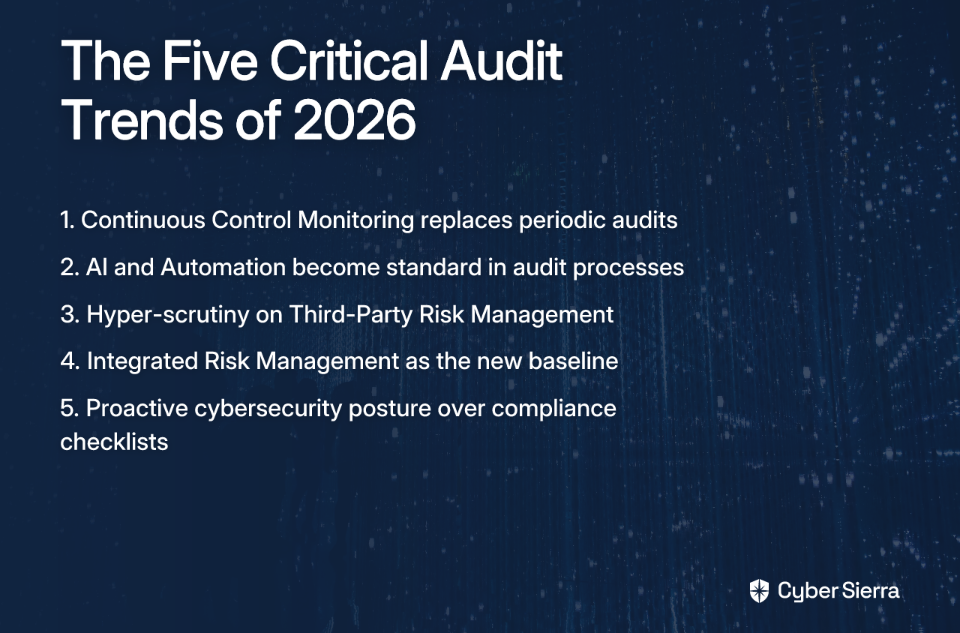
Let's explore the five critical audit trends that will define 2026 and how you can prepare your organization today.
Trend 1: The End of an Era: From Periodic Audits to Continuous Control Monitoring (CCM)
The days of the annual "audit scramble" are numbered. By 2026, continuous control monitoring (CCM) will become the baseline expectation rather than a leading-edge practice.
"For many security teams, the most painful part of an audit is evidence gathering," notes a Reddit user in a discussion on compliance automation. This pain point is precisely what CCM addresses by fundamentally changing how controls are validated.
Unlike traditional point-in-time assessments that evaluate a small sample of data, continuous monitoring analyzes 100% of relevant activity and provides real-time visibility into control effectiveness. This approach offers several advantages:
- Early Detection of Control Failures: Issues are identified and remediated when they occur, not months later during an audit.
- Reduced Subjectivity: Full data analysis reduces the reliance on small samples that might not represent actual performance.
- Audit Fatigue Elimination: Evidence collection becomes an automated, ongoing process rather than a periodic scramble.
- Cost Reduction: Distributing monitoring throughout the year significantly lowers overall compliance costs.
Real-world applications include monitoring employee data access patterns to prevent intellectual property theft during transitions, scrutinizing payment processes to detect fraud, and validating configuration management to prevent drift from secure baselines.
Platforms like Cyber Sierra's Continuous Control Monitoring module are enabling this transition by automating evidence collection across frameworks like NIST, ISO 27001, and PCI DSS, while maintaining a central repository of controls with near real-time updates.
Trend 2: The New Workforce: AI and Automation Become Standard in Audit Processes
By 2026, artificial intelligence and automation won't just be nice-to-have features in the audit world—they'll be essential components of every mature security program.
The integration of AI in audit processes is already transforming how organizations approach compliance. According to Wolters Kluwer, these technologies are streamlining data collection, analysis, and report generation, drastically reducing audit time while increasing accuracy.
Key developments in this space include:
- AI-Powered Risk Assessments: Advanced algorithms will analyze vast datasets to identify patterns, detect anomalies, and predict potential risks, allowing security teams to focus on high-risk areas.
- Robotic Process Automation (RPA): Repetitive, manual tasks like data entry and reconciliation will be fully automated, freeing skilled security professionals for strategic analysis.
- Natural Language Processing: AI will parse through policies, procedures, and regulatory requirements to identify compliance gaps automatically.
The efficiency gains are substantial. In one case study highlighted by Wolters Kluwer, integrated cloud-based solutions reduced audit review time by 50%. This kind of improvement directly addresses the resource constraints many security teams face.
For CISOs struggling with lean teams and budget limitations, platforms like Cyber Sierra's Governance, Risk & Compliance solution can automate data collection, risk assessments, and reporting across multiple frameworks (SOC2, ISO 27001, GDPR, HIPAA) from a single dashboard, significantly reducing manual effort and compliance fatigue.
Trend 3: The Supply Chain Spotlight: Hyper-Scrutiny on Third-Party Risk Management (TPRM)
If you thought vendor security assessments were demanding now, prepare for even more rigorous scrutiny by 2026. Third-party risk management will move from a peripheral concern to a central focus of security audits.
This shift is driven by sobering statistics: according to UpGuard, nearly half of data breaches are linked to third-party vendors and an average of 181 vendors are granted access to company environments weekly.
The challenges with current TPRM approaches are well-documented in user discussions:
"They don't tell you whether your third parties are doing code review or have an employee offboarding policy," notes one security professional in a Reddit thread on TPRM solutions. Another mentions that "many TPRM tools use the SIG questionnaire... which means your third parties have many questions to answer and you have many answers to evaluate."
By 2026, auditors will expect:
- Continuous Vendor Monitoring: Point-in-time assessments will be replaced by real-time visibility into vendor security postures.
- Validation Beyond Questionnaires: Organizations will need to verify vendor security claims with technical evidence.
- Automated Scaling: As vendor ecosystems grow, manual processes won't be feasible—automation will be essential.
One security professional highlighted the value of verification: "Super helpful to check if a vendor says they've patched X, you can see if that's reflected in their external exposure."
Modern TPRM solutions like Cyber Sierra's Third-Party Risk Management module are addressing these challenges by providing near real-time, 24/7 visibility into vendor security compliance, automatically prioritizing vendors based on risk levels, and streamlining assessment workflows.
Trend 4: Breaking Down Silos: Integrated Risk Management as the New Baseline
By 2026, siloed security functions will be a liability in audits. Regulators and auditors will expect to see integrated risk management practices that connect IT, legal, compliance, and business operations.
According to Becker, effective risk management requires a holistic view across departments. Organizations are shifting toward an integrated approach where audit processes align with broader GRC strategies.
Cloud-based platforms are critical enablers of this trend, supporting collaboration and reducing the risk of miscommunication between teams. This integrated approach addresses a key pain point identified in user research: "Communication with auditors can be a bottleneck in the audit process."
Unified GRC platforms provide a single source of truth across multiple security domains, helping CISOs communicate a consistent risk posture to the board, auditors, and other stakeholders. This capability will be especially valuable as audit requirements continue to expand in scope and complexity.
Trend 5: From Defense to Offense: Audits Demand Proactive Cybersecurity Posture
The final trend reshaping audits by 2026 is the shift from compliance checklists to demonstrated security effectiveness. According to auditing experts, future audits will prioritize evaluating how well security measures actually work in preventing, detecting, and responding to threats—not just whether they exist on paper.
This evolution is driven by increasing regulatory scrutiny around cybersecurity hygiene and a growing recognition that point-in-time compliance doesn't guarantee ongoing security.
Organizations will need to demonstrate:
- Proactive vulnerability management with continuous scanning
- Effective attack surface monitoring and management
- Regular security testing and validation
- Integrated threat intelligence
Tools like Cyber Sierra's Threat Intelligence module can help organizations stay ahead of this trend by conducting network and cloud infrastructure vulnerability scanning, providing a comprehensive security scorecard, and supporting proactive threat detection.
Preparing for the Future of Audits
The audit landscape of 2026 will be characterized by continuity, automation, integration, and proactive security validation. For CISOs, this evolution offers an opportunity to transform GRC from a periodic burden into a value-driving function that strengthens the organization's security posture.
Forward-thinking security leaders are already:
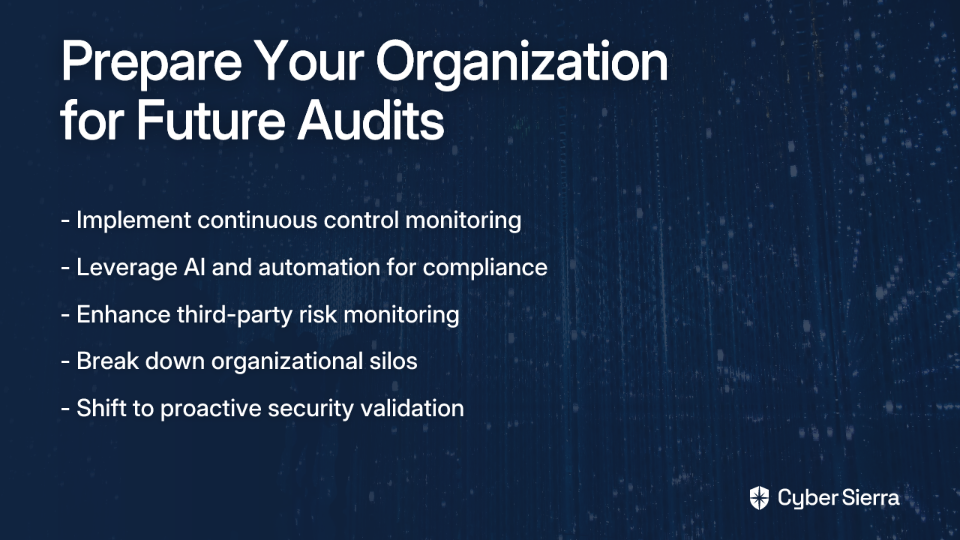
- Implementing continuous control monitoring to replace point-in-time assessments
- Leveraging AI and automation to reduce manual effort in compliance tasks
- Enhancing third-party risk management with continuous monitoring capabilities
- Breaking down silos between security, IT, and compliance functions
- Shifting from reactive to proactive security validation
By embracing these trends today, CISOs can not only prepare for the audits of tomorrow but also build more resilient security programs that deliver greater value to the business.
The tools and strategies are now available to transform GRC from a periodic pain into a continuous, value-driving function. Is your organization ready?
Frequently Asked Questions
What is Continuous Control Monitoring (CCM)?
Continuous Control Monitoring (CCM) is an automated approach that validates security controls in real-time, replacing traditional periodic, sample-based audits. Unlike point-in-time assessments that provide a snapshot, CCM analyzes 100% of relevant activity to provide continuous visibility into control effectiveness, enabling early detection of failures and eliminating last-minute evidence gathering.
How will AI and automation impact security audits by 2026?
By 2026, AI and automation will become standard in security audits by streamlining data collection, performing advanced risk analysis, and automating repetitive compliance tasks. These technologies allow audit processes to become more accurate and efficient, freeing skilled security professionals from manual work like data entry to focus on high-level strategic analysis and risk mitigation.
Why is third-party risk management (TPRM) receiving more audit scrutiny?
Third-party risk management is under hyper-scrutiny because a significant number of data breaches originate from third-party vendors, making the supply chain a critical area of organizational vulnerability. Auditors now expect organizations to move beyond simple questionnaires and implement continuous monitoring to actively verify the security posture of their vendors in real-time.
What is the difference between a proactive security posture and a compliance-focused approach?
A proactive security posture focuses on demonstrating real-world security effectiveness through continuous testing and threat detection, whereas a compliance-focused approach often prioritizes meeting the minimum requirements of a checklist at a specific point in time. Future audits will increasingly value verifiable proof that security measures can prevent, detect, and respond to threats, rather than just confirming that a policy or control exists on paper.
How can a CISO prepare their organization for the future of audits?
CISOs can prepare for future audits by creating a strategy that includes adopting Continuous Control Monitoring (CCM), leveraging automation tools for compliance, enhancing third-party risk programs, and shifting focus from periodic checks to proactive, continuous security validation. A practical first step is to automate evidence collection for a single, high-priority framework (like SOC 2 or ISO 27001) to build momentum and demonstrate the value of this modern approach.