



Top Supply Chain Cyber Risk Trends (2026) for Board-Level Briefings

Join thousands of professionals and get the latest insight on Compliance & Cybersecurity.
Summary
- Supply chain cyberattacks have surged over 400%, and new regulations (SEC, NIS2) are making boards directly accountable for managing third-party risks.
- Attackers are using AI to exploit vendor relationships, while traditional annual audits fail to keep pace, leaving significant security gaps.
- Organizations must adopt a proactive strategy by embedding security throughout the vendor lifecycle and shifting from periodic checks to continuous, automated monitoring.
- Automating vendor oversight with a Third-Party Risk Management (TPRM) platform provides the continuous visibility needed to manage these complex risks effectively.
The Supply Chain is No Longer a Black Box—It's Your Biggest Attack Surface
You've seen the warning signs: odd vendor issues, sudden downtime, weird email patterns, and those random invoices with slightly-off bank details that almost tricked your finance department. This digital supply chain has started to feel like a black hole, and the gravitational pull of potential risks is getting stronger by the day.
The stakes couldn't be higher. Supply chain-related cyberattacks have surged 431% since 2021, making them one of the most significant threats to modern enterprises. What was once considered an IT department problem has transformed into a fundamental component of business resilience requiring board-level attention.
This is no longer just about compliance checkboxes. New frameworks like the SEC's cyber disclosure rules and the EU's NIS2 directive place responsibility squarely on the board, not just the CISO, to oversee third-party cyber risks. As one supply chain professional put it, "a vendor's breach can halt your entire operation, damage your reputation, and lead to financial losses."
This briefing cuts through the noise to identify the top three supply chain cyber risk trends boards must understand for 2026, and provides a strategic playbook for building resilience in an increasingly interconnected business ecosystem.
The New Reality: Key Statistics Defining the Supply Chain Threat Landscape
Before diving into specific trends, let's establish the scale of the challenge with some sobering statistics:
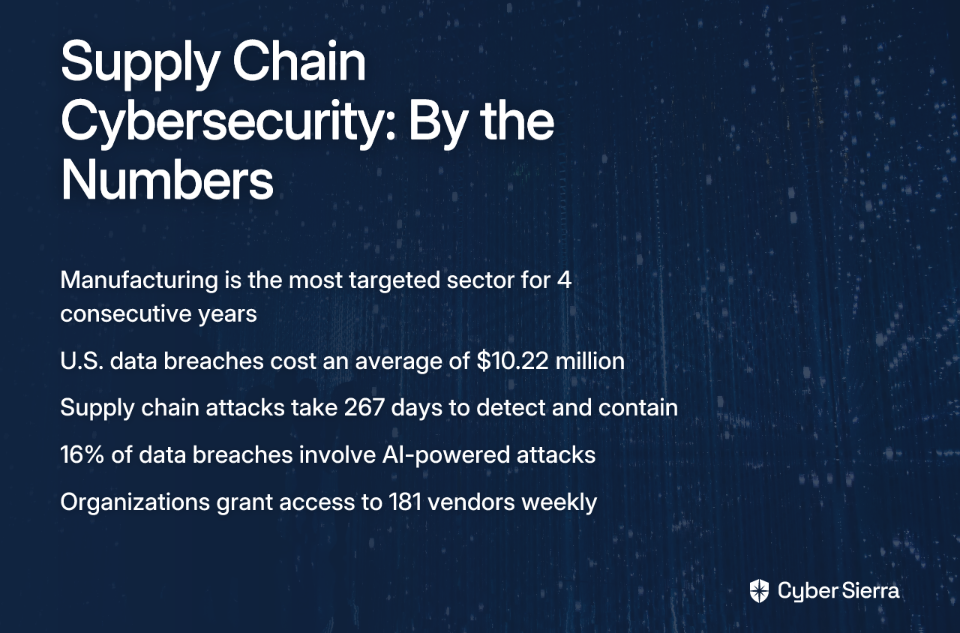
- Manufacturing has been the most targeted sector for cybercriminals for the fourth consecutive year, highlighting the risk for physical-digital hybrid industries.
- The average cost of a data breach in the U.S. has reached $10.22 million, with breaches originating in the supply chain often costing significantly more.
- Supply chain attacks take an average of 267 days to detect and contain. As one operations leader noted, "3 weeks?! Holy crap. That kinda delay would literally cost us a client or two."
These figures represent more than just financial risk—they signal an existential threat to business continuity and customer trust that boards cannot afford to ignore.
Trend 1: AI as a Double-Edged Sword—Sophisticated, AI-Powered Attacks
The rise of artificial intelligence has dramatically changed the cybersecurity landscape, particularly in supply chain contexts. Attackers now deploy AI to craft highly convincing deepfake impersonations and sophisticated phishing scams that even seasoned professionals struggle to detect.
In 2025, 16% of data breaches involved AI to execute these advanced attacks. As one supply chain manager lamented, "it feels like these scammers have a degree in 'how to be slightly off but believable.'"
The most concerning development is how hackers are exploiting trusted relationships within your supply chain. By compromising vendor accounts and systems, they gain the ability to move laterally through interconnected networks, making every partner a potential entry point. This means that traditional perimeter defenses are no longer sufficient—the threat is coming from inside your trusted partner ecosystem.
Trend 2: The Cascading Risk of Vendor Oversight Gaps
Many organizations lack visibility and control over their third- and fourth-party suppliers. This blind spot creates cascading risk that can quickly spiral out of control. "I'm kinda overwhelmed," admitted one supply chain professional. "Not even sure how deep we need to go for supplier risk stuff."
This uncertainty is compounded by what we call the awareness-action gap. A recent Gartner survey revealed a startling disconnect: 95% of organizations noticed red flags with their vendors, but only 50% escalated the issues for remediation. This is akin to "having smoke alarms but nobody knowing where the extinguisher is."
The scale of the challenge is daunting. Traditional, manual risk assessments simply cannot keep pace with modern supply chains. An average organization grants network access to 181 vendors weekly, making comprehensive oversight impossible without automation. When combined with limited visibility into fourth-party suppliers (your vendors' vendors), the risk exposure multiplies exponentially.
Trend 3: The Spotlight on the Board—Increased Accountability & Regulatory Scrutiny
Perhaps the most significant shift for 2026 is the intensifying regulatory focus on board-level accountability for supply chain cyber risks. Cybersecurity is no longer just an operational concern but a critical governance issue where board members are personally accountable.
Several key frameworks and regulations are driving this change:
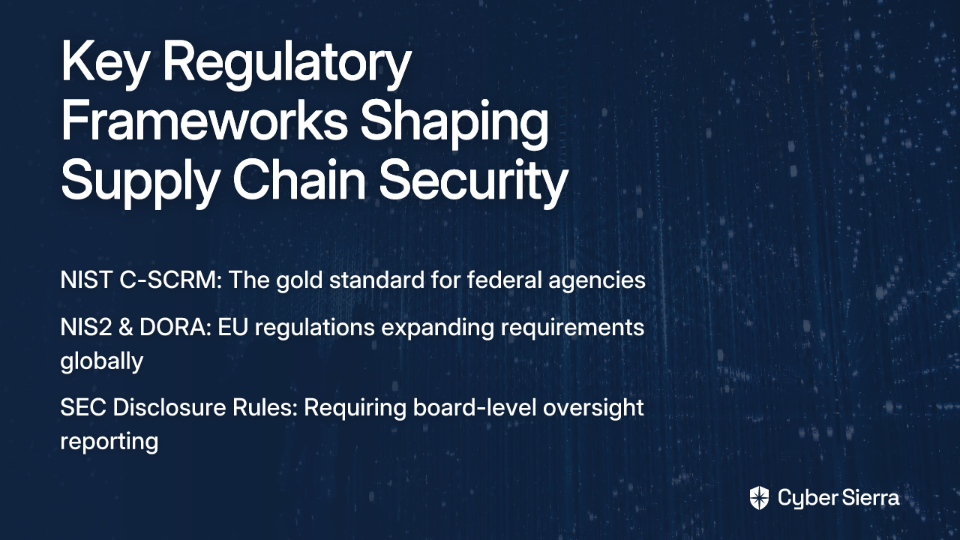
- NIST C-SCRM: Federal agencies are legally required to use NIST's Cybersecurity Supply Chain Risk Management (C-SCRM) standards, making frameworks like NIST SP 800-161r1 the gold standard. While not mandatory for private organizations, these frameworks are increasingly viewed as the benchmark for due diligence.
- NIS2 and DORA: The EU's NIS2 Directive and Digital Operational Resilience Act (DORA) are expanding supply chain security requirements globally, affecting any organization doing business in Europe. These regulations explicitly place responsibility on senior management and boards.
- SEC Disclosure Rules: New SEC rules require public companies to disclose material cybersecurity incidents and risk management oversight at the board level, creating potential shareholder liability for inadequate supply chain cyber governance.
The message is clear: boards that fail to actively oversee supply chain cyber risk may face regulatory penalties, shareholder lawsuits, and personal liability.
A Strategic Playbook for 2026: Fortifying Your Digital Supply Chain
In response to these evolving threats, boards must champion a more sophisticated approach to supply chain cyber resilience. Here's a strategic playbook with actionable recommendations:
Recommendation 1: Shift from Periodic Audits to Continuous, Automated Monitoring
Annual questionnaires and point-in-time assessments are no longer sufficient. A vendor's security posture can change overnight, and waiting months between reviews leaves dangerous blind spots.
Implement continuous risk monitoring and threat intelligence to gain real-time visibility into your entire vendor ecosystem. This approach provides early warning of emerging threats and helps prioritize remediation efforts based on actual risk rather than perceived risk.
Platforms like Cyber Sierra's Third-Party Risk Management (TPRM) can help organizations move beyond static assessments by providing "near real-time, 24/7 visibility into vendor security compliance." This automated approach helps scale oversight across hundreds or thousands of vendors while providing the continuous "vendor cyber health" monitoring that modern supply chains require.
Recommendation 2: Embed Cybersecurity into the Entire Vendor Lifecycle
Cybersecurity considerations must be woven into every stage of the vendor relationship—from selection to offboarding. As one supply chain professional suggested, there's a need for a "first date report card" for vendors that evaluates security posture alongside traditional criteria like cost and quality.
Here are key actions boards should champion:
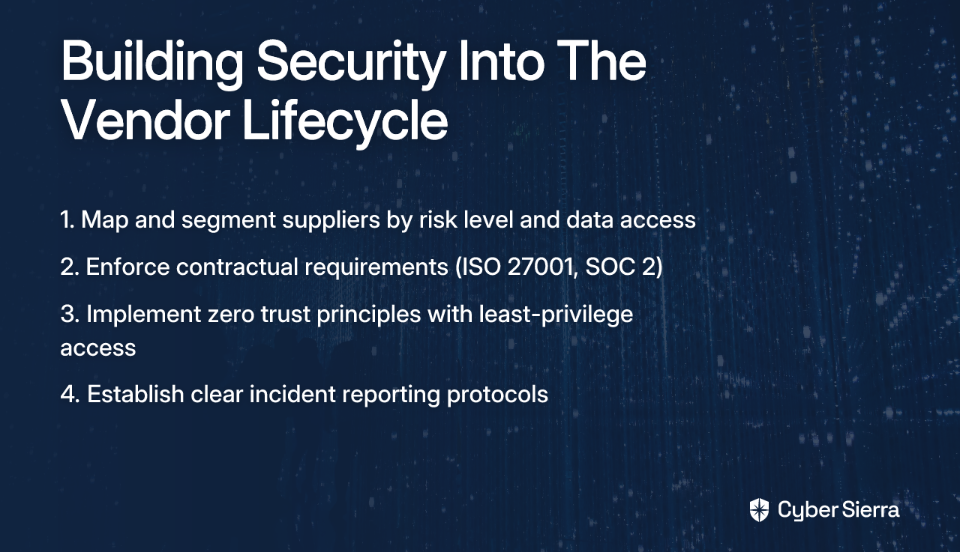
- Map and Segment Suppliers: Categorize vendors based on their level of data access and business criticality to focus resources on the highest-risk relationships. This allows for proportionate security requirements based on actual risk exposure.
- Enforce Contractual Requirements: Mandate compliance with standards like ISO 27001 or SOC 2 in vendor contracts. Include clauses for timely incident reporting and regular security assessments to establish clear expectations and remediation processes.
- Adopt Zero Trust Principles: Ensure vendors are granted least-privilege access, with ongoing verification rather than persistent trust. This minimizes the impact of a compromise by preventing lateral movement across your network.
Managing these complex requirements across hundreds of vendors is a major challenge. Cyber Sierra's GRC platform can help by automating data collection and managing multiple compliance frameworks in a unified dashboard, making it easier to enforce standards consistently and prepare for audits efficiently.
Recommendation 3: Foster a Culture of Cross-Functional Collaboration and Security Awareness
Supply chain security cannot be siloed within IT or security departments. As one professional observed, organizations need to "break those silos somehow—before a breach forces us to." Effective risk management requires collaboration between procurement, legal, operations, finance, and security teams.
Boards should mandate:
- Regular, cross-functional supply chain risk committees with representation from all stakeholder departments
- Clear escalation paths for vendor security concerns that empower operational teams to flag issues
- Comprehensive security awareness training that addresses supply chain-specific threats like vendor email compromise
To build this resilience, organizations can leverage tools like Cyber Sierra's Employee Security Training, which offers simulated phishing campaigns and interactive modules specifically designed to help employees recognize and report supply chain attack vectors.

From Risk Mitigation to Strategic Advantage
The supply chain cyber risk landscape of 2026 will be defined by sophisticated AI-powered threats, growing vendor oversight challenges, and unprecedented board accountability. Organizations that take a proactive approach will not only mitigate risks but gain competitive advantage through enhanced resilience.
As boards confront these challenges, the key to success lies in shifting from reactive to proactive postures:
- Replace periodic assessments with continuous monitoring
- Integrate security throughout the vendor lifecycle
- Break down organizational silos with cross-functional collaboration
- Leverage automation and AI to scale oversight
By championing these approaches, boards can transform supply chain cybersecurity from a compliance burden into a a strategic enabler of business resilience and trusted partner relationships. In a world where cyber threats increasingly target the weakest links in your supply chain, the organizations that master this discipline will be those that thrive in 2026 and beyond.
Frequently Asked Questions
Why is supply chain cybersecurity a board-level concern?
Supply chain cybersecurity is a board-level concern due to new regulations like the SEC's disclosure rules and the EU's NIS2 directive, which place direct responsibility on boards for overseeing third-party cyber risks. This shift moves cybersecurity from a purely technical issue to a critical component of corporate governance. Failure to demonstrate adequate oversight can lead to regulatory penalties, shareholder lawsuits, and significant reputational damage. The board's role is to ensure that a strategic, enterprise-wide approach to supply chain risk management is in place.
What is a supply chain cyber attack?
A supply chain cyber attack is an attack that targets an organization by exploiting vulnerabilities in its network of suppliers, vendors, or partners. Instead of attacking a well-defended target directly, attackers compromise a less-secure third-party vendor that has trusted access to the target's systems or data. Common examples include injecting malicious code into software updates, using a compromised vendor’s email to send phishing scams, or exploiting a vendor's network access to move laterally into the target's environment.
How can organizations manage risks from their vendors' vendors (fourth-party risk)?
Managing fourth-party risk requires extending visibility beyond your direct suppliers by making third-party security posture a contractual obligation and leveraging automated monitoring tools. Start by including clauses in your vendor contracts that require them to enforce equivalent security standards on their own critical suppliers. Utilize third-party risk management (TPRM) platforms that can help map these dependencies and provide visibility into fourth-party risks, ensuring your entire supply chain ecosystem adheres to a baseline level of resilience.
What is the difference between traditional vendor audits and continuous monitoring?
Traditional vendor audits are periodic, point-in-time assessments like annual questionnaires, while continuous monitoring provides real-time, ongoing visibility into a vendor's security posture. An annual audit can quickly become outdated, as a vendor's security status can change daily. Continuous monitoring tools automatically scan for issues and provide immediate alerts on emerging threats, enabling organizations to move from a reactive, compliance-focused approach to a proactive, risk-based strategy.
How does a Zero Trust architecture apply to supply chain security?
A Zero Trust architecture applies to supply chain security by removing implicit trust for any vendor or partner, instead requiring continuous verification for every access request. This means granting vendors the absolute minimum level of access (least-privilege) needed to perform their function. Every connection and data request from a third party is authenticated and authorized, significantly minimizing the potential damage of a vendor compromise by preventing attackers from moving laterally through your systems.
