



AuditBoard Alternatives for Compliance Risk Assessment (Built for Lean Security Teams)

Join thousands of professionals and get the latest insight on Compliance & Cybersecurity.
Summary
- AuditBoard is often a poor fit for lean teams due to its high cost ($42k-$88k annually) and a model built for periodic audits, not continuous monitoring.
- Modern security teams require a continuous compliance approach, automating evidence collection in near real-time to stay perpetually audit-ready and avoid last-minute scrambles.
- When choosing a GRC tool, prioritize platforms that integrate GRC with Third-Party Risk Management (TPRM) to reduce tool sprawl and gain a unified view of risk.
- Cyber Sierra offers an all-in-one platform that combines GRC, TPRM, and AI-enabled continuous monitoring to help lean teams get audit-ready in weeks, not months.
AuditBoard is a legitimate, well-respected GRC platform. If your organization is a Fortune 500 company with a dedicated internal audit department, a six-figure software budget, and a team of people whose full-time job is managing the tool — it deserves serious consideration.
But that's not most security teams reading this.
If you're a CISO or compliance lead at a mid-market company in BFSI, HealthTech, or Technology, you're likely running a lean operation. You need to juggle SOC 2, ISO 27001, and HIPAA simultaneously — without a six-month implementation project eating your team's bandwidth. You need compliance risk assessment software that works with your capacity, not against it.
And that's exactly where AuditBoard starts to crack.
This guide is for lean security teams who need to do more with less. We'll cover the top AuditBoard alternatives, break down a side-by-side comparison, and help you find a tool that actually fits how you work.
Why AuditBoard's Model Doesn't Fit Lean Teams
Before jumping to alternatives, it's worth understanding why AuditBoard creates friction for agile security programs — because not all of its pain points are obvious upfront.
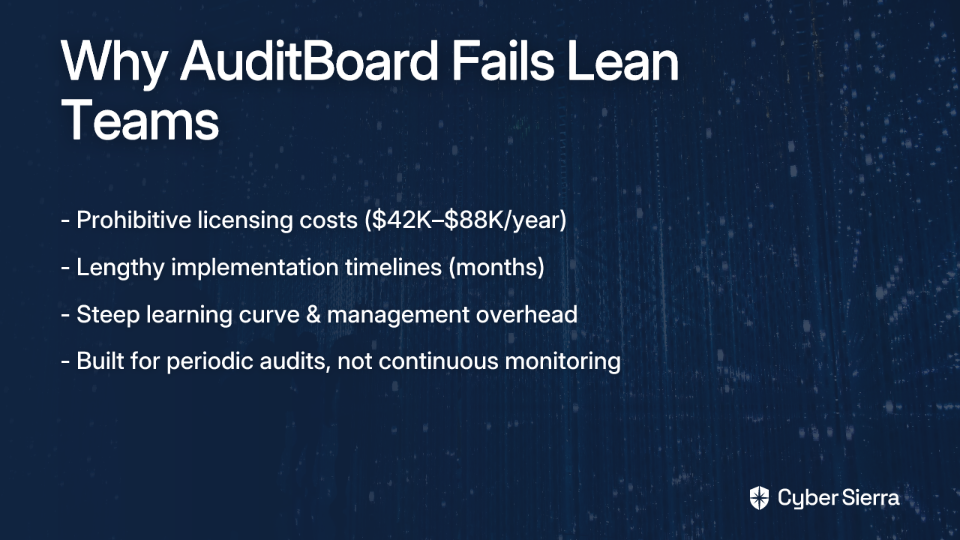
Users on Reddit have consistently raised concerns about its high expense, with licensing costs ranging from $42,775 to $88,000 annually. Beyond cost, teams report "tedious and cumbersome" workflows, poor implementation support, and a tool that feels like it needs its own full-time manager just to function properly.
The core issues often come down to four key areas:
- Prohibitive costs. The annual license cost alone can consume a significant chunk of a lean team's security budget. When you factor in implementation services and ongoing management overhead, the true cost of ownership climbs even higher. Users in r/InternalAudit have flagged that "high costs of software licenses create budget constraints" — and that's before you account for training.
- Lengthy implementation timelines. A typical AuditBoard rollout can stretch across several months. For a lean team trying to prepare for an audit in Q2, that timeline simply doesn't work. Poor implementation support compounds the issue — users report frustration and dissatisfaction when handoffs happen without adequate guidance, leaving teams to figure things out alone.
- Complexity and management overhead. AuditBoard was designed for large internal audit departments with dedicated headcount. Its feature depth, while impressive in that context, often translates to a steep learning curve and ongoing management burden for smaller teams. When a compliance tool requires more effort to run than the compliance program itself, something is wrong.
- Periodic vs. continuous monitoring. Perhaps the biggest structural mismatch. AuditBoard is built around a traditional, periodic audit mindset — you collect evidence, run assessments, and close the loop on a schedule. But modern security teams need real-time compliance monitoring to proactively catch gaps before they become audit findings or breach vectors. A tool that's optimized for point-in-time reviews can't deliver that.
Top 5 AuditBoard Alternatives for Agile Compliance
Here are the leading AuditBoard alternatives that are better suited for the speed and budget of lean, agile security teams.
1. Cyber Sierra — Best All-in-One Platform for Continuous Compliance
Ideal for: Lean security teams in regulated industries (BFSI, HealthTech, Technology) that need GRC, TPRM, and continuous monitoring in a single, automated platform.
Cyber Sierra was built specifically to address the pain points that make enterprise GRC tools like AuditBoard a poor fit for agile, multi-framework compliance programs. It brings together three capabilities that lean teams typically have to cobble together from separate vendors:
- AI-Enabled Continuous Control Monitoring (CCM). Instead of manual, point-in-time evidence collection, Cyber Sierra automates data gathering across your tech stack 24/7. This builds a live controls repository with near real-time updates, giving your team continuous visibility into your security posture across SOC 2, ISO 27001, HIPAA, PCI DSS, and more.
- Integrated Third-Party Risk Management (TPRM). Cyber Sierra moves beyond static questionnaires to provide continuous monitoring of vendor security posture, automated assessments, and streamlined onboarding. This addresses the common challenge of difficulty validating vendor controls without requiring a dedicated TPRM headcount.
- Faster Time-to-Audit-Readiness. By automating data collection, risk assessments, and compliance reporting, Cyber Sierra's GRC module helps teams get audit-ready in weeks, not months. It also reduces the "compliance fatigue" that burns out lean teams.
2. Vanta — Best for Startups Focused on SOC 2
Ideal for: Early-stage and growth-stage tech companies prioritizing SOC 2 certification.
Vanta has built a strong reputation for making SOC 2 compliance accessible and fast. Its user-friendly dashboard and deep integrations with cloud services and developer tools can automate up to 90% of the work for SOC 2. If your primary goal is a clean SOC 2 report and you operate in a modern cloud-native stack, Vanta is worth evaluating. However, its framework coverage beyond SOC 2 is more limited, and it lacks a native, integrated TPRM capability — meaning you'll likely need a separate vendor risk tool as your program matures.
3. Secureframe — Best for a Guided Path to SOC 2 and ISO 27001
Ideal for: Mid-market organizations looking for structured guidance through their first SOC 2 or ISO 27001 certification.
Secureframe provides a clear compliance roadmap, continuous monitoring, and strong audit support. Its pricing — often based on company revenue — can make it accessible for organizations that find AuditBoard's flat licensing prohibitive. It's a solid choice if your primary need is framework certification support, though its TPRM capabilities are limited and customization options may not meet the needs of more mature security programs.
4. Drata — Best for Automation-Heavy Tech Environments
Ideal for: Tech companies looking for deep workflow automation and a broad integration library.
Drata focuses heavily on automating compliance workflows and evidence collection, with a growing list of supported frameworks beyond SOC 2. Its interface is notably user-friendly, which helps lean teams onboard quickly. Like Vanta and Secureframe, Drata is strong on the compliance automation front but offers limited built-in vendor risk management — a gap that becomes significant as your third-party ecosystem grows.
5. LogicGate — Best for Teams Needing Custom GRC Workflows
Ideal for: Organizations that need highly configurable risk and compliance workflows without heavy IT involvement.
LogicGate is a flexible, no-code GRC platform that allows teams to build and adapt risk applications to their specific processes. It leverages AI for predictive insights and workflow optimization. While this flexibility is powerful, it can also mean a longer setup time to get workflows right — making it better suited for teams with some GRC maturity rather than those looking for an out-of-the-box, fast-start solution.
Feature Face-Off: Side-by-Side Comparison
To help clarify the key differences, here is a direct comparison of the top alternatives:
| Feature | Cyber Sierra | Vanta | Secureframe | Drata | LogicGate |
|---|---|---|---|---|---|
| Framework Coverage | Multi-framework (SOC 2, ISO 27001, HIPAA, PCI DSS, NIST, GDPR, etc.) | Primarily SOC 2, limited others | SOC 2 & ISO 27001 focused | SOC 2, growing others | Highly customizable |
| Monitoring Type | Continuous (AI-enabled, near real-time) | Continuous | Continuous | Continuous | Periodic / Workflow-based |
| Vendor Risk (TPRM) | Yes — Integrated & Continuous | Not a core feature | Limited | Limited | Limited |
| Time to Audit Readiness | Weeks | Weeks | Weeks–Months | Weeks | Months |
| Pricing Transparency | Flexible plans available | Subscription-based | Revenue-based subscription | Subscription-based | Custom quotes |
| Ideal User | Lean teams needing integrated GRC + TPRM | Startups needing SOC 2 | Mid-market needing SOC 2/ISO 27001 | Tech firms needing automation | Enterprises needing custom workflows |
How to Choose the Right GRC Tool for Your Lean Team
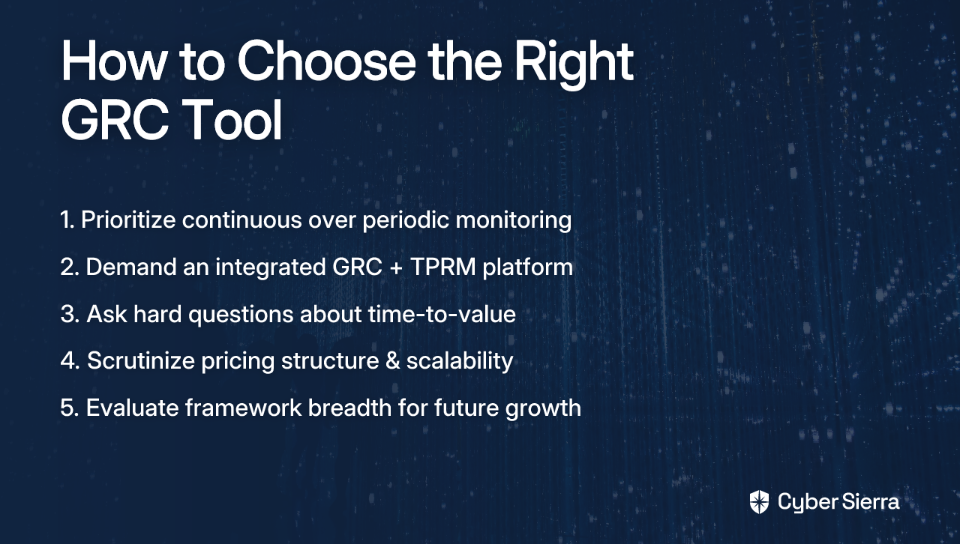
With so many options available, the decision comes down to a few key criteria that matter most for lean security programs:
- Prioritize continuous over periodic monitoring. If a tool is built around point-in-time assessments, you'll always be playing catch-up. Look for platforms that automate evidence collection in near real-time so you're perpetually audit-ready. This need for real-time compliance monitoring is one of the most common themes among GRC practitioners.
- Demand an integrated platform. Juggling separate tools for GRC, TPRM, and vulnerability management creates data silos and duplicate effort. A unified platform like Cyber Sierra provides a single source of truth, reducing tool sprawl and giving you a cleaner view of your overall risk posture.
- Ask hard questions about time-to-value. Any vendor can promise a smooth implementation. Push them on specifics: How long does onboarding typically take? What does support look like in the first 90 days? The frustration with poor implementation support is one of the most cited reasons teams regret their GRC tool choice.
- Scrutinize pricing structure. Opaque, enterprise-only pricing is a red flag for lean teams. Look for vendors with transparent tiers that scale with your headcount and framework needs — not tools that lock you into a six-figure contract before you've proven value.
- Evaluate framework breadth vs. depth. If your compliance road map includes multiple frameworks — say, SOC 2 today, ISO 27001 next year, and HIPAA the year after — choose a platform that can grow with you rather than forcing a tool migration every time you add a new certification.
Make Your Next GRC Tool Your Last
Choosing a GRC platform isn't just about passing an audit; it's about building a sustainable compliance program that doesn't burn out your team. The old model of periodic, manual evidence collection is broken. For lean teams, success hinges on automation and a unified view of risk.
Remember these key takeaways:
- Shift from periodic to continuous. Your security posture is live, 24/7. Your monitoring should be, too. Don't settle for point-in-time snapshots.
- Integrate GRC and TPRM. Managing vendor risk in a separate silo creates blind spots and duplicates effort. A single platform provides a clear, comprehensive view.
Before you schedule another demo, take ten minutes to map your single biggest compliance bottleneck. Is it chasing evidence? Onboarding vendors? Prepping for audits?
When you're ready to see how a unified platform solves that exact problem, book a custom demo and we'll show you how to get audit-ready in weeks, not months.
Frequently Asked Questions
What makes AuditBoard a poor choice for lean security teams?
AuditBoard is often a poor choice for lean teams due to its high cost, complex setup, and lengthy implementation. Designed for large enterprises, its periodic audit model and management overhead create friction for agile teams needing continuous, real-time compliance monitoring.
Why is continuous compliance monitoring better than periodic audits?
Continuous compliance monitoring is better because it provides real-time visibility into your security posture, catching gaps before they become audit findings. Unlike periodic audits that offer a point-in-time snapshot, it automates evidence collection 24/7, ensuring you're always audit-ready.
What are the most important features in GRC software for a small team?
The most important features for a small team are continuous control monitoring (CCM), integrated third-party risk management (TPRM), and rapid implementation. Look for a platform that automates manual work, unifies GRC and vendor risk, and delivers value in weeks, not months.
How much should a mid-market company expect to pay for a GRC tool?
Mid-market companies should look for GRC tools with transparent, scalable pricing that avoids the high six-figure costs of enterprise platforms like AuditBoard. Many modern platforms offer tiered subscriptions based on company size or frameworks, making them far more budget-friendly.
What is the difference between compliance automation tools like Vanta and all-in-one platforms like Cyber Sierra?
The main difference is scope. Tools like Vanta excel at automating a specific framework like SOC 2. All-in-one platforms like Cyber Sierra integrate GRC with continuous monitoring and third-party risk management (TPRM), providing a unified view of your entire security program.
