



5 Best AI Evidence Auditors for Compliance Teams in 2026


Join thousands of professionals and get the latest insight on Compliance & Cybersecurity.
- A true AI evidence auditor autonomously reviews evidence and assigns a pass/fail rating, unlike AI-assisted tools that only organize files for human review.
- Autonomous AI auditing can be up to 530x faster than manual review, reducing weeks of compliance work to just hours.
- When evaluating tools, ask if the AI performs the audit judgment or merely assists a human reviewer, as this is the key difference.
- For teams seeking to replace manual review, Cyber Sierra's AI Analyst offers autonomous evidence auditing with a proven zero false negative rate.
Three weeks before the audit window closes, your team is still chasing vendors over email, dragging PDFs into a shared drive, and staring down 150 assessment questions with no clear end in sight. The auditor wants evidence of continuous control monitoring. You have point-in-time screenshots from last quarter.
Your team reviewed 10% of controls. The other 90% went unchecked. That is the audit reality for many teams managing ISO 27001, SOC 2, MAS TRM, or PCI DSS today.
The evidence review bottleneck is real. GRC teams typically go through two full review rounds before findings are accepted, and the bulk of that time is spent on repetitive work that is scalable only by adding headcount. AI is changing this, but not all "AI" tools solve the same problem.
What Is an AI Evidence Auditor?
Before evaluating tools, the definition matters. The term has been applied loosely, and conflating it with adjacent categories leads to purchasing the wrong thing.
An AI evidence auditor autonomously reviews uploaded compliance evidence (such as screenshots, logs, policy documents, and reports) against specific control requirements. It then outputs a compliance determination, pass or fail, with detailed written reasoning explaining why the evidence meets or does not meet the requirement. No human reads every file; the AI makes the call. Research from the American Accounting Association highlights that this autonomous determination capability is what separates genuine AI auditing from AI-assisted workflows.
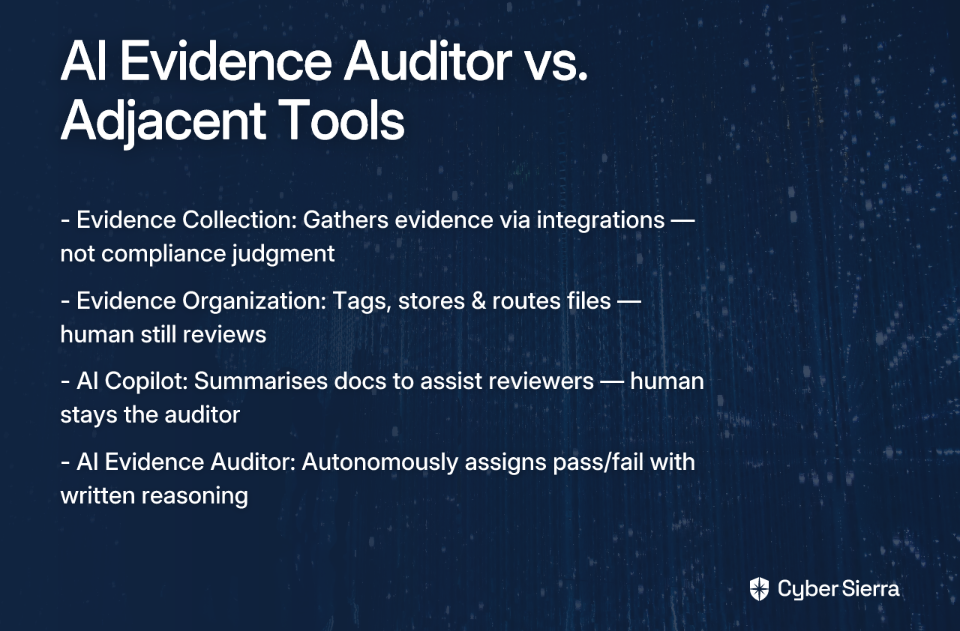
This is meaningfully different from three other categories that often get confused with it:
Evidence collection tools. These automate the gathering of evidence via integrations, pulling logs from AWS, tickets from Jira, or configs from GitHub. They answer "what evidence exists?" but not "does this evidence satisfy the control?"
Evidence organization tools. These tag, store, and route evidence to the right reviewer. They make human review faster and more structured, but the human still makes the compliance judgment.
AI copilots. These summarize documents or suggest tags to help a human reviewer work more efficiently. The human remains the auditor; the AI is a smart assistant.
The litmus test for a true AI evidence auditor is simple: does the tool itself assign a compliance rating and produce defensible, written reasoning per control? If the answer is no, it belongs in one of the three categories above. These tools are useful, but they are not evidence auditors.
The compliance community has raised legitimate questions about AI-generated artifacts. Practitioners openly ask: "What's your bar for audit-grade?" That is exactly the right question. The answer should be reproducible reasoning, zero false negatives on missed gaps, and output that can be reviewed and defended to an external auditor. That bar is achievable.
The tools below are evaluated against it.
The 5 Best AI Evidence Auditors for Compliance Teams
Here are the five best AI evidence auditors for compliance teams, ranked by how fully each meets that definition.
1. Cyber Sierra Audit Evidence AI Analyst
Cyber Sierra’s Audit Evidence AI Analyst is the only tool on this list that fully satisfies the definition of an AI evidence auditor. It autonomously reviews uploaded evidence files against control requirements in your framework, produces a compliance rating per control, and generates written reasoning for every determination without a human needing to read the underlying files.
How It Works
The Analyst is deployed within Cyber Sierra's Continuous Controls Monitoring (CCM) module, connecting evidence review directly to your control library. You upload evidence files (like PDFs, Word documents, screenshots, and log exports) against the relevant control requirements. The AI reviews the content, maps it to the specific control language, and outputs a structured result of pass or fail, plus a written explanation that is defensible in front of an external auditor.
It works alongside the Suggested Evidence AI Analyst, which tells you what evidence to collect before you collect it. Together, they cover the full workflow from knowing what to gather to confirming if what you gathered is sufficient. You can explore the full AI Analysts capability on the CCM page.
Proof Points
The performance data here comes from live enterprise deployments, not product benchmarks.
A Fortune 500 regional insurer deployed the Audit Evidence AI Analyst, resulting in review speeds 530x faster than its previous manual process. This reflects the difference between a compliance team spending weeks on evidence review versus clearing the same workload in hours.
Across multiple live enterprise deployments, the confirmed false negative rate is 0%. Every gap gets flagged. This directly addresses the core concern compliance leaders raise about AI reliability: that an AI-produced artifact might miss something a human would catch. The deployment data from these deployments indicates otherwise.
The Analyst works across ISO 27001, SOC 2, MAS TRM, PCI DSS, and any custom framework loaded into the GRC platform. Framework flexibility matters at the enterprise level, where teams are often running multiple concurrent certifications.
For organizations managing third-party risk alongside internal controls, the TPRM module connects to the same evidence and control infrastructure, extending the same AI review capability to vendor assessments.
Industry Recognition
Cyber Sierra was recognized as a Sample Vendor in the Gartner® Hype Cycle™ for Cyber-Risk Management, 2024. The company was also selected for Singapore’s IMDA Spark Programme, a marker of enterprise readiness for regulated markets.
The Verdict
For compliance teams running enterprise-scale GRC programs, Cyber Sierra is the benchmark. It is the only tool reviewed here that replaces manual evidence review with autonomous AI determination — producing output that is fast, accurate, and audit-grade.
Best for: Enterprise compliance teams running ISO 27001, SOC 2, MAS TRM, PCI DSS, or custom frameworks. Not ideal for: Startups with fewer than 50 controls or teams not yet running a structured GRC program.
2. Hyperproof
Hyperproof is a well-regarded compliance operations platform. Its strength is workflow management: assigning evidence collection tasks, tracking completion status, organizing files by control, and giving compliance teams a structured environment to manage audit readiness over time.
The UX is clean and the compliance workflow logic is solid. Teams that have previously managed evidence in spreadsheets or shared drives will notice an immediate improvement in how evidence is organized and routed.
Where Hyperproof falls short of the AI evidence auditor definition is in the final step. Its AI features are focused on evidence organization and routing — getting the right documents in front of the right reviewer. They do not autonomously assess evidence against control requirements. A human auditor still opens the file, reads it, and makes the compliance judgment. There is no autonomous pass/fail rating with written reasoning.
Hyperproof is strong compliance operations software. It is not an evidence auditing automation tool in the autonomous sense.
Best for: Teams that need structured workflow management and evidence organization. Limitation: AI organizes and routes evidence. Humans still perform the actual audit.
3. AuditBoard
AuditBoard has deep roots in internal audit. Its workflows are built around how internal audit teams actually operate — from audit planning and fieldwork through to reporting and issue tracking. For internal audit departments with complex programs, the platform's depth is genuine.
AI capabilities are an area of active development. Based on user feedback on Gartner Peer Insights, AuditBoard's AI is currently described as underdeveloped. Current AI functionality assists with tasks like tagging evidence and surfacing related items. The core review process — reading evidence files and forming a compliance judgment against a control requirement — remains manual.
This is not a dismissal of the platform. AuditBoard is a strong choice for managing the internal audit lifecycle. It is not, at this point, a tool that performs autonomous evidence auditing. The AI assists the human auditor rather than performing the audit.
Best for: Internal audit teams managing complex audit programs with structured methodologies. Limitation: Evidence review is manual. AI is early-stage and focused on workflow assistance, not autonomous assessment.
4. Vanta
Vanta's primary value is in automated evidence collection. It connects to hundreds of integrations like AWS, GitHub, Jira, and Google Workspace, and automatically pulls relevant evidence for SOC 2, ISO 27001, and other frameworks. The reduction in manual evidence gathering is significant, particularly for cloud-native companies.
Compliance automation tools that connect to live systems are genuinely useful for reducing the collection burden. Vanta does this well.
The limitation relevant to this comparison is that Vanta's AI assistance for evidence review does not produce autonomous reasoning per control. The platform surfaces evidence and organizes it by control, but the final determination — "does this evidence satisfy the requirement?" — is still a human judgment. The tool is also designed primarily for startup and mid-market certifications, and compliance teams at enterprise scale often find it stretches beyond its intended use case.
Best for: Startup and mid-market teams pursuing SOC 2 or ISO 27001 for the first time. Limitation: No autonomous compliance determination per control. Enterprise GRC complexity is not its primary design target.
5. ServiceNow GRC (with Now Assist)
ServiceNow GRC is enterprise-grade workflow infrastructure. It handles evidence collection through its workflow engine, maintains audit trails across the organization, and integrates with the broader ServiceNow ecosystem that many large enterprises already run. For organizations that are deeply embedded in ServiceNow, extending it to cover GRC workflows has obvious operational logic.
Now Assist is the AI layer. It provides summarization capabilities, helping a human reviewer get through a long policy document or technical report more quickly. That is useful when a reviewer is already sitting down to evaluate evidence. But Now Assist is a copilot, not an auditor. It reduces reading time but does not make the compliance determination, produce a pass/fail rating, or generate written reasoning per control. The human remains the auditor throughout.
There is also a cost consideration that matters at the evaluation stage. A proper ServiceNow GRC implementation typically requires a substantial System Integrator engagement and investment. For organizations already on the ServiceNow platform, this may be the right path. For teams evaluating GRC tooling fresh, the cost of entry is a material factor.
Best for: Large enterprises already running ServiceNow that want GRC capabilities within existing infrastructure. Limitation: No autonomous evidence assessment. AI is a summarization copilot. High total cost of ownership for new implementations.
How These Tools Compare
This table summarizes the key differences in how each tool approaches evidence review.
| Tool | Evidence Collection | Evidence Organization | Autonomous AI Review | Pass/Fail + Written Reasoning |
|---|---|---|---|---|
| Cyber Sierra | Yes | Yes | Yes | Yes |
| Hyperproof | Partial | Yes | No | No |
| AuditBoard | Yes | Yes | No | No |
| Vanta | Yes (hundreds of integrations) | Yes | No | No |
| ServiceNow GRC | Yes | Yes | No | No |
The table makes the category distinction visible. Four of the five tools handle collection and organization well. Only Cyber Sierra performs the autonomous review step that defines evidence auditing automation.
From Manual Review to Autonomous Audit
The core bottleneck in compliance is not collecting evidence; it's the hours spent manually reviewing each file to make a judgment call. While many tools organize this workflow, efficiency comes from automating the judgment itself.
When evaluating tools, the deciding question is whether the AI makes the audit judgment or just assists a human reviewer. The answer reveals if you are getting a file organizer or a tool that can scale your team's review capacity.
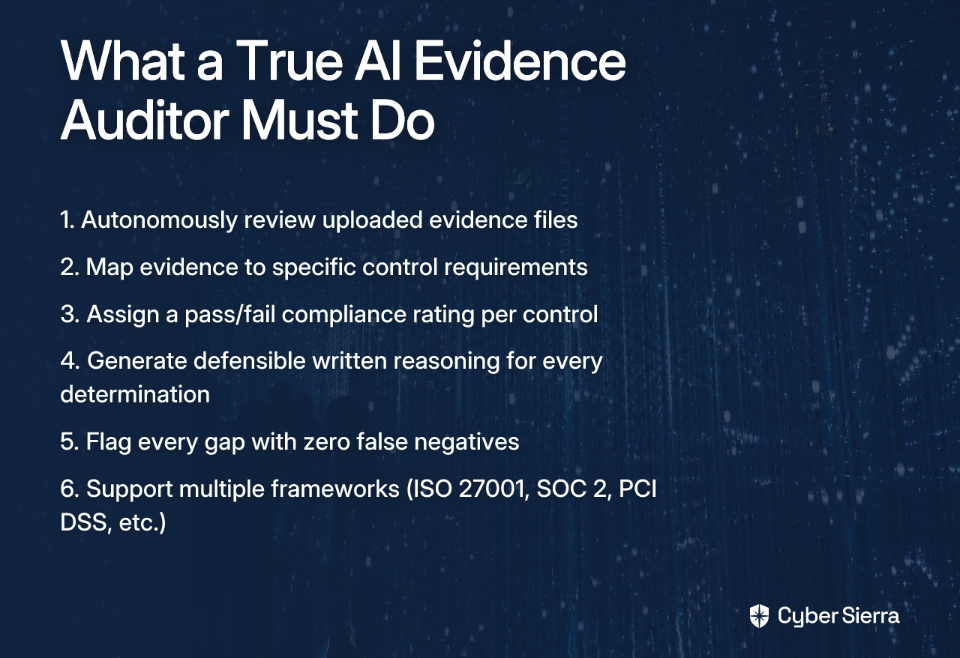
Cyber Sierra's AI Analyst provides autonomous evidence review, pass/fail ratings, and a complete audit trail for every decision. Book a demo to see how it fits your current compliance process.
Frequently Asked Questions
What is an AI evidence auditor?
An AI evidence auditor is a tool that autonomously reviews compliance evidence, assigns a pass/fail rating against a control, and provides written reasoning for its determination. Unlike tools that only collect or organize evidence, it performs the actual compliance judgment.
How is an AI evidence auditor different from a compliance AI copilot?
An AI evidence auditor makes the compliance decision, while an AI copilot assists a human who remains the auditor. The auditor tool provides a pass/fail rating with reasoning, whereas a copilot might summarize documents or suggest tags to help a human reviewer work faster.
What are the main benefits of using an AI evidence auditor?
The primary benefits are dramatic speed improvements, increased accuracy, and the ability to achieve continuous control monitoring. Teams can reduce evidence review time from weeks to hours, ensure every gap is flagged, and scale compliance programs without adding headcount.
What kind of compliance evidence can an AI auditor review?
AI evidence auditors can review a wide range of unstructured evidence types. This includes policy documents (PDFs, Word), screenshots of system configurations, log exports, and technical reports used for frameworks like ISO 27001, SOC 2, and PCI DSS.
Will external auditors accept findings from an AI evidence auditor?
Yes, provided the AI's output is defensible, transparent, and reproducible. A true AI evidence auditor generates detailed, written reasoning for each pass/fail determination, creating a clear audit trail that can be reviewed and validated by external auditors.
How can I trust the accuracy of an AI evidence auditor?
Trust is established through proven performance metrics, such as a zero false negative rate in live deployments. Look for tools with verifiable data confirming that every control gap is flagged. The AI's detailed reasoning also allows for human oversight and validation.
