



AI Compliance Analyst vs. Human Analyst: What Each Does Best


Join thousands of professionals and get the latest insight on Compliance & Cybersecurity.
- AI compliance analysts excel at high-volume tasks, reviewing evidence significantly faster than manual processes and completing vendor questionnaires in minutes instead of weeks.
- Human analysts remain irreplaceable for strategic roles that require judgment, such as interpreting ambiguous regulations, negotiating with stakeholders, and communicating risk to leadership.
- The most effective GRC teams use a hybrid model, amplifying their capacity to manage significantly more vendors and frameworks without increasing headcount.
- Teams that automate repetitive tasks with a platform like Cyber Sierra's AI-enabled GRC can shift their focus from manual execution to high-value strategic oversight.
The conversation around the AI compliance analyst vs human debate has been dominated by a single question: will AI replace compliance jobs? For a CISO or Head of GRC, that question is largely irrelevant. The real question is far more practical: which tasks should an AI compliance analyst execute, and which still demand experienced human judgment? The answer has direct implications for how a compliance team is structured and where the technology budget goes.
This article breaks down the task-level division of labor in a modern GRC program. The AI compliance analyst vs human analyst comparison is not a contest. It is a framework for building a more capable, efficient, and defensible compliance function, one where each resource is deployed where it performs best.
What AI Compliance Analysts Execute Well
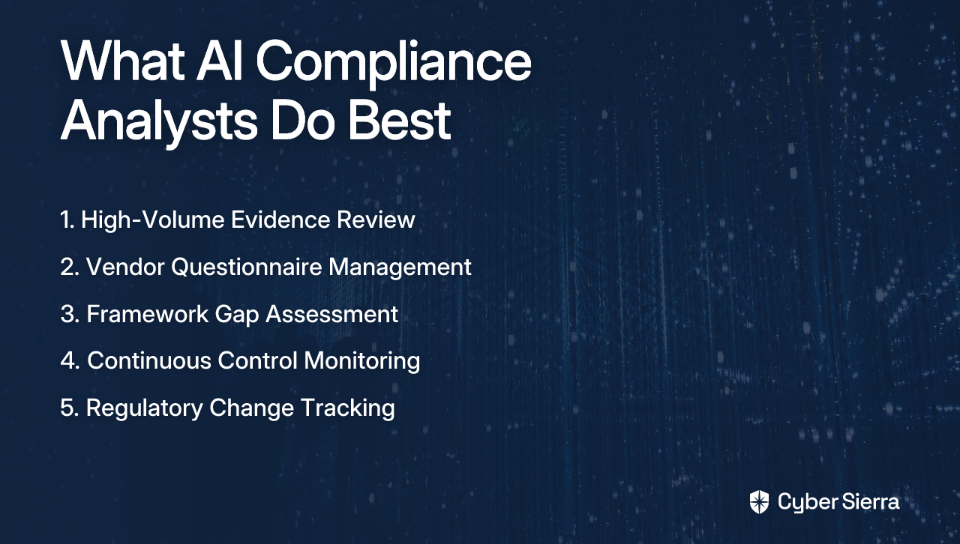
An AI compliance analyst excels at tasks defined by volume, speed, and repetition. These are the areas where human performance degrades due to fatigue, cognitive limits, and the sheer pressure of scale. As noted by practitioners on r/fintech, analysts today "spend more time navigating PDFs, portals, and email chains than actually making decisions." That is exactly the work an AI compliance analyst is built to absorb.
1. High-Volume Evidence Review
When a compliance team prepares for an audit, evidence review is the single most time-intensive bottleneck. An AI compliance analyst parses thousands of documents, system configurations, and logs to verify control implementation at a scale no human team can match.
Cyber Sierra's AI can dramatically improve control coverage, reviewing evidence much faster than a manual process and reducing exceptions. That level of coverage transforms audit readiness from a quarterly scramble into a continuous state. This capability is central to modern GRC platforms designed to replace sampling-based reviews with full-population analysis.
2. Vendor Questionnaire Management
Third-party risk management buries analysts in questionnaire cycles. A single vendor assessment can run over a hundred questions, and managing dozens of vendors simultaneously creates a backlog that delays procurement, security reviews, and contract renewals.
An AI compliance analyst can ingest a vendor's documentation and produce a completed first draft of a comprehensive security questionnaire in a fraction of the time it takes a human analyst. This difference fundamentally changes how third-party risk management teams operate, moving from a bottleneck model to an always-on review process.
3. Framework Gap Assessment
Mapping existing controls against a new regulatory framework, or against multiple frameworks simultaneously, is a task that has traditionally consumed entire analyst teams for weeks. An AI compliance analyst performs paragraph-level analysis of control descriptions and evidence against framework requirements.
A gap assessment that previously took weeks with a full analyst team can be completed much faster. This speed matters when frameworks like MAS TRM, ISO 27001, or SOC 2 shift their requirements and teams need immediate visibility into their exposure.
4. Continuous Control Monitoring
No human analyst can monitor cloud configurations, user access logs, and technical controls around the clock without interruption. An AI compliance analyst operates 24/7, flagging deviations from policy the moment they occur.
This continuous coverage eliminates the gaps between point-in-time assessments that auditors often find most concerning. This breadth of coverage is difficult to replicate with any size of human team.
5. Regulatory Change Tracking
Monitoring regulatory bodies for new circulars, guidance, and amendments is reactive by nature when done manually. An AI compliance analyst tracks new MAS circulars and regulatory publications automatically, identifying which internal controls are affected and flagging them for human review before the team even opens their inbox. This proactive posture of flagging impacted controls automatically is a capability that forward-looking compliance functions are increasingly relying on to stay ahead of regulatory cycles.
Where Human Analysts Still Add More Value
The AI compliance analyst vs human analyst comparison only tells half the story if it stops at what AI does well. There are four areas where human judgment is not just preferable, it is irreplaceable. As AML Watcher notes, AI enhances efficiency but does not replace humans in compliance operations, particularly where accountability is at stake.
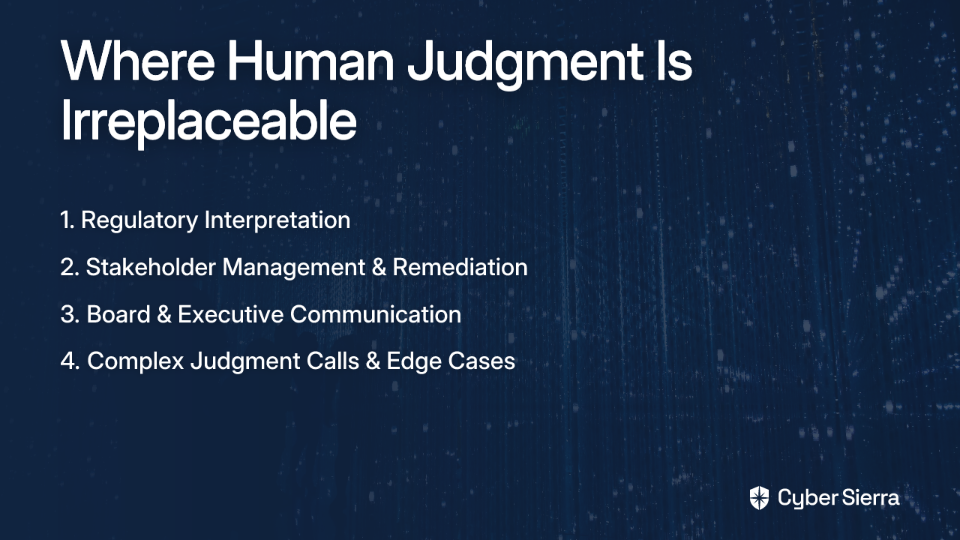
1. Regulatory Interpretation
An AI compliance analyst can flag a new regulatory clause or identify a gap against a framework requirement. It cannot determine what that novel language means for a specific business model, interpret regulatory intent in an ambiguous situation, or decide on a risk-based response. That requires a human analyst who understands the regulatory relationship, the organization's risk appetite, and the operational context. As user research confirms, "regulators expect human judgment on AML decisions," and that expectation extends to final interpretive calls across all compliance domains.
2. Stakeholder Management and Remediation
AI can generate a prioritized remediation list sorted by risk severity and control owner. It cannot walk into a conversation with a business unit leader, understand their capacity constraints, and negotiate a realistic timeline that balances security requirements with operational reality.
The human compliance analyst vs AI distinction here is between analysis and influence. According to Lucinity's research on emerging compliance skills, strategic communication and the ability to drive organizational change are now among the most valuable capabilities a compliance professional can hold.
3. Board and Executive Communication
A board needs to understand risk in business terms, not as a control matrix. An AI compliance analyst generates the underlying data: coverage percentages, open findings, and overdue remediations. A human analyst translates that data into a strategic narrative that connects compliance posture to business risk, regulatory exposure, and competitive positioning. That translation requires judgment about what leadership actually needs to act, not just what the data shows.
4. Complex Judgment Calls and Edge Cases
Edge cases, materiality determinations, cross-jurisdictional conflicts, and investigations into sophisticated or novel threats all require human reasoning. As practitioners have observed, "most failures in compliance automation come from edge cases, silent UI changes, or missing context that a human analyst would normally catch."
This is the human-in-the-loop model in practice: AI handles the predictable and the scalable, while humans absorb the ambiguous and the consequential. Full automation of SAR filings, sanctions screening decisions, and adverse media reviews remains unrealistic because regulatory accountability requires a human decision-maker.
How Enterprise Teams Are Structuring This
Leading GRC teams are not debating the AI compliance analyst vs human question abstractly. They are redesigning workflows to create a hybrid model where the human analyst's role shifts from manual execution to strategic review of AI-generated outputs. The result is a team that does more, at higher quality, without adding headcount.
Amplified TPRM capacity. A single compliance manager using an AI compliance analyst can oversee a high volume of vendor assessments annually. That volume would have previously required a team of multiple analysts, each managing their own vendor queues and questionnaire cycles. The AI handles the first-pass analysis, and the human manager reviews findings and makes risk decisions.
Accelerated GRC processes. A framework gap assessment that previously tied up multiple analysts for weeks can be reviewed by one or two analysts who validate the AI's paragraph-level output in hours. The analyst is no longer executing the gap analysis. They are reviewing, challenging, and approving it. That is a fundamentally different, higher-value activity. Similarly, a User Access Review that once consumed significant team resources is now completed in a fraction of that time, with human analysts focused on exception review rather than data collection.
The structural shift. The compliance team moves from a pyramid of executors to a lean group of reviewers and strategists. The "analyst bottleneck," where alert volume and manual documentation work outpaces team capacity, is resolved by delegating high-volume execution to the AI GRC analyst layer. Human analysts focus on the outputs that require judgment, escalation, or stakeholder engagement.

What This Means for Your Team Size
The AI compliance analyst vs human headcount conversation is not a 1:1 replacement calculation. It is a capacity expansion question. The relevant metric is not how many analysts can be eliminated. It is how much compliance scope a fixed team can now cover.
The TPRM math. A small TPRM team running Cyber Sierra's AI analyst layer can manage a high volume of third-party assessments per year, a workload that would have been operationally difficult without significant additional hiring. Each human analyst spends less time on document collection and first-draft questionnaires and more time on risk assessment, vendor escalations, and remediation tracking.
The GRC framework math. A small GRC team can now actively manage multiple frameworks simultaneously, monitoring control coverage, tracking regulatory changes, and maintaining gap assessments across ISO 27001, SOC 2, MAS TRM, and others in parallel. Previously, that scope would have required a much larger team or significant tradeoffs in coverage depth.
The role elevation effect. As Forbes has noted in its analysis of AI in compliance, the shift is from execution to strategic oversight. Human analysts are no longer valued primarily for how fast they can process evidence or how many questionnaires they can turn around. They are valued for the quality of their risk judgment, their ability to manage regulatory relationships, and their capacity to communicate risk to leadership.
The AI analyst for compliance handles the scale; the human analyst handles the strategy. That elevation makes the compliance function more defensible to regulators and more credible to the board.
The AI compliance analyst vs human debate, when framed as a staffing question, often misses this point. Teams that deploy AI compliance analysts do not necessarily get smaller — they get more capable. They take on more frameworks, cover more vendors, and respond faster to regulatory change without burning out their best people on manual preparation work.
From Manual Work to Strategic Oversight
The most effective GRC teams are not debating AI versus humans; they are building a hybrid model that uses each for its unique strengths. The path forward is clear: let AI compliance analysts handle the high-volume, repetitive work that burns out your best people. This frees your human experts to focus where they add irreplaceable value, such as interpreting complex regulations, negotiating with stakeholders, and communicating risk to leadership.
This shift from manual execution to strategic oversight allows compliance teams to cover more ground without adding headcount. When you're ready to see this hybrid model in practice, book a demo to learn how Cyber Sierra's AI absorbs manual work so your team can focus on strategy.
Frequently Asked Questions
What is an AI compliance analyst?
An AI compliance analyst is a software tool using artificial intelligence to automate high-volume GRC tasks. It handles repetitive work like evidence review and vendor questionnaires, allowing human experts to focus on strategic analysis and complex decision-making.
Will AI replace human compliance analysts?
No, AI is not expected to replace human compliance analysts but rather augment their capabilities. AI handles scalable, repetitive tasks, freeing humans to focus on roles requiring judgment, regulatory interpretation, stakeholder management, and final accountability.
How does AI improve the GRC process?
AI improves GRC by increasing speed and coverage. For instance, it can review evidence much faster than manual methods and provide more complete control coverage. This accelerates audit readiness, improves vendor risk management, and enables continuous control monitoring.
What are the best tasks for an AI compliance analyst?
An AI compliance analyst excels at tasks defined by high volume and repetition. These include automated evidence review, managing vendor security questionnaires, performing framework gap assessments, continuous control monitoring, and tracking regulatory updates.
What roles remain essential for human analysts?
Human analysts are essential for tasks requiring deep expertise and judgment. This includes interpreting ambiguous regulations, negotiating remediation plans with stakeholders, communicating risk strategy to leadership, and making final decisions on complex edge cases.
How can a company start using AI in compliance?
Start by identifying your team's most time-consuming, repetitive tasks, such as evidence collection or initial questionnaire drafts. Then, deploy an AI-powered GRC platform to automate that work, shifting your human analysts' focus to strategic review and validation.
