



AI Analysts for Compliance: A Complete Guide to Autonomous GRC Workers


Join thousands of professionals and get the latest insight on Compliance & Cybersecurity.
- Autonomous AI analysts execute entire GRC workflows from start to finish, providing a capacity solution for understaffed teams, unlike AI assistants which only speed up manual tasks.
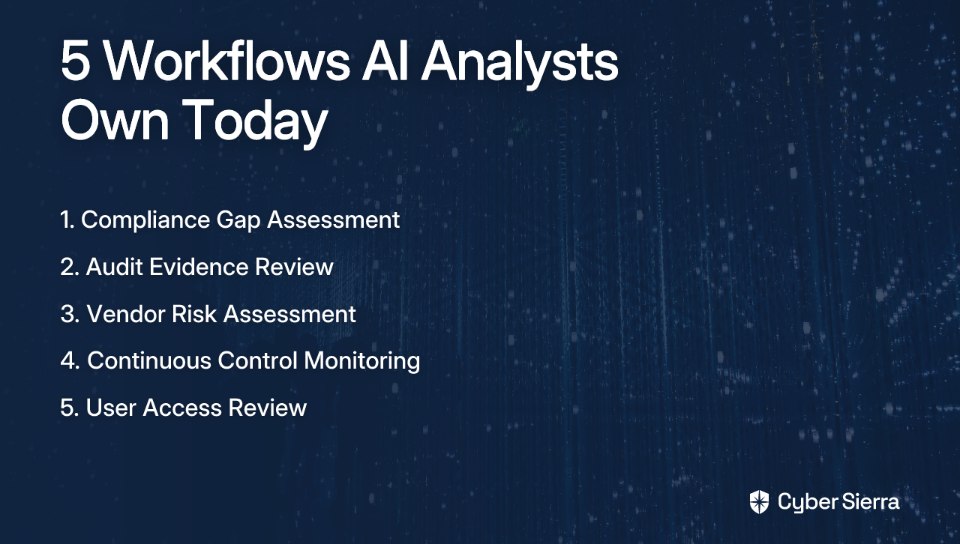
- Key workflows being automated today include compliance gap assessments, audit evidence reviews, vendor risk assessments, continuous control monitoring, and user access reviews.
- The impact is significant, with deployments showing dramatic increases in task execution speed, allowing teams to process complex assessments in minutes instead of hours.
- Platforms like Cyber Sierra use AI to automate these workflows, enabling teams to shift their focus from manual data gathering to strategic risk management.
GRC teams are chronically understaffed relative to the volume of work expected from them. Frameworks multiply, vendor counts grow, and audit cycles never stop, yet headcount stays flat. The result is that analysts are buried under alerts, emails, PDFs, and checks, leaving an endless supply of high-priority work that teams cannot get to. The emergence of the AI analyst for compliance is a direct response to this scale problem, offering a structural capacity solution rather than just another productivity tip.
Most AI in GRC today is assistive, helping analysts work marginally faster. Autonomous AI analysts are a different category, designed to execute full compliance workflows from start to finish without a human initiating each step.
This guide explains exactly how autonomous AI analysts work, which workflows they are taking on today, and what to look for when evaluating them for your organization.
What Are AI Analysts for Compliance?
An AI analyst for compliance is an autonomous digital worker that plans, reasons, and executes GRC workflows without human initiation. It is not responding to a prompt; it is running a process.
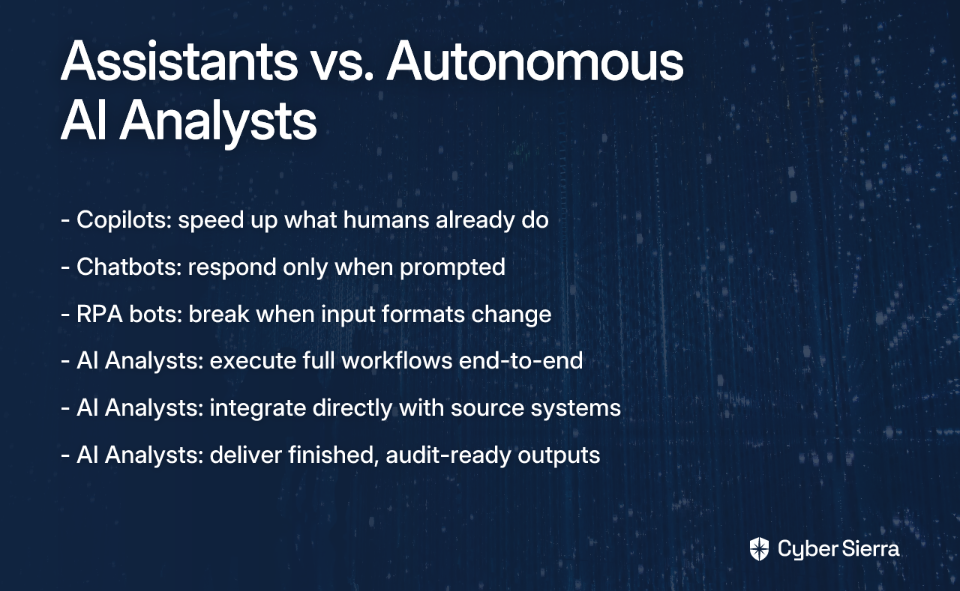
The distinction from other automation technologies matters operationally. RPA bots follow hard-coded rules and break when inputs change format. Chatbots wait for a human question. Copilots enhance what a human is already doing. An autonomous compliance AI analyst, by contrast, receives a trigger — a new vendor onboarding, a failed control test, a quarterly access review cycle — and completes the full workflow: pulling data from integrated systems, applying reasoning against policy requirements, flagging exceptions, and producing audit-ready outputs.
What enables this level of autonomy is a combination of document intelligence, multi-system integration, and the ability to handle unstructured inputs like PDFs, questionnaire responses, and system logs. The AI analyst operates as a virtual team member, owning a process end-to-end rather than assisting a human who owns it.
Why GRC Teams Need Analysts, Not Just Assistants
The biggest bottleneck in compliance operations is rarely the volume of alerts in isolation. It is the manual glue between tools: the copy-paste between systems, the manual cross-referencing of spreadsheets, and the evidence gathering that requires touching six different platforms before a single control can be confirmed.
Consider what a single compliance cycle now involves: mapping controls across multiple overlapping frameworks (SOC 2, ISO 27001, NIST CSF, GDPR), collecting evidence from cloud infrastructure and SaaS applications, assessing dozens of third-party vendors, and running access reviews across every business system. Each of these tasks involves structured and unstructured data, human judgment calls, and cross-system coordination. Assistive tools can shave time off individual steps. They do not eliminate the coordination overhead.
Autonomous AI analysts are designed specifically to eliminate that overhead. They integrate directly with source systems, execute the cross-tool workflow, and deliver a finished output such as a gap analysis, a risk report, or a flagged access exception list, ready for human review. The human role shifts from executing the process to reviewing and deciding on exceptions. This is not a marginal improvement; it is net-new capacity for teams that have no room to grow headcount.
The 5 Core Compliance Workflows AI Analysts Are Executing Today
The following workflows represent where autonomous AI analysts are being deployed right now in enterprise GRC programs. Each example shows the manual process being replaced and the autonomous workflow that replaces it.
1. Compliance Gap Assessment
Manual process: A GRC analyst receives a new regulatory requirement or updated framework. They manually read through each section, paragraph by paragraph, and cross-reference it against a control library maintained in a spreadsheet. For a 100-page regulation, this takes days and is highly prone to human error or omission.
Autonomous workflow: The compliance AI analyst ingests the framework document, parses each requirement using document intelligence, understands the semantic intent of each clause, and maps it automatically against the existing control set. It produces a gap analysis report that identifies which controls satisfy each requirement, which are partially satisfied, and which are missing entirely. The analyst reviews the output rather than producing it.
2. Audit Evidence Review
Manual process: An auditor submits a request for evidence that all terminated employees had system access revoked within 24 hours of termination. The analyst must locate the termination tickets in the ITSM system (Jira or ServiceNow), find the corresponding de-provisioning logs in the identity platform (Okta or Azure AD), cross-reference against the HRIS termination dates, take screenshots, and compile the package manually.
Autonomous workflow: The AI analyst receives the evidence request, connects to the HRIS to retrieve the termination list, queries the ITSM for de-provisioning tickets linked to each employee, and validates the timing against access logs from connected systems. It compiles a structured evidence package (confirmed, flagged, or failed) for each user in scope. The human reviews the flagged exceptions, not the full dataset.
3. Vendor Risk Assessment
Manual process: A 300-question security questionnaire (CAIQ, SIG Lite) is sent to a vendor. Weeks pass. When the response arrives, an analyst manually reads through every answer, then tries to validate claims against a 90-page SOC 2 report. This process is often seen as a checkbox exercise: burdensome for vendors, difficult to validate for assessors, and rarely producing confident risk decisions.
Autonomous workflow: The AI analyst ingests the completed questionnaire and the vendor's supporting evidence documents simultaneously. It reviews each answer, cross-validates claims against the text in uploaded SOC 2 reports, ISO 27001 certifications, or policy documents, and flags inconsistencies where stated controls are not evidenced. The output is a structured risk report with specific findings, reducing the review burden on human analysts to exception handling. Explore Cyber Sierra's TPRM capabilities built around this workflow.
4. Continuous Control Monitoring
Manual process: Control testing is point-in-time. A GRC analyst runs a quarterly check to confirm that no developers have admin access in production environments. A misconfiguration introduced in week two of the quarter goes undetected for 10 weeks.
Autonomous workflow: The AI analyst connects directly to cloud infrastructure via API (such as AWS, Azure, or GCP) and to SaaS applications and code repositories. It monitors continuously for control breaks, such as a public S3 bucket, MFA disabled on a privileged account, or a firewall rule change outside change management. When a break is detected, it generates an immediate alert with full context: what changed, when, what control it violates, and what remediation is required. See how Cyber Sierra's CCM platform implements this in practice.
5. User Access Review
Manual process: Exporting CSV files of user permissions from 20 or 30 applications, building spreadsheets for each manager, and asking them to certify their team's access. The process is so complex and time-consuming that most managers rubber-stamp it without meaningful review, leaving orphaned accounts, privilege creep, and separation of duty violations in place.
Autonomous workflow: The AI analyst treats the HRIS as the source of truth for current employee roles and reporting structure. It pulls access data from all integrated systems, reconciles it against current employment and role data, and automatically identifies orphaned accounts (belonging to former employees), excessive privileges relative to job function, and separation of duty conflicts. Only the flagged exceptions are routed to managers for review, which is a fraction of the original review volume.

How AI Analysts Are Built for Accuracy and Trust
Accuracy is non-negotiable in compliance. A false positive wastes analyst time and creates audit noise, while a false negative misses a real control failure. GRC practitioners are right to be skeptical of AI tools that cannot explain their outputs. Real observability and decision logging are minimum requirements before any autonomous action should be considered final.
Three architectural components separate reliable AI analysts from generic AI tools applied to compliance problems.
Context Graph: A knowledge model that maps the relationships between your assets, policies, controls, regulations, and people. It understands that a specific AWS IAM configuration satisfies control PR.AC-4 from the NIST CSF, which maps to Article 25 of GDPR. This contextual reasoning, not keyword matching, is what enables accurate gap assessments and control mapping at scale. The Cyber Sierra platform is built on a Context Graph that gives every AI analyst a shared understanding of your organization's specific compliance posture.
Reflective Agents: AI agents capable of reviewing their own outputs before delivering them and of incorporating feedback from human reviewers to refine future decisions. This is what makes a human-in-the-loop model operationally practical. When a human analyst corrects an AI assessment, the agent incorporates that feedback, becoming more accurate against your specific environment over time. The human oversight layer is not a limitation; it is how the system gets calibrated to your organization's risk standards.
Audit-Ready Decision Trails: Every action taken by an autonomous AI analyst is logged in an immutable audit trail: what data was reviewed, what reasoning was applied, what decision was made, and when. This is exactly what regulators and auditors need to see. It also satisfies the legitimate concern that fully automated compliance without human oversight creates liability, as the trail makes the oversight visible and defensible. Explore the Cyber Sierra GRC platform to see how decision trails are implemented across the full workflow suite.
Real-World Outcomes From Autonomous AI Analysts
Early adopters of autonomous AI analysts in compliance have reported significant operational improvements. While specific results vary, the outcomes consistently point to three areas of impact.
- Increased speed. Teams can complete compliance tasks, like reviewing vendor questionnaires, in a fraction of the time previously required. Work that once took a senior analyst hours can be processed in minutes.
- Greater efficiency. By automating entire workflows, organizations can handle a much larger volume of assessments, control tests, and evidence requests without increasing headcount.
- Cost reduction. Automating functions that previously required dedicated analyst time can lead to direct operational savings and allows skilled professionals to focus on higher-value risk management.
These outcomes are not the result of AI generating faster first drafts. They come from autonomous agents executing full workflows, from ingesting evidence and applying reasoning to producing structured outputs for review. This applies across vendor assessments, control monitoring, and audit evidence collection.
How to Evaluate AI Analysts for Compliance
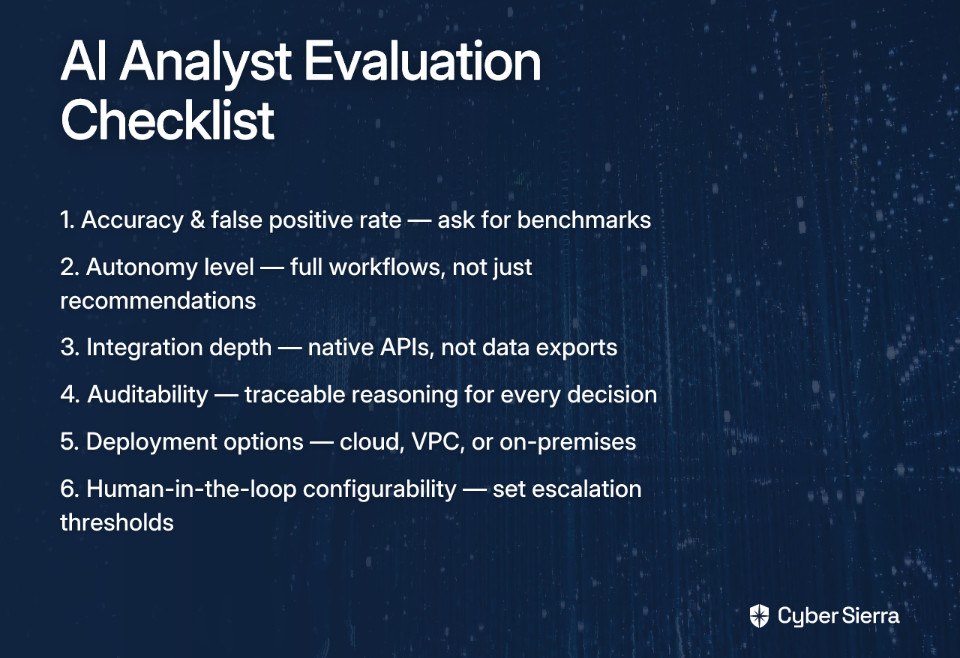
Not every product marketed as an AI analyst is genuinely autonomous. Use these criteria to assess whether a solution will deliver the capacity gains you need.
Accuracy and false positive rate: Ask for documented benchmarks on specific GRC workflows. How does the vendor measure false positive rates? What is the human correction rate on AI-generated outputs after the first 90 days? Evaluation rigor matters more with autonomous agents than with assistive tools because errors propagate further.
Autonomy level: Is the system executing full workflows, or is it generating recommendations that a human must implement step-by-step? A genuine AI analyst can be given a trigger (new vendor added, quarterly review cycle begins) and complete the process without human intervention until the exception review stage.
Integration depth: Shallow integrations that require data exports and imports reproduce the manual glue problem. Look for native API connections to your HRIS, cloud infrastructure, ITSM, identity platforms, and SaaS applications. The depth of integration directly determines the autonomy level achievable.
Auditability: Can you see every step of the AI's reasoning process? Can you export the decision trail to satisf an external auditor? Tools that produce outputs without traceable reasoning are not appropriate for regulated compliance workflows.
Deployment options: Enterprise security requirements vary. Confirm whether the platform supports your deployment model (cloud, virtual private cloud, or on-premises) and how sensitive compliance data is handled and isolated.
Human-in-the-loop configurability: The most effective autonomous systems allow you to set the escalation threshold. Routine controls can execute fully autonomously, while high-risk decisions route to a human reviewer before action is finalized. This configurability is what makes autonomous AI analysts acceptable to regulators who require human judgment on critical decisions.
Trade Manual Tasks for Strategic Impact
The core takeaway is simple: autonomous AI analysts are not just another productivity tool. They are a capacity solution for chronically understaffed GRC teams. Instead of making manual tasks slightly faster, they execute entire workflows, like vendor risk assessments and continuous control monitoring, from start to finish. This frees your team from the data-gathering grind.
Your next step is to identify the single most time-consuming compliance task on your team's plate, whether it is chasing down audit evidence or manually reviewing vendor questionnaires. Once you have pinpointed that bottleneck, you have a clear use case for an autonomous AI analyst. To see how AI-driven automation executes that exact workflow, book a demo and learn how to shift your team’s focus to strategic risk management.
Frequently Asked Questions
What is an AI analyst for compliance?
An AI analyst for compliance is an autonomous digital worker that executes entire GRC workflows from start to finish. Unlike assistive AI, it doesn't just help a human; it independently runs processes like vendor assessments or evidence collection, freeing up your team for strategic work.
How do autonomous AI analysts differ from AI copilots?
AI copilots assist humans with tasks, while autonomous AI analysts execute entire workflows independently. A copilot might help you draft a policy, but an AI analyst will run a full vendor risk assessment on its own, from data collection to producing a final report for review.
What specific GRC tasks can an AI analyst automate?
AI analysts can automate many core GRC tasks. Key workflows include compliance gap assessments against new regulations, audit evidence collection and review, third-party vendor risk assessments, continuous control monitoring across cloud environments, and user access reviews.
Will AI analysts replace GRC professionals?
No, AI analysts are designed to augment GRC teams, not replace them. They handle repetitive, data-intensive tasks, which allows human professionals to shift their focus from manual execution to strategic decision-making, exception handling, and managing overall risk posture.
How can you trust the decisions made by an AI analyst?
Trust is built through key architectural features. Reliable AI analysts use a context graph for accurate reasoning, reflective agents to self-correct, and maintain a complete, immutable audit trail for every action. This ensures every decision is transparent and defensible to auditors.
What is the first step to implementing AI analysts in a GRC program?
Start by identifying your most time-consuming, manual workflow. High-return starting points are often vendor risk assessments or continuous control monitoring. Deploying an AI analyst for one specific, high-pain area demonstrates value quickly and builds a foundation for broader adoption.
