7 Tools You Can Replace with an AI-Driven GRC Platform


Join thousands of professionals and get the latest insight on Compliance & Cybersecurity.
Summary
- Traditional GRC tools like spreadsheets and manual checklists are inefficient, creating security gaps and audit fatigue.
- AI-driven GRC platforms improve compliance efficiency by up to 62% through automation of evidence collection, risk assessments, and continuous monitoring.
- By consolidating disparate tools, organizations can shift from a reactive, audit-focused posture to a proactive, data-driven approach to risk management.
- An integrated platform like Cyber Sierra's GRC solution automates these workflows, transforming GRC into a strategic business enabler.
You've been there: drowning in spreadsheets, managing multiple disconnected systems, and scrambling to gather evidence for your next audit. As a GRC professional, you're all too familiar with being perpetually understaffed and under-budgeted while facing an endless supply of tasks.
The reality is stark—most GRC teams spend the majority of their time on tedious "busy-work" rather than strategic initiatives that could actually move the needle for their organizations. But what if there was a better way?
Enter AI-driven Governance, Risk, and Compliance (GRC) platforms: the modern solution to consolidate your fragmented toolkit, automate manual processes, and transform GRC from a reactive cost center to a proactive strategic function.
Let's explore seven traditional tools you can replace with an integrated, AI-driven GRC platform—and why making this switch could be the most impactful decision for your security and compliance program this year.
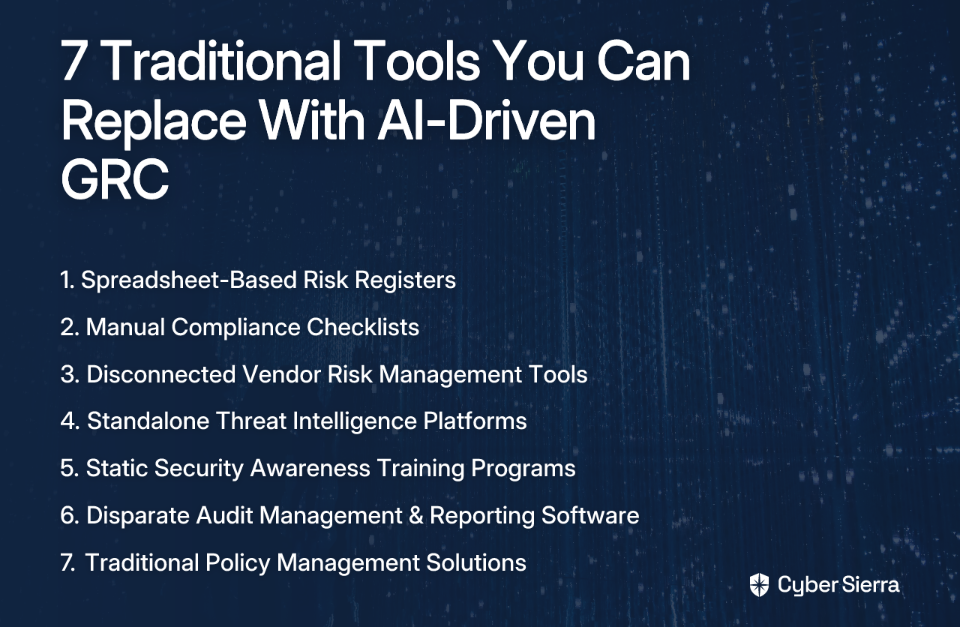
1. Spreadsheet-Based Risk Registers
The Old Way
If you're like most organizations, your risk management process revolves around spreadsheets—complex matrices tracking risks, controls, and assessments manually. This approach is:
- Static and provides no real-time visibility into your risk posture
- Error-prone due to manual data entry and formula mistakes
- Lacking version control, leading to confusion about which file is current
- Difficult to collaborate on, especially across departments
- Inconsistent in how risks are evaluated and prioritized
The AI-Driven Way
Modern AI-powered GRC platforms transform risk management through:
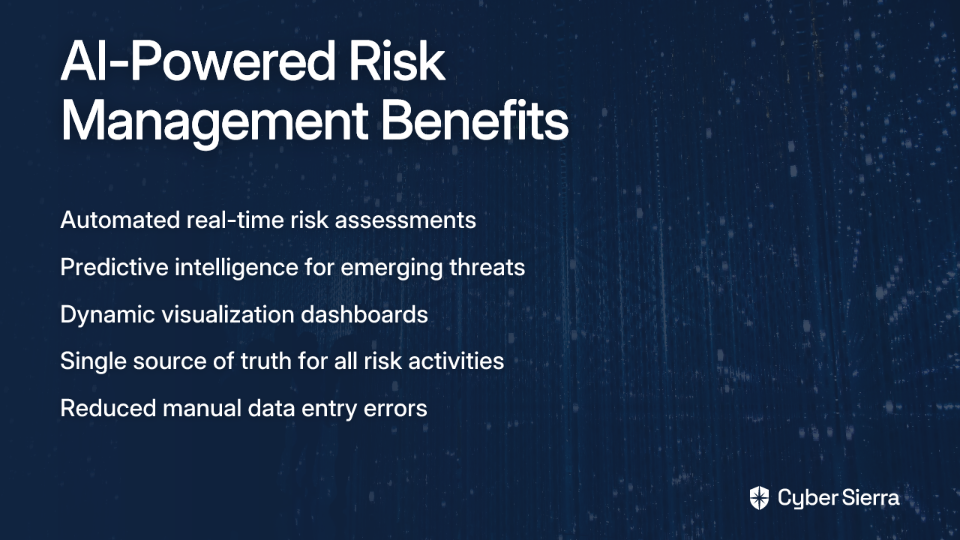
Automated Risk Assessments: These platforms connect to your systems to automatically collect data and evaluate risks in real-time. They analyze configurations, historical data, and system changes to identify potential issues before they become problems.
Predictive Risk Intelligence: Rather than simply listing known risks, AI uses machine learning to identify patterns and forecast emerging threats. This enables a truly proactive stance toward risk management.
Dynamic Risk Visualization: Interactive dashboards provide a real-time view of your risk landscape, allowing stakeholders to understand the organization's risk posture at a glance.
Cyber Sierra's GRC module replaces static spreadsheets with a dynamic risk register that automates assessments and provides a single source of truth for all risk-related activities.
2. Manual Compliance Checklists & Point-in-Time Auditing Solutions
The Old Way
Traditional compliance management involves:
- Conducting periodic audits (quarterly, annually) using manual checklists
- The painful process of taking screenshots, chasing down documents, and organizing files for evidence collection
- Point-in-time compliance checks that leave dangerous gaps between audits
- Significant stress and overtime as teams scramble to prepare for audits
The AI-Driven Way
AI-driven Continuous Control Monitoring (CCM) revolutionizes the compliance process:
Automated Evidence Collection: AI GRC platforms connect directly to your cloud and SaaS environments to automatically collect and organize evidence, eliminating the need for manual screenshots and documentation.
Continuous Monitoring: Instead of point-in-time assessments, these platforms monitor your security controls 24/7, validating their effectiveness in near real-time.
Real-Time Gap Identification: Rather than discovering a misconfiguration during an audit, CCM alerts you the moment a control fails or a new risk emerges.
Multi-Framework Mapping: AI can automatically map controls to multiple frameworks (SOC 2, ISO 27001, NIST, etc.), eliminating redundant work when complying with multiple standards.
Cyber Sierra's CCM module transforms compliance from periodic checks into a continuous, automated process, building a central controls repository and automating evidence collection to drastically reduce audit fatigue.
3. Disconnected Vendor Risk Management (VRM) Tools
The Old Way
Traditional vendor risk management typically involves:
- Sending lengthy questionnaires via email and tracking responses in spreadsheets
- Manually following up on incomplete assessments
- Relying solely on self-attested information with no way to verify claims
- No visibility into a vendor's actual security posture between assessments
- Inefficient onboarding processes that delay business initiatives
The AI-Driven Way
AI-driven Third-Party Risk Management (TPRM) transforms this process through:
Automated Vendor Assessments: AI streamlines the entire assessment process, from questionnaire distribution to response analysis, dramatically reducing the time spent on administrative tasks.
Continuous Monitoring: Instead of point-in-time assessments, AI platforms use external scanning and data feeds to continuously monitor your vendors' security posture, alerting you to new risks as they emerge.
Risk Prioritization: AI analyzes vendor data to classify and prioritize them based on risk levels, allowing your team to focus attention on the highest-risk third parties.
Streamlined Onboarding: Automated workflows reduce the time to onboard new vendors while ensuring all security requirements are met.
Cyber Sierra's TPRM platform simplifies vendor risk management by providing 24/7 visibility into vendor compliance, automating assessments, and streamlining due diligence beyond point-in-time questionnaires.
4. Standalone Threat Intelligence Platforms
The Old Way
Traditional threat intelligence often involves:
- Subscribing to feeds that provide high volumes of raw data lacking context for your specific organization
- Manually sifting through alerts to determine what's relevant, leading to alert fatigue
- Difficulty connecting external threats to internal vulnerabilities
- Reactive security postures that respond to threats after they've been exploited
Research shows the impact of this approach: DXC Technology achieved a 60% reduction in alert fatigue and a 50% improvement in response times when implementing AI for threat intelligence, according to aimultiple.com.
The AI-Driven Way
AI-powered threat intelligence platforms provide:
Integrated & Actionable Intelligence: These platforms correlate external threat data with your internal vulnerability information and asset inventory, prioritizing remediation based on actual business risk.
Proactive Defense: AI helps forecast potential attacks by analyzing threat data, enabling your organization to move from reactive incident response to proactive defense.
Contextual Alerts: Instead of overwhelming your team with generic alerts, AI delivers focused, contextual notifications about threats specifically relevant to your environment.
Cyber Sierra's Threat Intelligence module provides a comprehensive security scorecard by conducting network and cloud vulnerability scanning, offering an outside-in view of your attack surface to help prioritize remediation before threats are exploited.
5. Static Security Awareness Training Programs
The Old Way
Traditional security awareness approaches include:
- Annual, one-size-fits-all training modules that employees click through without retaining information
- Generic phishing simulations that don't reflect real-world attack techniques
- Difficulty measuring the effectiveness of training initiatives
- No way to target training to specific departments or roles with unique risk profiles
The AI-Driven Way
AI transforms security awareness training through:
Personalized Learning: AI tailors training content to an employee's role, department, and previous performance, ensuring they receive relevant information.
Adaptive Phishing Simulations: AI can create sophisticated, targeted phishing campaigns that adapt based on employee responses, providing immediate feedback to those who fall for them.
Continuous Reinforcement: Instead of annual training, AI delivers bite-sized learning opportunities throughout the year, improving retention and building a truly security-conscious culture.
Effectiveness Analytics: AI measures not just completion rates, but actual changes in behavior, allowing you to demonstrate the ROI of your training initiatives.
Cyber Sierra's Employee Security Training module empowers your human firewall with interactive training and simulated counter-phishing campaigns, offering a dashboard overview of your company's security quotient.
6. Disparate Audit Management & Reporting Software
The Old Way
Traditional audit and reporting processes typically involve:
- Using separate tools to manage audit workflows, track findings, and generate reports
- Manually compiling data from multiple sources (risk registers, compliance checklists, vulnerability scans) into reports
- Time-consuming preparation for board and executive presentations
- Difficulty providing real-time status updates to stakeholders
The AI-Driven Way
AI-driven GRC platforms streamline audit management and reporting:
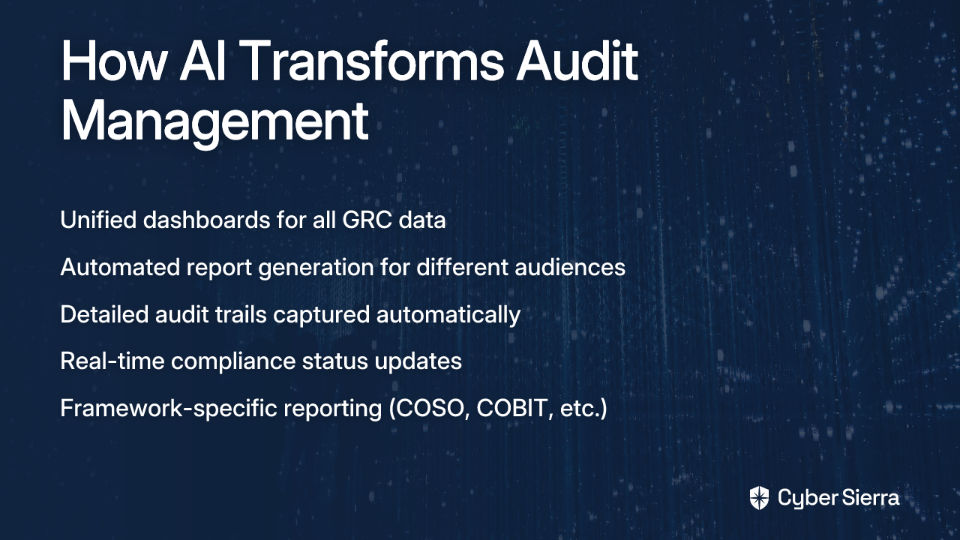
Unified Dashboards: An integrated platform centralizes all GRC data, allowing for the creation of comprehensive, real-time dashboards with a few clicks.
Automated Report Generation: AI can automatically compile data from across the platform to generate reports for different audiences—from technical details for auditors to executive summaries for the board.
Automated Audit Trails: The platform automatically maintains detailed audit trails, capturing every change to controls, policies, and risks, simplifying evidence presentation for auditors.
Real-Time Status Updates: Stakeholders can access current compliance status and risk information at any time, eliminating the need for manual status reports.
The core of Cyber Sierra's GRC platform is its ability to automate data collection and generate comprehensive reports, ensuring enterprises are audit-ready and can demonstrate compliance across frameworks like COSO and COBIT.
7. Traditional Policy Management Solutions
The Old Way
Conventional policy management often involves:
- Storing policies in Word documents or a simple document repository
- Manually mapping policies to specific regulatory controls and business processes
- Difficulty keeping policies updated as regulations change
- No way to verify if policies are actually being followed
The AI-Driven Way
AI transforms policy management through:
AI-Powered Policy Analysis: Using Natural Language Processing (NLP), AI can analyze policy documents and automatically map them to controls across multiple frameworks (NIST, ISO 27001, GDPR).
Automated Gap Analysis: The platform can automatically identify gaps where a policy doesn't cover a required control or where a control lacks a supporting policy.
Policy Implementation Verification: AI can help determine if policies are actually being followed by analyzing system configurations and user activities.
Regulatory Change Monitoring: AI can track changes to regulations and automatically flag policies that may need updates to maintain compliance.
By integrating policy management within its GRC platform, Cyber Sierra ensures that organizational policies are not just documents but living, enforced components of your security program.
Why Make the Switch? The Strategic Advantage of AI in GRC
Implementing an AI-driven GRC platform isn't just about replacing legacy tools—it's about transforming how your organization approaches governance, risk, and compliance:
Efficiency and Cost Optimization: AI can lead to a 62% improvement in compliance efficiency by automating routine tasks, according to research. This directly addresses the pain of understaffed and under-budgeted teams.
Proactive vs. Reactive: Shift from a reactive posture (finding problems during audits) to a proactive one (predicting and mitigating risks before they materialize).
Data-Driven Decision Making: Move beyond gut feelings to make security and compliance decisions based on comprehensive, real-time data.
Human in the Loop: Most importantly, AI doesn't replace GRC professionals—it augments their capabilities. As noted by GRC professionals, "all AI can do is help facilitate and populate information to help companies make better decisions." AI handles the data crunching and tedious tasks, allowing your team to focus on strategy, context, and complex decision-making.
Conclusion: Beyond the Toolkit
The era of managing GRC with a fragmented toolkit of spreadsheets and standalone software is over. It's inefficient, risky, and the primary source of the "GRC busy-work" that plagues so many teams.
An AI-driven GRC platform consolidates these seven functions (and more) into a single, intelligent system that not only automates the tedious tasks but provides insights that weren't possible with disconnected tools.
By making this switch, you can transform your GRC function from a reactive cost center to a strategic business enabler that proactively manages risk and demonstrates clear value to the organization.
Ready to move beyond the busy work? Explore how an AI-driven platform like Cyber Sierra can transform your approach to governance, risk, and compliance—empowering your team to become strategic drivers of business resilience rather than spreadsheet managers.
Frequently Asked Questions
What is an AI-driven GRC platform?
An AI-driven GRC platform is an integrated software solution that uses artificial intelligence to automate and enhance governance, risk management, and compliance processes. It consolidates tools like risk registers, compliance checklists, and vendor management systems into a single platform. Unlike traditional tools, it provides continuous monitoring, predictive insights, and automated evidence collection, transforming GRC from a manual, reactive function into a proactive, strategic one.
Why should I replace spreadsheets with a GRC platform?
You should replace spreadsheets with a GRC platform to eliminate manual errors, gain real-time visibility into your risk posture, and automate tedious compliance tasks. Spreadsheets are static, error-prone, and difficult to collaborate on. An AI-driven GRC platform offers a dynamic, centralized system with automated risk assessments, continuous control monitoring, and a single source of truth, saving significant time and reducing audit fatigue.
How does AI improve compliance and audit management?
AI improves compliance and audit management by automating evidence collection, providing continuous control monitoring, and generating real-time reports. Instead of periodic manual checks, AI-powered platforms connect directly to your systems to monitor controls 24/7. This identifies gaps as they occur, maintains a constant state of audit-readiness, and automatically maps controls to multiple frameworks like SOC 2 and ISO 27001, drastically reducing the effort required for audits.
Will AI replace GRC professionals?
No, AI is designed to augment GRC professionals, not replace them. AI excels at automating repetitive, data-intensive tasks like evidence collection, risk calculation, and monitoring. This frees up GRC experts to focus on higher-value strategic activities such as interpreting complex risks, making nuanced decisions, and advising business leaders. The goal is to empower professionals by handling the "busy-work," allowing them to be more effective.
What are the main benefits of an integrated AI-GRC platform over separate tools?
The main benefits of an integrated AI-GRC platform are increased efficiency, a holistic view of risk, and improved data-driven decision-making. Using separate tools for risk, compliance, vendor management, and audits creates data silos and requires manual consolidation. An integrated platform provides a single source of truth, correlates data across functions (e.g., linking a vendor risk to an internal control), and offers unified dashboards, enabling a more proactive and strategic approach to managing your organization's overall risk landscape.
How does an AI-driven GRC platform help with third-party risk management (TPRM)?
An AI-driven GRC platform helps with TPRM by automating vendor assessments and providing continuous monitoring of their security posture. It moves beyond static, point-in-time questionnaires by using external data feeds and scanning to track vendor risks in near real-time. This allows you to prioritize high-risk vendors, get alerted to emerging threats in your supply chain, and streamline the entire vendor due diligence process.