



How to Assess Vendor AI Risks Effectively

Join thousands of professionals and get the latest insight on Compliance & Cybersecurity.
You've just discovered that one of your key SaaS vendors is using your company's data to train their machine learning models. The contract you signed didn't explicitly prohibit this, and now you're facing potential regulatory exposure and intellectual property risks. Sound familiar?
Welcome to the new reality of vendor risk management in the age of AI.
The Shadow AI Problem
"It's not shadow IT anymore. It's shadow AI. And it's growing faster than any policy can keep up." This sentiment, shared by a frustrated GRC professional, captures the challenge many organizations face today. Employees are using AI tools without proper vetting, and traditional governance approaches are failing to keep pace.
The explosion of AI functionality across SaaS platforms has created a perfect storm for Governance, Risk Management, and Compliance (GRC) teams:
- Employees freely use AI tools without seeking approval
- Vendors provide vague answers about their data usage practices
- Standard Data Loss Prevention (DLP) solutions can't effectively monitor or control AI-related data flows
- Traditional governance platforms assume a world where "employees actually ask for permission" - a fantasy in today's fast-paced business environment
As one GRC professional put it, "We went through the struggle of asking ALL of our vendors to tell us if and how they use our data for ML or AI. And ALL came back with a 'yes, but we.....'." This lack of transparency creates significant challenges for organizations attempting to manage third-party AI risk.
This checklist will help you cut through the ambiguity and ensure your organization isn't blindly exposing itself to AI-related risks through vendor relationships.
Understanding the Modern AI Risk Landscape
Before diving into the assessment checklist, it's important to understand the unique risks that AI and ML technologies introduce to vendor relationships.
Economic Context
While AI presents significant risks, we must acknowledge its enormous economic potential. McKinsey estimates that generative AI could add trillions to the global economy. This makes wholesale prohibition impractical - the goal is to enable safe, governed use.
Key AI Risk Categories
When assessing vendors using AI technologies, consider these four major risk categories:
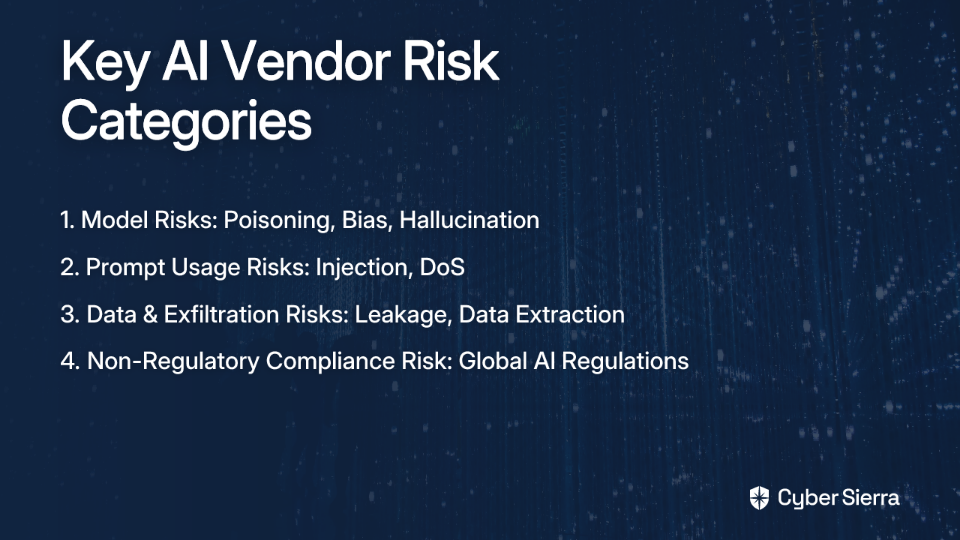
- Model Risks
- Model Poisoning: Malicious actors injecting misleading data into training datasets
- Bias: Prejudiced outputs stemming from discriminatory assumptions or imbalanced data
- Hallucination: The model generating coherent but factually incorrect information
- Prompt Usage Risks
- Prompt Injection: Manipulating inputs to bypass safety controls
- Prompt DoS: Overloading AI systems with complex prompts to cause failures
- Data & Exfiltration Risks
- Data Leakage: The model inadvertently revealing sensitive information
- Exfiltration: Attackers crafting prompts to extract sensitive training data
- Non-Regulatory Compliance Risk
- Failure to comply with emerging global AI regulations like the EU AI Act
- Potential penalties and reputational damage from non-compliance
Understanding these risks provides the foundation for effective vendor assessment. With this context in mind, let's establish a framework for your internal AI governance.
Establishing Your Internal AI Governance Foundation
Before you can effectively assess vendors, you need to establish internal AI governance foundations. A checklist is a valuable tool, but it must be part of a larger strategy.
Risk Assessment Methodology
Adopt a structured approach to evaluate and score vendor risk consistently. This could be:
- Qualitative: Based on subjective assessments (low, medium, high)
- Quantitative: Using numerical scoring systems
- Hybrid: Combining both approaches for comprehensive assessment
According to risk assessment methodology best practices, the framework should align with your organization's risk tolerance and regulatory requirements.
Vendor Risk Categorization
Not all AI vendors pose the same level of threat. Categorize them based on:
- Sensitivity of data they access
- Criticality of business processes they support
- Depth of integration with your systems
- Potential impact of service disruption
Three Lines of Defense Model
Implement this proven risk management model to create clear accountability:

- First Line (Business Units):
- Own vendor relationships and perform initial risk identification
- Responsible for day-to-day management of vendor relationships
- Second Line (Support Functions):
- GRC, Legal, and IT Security teams provide oversight and specialized assessment
- Develop policies, procedures, and controls for vendor risk management
- Third Line (Internal Audit):
- Provides independent assurance that risk management processes are effective
- Identifies gaps in the vendor management program
AI Model Discovery & Mapping
You can't govern what you don't know. Create and maintain an inventory of all AI models in use, including those from vendors. Map these models to:
- The data they process
- The compliance obligations associated with that data
- The business processes they support
With these foundations in place, let's move to the core assessment checklist.
The Core Assessment Checklist: Critical Questions for Your AI Vendor

This comprehensive checklist is organized into three key sections to help you thoroughly evaluate AI vendors.
Understanding the AI Model & Its Origins
Technology & Architecture:
- Can you provide a high-level overview of the AI technology you use?
- Is your solution built on a third-party foundational model (e.g., via API calls to OpenAI, Anthropic, Google)? If so, which one(s)?
- What are the data retention and usage policies of the underlying foundational models you use?
- How does your system handle inter-process communication between AI components?
Training Data Integrity:
- What were the specific sources of data used for the initial training of your model?
- If web scraping was used, how do you ensure compliance with terms of service, copyright law, and data protection regulations?
- How do you ensure your training data is diverse and has been vetted to minimize inherent bias?
- Do you use web content filtering to screen problematic content from your training data?
Your Data, Their Model: The Critical Questions
Use of Customer Data (Production Data):
- The crucial question: Do you use our company's inputs (Production Data) or the Outputs generated by the model for us, to train, retrain, or fine-tune your AI model(s) for any purpose?
- If yes, is this an opt-in or opt-out process? Where is this choice documented and configured?
- If you claim our data is "de-identified" or "anonymized" before use, please provide your specific methodology and technical/policy safeguards that prevent re-identification.
- Do you have a user management API that allows us to control which of our employees can access the AI features?
Data Governance and Privacy:
- How do you handle our data in compliance with privacy regulations like GDPR and CCPA?
- Where will our Production Data be stored and processed geographically?
- What are your data retention policies for our inputs and the generated outputs?
- What specific data usage practices do you employ to ensure the security of our information?
Security, Privacy, and Model Guardrails
Security Posture & Audits:
- Can you provide documentation of your security certifications (e.g., SOC 2 Type II reports, ISO 27001 certification)?
- Do you have a documented incident response plan and disaster recovery plan?
- Can you share details on how you have handled past security incidents?
- What DLP controls do you have in place to prevent unauthorized data exfiltration?
Model Safety & Integrity:
- What specific guardrails, policies, and review processes (including human-in-the-loop) are in place to test for and mitigate bias, accuracy issues, and hallucinations?
- What measures are in place to prevent prompt injection attacks from other tenants or malicious actors?
- How do you ensure ML models maintain their integrity when processing our data?
- What controls exist to prevent Shadow AI development within your organization?
Decoding the Truth: Interpreting Vague Answers and Contractual Red Flags
Interpreting Vague Answers
When vendors provide ambiguous responses, it's essential to probe further and verify their claims. Here's how to handle common evasive answers:
The "Trust but Verify" Principle:
If a vendor says: "We use a variety of public and proprietary data sources." Your follow-up: "Please provide documentation of your data licensing and a list of your main public data sources. How do you vet them?"
If a vendor says: "We may use customer data to improve our services." Your follow-up: "Please specify exactly what customer data is used, how it's used, and what opt-out mechanisms are available."
If a vendor says: "We have robust security measures in place." Your follow-up: "Please share your most recent security audit reports and certifications."
Actionable Step: Never accept verbal assurances. Always request written documentation, including:
- Data processing agreements (DPAs)
- Data management policies
- Security whitepapers
- Copies of audit reports
- Detailed descriptions of their AI governance frameworks
Contractual Red Flags
When reviewing vendor contracts, be vigilant for these warning signs:
Ambiguous Definitions:
- Red Flag: The contract lacks clear, precise definitions for key terms.
- Look for definitions of: Solution, Training Data, Production Data (your inputs), Output (results), and Evolution (how the model changes).
- Better Alternative: Insist on precise definitions that clearly distinguish between your data and the vendor's pre-existing intellectual property.
Weak Data Ownership and Usage Rights:
- Red Flag: The contract fails to state explicitly that you (the customer) own your Production Data and the Outputs generated from it.
- Red Flag: Broad, ambiguous language granting the vendor rights to use your data for "service improvement," "analytics," or "research" without an explicit opt-out.
- Better Alternative: Clearly state that you retain ownership of your data and any outputs, with specific, limited licenses granted to the vendor only for providing the contracted service.
Inadequate Intellectual Property (IP) Indemnification:
- Red Flag: The vendor only indemnifies you against claims arising from their core platform, but not from the Outputs it generates.
- Red Flag: The vendor refuses to indemnify you against claims arising from their use of Training Data.
- Better Alternative: Comprehensive indemnification covering both the platform and any outputs it generates, plus protection against claims related to the vendor's training data sources.
Lack of Compliance & Security Guarantees:
- Red Flag: Absence of a clause obligating the vendor to comply with specific data protection laws.
- Red Flag: No clear service level agreements (SLAs) for accuracy, error rates, and scalability.
- Better Alternative: Explicit commitments to comply with relevant regulations and measurable performance standards.
Poor Termination Clauses:
- Red Flag: The contract does not include a clear process for the secure and certified deletion or return of all your data upon termination.
- Better Alternative: Detailed termination procedures including certified data deletion, transition assistance, and continuing confidentiality obligations.
Beyond the Checklist: Continuous Monitoring and Lifecycle Management
Assessment is not a one-time event. A vendor's risk profile constantly evolves as they update their models, change policies, or undergo organizational changes like acquisitions. Implement these practices for ongoing governance:
Regular Review Schedule
Implement a schedule for regular reviews of:
- Updated SOC 2 or other audit reports
- Reports of data breaches or security incidents
- Changes to the vendor's terms of service or privacy policy
- Updates to their AI models or training methodologies
As UpGuard recommends, the frequency of these reviews should correspond to the criticality and risk level of the vendor.
Manage the Full Vendor Lifecycle
Effective AI governance requires a systematic approach across the entire vendor relationship:
- Qualification:
- Initial vetting using the comprehensive checklist provided
- Verification of security certifications and compliance documentation
- Thorough contract review with legal counsel experienced in AI issues
- Engagement & Onboarding:
- Secure vendor onboarding with clear contractual terms
- Implementation of necessary technical controls
- User access management configuration
- Employee training on appropriate use
- Information Security Management:
- Continuous monitoring throughout the relationship
- Regular reassessment based on changing business requirements
- Tracking of incident reports and resolution
- Monitoring for Shadow AI usage within the organization
- Termination:
- Secure offboarding process
- Verification that all contractual obligations are met
- Certified destruction of data
- Transition to alternative solutions if necessary
Technology-Enabled Monitoring
Consider leveraging specialized AI-powered third-party risk management (TPRM) platforms to automate and scale continuous monitoring. These tools can provide:
- Real-time alerts about vendor security incidents
- Continuous scanning for contractual compliance
- Automated questionnaire distribution and tracking
- Integration with GRC platforms for holistic risk management
Conclusion: From Risk Mitigation to Informed Partnership
The rise of shadow AI and the ambiguity of vendor data practices have made proactive, detailed assessment essential for modern GRC teams. Traditional DLP solutions and governance approaches are insufficient to address the unique challenges posed by AI and ML technologies.
By implementing this comprehensive checklist, you can:
- Gain clarity on how vendors use your data in their ML models
- Identify contractual vulnerabilities before they become problems
- Create a foundation for ongoing vendor governance
- Enable your organization to leverage AI safely and effectively
Remember that the goal isn't to find a "perfect" AI vendor – they likely don't exist. Instead, aim to make fully informed decisions based on a clear understanding of each vendor's technology, data practices, and commitment to security. This allows you to implement appropriate controls and contractual protections tailored to your organization's risk tolerance and compliance requirements.
In the rapidly evolving AI landscape, this checklist serves as more than a compliance exercise – it's a tool to drive transparency and establish partnerships with vendors who respect your data sovereignty and share your commitment to responsible AI use.
By taking a proactive, structured approach to vendor AI risk assessment, GRC teams can move beyond being "the police" and become strategic enablers, helping their organizations safely harness the transformative power of artificial intelligence while protecting against its unique risks.
Frequently Asked Questions
What is "Shadow AI" and why is it a significant risk?
Shadow AI refers to employees using AI tools and services without official approval or vetting from their organization. It's a significant risk because it introduces unmanaged security vulnerabilities, potential data leaks, and compliance violations that traditional governance processes can't track. Unlike "shadow IT," shadow AI involves feeding sensitive company data into external models, which can lead to intellectual property loss and regulatory fines without the knowledge of GRC and security teams.
How can I find out if a SaaS vendor uses my data for AI training?
The most direct way is by asking them pointed questions and reviewing your contract. You should explicitly ask: "Do you use our company's inputs (Production Data) or the Outputs generated by the model for us, to train, retrain, or fine-tune your AI model(s) for any purpose?" This question forces a clear "yes" or "no" answer and helps you avoid vague language like "to improve our services." Ensure all terms are clearly defined and documented in a legally binding data processing agreement (DPA).
What are the most critical red flags to look for in an AI vendor's contract?
The most critical red flags are ambiguous definitions of data, weak data ownership clauses that grant the vendor broad rights to your data, and inadequate IP indemnification that doesn't cover the AI-generated outputs. A solid contract will explicitly state that you own your data and the outputs. Be wary of any language that allows the vendor to use your information for "research" or "analytics" without a clear opt-out mechanism.
Why aren't my existing security tools, like DLP, enough to manage AI risks?
Traditional Data Loss Prevention (DLP) tools are often insufficient because they struggle to monitor the nuanced data flows to and from AI services, especially those integrated within approved SaaS platforms via APIs. DLP solutions may not be configured to inspect this traffic for sensitive content or distinguish between legitimate use and data being sent for model training. Furthermore, they can't address AI-specific risks like prompt injection attacks, which require a different set of controls.
Who is responsible for AI vendor risk management within an organization?
AI vendor risk management is a shared responsibility, best managed using a "Three Lines of Defense" model. Business units are the first line, GRC and security teams are the second, and internal audit is the third. In this model, the first line (business users) owns the vendor relationship. The second line (GRC, Legal, IT Security) provides expert oversight and sets policies. The third line (Internal Audit) provides independent assurance that the process is working effectively.
Is it realistic to prohibit vendors from using our data for any AI training?
While a complete prohibition is the safest stance, it may not always be realistic. The key is to make an informed decision and have contractual control. Instead of a blanket "no," the goal should be to achieve full transparency. This means ensuring any data usage is strictly opt-in, the data is properly anonymized (with proof), and the vendor's security practices meet your standards. The decision to allow it should be based on a thorough risk assessment, not a vendor's default setting.
This checklist should be customized to your organization's specific industry requirements, risk tolerance, and regulatory environment. Consider consulting with legal counsel experienced in AI governance to adapt these recommendations to your particular needs.
